The damage you can see is already two weeks late
Stand in front of a healthy-looking box hedge in early May. Run your hand along the top. The outer leaves are glossy, green, untouched. There’s no obvious problem.
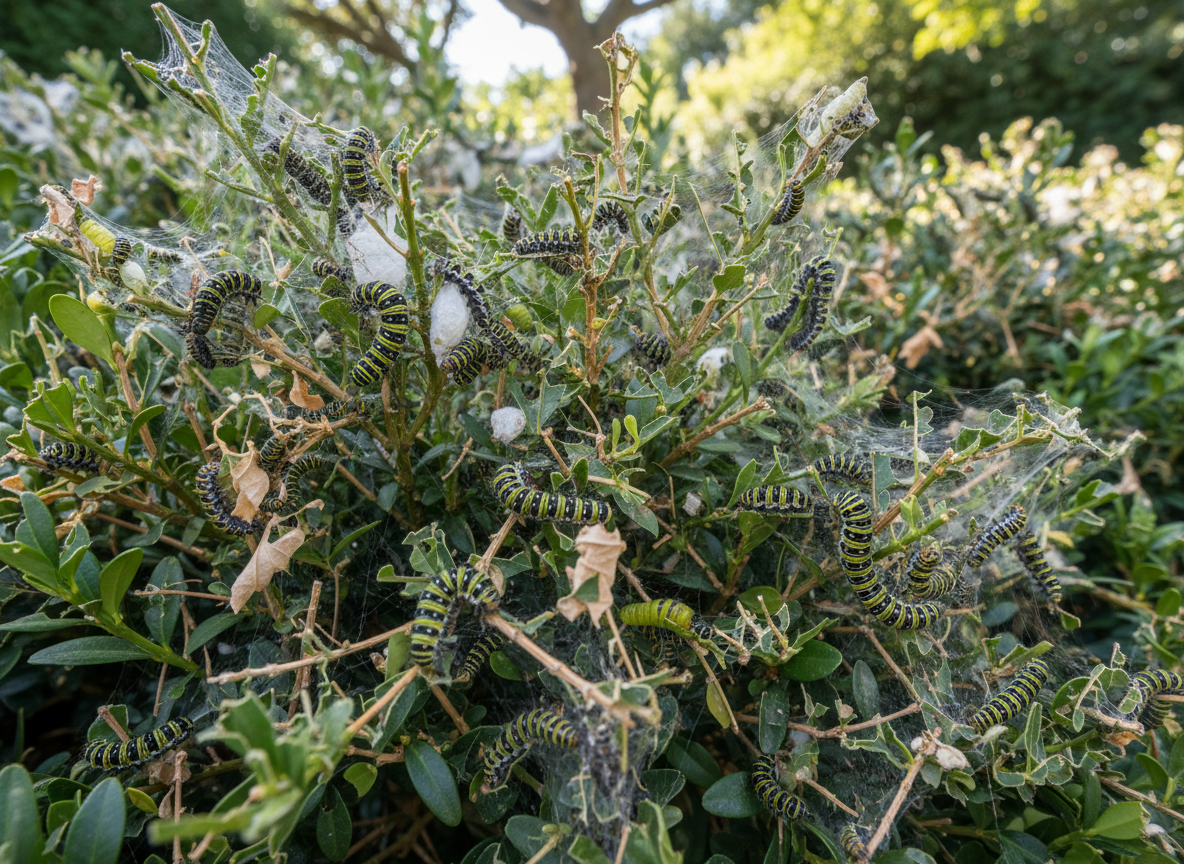
Now part the foliage near the centre of the plant and look at the inner branches — the ones that haven’t seen sun in years. If you see fine, slightly sticky silk webbing tying a few leaves together, or small dark-green pellets the size of poppy seeds caught in the lower branches, you already have a serious infestation. The caterpillars have been feeding for at least two weeks. They started on the oldest, most sheltered foliage, deep inside the hedge, where you can’t see them and where birds can’t reach them.
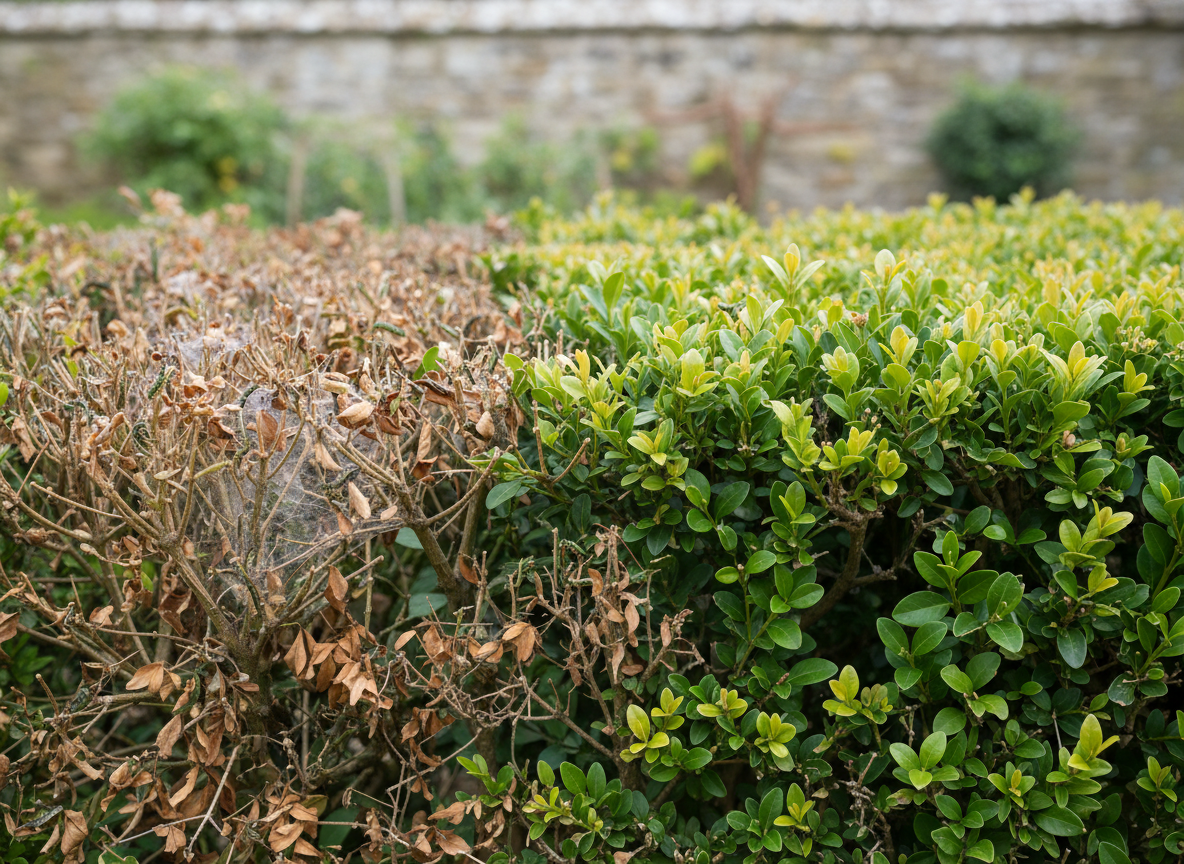
By the time the damage shows on the outside of the hedge — bare twigs, bronzed patches, that distinctive straw-coloured skeleton of leaves — it’s often too late to save the plant in one season. A single late-stage caterpillar can eat its own body length in leaves every day, and a hedge that looked fine on a Friday can be reduced to bare twigs by the following Friday in warm weather. That’s not gardening hyperbole. That’s the published feeding rate of Cydalima perspectalis, the box tree caterpillar, which has now been confirmed in every UK county and across all of Western Europe.
May is when the first generation emerges from overwintered cocoons. The window to catch them while they’re still small enough for biological control to actually work is roughly two to three weeks long, depending on your local temperatures, and it’s happening right now.
 AI-generated illustration
What you’re actually dealing with
The box tree moth (Cydalima perspectalis) is a small, mostly white moth with a dark brown wing border, native to East Asia and accidentally introduced into Europe via the ornamental plant trade in the mid-2000s. The first UK sighting was in Kent in 2007. Within fifteen years it had reached Scotland, Ireland and the far north of Norway. The Royal Horticultural Society now lists it as one of the top-ranked pests reported by UK gardeners every year, and it’s been the single most-asked-about insect on Dutch gardening forums every spring since 2018.
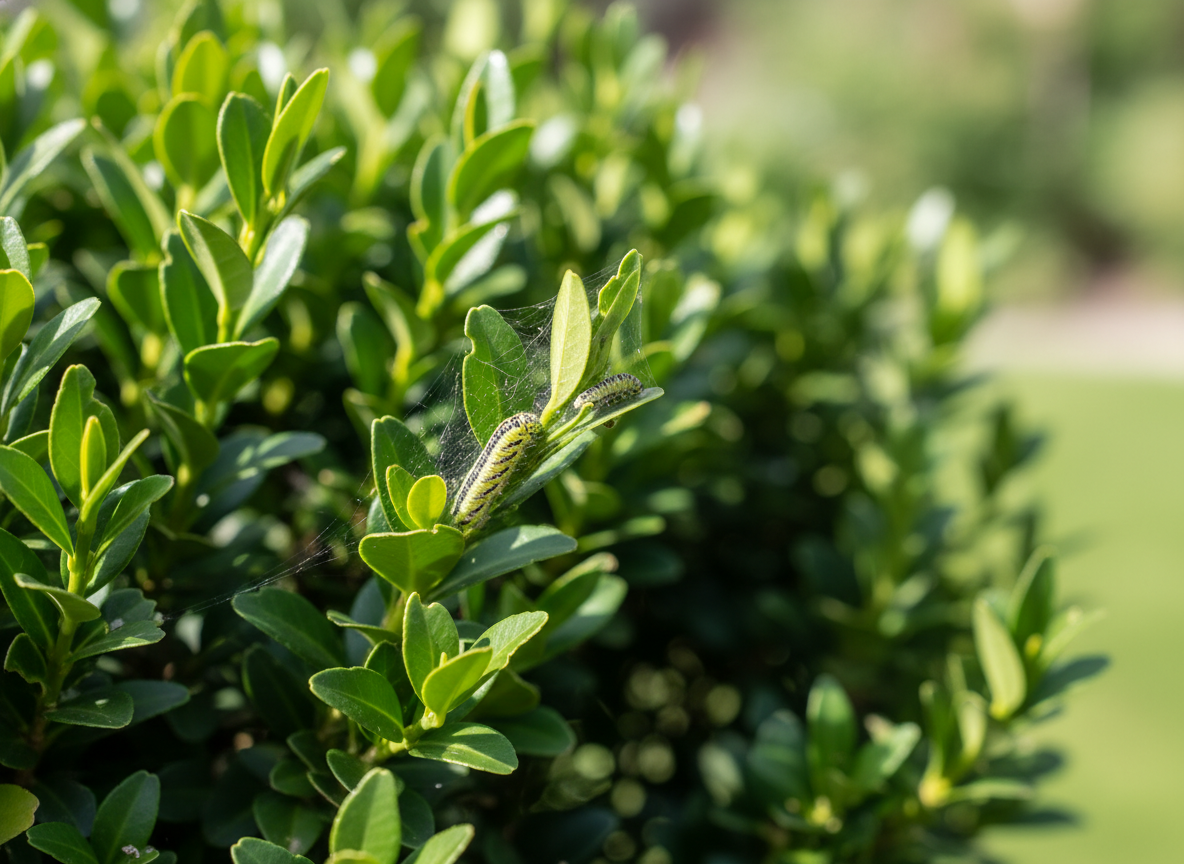
The moth itself does nothing. It’s the caterpillar that strips your buxus. Larvae are bright green with thick black stripes running the length of the body and a shiny black head. They move in a characteristic looping motion, fall on a silk thread when disturbed, and grow from a barely-visible 2 mm hatchling to a 4 cm late-stage feeder over about three to four weeks.
Crucially, the species runs through two to three full generations per year in temperate Europe — sometimes four in a hot summer — with each generation overlapping the next. Miss the May cohort and you’re chasing them all summer. Catch the May cohort and you’ve often broken the cycle in your own garden for the rest of the season, because the second generation in July is much smaller when the first one’s been suppressed.
Why May matters more than any other month
The first generation of caterpillars hatches from eggs laid the previous summer or from overwintered late-instar larvae sheltering in cocoons of webbed leaves deep inside the hedge. The trigger is temperature, not date — the threshold for resumed feeding sits at around 9°C, and active development needs sustained daytime temperatures above 12°C.
In southern England and the Low Countries, that threshold is typically crossed in the second or third week of April. Eggs laid by the first emerging adults hatch about a week later, and the new larvae are small enough — first and second instar — to be susceptible to biological control through most of May. By the end of May the survivors have entered the fifth and final instar, where they’re large, voracious, and far less affected by the standard sprays.
This is the asymmetry that catches everyone out: a 4 mm caterpillar in mid-May is killed by a foliar spray of Bacillus thuringiensis var. kurstaki (Bt-k) within 48 hours. A 35 mm caterpillar in late May survives the same spray and just keeps eating. The treatment is identical. The window isn’t.
If you garden further north — central Scotland, central Sweden, northern Germany — push everything in this article back by two to three weeks. If you garden in the Mediterranean basin, the first generation has likely already pupated and the second is what you’ll meet in May. Local degree-day timing matters more than the calendar.
 Box caterpillars and subtle webbing on green boxwood leaves — AI-generated illustration
How to find them before the damage shows
The single most important diagnostic is silk webbing on inner branches. Box plants don’t naturally produce webbing. Spider webs are coarser, span open spaces, and aren’t tied to leaves. Box caterpillar webbing is fine, almost greasy to the touch, sticks individual leaves together in small irregular bundles, and is always concentrated on the inside of the plant first.
Walk around your hedge with the back of your hand. Push gently into the foliage at chest height, then at knee height. If there’s webbing, you’ll feel it before you see it — a faint stickiness, slightly tacky against the skin, where there should just be smooth leaves.
The second tell is frass: caterpillar droppings the colour and shape of dark green to black poppy seeds. Look on lower leaves, in the crotches of branches, and on the soil directly under the densest part of the hedge. A single fresh pile of frass means an active caterpillar within an arm’s reach of that spot. Old, faded, brown frass means a generation has already pupated and moved on — useful information, but not actionable.
The third tell is leaf scraping. Very young caterpillars don’t chew through leaves, they scrape the green surface off one side, leaving a thin papery window. Hold a suspicious leaf up to the light. If you can see through it where you couldn’t see through the leaf next to it, that’s first-instar damage and you have maybe ten days before those caterpillars are fully grown.
The least reliable tell is the moth itself. Pheromone traps designed for Cydalima perspectalis will catch males starting around late April in the south of the UK and the Netherlands, but a single moth caught in a trap doesn’t tell you whether your specific hedge has been laid on. Use traps for timing, not for control.
What to spray, and the timing that decides whether it works
There are three honest options for biological control, and one for chemical. The order below is by practical effectiveness in May.
Bacillus thuringiensis var. kurstaki (Bt-k) is a soil bacterium whose crystalline endotoxin kills caterpillars when they ingest it — and only caterpillars. It does nothing to bees, birds, ladybirds, hoverflies or you. The toxin needs to be eaten, which means it has to land on the leaves the caterpillars are about to eat. That means thorough spraying inside the hedge, not just on the outside.
The catch with Bt-k is the timing. It works on first, second and third instar larvae — caterpillars below roughly 15 mm. By the fourth and fifth instar, the gut chemistry has changed enough that the toxin is far less effective. In May, you’re aiming to spray when most of the visible caterpillars are still pinhead-sized. That’s typically the second or third week after the first webbing appears. Spray in the evening or on an overcast day, because UV degrades Bt-k within 24 to 48 hours of application. Repeat after a week, because eggs hatch in waves.
Pheromone traps (a yellow-and-white funnel trap baited with synthetic Cydalima perspectalis pheromone) catch adult males. They don’t reduce caterpillar pressure on their own — the females you didn’t catch will still lay eggs — but they’re the best diagnostic tool you have for knowing exactly when adults are flying in your garden. The trap fills, you mark the date, you spray Bt-k seven to ten days later, and you’ve timed your control to the eggs hatching. One trap per 100 m² of box is enough.
Steinernema carpocapsae nematodes are microscopic parasitic worms that hunt caterpillars in soil and on damp foliage. They’re effective only above 12°C soil temperature and need leaves to stay wet for several hours after application. In practice this means evening spraying in late May at the earliest, on a damp or rainy day. They’re a fallback when Bt-k hasn’t been applied early enough.
Synthetic pyrethroids (deltamethrin, cypermethrin, lambda-cyhalothrin) work on caterpillars of any age, but they also kill every other insect they touch — including the parasitic wasps and predatory flies that would otherwise help you. They’re not licensed for amateur use in some EU countries on edible-adjacent plantings. If you reach for them, accept that you’ve made a one-season choice and that your beneficial insect population will need to rebuild from neighbouring gardens. I don’t recommend them for a hedge that’s been infested for under a season; I do recommend them, used once, for a hedge that’s been chewed twice already and is on its last warning.
What you should not bother with: oil sprays on dry leaves (they smother eggs in theory, in practice the eggs are protected on the underside and behind webbing); soap sprays (no effect on protected larvae); manual picking on a mature hedge (you’ll find one caterpillar for every twenty that are still hidden); pruning the hedge to “let in light” in May (you remove the youngest, most edible leaves and concentrate the caterpillars onto less foliage).
 A green hedge next to a brown, damaged hedge with cobwebs — AI-generated illustration
When to give up on the hedge — and when not to
Buxus has remarkable powers of recovery from the rootstock, even after near-complete defoliation, provided two conditions are met: it gets defoliated only once, and the underlying wood doesn’t dry out and die before resprouting.
If your hedge has been completely stripped for the first time, leave it. Do not dig it up, do not replace it, do not even cut it back hard. Water it through any dry weather in May and June — at the roots, not on the canopy — and leave the bare twigs alone until July. Most plants will resprout from the lower trunk and main framework branches by midsummer. Resume light shaping with shears no earlier than late August, and treat that autumn cohort of caterpillars aggressively to prevent a second strip.
If your hedge has been completely stripped twice in successive seasons, the rootstock reserves are usually exhausted and resprouting is patchy. At that point you have a real decision to make: persist with intensive trapping and Bt-k for two more seasons and accept thin patches, or replace.
If you’re replacing, the conventional wisdom of the last decade — switch to Ilex crenata ‘Dark Green’ or Ilex crenata ‘Convexa’ — still holds for hedges, though Ilex has its own pest pressures (leaf miner) that need watching. For topiary and ball-shaped specimens, Lonicera nitida ‘Tidy Tips’ has won most of the practical comparisons in the last few years; it grows faster than box, takes a tighter shape than people expect, and is genuinely unaffected by Cydalima. Don’t replace box with more box. The moth pressure isn’t going down, and a new plant from a nursery is just as likely to arrive carrying eggs as your existing one was to develop them locally.
The garden-level mistake almost everyone makes
Treat one hedge in a garden where the next-door neighbour has untreated box, and you’ve bought yourself maybe two weeks before the next generation flies in. Box tree moths can travel up to 10 km a year as adults, but most of the damage in a given garden comes from females laying within metres of where they emerged. If you have neighbours with box, the conversation about coordinated treatment is more valuable than another bottle of Bt-k.
A practical version: tell the people on either side of you what you’re doing and when. Offer them a pheromone trap if they don’t have one. The cost of a trap is less than the cost of replacing a single mature hedge plant, and the moths you catch in their gardens are moths that won’t lay eggs in yours.
A note for Cresco app users
The reason Cresco asks for your postcode when you set up a garden isn’t to send you junk mail — it’s to pull historical and current temperature data for your specific location and time the alerts in your pruning and pest schedules to local conditions, not a national average.
For Cydalima perspectalis specifically, the app tracks the cumulative temperature above the 9°C development threshold from 1 March each year and pushes a “first-generation egg hatch likely in your area” notification when your local degree-day total crosses the published hatching threshold. That’s typically a week earlier than the gardening magazines tell you, because the magazines are written for a national average and your hedge is in a specific microclimate that’s often warmer.
If you’ve added box (Buxus sempervirens or Buxus microphylla) to your garden in Cresco, the May notification will include the exact date range to set a pheromone trap, the date to spray Bt-k afterwards, and the recommended repeat date. If you haven’t added it yet, take a photo of one leaf with the Cresco app, identify it, and you’ll be on the schedule for next year automatically.
Either way: go and part your hedge tonight. If there’s webbing on the inside, you have about three weeks before it shows on the outside, and that’s the difference between a hedge you save and a hedge you replace.
Sources: Royal Horticultural Society advice on box tree caterpillar; Defra Plant Pest Factsheet on Cydalima perspectalis (2024); peer-reviewed work on multi-introduction invasion dynamics in Biological Invasions (Springer, 2023). Personal observation in our trial gardens in Boskoop and Surrey, 2022–2025.