The six weeks nobody sees
A daffodil in early May looks finished. The flower is gone, the stem is browning, and the strappy leaves are starting to flop sideways into the path or across the early perennials. Visually the show is over. Underground, it has barely begun.
For the next six weeks the bulb is doing almost everything that decides next April. Photosynthesis in the leaves is moving sugars down into the bulb tissue. The bulb itself is fattening — measurably, by 30–60% in mass for a healthy plant. New flower initials are forming inside the bulb scales, microscopic at this stage but already deciding whether you’ll get one stem, two stems or none at all next spring. And — this is the part most gardeners forget — the bulb is also producing daughter offsets, the small bulblets that turn one daffodil into a clump of three over four or five years.
All of that is powered by the leaves. Cut them, fold them, knot them, braid them, rubber-band them — and you cut the supply. Every leaf surface that doesn’t get full sun is a leaf surface that isn’t paying into the bulb. The plant doesn’t die. It just quietly produces a smaller bulb, with fewer flower initials, and the following April you get a thinner display that you can’t trace back to anything you did.
The window is roughly the first week of May to the second week of June across most of northern Europe — six weeks from the last petal dropping to the foliage genuinely turning yellow at the base. Almost everything that determines next year’s daffodil display happens inside that window, and the only job in the garden is to leave the leaves alone.
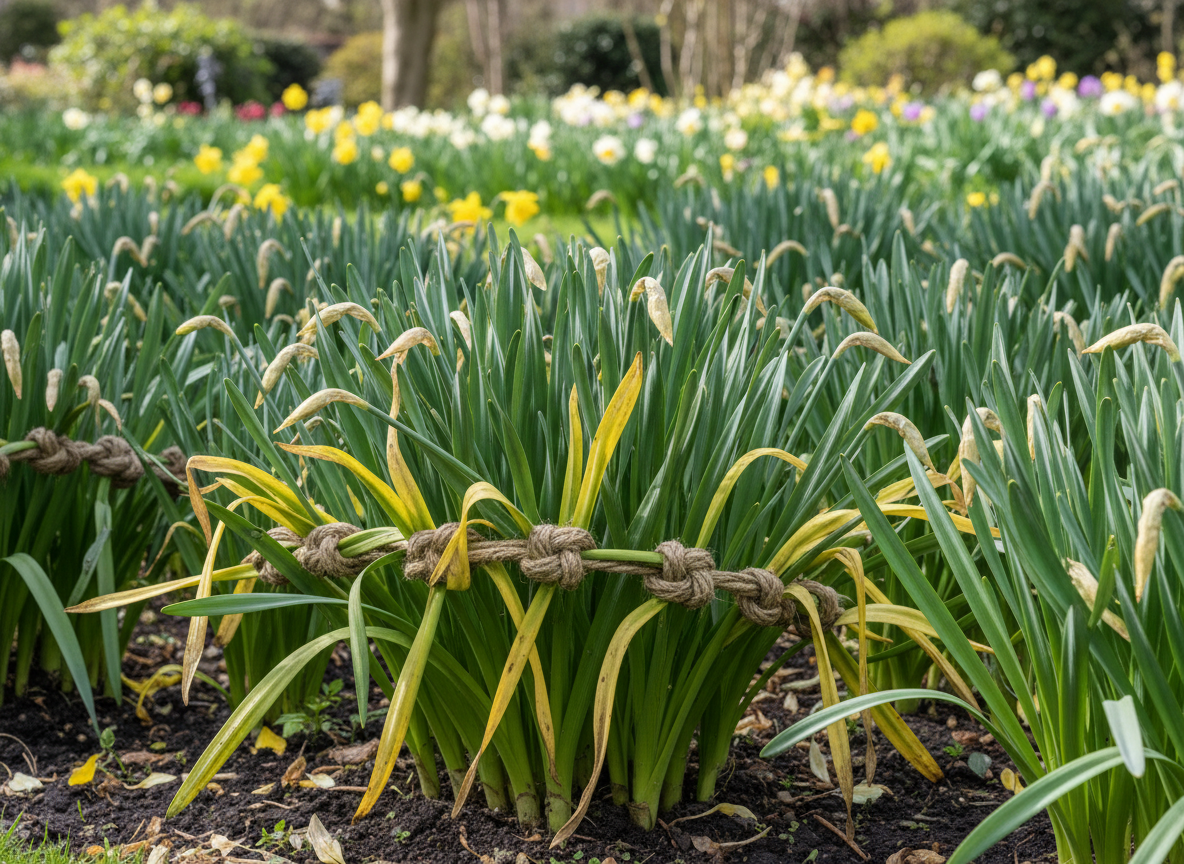 . A bed of daffodils in a garden, with some leaves tied in knots — AI-generated illustration
The tidy knot is a 1950s mistake
The instruction to knot or braid the foliage shows up in mid-twentieth-century British gardening books and in countless newspaper columns since. The logic was always cosmetic — a tied bundle takes up less border space and looks less like decay — and the implicit claim was that “the bulb doesn’t mind”. The Royal Horticultural Society tested that claim in a structured trial published in The Garden in the late 1980s and has reaffirmed it through bulb advisory work since.
The result was unambiguous. Bulbs whose leaves were left to die back naturally produced flowers the following spring at roughly 100% of their previous year’s display. Bulbs whose leaves were tied into a knot produced about 60% as many flowers and the flowers were smaller. Bulbs whose leaves were cut off at four weeks dropped to about 25%, and bulbs whose leaves were cut off immediately after flowering produced almost no flowers in year two and were effectively blind in year three.
The mechanism is straightforward. A knotted leaf has roughly half its blade folded against itself or shaded by another blade, and the shaded surface produces near-zero net photosynthesis even though the unshaded half keeps working. A folded-and-banded leaf is worse — the rubber band crushes the vascular tissue and the upper portion stops translocating sugars to the bulb at all. Cutting is the most extreme version of the same thing: zero leaf, zero photosynthate, the bulb spends what reserves it has just staying alive and produces a bulb scale rather than a flower bud.
The myth survives because the damage shows up a year late. Tie your daffodils in May 2026 and the April 2026 flowers were already programmed inside the bulb from the previous spring; you’ll get a perfectly normal show. It’s the April 2027 display that quietly halves. By then most gardeners have forgotten what they did and blame the weather, the soil, or the bulbs themselves.
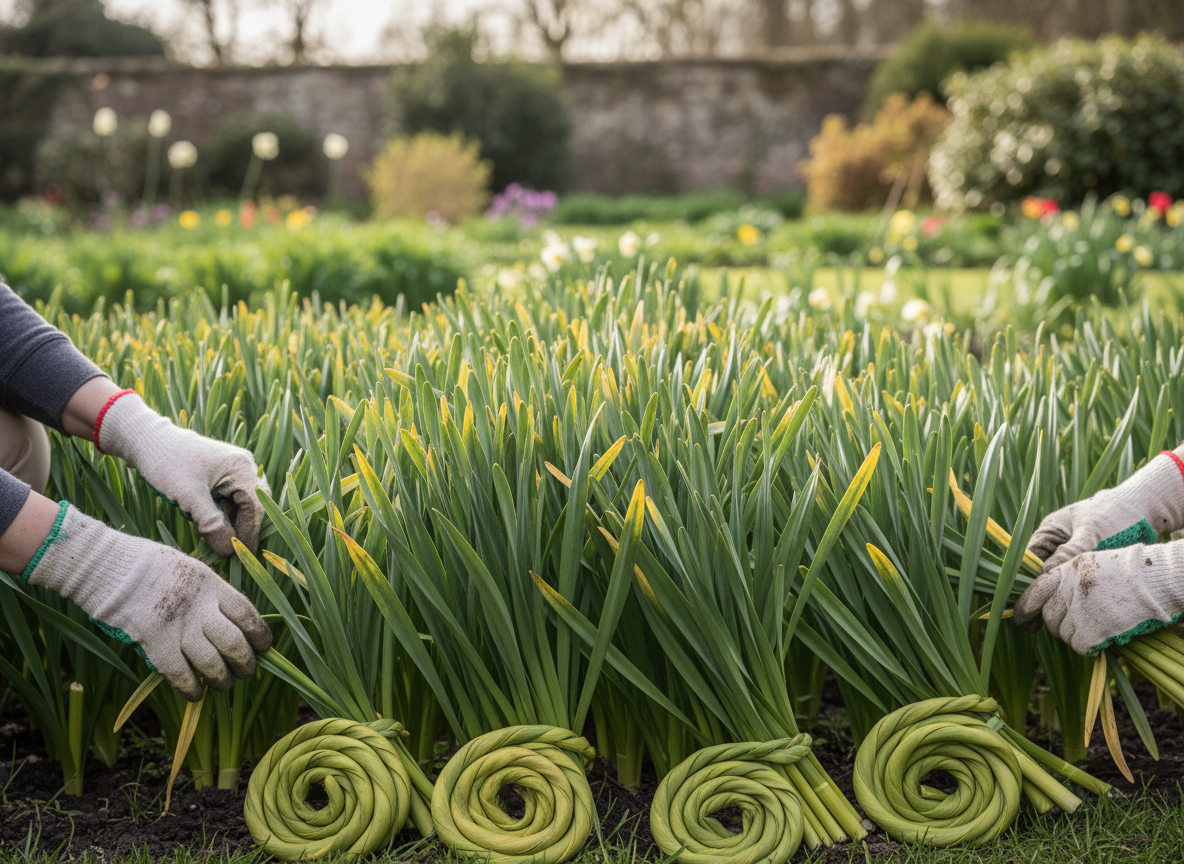 Two hands in gardening gloves arranging daffodil leaves in a garden — AI-generated illustration
What you should actually do in the six-week window
Doing nothing to the leaves doesn’t mean doing nothing in the bed. There are four small jobs that genuinely help the bulb along, and they’re all worth fifteen minutes of your time across the whole month.
Snap off the spent flowers, but leave the stem. This is the one cosmetic job that also helps the plant. A daffodil that has been pollinated will start swelling a seed pod behind the petals — the green capsule at the top of the stem — and pulling that pod to maturity costs the bulb a meaningful share of the same energy that should be going into next year’s flower bud. Pinch the swelling pod off cleanly, just behind the petals, and leave the stem itself in place. The hollow green stem is doing photosynthesis just like the leaves and contributes for another two to three weeks before it browns.
Feed once, with a liquid potash-rich feed. Tomato food is exactly the right balance — high potassium, moderate phosphate, lower nitrogen. Water it in around the clump in the first or second week after flowering finishes. Nitrogen-heavy lawn fertiliser is the wrong move here; it pushes leafy growth at exactly the moment the bulb wants to be storing carbohydrate, and on a daffodil it can actually reduce the flower count for the following spring. One feed is enough — bulbs aren’t bedding plants, and a second feed in late May does almost nothing because the leaves are already winding down.
Water in a dry May. This is the year-on-year variable that decides bulb size more than any other single factor. The 30–60% mass gain the bulb is targeting depends on consistent soil moisture in the upper 15 cm of soil — exactly the depth at which most bulbs sit. A dry, baked May produces a small bulb and a thinner display next spring, and the gardeners who get the best year-on-year displays are the ones who give a thorough soak once a week if there’s been no rain. Don’t rely on a sprinkler — the foliage is already starting to flop and water rolls off; aim a hose at the soil under the leaves for thirty seconds per clump.
Resist the urge to cut anything for at least six weeks. The signal that the leaves are ready to come off isn’t a date in the calendar — it’s the foliage. When the leaves are yellow from base to tip, soft to pull, and slip cleanly out of the soil with a gentle tug, the bulb has finished translocating and you can clear the bed. If they’re still green at the base or still firm in the middle, the bulb is still being fed and the leaves stay. In a cool, wet May this can stretch to seven or eight weeks; in a warm, dry one the foliage might be ready by the second week of June.
How to hide the foliage without harming it
The real reason gardeners knot daffodil leaves isn’t cruelty — it’s that yellowing strap-foliage looks miserable next to a border that’s just hitting its May stride. There are three workable solutions and the difference between them mostly comes down to how the bed is laid out.
Plant through later perennials. The classic trick is to put daffodils underneath or between herbaceous plants that emerge later and grow taller. Hardy geraniums, hostas, peonies, day lilies, alchemilla and lady’s mantle all start out small in March when the daffodils are flowering and have flopped over the dying foliage by mid-May. By the time the daffodil leaves are yellow you can’t see them. This is how Beth Chatto and a generation of British plantswomen handled the problem and it works on every garden style from cottage to contemporary.
Plant in the rough or in mown grass. If you have an area of meadow, orchard, or rough lawn, daffodils naturalised there get to die back on their own schedule because you simply don’t mow that strip until mid-June. The mown line moves around them. The bulbs spread, the clumps thicken, and over five or six years you get the genuine drift effect that gardens magazines photograph and that bedding daffodils in a border can never quite reproduce.
Hide them with annuals. If the daffodils are in a defined bed and you can’t move them, sow an annual screen now. Cosmos seedlings planted out in early May will be 40 cm tall by the end of the month and screen the dying foliage; California poppies, calendula and sweet alyssum work similarly and self-seed for next year. This is the only situation in which planting around dying daffodils makes more horticultural sense than relocating the bulbs in autumn.
What doesn’t work is folding the leaves under the surrounding planting. Pressing strap leaves flat to the soil under a hardy geranium does the same thing as knotting them — the lower surface is shaded, the bulb gets a fraction of the photosynthate it should, and you’ll see the cost next April. If the foliage is in the way, leave it sticking up; if it’s truly intolerable, the answer is autumn relocation, not May origami.
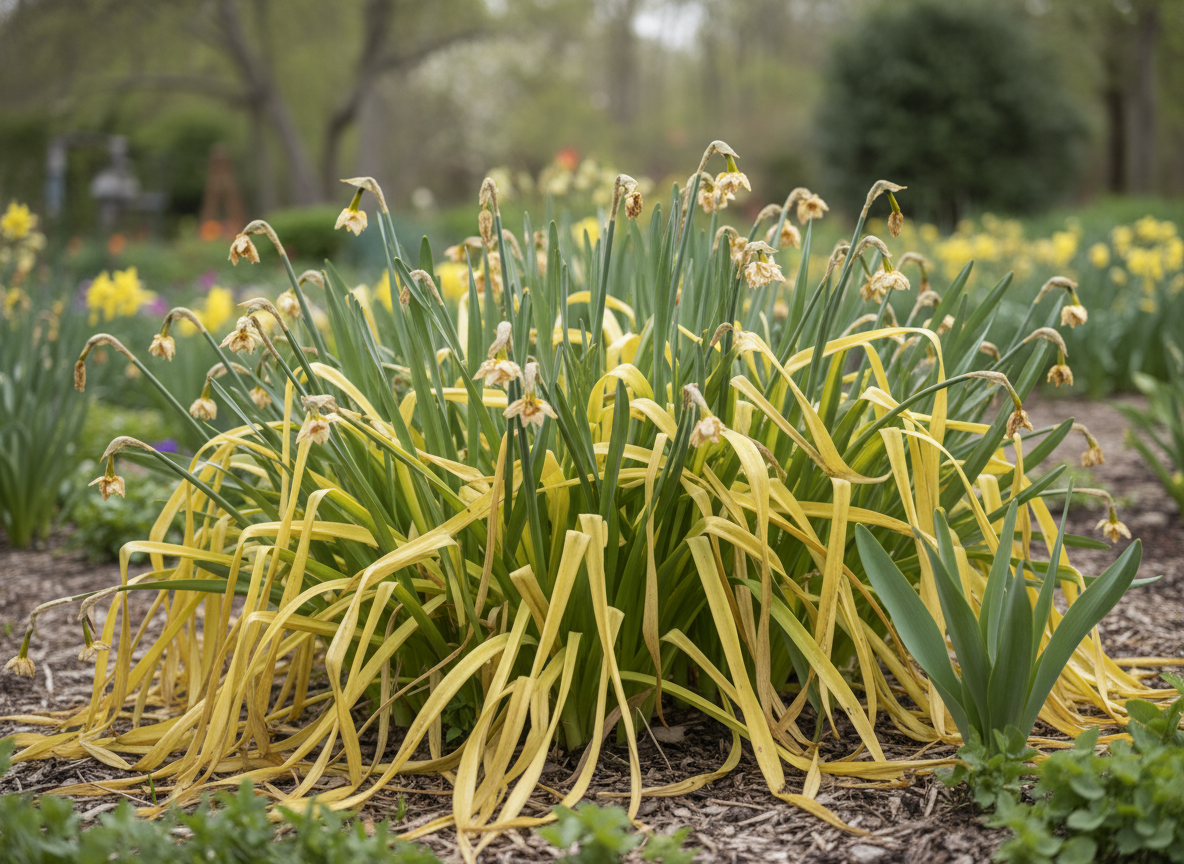 AI-generated illustration
When daffodils go blind, May is usually the cause
A “blind” daffodil is one that produces a clump of foliage in spring but no flower stem. It’s the single most common complaint in late-spring gardening Q&A columns and almost every cause traces back to either how the leaves were treated the previous May or how long the clump has been in the same spot.
Cause one: leaves were tied or cut early. This is the diagnosis described above. A bulb that didn’t get its full six-week feed produces a flower scale instead of a flower bud, and the next spring all you see is leaves. The fix is to leave this year’s foliage strictly alone and accept that the recovery takes one full season — you’ll see flowers again in 2027 if you treat the leaves correctly through May and June 2026.
Cause two: the clump is overcrowded. Daffodils multiply by offsets, and a clump that flowered well at year three or four often goes blind at year six or seven simply because there are now thirty bulbs jostling for the resources of a patch that was originally planted with five. The bulbs themselves are getting smaller as they divide, and below a critical size — roughly the diameter of a 50-cent coin or a US quarter — a daffodil bulb cannot fund a flower bud. The fix is to lift, divide and replant in autumn (October is ideal), spacing the larger bulbs at 8–10 cm and discarding or moving the small ones to a nursery bed where they can fatten up for a season or two.
Cause three: the bulb is too shallow. Daffodils need to be planted at three times their own height — for a typical bulb that’s 15–20 cm of soil over the top of the bulb. Planted shallower they’re more vulnerable to summer drought drying out the bulb and to spring frost damaging the new flower bud, and they often respond by skipping a flowering year. The fix is to lift in autumn and replant deeper. Naturalised daffodils in lawns will sometimes work themselves shallower over the years and benefit from being lifted and reset every decade.
Cause four: deep shade. A spot that was sunny when the daffodils were planted may be shaded ten years later as a tree grew up next to it. Daffodils need at least six hours of direct sun in March and April to bank enough energy to flower the following year. Light shade in May and June (when the leaves are working) is fine; deep shade in March and April (when the flower itself is happening) is not. The fix is to move the bulbs in autumn to a sunnier spot.
In Cresco the seasonal feed reminder for spring bulbs goes out in the first week after your local daffodils finish flowering — typically the last week of April or first week of May, depending on your latitude. The reminder includes the six-week leave-the-leaves rule and a follow-up nudge in the second week of June to check whether the foliage is ready to come off. We don’t bury this in a generic “spring bulb care” article — it’s a single dated task tied to your local daffodil bloom date, because the timing genuinely matters and a calendar that runs by month rather than by phenology will get it wrong by a fortnight in any year that isn’t average.
A quick May checklist for daffodils
For the gardener who’s already mid-May and wants to know exactly what to do this week, the short version of everything above:
- Don’t tie, knot, braid, fold or rubber-band the foliage. Leave it standing.
- Snap the spent flowers off at the base of the green seed pod. Leave the stem.
- Feed once with a liquid tomato feed in the first or second week after flowering.
- Water deeply once a week if May is dry. Aim at the soil, not the leaves.
- Mark blind clumps with a stick or a label so you can find them in October to lift and divide.
- Mark crowded clumps the same way — anything that produced fewer flowers per leaf this year than it did three years ago is heading for blindness.
- Plant cosmos, calendula or alyssum between the bulbs if the dying foliage is genuinely in the way.
- Wait until the leaves are yellow from base to tip before clearing them — usually mid-June, sometimes early June, sometimes late June.
- Lift, divide and replant overcrowded clumps in October — 15–20 cm deep, 8–10 cm apart, larger bulbs to flowering positions and small offsets to a nursery bed.
The single most useful sentence in any May gardening book is the one telling you to do less. Daffodil bulbs spent eight months underground building up to the April show. They need the next six weeks underground, untouched, to do it again next year. Walk past the bed, resist the tidying urge, and the bulb will pay you back in flowers — every single year for a decade or more.
If you want a reminder that lands on the right week for your specific garden — based on when your daffodils actually finished flowering rather than a generic calendar — Cresco builds a personalised seasonal schedule from a single photo of each plant. The leave-the-leaves reminder is one of about a hundred small May jobs we time to your local conditions, and it’s free to try for your first three plants.