The hill that isn’t really a hill
Walk past any allotment in Belgium, the Netherlands, or southern England this week and you’ll see the same scene at every potato bed: ridges of dark soil with green shoots poking out the top, and a gardener leaning on a draw hoe deciding whether it’s time to do it again. Earthing up — aanaarden in Dutch, buttage in French, Anhäufeln in German — is one of the oldest jobs in the European vegetable calendar. It’s also one of the most badly timed.
The advice almost everyone has absorbed runs something like this: “When the shoots are a hand high, draw soil up around them. Repeat once or twice.” It’s not wrong, exactly. It’s just imprecise enough that two gardeners can follow the same rule on the same row and end up with crops that differ by 30 to 50 percent. The variable that matters isn’t the gardener’s hand or the calendar week. It’s the height of the stem at the moment of the first hilling, the length of buried stem you create, and whether your variety can actually do anything with that buried stem.
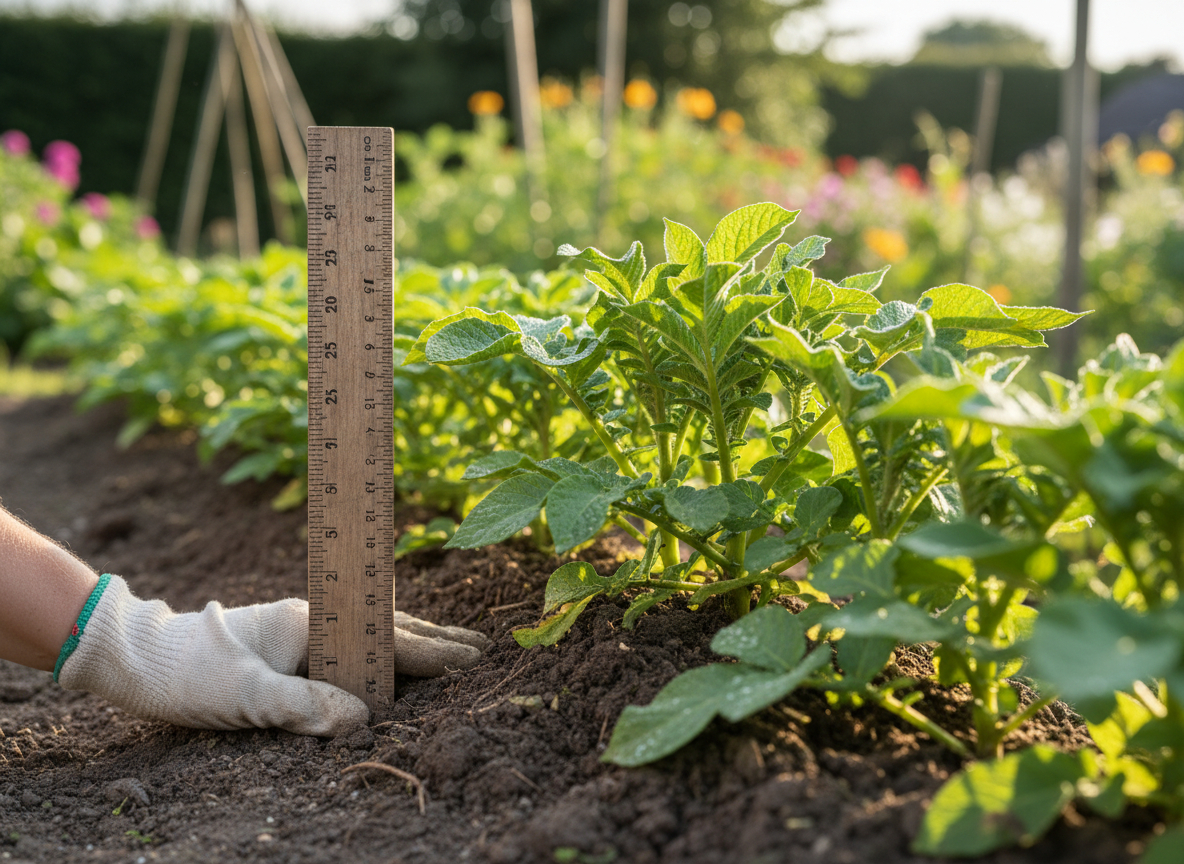
Mid-May, in most of north-west Europe, is when first earlies planted in early April hit that height. The shoots are 20 to 25 cm, the leaves have unfurled into clear lobes, and the bed looks ready to be tidied up. This is the moment that decides whether the row produces a polite handful of tubers per plant or a heavy clutch that fills a bucket. The decision rests on three things the standard advice tends to skip: a measurement, a varietal distinction, and a timing window for the second hilling that closes faster than most gardeners realise.
 AI-generated illustration
Why 23 cm, not “a hand high”
The number 23 cm comes straight out of the RHS guide to growing potatoes, and it isn’t an arbitrary round figure pulled from a height chart. It’s the height at which a potato shoot has produced enough leaf area to fund its own continued growth from photosynthesis, while still being soft and green low down on the stem — the two conditions that need to coexist for earthing up to do what it’s supposed to do.
Earth up at 10 cm — the moment most gardeners feel the urge — and you’re burying the only working leaves the plant has. The stem below the lowest leaf is barely 3 to 5 cm of bare tissue. You bury those leaves, the plant has to spend a week of stored seed-tuber energy throwing up replacements, and you’ve achieved nothing for tuber count because the buried section was too short to make a meaningful difference. You’ve also given the soft, etiolated tissue you just covered an open invitation to rot if the weather turns wet — and a Northern European mid-May, statistically, will turn wet.
Earth up at 35 cm — the moment a procrastinator notices the row has flopped sideways under its own weight — and you’ve missed the window for a different reason. The lower stem has begun to lignify. The cells that would have produced new stolons in response to being buried have committed to being structural support instead. You can pile soil over the bottom 20 cm and the plant will tolerate it, but the buried section will throw roots, not stolons, and roots don’t make potatoes.
Twenty-three centimetres is the sweet spot because it gives you about 13 cm of soft, green, photosynthetically retired stem to bury (leaving the top 10 cm exposed), every node of which is still capable of switching from leaf-bearing to stolon-bearing. The plant reads the sudden darkness around those nodes as a signal that it’s now underground, and the latent buds at each node initiate stolons within 7 to 10 days. Each stolon, if conditions hold, swells at its tip into a new tuber. Bury 13 cm of stem with three or four nodes inside it and you’ve roughly doubled the number of stolon-producing sites compared with leaving the row flat.
 Potato plants growing in an allotment with harvested potatoes and a trowel nearby — AI-generated illustration
The variety question almost no allotment guide mentions
Here’s the part that the cheerful “more soil = more spuds” advice glosses over, and it’s the part that explains why two gardeners following identical earthing-up routines end up with very different yields. Not every potato variety responds to a buried stem by making more tubers. Whether yours does depends on whether it’s an indeterminate or determinate type — a distinction the seed-potato catalogues rarely print on the label, but one that’s been documented in the potato research literature for decades and confirmed by smaller-scale grower trials.
Indeterminate varieties — the second-earlies and maincrops, broadly — keep growing upward all season and form tubers in successive layers along their stems. Bury more stem and you genuinely get more stolons, and therefore more potatoes. Classic indeterminate varieties grown across Europe include ‘Désirée’, ‘King Edward’, ‘Sarpo Mira’, ‘Cara’, ‘Maris Piper’ and ‘Pink Fir Apple’. These are the varieties for which “earth up two or three times” is yield-changing advice. A serious second hilling, done at the right moment, can lift the harvest by something on the order of 50 to 100 percent compared with a row that’s been left flat — Mark Diacono and Charles Dowding have both written about hilling lifts in that range on their own beds, and the Cultivariable trials on tuber-on-stem behaviour back the principle up.
Determinate varieties — most first earlies, including ‘Charlotte’, ‘Lady Christl’, ‘Swift’, and ‘Rocket’ — set their tubers in a single tight cluster at the base of the plant early in the season, and then more or less stop. Bury more stem on a determinate variety and the buried nodes throw roots rather than stolons. You don’t lose anything, but you don’t gain a yield bump either. For determinate first earlies, earthing up is purely about keeping the existing tubers covered so they don’t green and turn toxic.
The practical consequence: if your row is ‘Charlotte’, one tidy hilling at 23 cm to cover the developing tubers is all you need, and a second one at 40 cm is wasted effort. If your row is ‘Désirée’, a first hilling at 23 cm followed by a second at 40 to 45 cm two to three weeks later is the difference between a routine harvest and a heavy one. The label usually tells you the maturity class even if it doesn’t say “determinate” — first earlies are almost always determinate, second earlies are mixed, and maincrops are almost always indeterminate.
The greening problem is real, and it’s chemical
Even on a determinate row where extra hilling won’t add tubers, you still need that first earthing-up at 23 cm — for a reason that has nothing to do with yield and everything to do with food safety. Potato tubers exposed to light start producing chlorophyll within 48 hours, which is the harmless green tinge most gardeners recognise. What goes with it is less harmless: a steep rise in solanine, a glycoalkaloid that the plant uses as a defensive toxin and that humans cannot fully cook out.
The European Food Safety Authority’s 2020 opinion on glycoalkaloids in food set a lowest-observed-adverse-effect level of 1 mg per kg of body weight per day for the combined effect of α-solanine and α-chaconine — the two main potato glycoalkaloids. Heavily greened tubers can carry 250 to 1000 mg/kg, comfortably enough to push a normal portion above that threshold for a child. Boiling reduces solanine only marginally; peeling the green flesh out is the only reliable kitchen response, and at that point you’ve lost most of the potato.
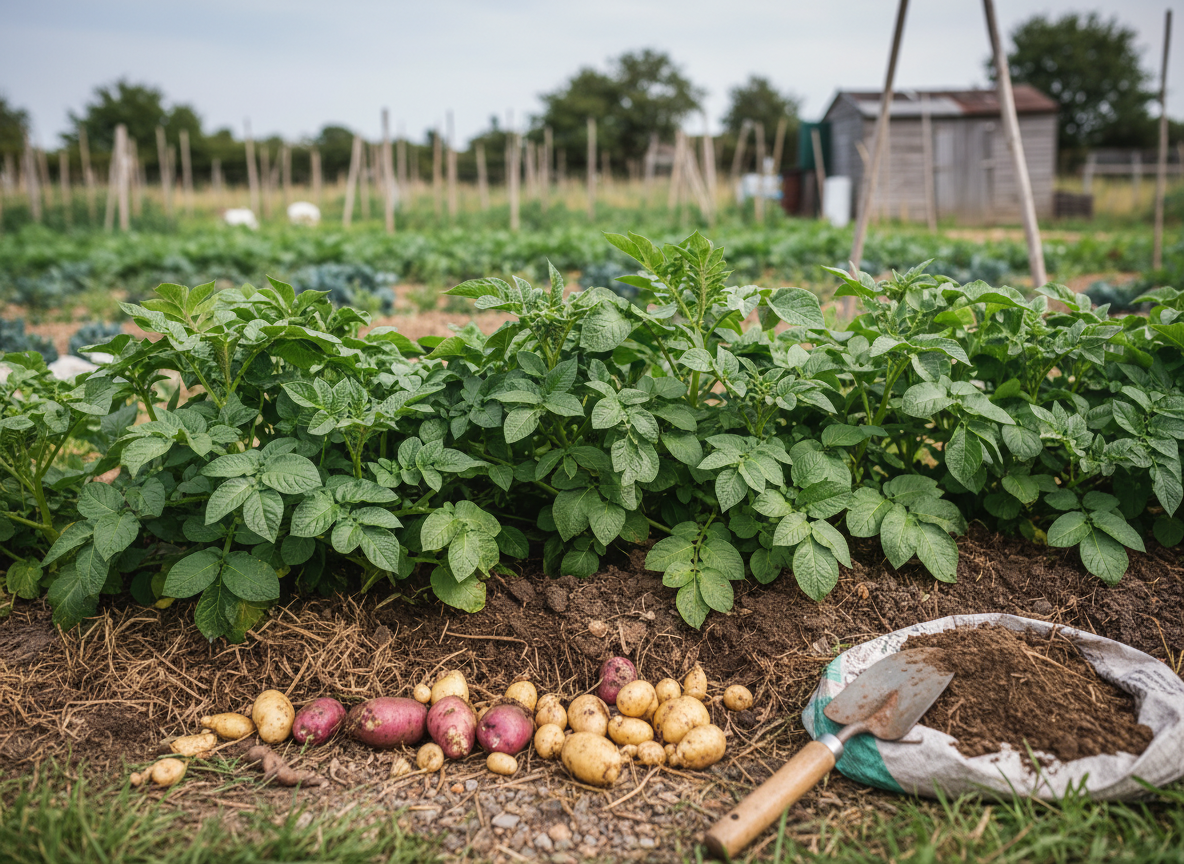
Greening happens whenever a tuber sits in light, and the most common reason for tubers to sit in light in May and June is that the soil mound has weathered down or never went on in the first place. Heavy rain — and there will be heavy rain in a Northern European May — washes loose ridge soil back into the furrows. A row that was perfectly hilled on May 10 can have shoulders of pale tuber showing by May 25. This is the case for going down the row again with the hoe at the second hilling, even on a determinate variety where the buried stem won’t make new tubers. The job is now purely defensive: keep the existing crop dark.
 . Potato plants being earthed up in a garden with gardening tools nearby — AI-generated illustration
What to actually do this week
Walk down the row at chest height and look at the tallest shoots, not the average. Potato shoots grow in flushes, and the leaders set the pace; if the tallest are 22 to 25 cm and the rest are 18 to 22 cm, you’re at the moment. If the tallest are still under 18 cm, give it another four to seven days. If they’re already over 30 cm and starting to flop, do the first hilling now anyway — you’ve missed the optimum, but the stem isn’t fully lignified for another week or so.
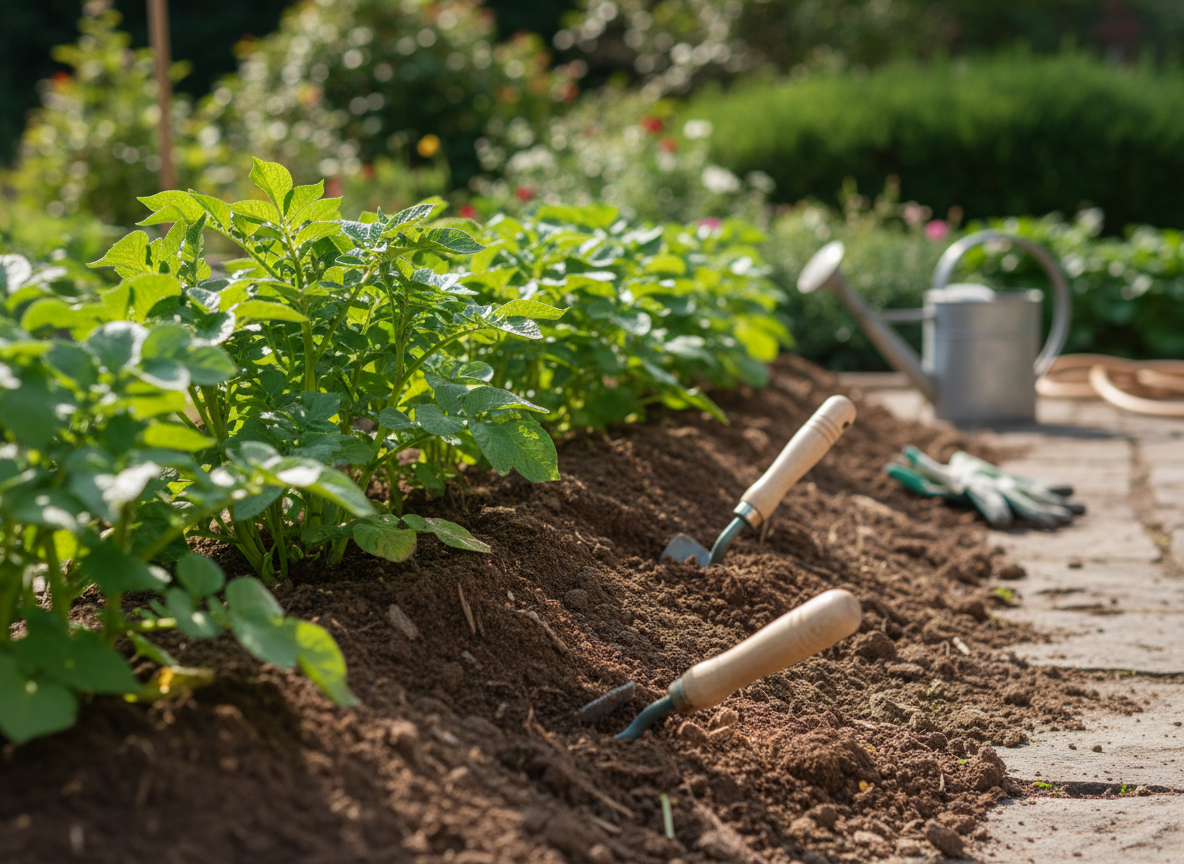
Use a draw hoe or a flat-bladed Dutch hoe pulled towards you, drawing soil from the path between the rows up around the stems on both sides. Aim to bury 13 to 15 cm of stem and leave the top 10 cm with its leaves clear in the air. The ridge profile should be a steep-sided triangle, not a low mound — flat hilling sheds water sideways and slumps within a fortnight. A steeper ridge sheds the heavy May rain off the shoulders into the furrow rather than scouring the tubers out.
Don’t use fresh manure or strong compost as your hilling material. The buried stem is in close contact with whatever you cover it with, and high-nitrogen contact at this stage encourages soft, sappy growth and rot. Use the soil that’s already in the path, with maybe a thin scatter of well-rotted leaf mould if you’re hilling on a thin sandy bed. If you’re growing in containers or potato sacks, top up with the same medium you started with — adding pure compost halfway through the season disrupts the moisture profile in the column and the tubers underneath end up sitting in a wetter layer than they want.
Mark the date you did the first hilling. The second hilling, on indeterminate varieties, wants to happen 14 to 21 days later, when the tops of the shoots have grown back to 35 to 40 cm above the new ridge surface. That puts it in the first week of June for most first-week-of-May rows. Wait longer than that and you’re back into the lignified-stem problem; do it sooner and you’re smothering newly produced leaves before they’ve earned their keep. The interval matters as much as the trigger height does.
How to tell, in late June, whether you got it right
You’ll know in five to seven weeks whether the row was hilled at the right moment. The diagnostic is the position and colour of the tubers when you tip the first plant out at harvest. A row hilled correctly at 23 cm with a second at 38 to 40 cm produces a vertical column of tubers strung along 20 to 25 cm of buried stem — the lower ones bigger and older, the upper ones smaller and younger, all of them clean and unblemished. A row hilled too early sits its entire crop in a shallow disc at the base, with the upper buried stem bare. A row hilled too late produces tubers only at the very base, with bald roots filling the rest of the buried stem. A row that wasn’t hilled at all puts you face to face with a cluster of greened, exposed tubers at soil level — every one of them a peeling job in the kitchen and a meaningful fraction of them inedible.
Cresco’s pruning and care planner doesn’t only handle ornamentals — the planting-and-care logic in the app reads your local mid-May soil temperature and rainfall pattern and times your second hilling to the indeterminate-variety window automatically, so the calendar reminder lands in the week the stem is still soft enough to react. The 23 cm trigger is universal; the gap to the second hilling is the bit that wants to flex with the weather, and that’s the bit a calendar reminder gets wrong on its own.
Earthing up looks like the most rustic, low-tech job on the allotment. The hoe is older than every tool in your shed, the gesture hasn’t changed in two centuries, and most gardeners can do it in their sleep. The reason it has stayed in the calendar that long isn’t tradition — it’s that done at the right height, on the right variety, at the right interval, it remains the single most leveraged action you can take on a potato row between planting and harvest. Mid-May is when the lever is in your hand. The plant has done its part. The next move is yours.