Get this wrong in mid-April and you won’t know until July, when the neighbour’s hydrangea is a blue cloud and yours is a wall of healthy green leaves with nothing on top.
This guide walks through the four hydrangea types you’re most likely to have in your garden right now, what April pruning should look like for each one, and the specific mistakes that turn a well-meaning clean-up into a flowerless summer.
Why April Is a Trap for Hydrangea Owners
Most pruning advice tells you to prune hydrangeas “in late winter to early spring.” That advice is half right and half catastrophic. It works for some hydrangea types and destroys the blooms of others.
Here’s what’s actually happening in April. Bigleaf and oakleaf hydrangeas set their 2026 flower buds back in August 2025. Those buds have spent the entire winter sitting on what looks like dead wood, waiting for a warm spell to push out. In April, they’re finally swelling visibly.
If you cut that wood back in April because it looks ugly, you’ve removed this year’s flowers. The plant will recover, leaf out beautifully, and give you nothing.
Panicle and smooth hydrangeas work the opposite way. They bloom on new growth made this spring, which means April pruning doesn’t cost you anything — in fact, a hard April cut gives them bigger blooms later.
One plant genus. Two completely opposite pruning rules. That’s why generic “prune hydrangeas in spring” advice is responsible for so many disappointed gardeners.
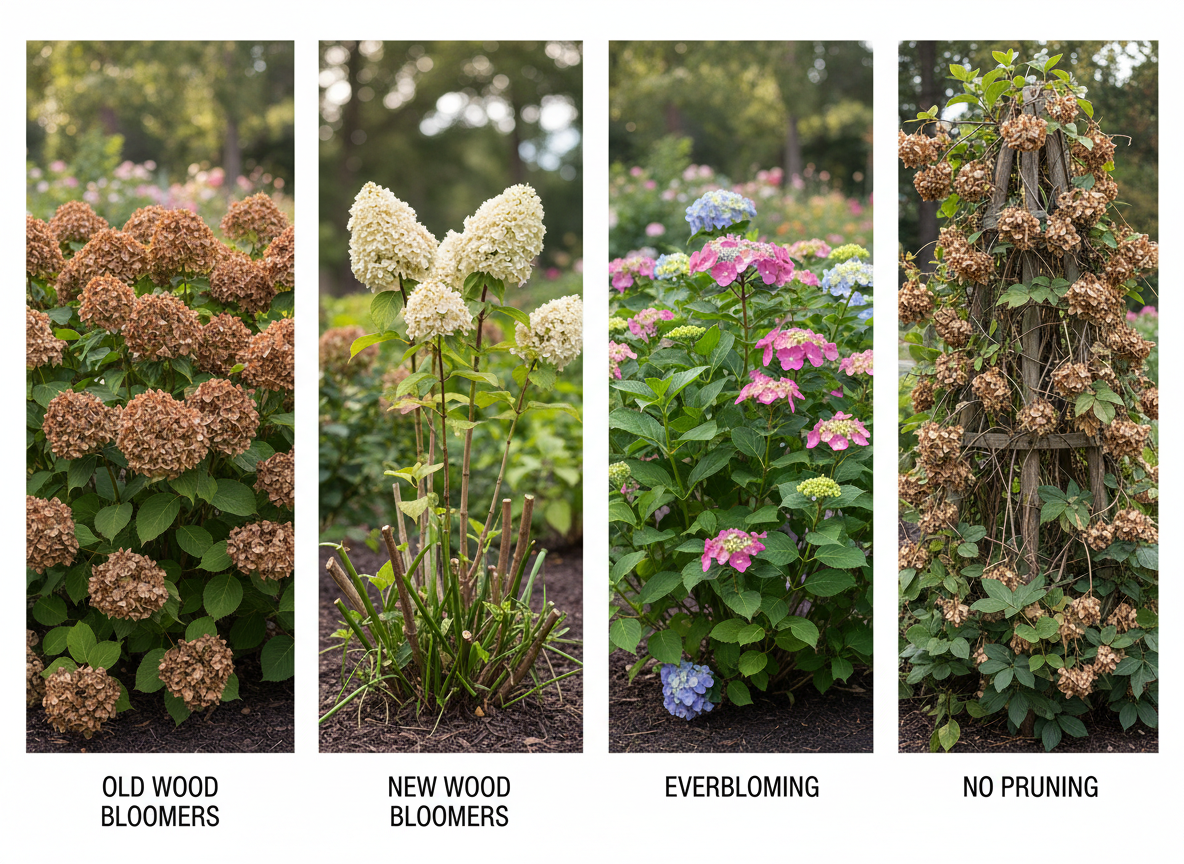 The photograph depicts four types of hydrangeas in various states of pruning — AI-generated illustration
The Four Types, and How to Tell Them Apart
Before you cut anything, identify what you have. Walk out to the plant now and check.
Bigleaf (Hydrangea macrophylla) — the classic mophead with pink or blue pom-pom flowers, or the flat lacecap with tiny fertile flowers ringed by showy sterile ones. Leaves are thick, glossy, slightly toothed. This is the one most people picture when they hear “hydrangea,” and the one most often ruined in April.
Oakleaf (Hydrangea quercifolia) — leaves shaped like oak leaves, cone-shaped white flower clusters that turn pink then brown. Foliage goes deep burgundy in autumn. Blooms on old wood, same rule as bigleaf.
Panicle (Hydrangea paniculata) — cone-shaped flower heads, often white fading to pink. Varieties like ‘Limelight’ and ‘Vanille Fraise’ are all panicles. Blooms on new wood — prune hard now.
Smooth (Hydrangea arborescens) — ‘Annabelle’ is the famous one, with huge round white flower heads on thinner stems. Native to North America. Blooms on new wood — prune hard now.
If you still can’t tell, look at the stems. Old wood feels woody, grey-brown, sometimes peeling slightly. New wood is green and flexible. Panicles and smooths don’t mind either being cut. Bigleafs and oakleafs need every bit of old wood you can leave them.
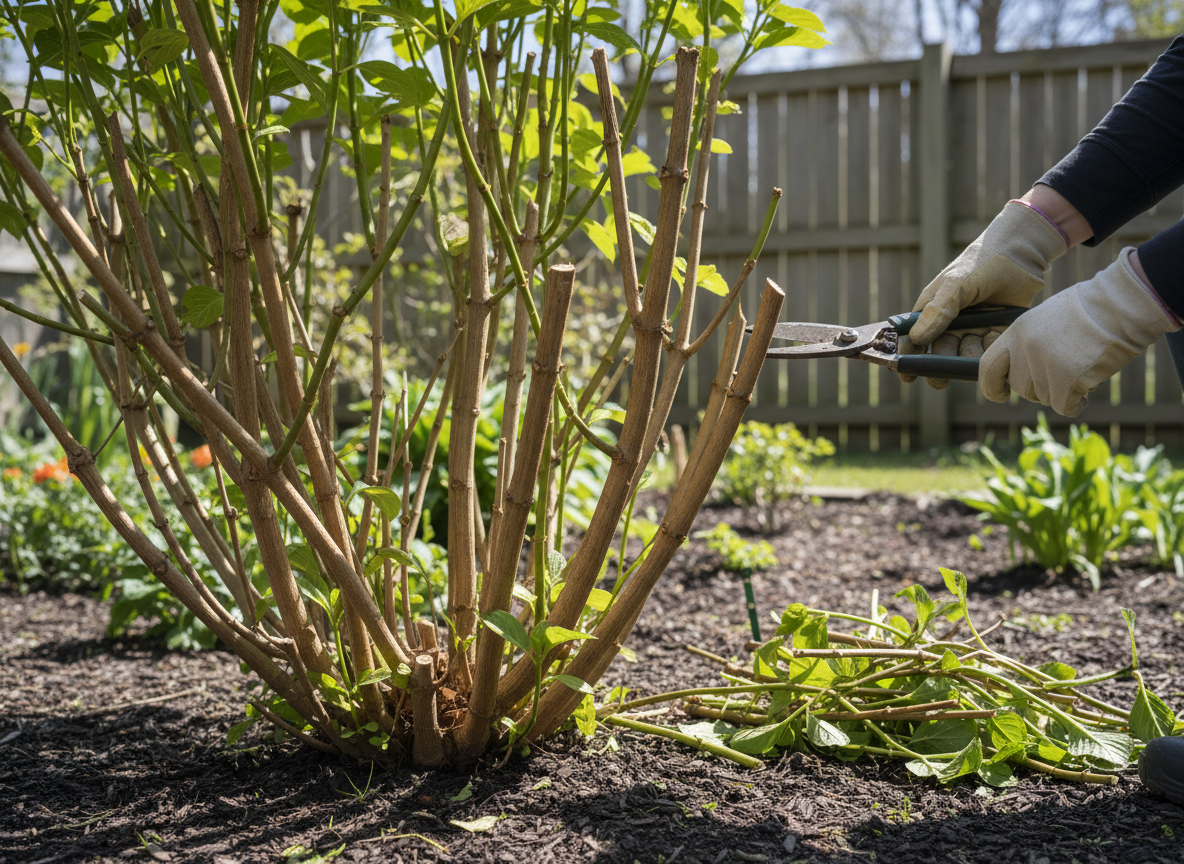 A person pruning a hydrangea bush in a garden with pruning shears — AI-generated illustration
What April Pruning Should Actually Look Like
For bigleaf and oakleaf (old-wood bloomers)
Your job in April is almost entirely restraint. You should:
- Remove any fully dead stems — snap test: if it breaks dry and hollow, it’s dead
- Cut out winter-killed tips back to the first pair of fat green buds
- Leave every stem with live buds alone, even if it looks scruffy
That’s it. No shaping. No height control. No “tidying up.” If you want a shorter plant, you chose the wrong plant — or wait and prune right after it finishes blooming in summer, which is the only safe window for structural pruning on these types.
The swollen buds on what looks like dead wood are your flowers. When in doubt, put the shears down and wait two more weeks. A hydrangea that leafs out will tell you exactly which wood is alive.
For panicle and smooth (new-wood bloomers)
Different plant, different rules. April is actually late for these — ideally you’d have cut them in February or March, but April is still fine if new shoots are only a few centimetres long.
- Cut the whole plant back to a framework of short, strong stems — roughly one third of last year’s height for panicles, or down to 15–30 cm for smooth hydrangeas
- Remove any thin, weak, or crossing stems entirely
- Don’t worry about cutting too hard; these plants respond to aggressive pruning with bigger, stronger blooms
If your ‘Annabelle’ flopped last year under the weight of its own flowers, that’s a sign you either didn’t prune hard enough or you need to leave a slightly taller framework for the new stems to brace against.
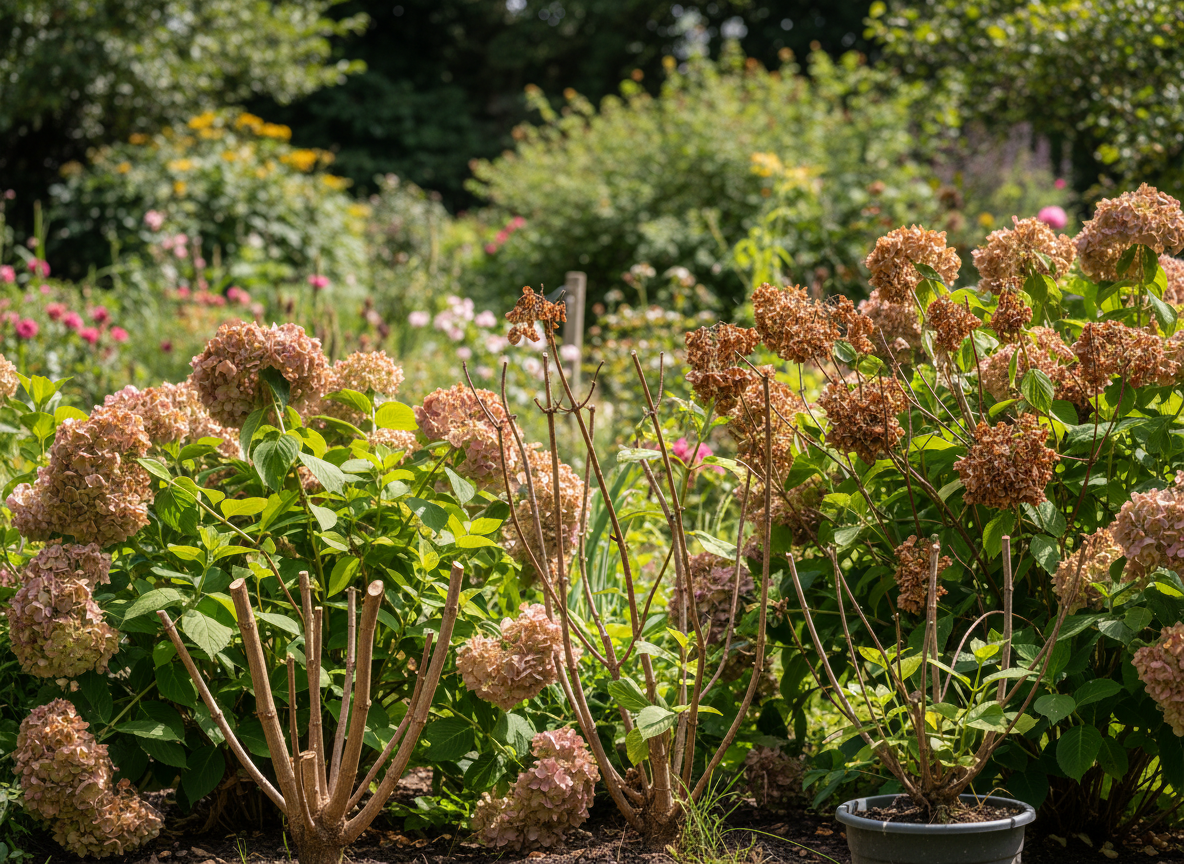 A garden with pruned hydrangeas and other blooming plants — AI-generated illustration
The Five Mistakes That Cost People Their Summer
1. Cutting bigleaf hydrangeas to the ground in April. The single most common mistake. The plant will look glorious in leaf and produce nothing.
2. Treating all hydrangeas the same. If you have a mix in your garden and you prune them all on the same Saturday with the same approach, you’re guaranteed to get it wrong on at least half of them.
3. Pruning during a warm spell. April heatwaves tempt gardeners into early action. But a week of 20°C followed by a late frost down to -3°C will kill the fresh cuts and the buds just below them. Watch the ten-day forecast, not the current weather.
4. Removing last year’s flower heads in April. On bigleafs, those dried brown heads were protecting the new buds directly beneath them all winter. Leave them until you see the new leaves emerging, then snap them off above the top pair of healthy buds.
5. “Shaping” to control size. Hydrangeas don’t respond to shaping the way a boxwood or a privet does. If size is your problem, the solution is a different variety, not harder cuts.
Why Weather-Aware Timing Matters More for Hydrangeas Than Most Plants
Hydrangea buds are unusually vulnerable to late frost. A bud that’s swollen and showing green tissue is essentially an open wound to a hard freeze. Unlike apples or roses, hydrangeas don’t easily push a second flush of flower buds if the first set gets killed.
This is why “prune in April” is lazy advice. What you actually want to know is: has your last hard frost passed? Is a cold snap coming in the next ten days? Have the buds on your specific plant started to break?
This is exactly the problem Cresco was built to solve. Instead of a calendar reminder, you get a prompt based on your local frost forecast, your specific hydrangea type, and the current state of your plant’s growth. If a cold snap is three days out, Cresco holds the pruning task. If conditions are safe and the buds are at the right stage, it tells you this week is the window.
For a plant where one wrongly-timed cut costs an entire season, that kind of timing specificity is the difference between green leaves and a garden full of blue, pink, and white in July.
What to Do This Week
If you’re reading this in mid-April with shears in hand, here’s the short version:
- Identify every hydrangea in your garden before you cut anything
- For bigleafs and oakleafs: only remove clearly dead wood, leave the rest
- For panicles and smooths: cut back hard to a low framework if you haven’t already
- Check the ten-day forecast — if a frost under -2°C is coming, wait
- Feed after pruning with a balanced slow-release fertiliser; hydrangeas are hungry plants and new growth needs fuel
Your hydrangeas will forgive almost any mistake except pruning the wrong type at the wrong time. Get the identification right, match the cut to the type, and watch the forecast — and you’ll have the summer you’re hoping for.
Want a pruning plan that knows which hydrangeas you have and when your local frost risk actually ends? Try Cresco at cresco-pruning.com.