Five saints, four nights, one piece of folklore that’s quietly drifting
If you garden in the Netherlands, Germany, Switzerland, Austria or anywhere in central Europe, you’ve heard the rule. Niet uitplanten voor de IJsheiligen. Don’t plant out before the Ice Saints. The saints in question are Mamertus on May 11, Pancras on May 12, Servatius on May 13, Boniface on May 14, and Cold Sophie (Sophia of Rome) on May 15. The block of cold air that traditionally swings down from the Arctic in the second week of May is named after them.
It’s a remarkable piece of weather folklore because it’s mostly correct. Climatological records from De Bilt, Frankfurt, Vienna and Zürich all show a real, measurable dip in average minimum temperatures around May 11 to 15, distinct from the warming trend of the surrounding days. The Königliches Bayerisches Statistisches Bureau noted it in print in 1879. The KNMI’s modern records, viewed across thirty-year averages, still show the bump. The folklore isn’t superstition — it’s an observed weather pattern dressed up in saints’ names.
What the folklore doesn’t capture is why mid-May used to matter, and why the calendar version of the rule is now drifting away from the temperature version. The original Ice Saints rule was written for fields, not glasshouses. It was written before global mean temperatures had risen 1.4°C, before April 2026 became the warmest April on record across most of north-west Europe, and before gardeners had a thermometer they could push into wet soil and read in real time.
The rule has not changed. The thing the rule was trying to predict — the last night of frost — has moved. In some years it’s now in late April. In other years, especially after a warm April that lulls you into planting early, it’s in the third week of May, well after Cold Sophie has gone home. The calendar rule says one thing. The actual frost says another. And the gap between them is what kills tomatoes.
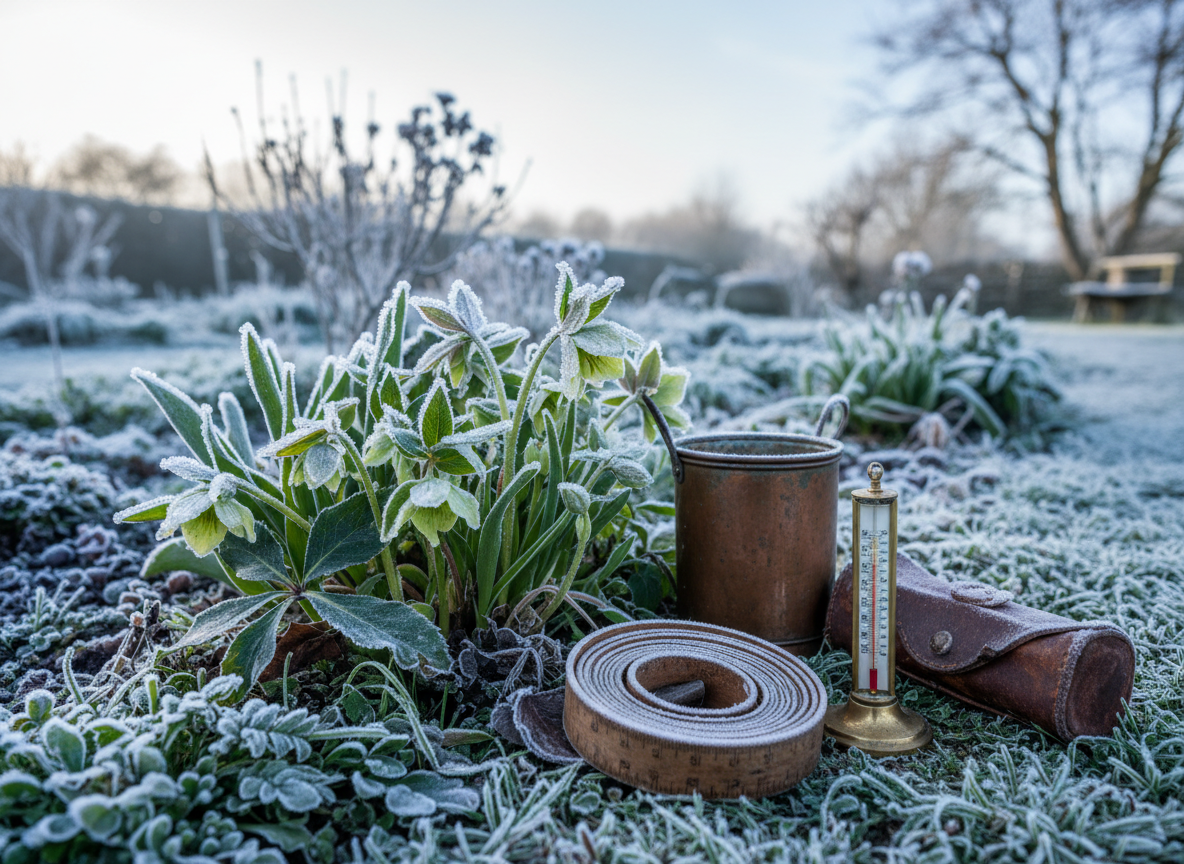 A frosty garden scene with a hellebore, copper pot, thermometer, and measuring tape — AI-generated illustration
What the saints were really telling you to measure
Strip the saints out of the rule and you get the actual decision a fifteenth-century farmer was making: is the ground warm enough, and is the air going to stay above freezing for the next ten nights? Both halves matter.
The first half — soil temperature — is the one most modern gardeners ignore. Tomato roots will sit in 8°C soil and do nothing for three weeks. Below 10°C, phosphorus uptake stops, growth stalls, and the plant becomes more susceptible to fungal damping-off than it would have been on a windowsill. A tomato plant set out into cold soil on May 1st often produces less fruit by August than the same variety planted on May 20th, because the early plant spends its first three weeks frozen in time while the later plant grows steadily from day one. Time in the ground is not the same as growth in the ground. Cold soil costs you yield more silently than a single frost ever will.
The second half — minimum nighttime air temperature — is what the saints’ calendar was trying to forecast. Most tender annuals (tomatoes, peppers, courgettes, beans, basil, dahlias) need overnight lows above 10°C to grow without stress, and absolutely cannot tolerate a single frost. A May 16th frost, even at -1°C for two hours, will kill a freshly planted tomato outright. The saints’ window historically covered most of the risk. It does not cover all of it any more.
There’s also a third number nobody talks about, which I’ll come back to: the dew point. It’s the single most reliable predictor of late-spring radiation frost in a clear, still night, and the one your phone’s weather app already shows you for free.
The three numbers that beat the calendar
If you’re going to plant out tender vegetables, dahlias, basil or fresh-cut bedding this week or next, run all three of these checks. Any single one failing means wait.
1. Soil temperature at 10 cm depth, measured at 8 a.m., for three consecutive mornings.
You want a stable reading above 12°C for tomatoes, peppers and basil; above 10°C for courgettes, French beans and dahlias; above 8°C for sweetcorn (which germinates lower but suffers in colder ground than people realise). A cheap compost thermometer with a 15 cm probe costs the same as a punnet of seedlings and lasts a decade. Push it into the bed where the plants are going, not into a sunny path. Read at 8 a.m., not at 4 p.m. when the surface has been baking.
The reason for “three consecutive mornings” is that one warm afternoon followed by a clear night will give you a soil temperature that swings five or six degrees overnight. A reading you can act on is a reading that’s stable. If your 8 a.m. soil temperature is 13°C, 11°C, 13°C across three days, the average is fine but the swing tells you the bed isn’t holding heat — usually a sign of wet, heavy clay that’s still releasing moisture from April rain. Wait a week and re-measure.
2. Forecast minimum air temperature for the next 7 nights, every night, at your specific postcode.
Not the regional forecast. Not the 5-day average. The actual minimum for each of the next seven nights at the location of your garden. The Met Office, KNMI, Buienradar and Apple Weather all publish hour-by-hour forecasts that are accurate to about 1.5°C at 7 days out. You’re looking for every single night to forecast above 4°C. Not above zero — above four.
Why four? Because forecast minimum temperatures are taken at 1.5 m above ground at the official weather station, which is usually in an open field. In a sheltered urban garden the actual minimum at plant height can be 2°C colder on a clear, still night, because cold air pools at ground level. A forecast of +3°C at the weather station can mean +1°C at plant height, and a single brushing frost on the leaf surface is enough to kill a tomato. The 4°C buffer is what makes the forecast actionable.
3. Dew point on the night of planting and the two nights after.
This is the number nobody teaches and almost nobody checks, and it’s the single best predictor of an unforecast night frost in May. The dew point is the temperature at which the air becomes saturated with water vapour. On a clear, still spring night, the air above your garden cannot cool below its dew point, because as it tries to, water condenses out and releases latent heat. The dew point sets a floor on how cold the night will get.
If the forecast minimum is +3°C and the dew point is also +3°C, you’re safe — the air can’t go below the dew point. If the forecast minimum is +3°C but the dew point is -2°C, the air has five degrees of room to keep falling, dew never forms, no latent heat is released, and you can wake up to ground frost even though the forecast said three above. Every weather app shows dew point. Most gardeners have never looked at it.
The rule of thumb: on a clear, still night in May, the actual minimum will be roughly halfway between the forecast minimum and the dew point. So a forecast of +5°C with a dew point of -3°C gives you a real-world ground minimum of about +1°C, which at plant height in a sheltered garden is at frost risk.
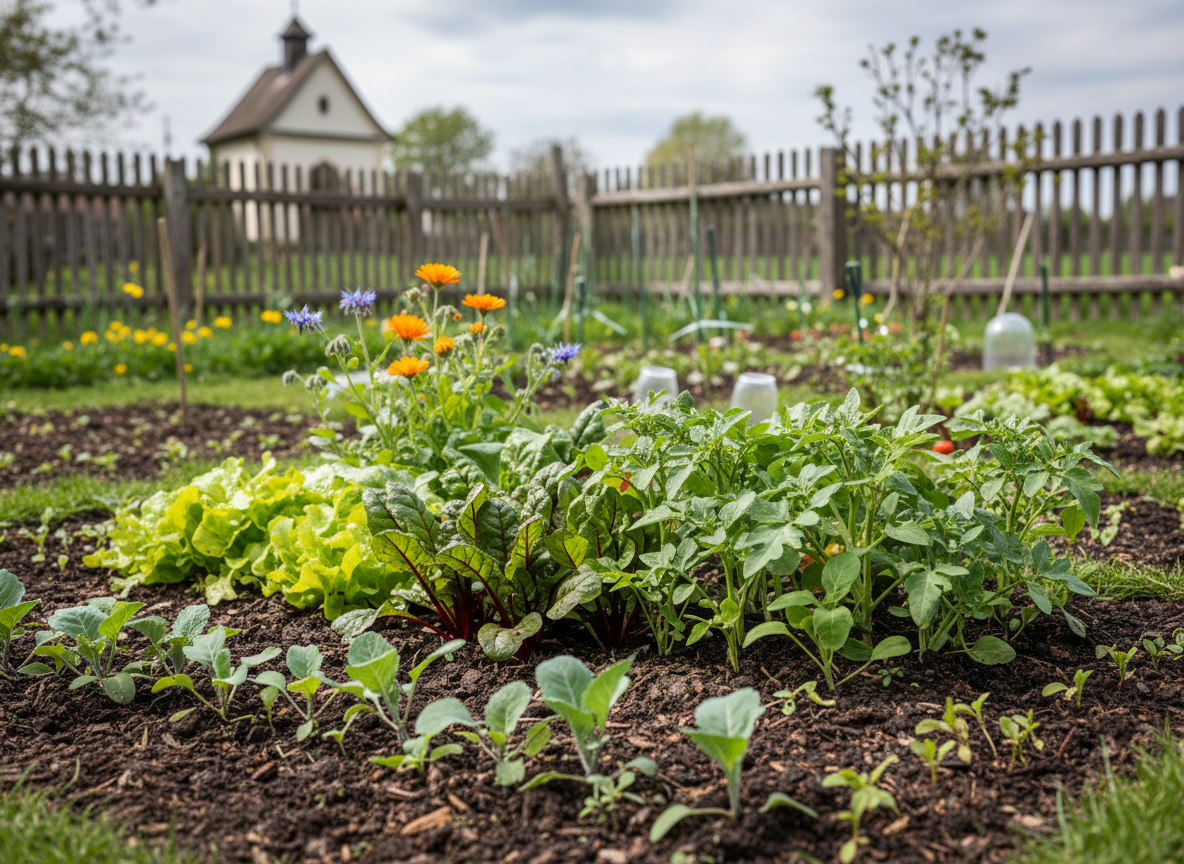 A freshly planted garden with various seedlings under a cloudy sky — AI-generated illustration
What you can already plant out today, May 5
Plenty. The Ice Saints rule is about tender plants — the ones that die at -1°C — and most of what you’ve raised under glass through April is hardier than that. If you’ve been hoarding trays in a cold frame waiting for May 15, you’re losing a fortnight of growing weather you don’t need to lose.
Hardy and ready now, soil temperature permitting (8°C+):
- Hardy annuals already hardened off — calendula, cornflower, larkspur, ammi, orlaya, nigella
- Sweet peas (in fact already late, ideally out by mid-April; plant immediately if you still have them in pots)
- Cool-season vegetables — lettuce, spinach, chard, beetroot, radish, peas, broad beans, spring onions, kale, kohlrabi
- Brassica transplants — brussels sprouts, summer cabbage, calabrese, sprouting broccoli (under fleece if pigeons or cabbage white are about)
- Onion sets and shallots, leeks, parsnips by direct sow
- Strawberry runners, raspberry canes, soft fruit
- Hardy perennials from the garden centre — geums, salvias, hardy geraniums, lupins, delphiniums, lady’s mantle
- Hardy biennials sown last summer for this year’s flowers — foxgloves, honesty, sweet williams, wallflowers
- Trees, shrubs and roses bought container-grown (not bare-root, which had to go in by March)
Wait until after the saints, even with all three numbers green:
- Tomatoes, peppers, chillies, aubergines (eggplant)
- Courgettes, marrows, pumpkins, squashes, cucumbers
- French and runner beans (broad beans are different; they’re hardy)
- Sweetcorn
- Basil, coriander (it’ll bolt anyway), nasturtium
- Dahlias as growing plants (dormant tubers in dry soil are fine to plant now)
- Tender bedding — pelargoniums, fuchsia, begonia, busy lizzy, petunia, lobelia
- Cannas, salvias from cuttings, gazanias
The three plants that wait regardless of any thermometer:
These three I would not bed out before May 20th in a typical year, even if every number says go. Their cost-of-loss is too high.
- Heritage tomato seedlings. Yes, a sheltered south wall and a perfect forecast might let you plant May 12 and get away with it. But you’ve grown these from seed since February. One cold night undoes ten weeks of windowsill care. The May 20 plant catches up with the May 12 plant by mid-July anyway. Don’t gamble.
- Dahlias as growing plants from a specialist nursery. Tubers in dry soil shrug off cold; plants in growth do not. A single frost burns the new shoots, and while the tuber will resprout, you’ve lost three weeks of bloom and probably the first cut.
- Basil. Different problem. Basil tolerates a 5°C night without dying, but it sulks for the rest of the season. A basil plant that experiences one cold night below 8°C will produce smaller leaves, bolt earlier, and be twice as susceptible to downy mildew in July. Keep it on the windowsill until soil temperatures hold above 14°C, which in most years is the last week of May.
A 7-day hardening-off rhythm that ends on the right side of the saints
If you’re aiming to plant tender crops out around May 16 to 20, this week is hardening-off week. The single biggest reason carefully raised seedlings collapse on transplanting is not frost — it’s wind and UV that the plant has never met. A tomato grown indoors has a leaf cuticle about a third the thickness of an outdoor-grown leaf. Dump it straight into a sunny, breezy garden and it will scorch within an afternoon.
Use this rhythm, starting today (May 5) for transplant on May 16 to 20. Adjust dates if your conditions or your saints’ window differ.
Day 1 (May 5): Outside in deep shade for 2 hours. No direct sun. Bring back in.
Day 2 (May 6): Outside in deep shade for 4 hours. Add 30 minutes of dappled morning sun at the start.
Day 3 (May 7): Outside for 4 hours including 1 hour of direct morning sun. If it’s windy, set the trays behind a row of pots or against a fence.
Day 4 (May 8): Outside all day, full sun from late morning, brought in at dusk. Water at midday — wind dries them faster than the sun does.
Day 5 (May 9): Outside all day. Water in the morning. Leave out until 8 p.m., bring in for the night.
Day 6 (May 10): Outside all day and overnight in a cold frame with the lid propped open, or under fleece if you don’t have a frame. This is the first night out. Check your dew point.
Day 7 (May 11) onwards: Outside continuously, fleece on hand, ready to plant when your three numbers go green.
The Ice Saints’ window is May 11 to 15. Your hardening-off run ends on Day 7 with plants outside in a cold frame, which means even if the saints arrive on time and bring a -1°C night, you can drop the lid and they’re fine. That’s the whole point of running the schedule this way: it positions the seedlings for either outcome.
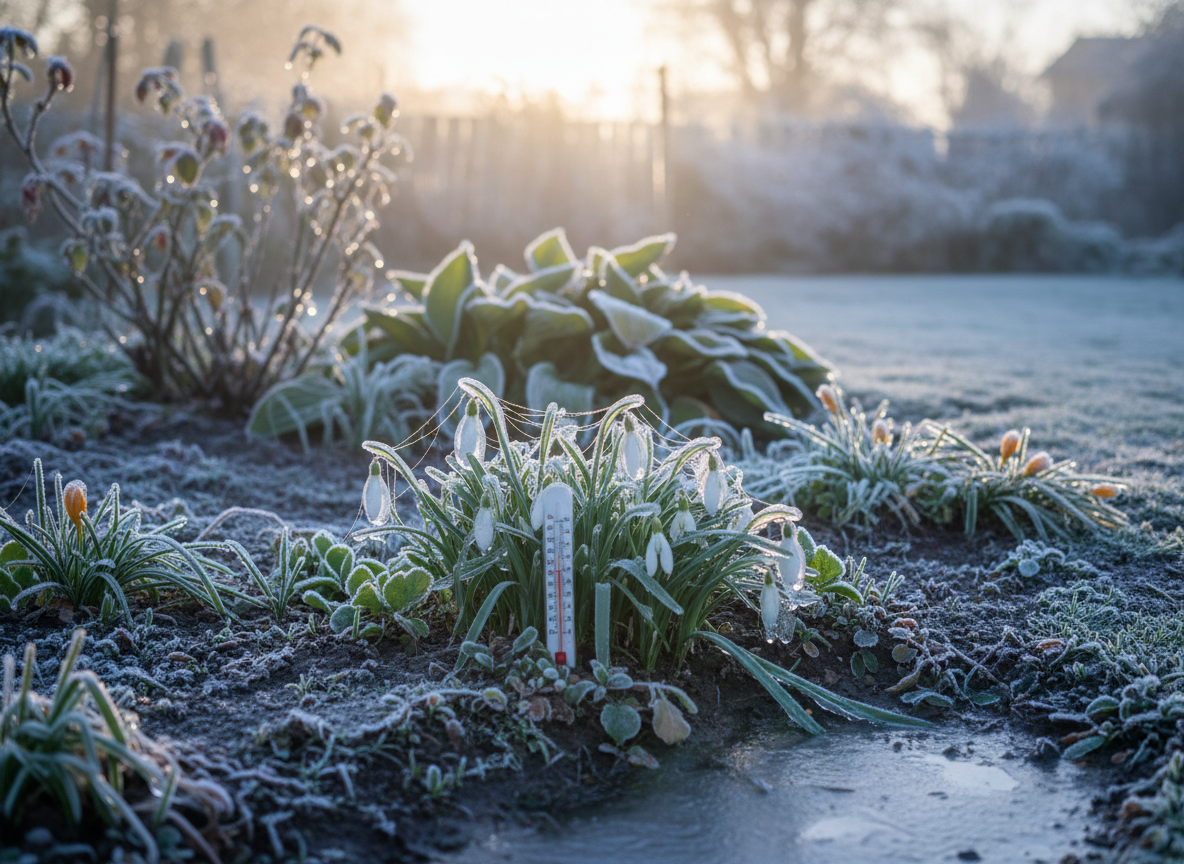 A thermometer stands amidst frosty plants and snowdrops in a cold garden — AI-generated illustration
When the saints lie: cold returns after May 15
Some years they don’t bring the cold on cue. Other years they bring it a week late. May 22 to 24 frosts have hit the Netherlands in 2017, 2019 and 2024. May 28 frosts have happened in Switzerland and southern Germany within living memory. There is no calendar date in May after which frost is impossible — only dates after which frost is improbable.
If a late-May cold snap is forecast (forecast minimum below 4°C, dew point below zero, clear sky, light wind) and your tomatoes are already in the ground, you have a four-hour evening to act. From most effective to least:
- Water the soil thoroughly in the late afternoon. Wet soil holds and releases more heat overnight than dry soil. This single act can lift the morning minimum at plant level by 1.5 to 2°C and is by far the highest-leverage thing you can do.
- Cover with fleece — not plastic — pegged down at the edges. Fleece traps the radiant heat coming up out of the soil. Plastic sheeting touching leaves will conduct frost straight through. If you only have plastic, suspend it on canes so it doesn’t touch the foliage.
- Add a second layer for the most vulnerable plants. Newspaper, cardboard, an upturned cardboard box weighed down with a brick, an old bedsheet over the fleece. Anything that adds an extra 0.5 to 1°C of insulation.
- For potted tomatoes and dahlias on a patio: move them against the house wall, ideally under an eave. The wall releases stored daytime heat overnight and the eave blocks the clear-sky radiation that drives the temperature down.
- Don’t wet the foliage at dawn. The folk advice to “spray your plants before sunrise” is for orchards with overhead sprinklers running continuously through the freeze, where the latent heat of fusion as water freezes on the leaves keeps the leaf at exactly 0°C. A garden hand-spray does the opposite — it adds water that then freezes, and the ice on the leaf surface drops the leaf below ambient air temperature. Skip it.
Uncover by mid-morning the next day. Fleece left on through a sunny May day will cook young tomatoes faster than a frost would have killed them.
How Cresco handles this for you
The whole point of Cresco is that you shouldn’t have to remember which night your dew point is going to drop, or whether your soil has held its temperature for three mornings. The app pulls your local weather forecast for the next 14 days, your historical last-frost date, and the soil temperature model for your postcode, and turns it into a single decision: plant your tomatoes out on this date — usually a specific day, sometimes a window, occasionally a “wait, the forecast just changed” notification on the morning you were going to plant.
It also tracks which of your plants are tender vs. hardy, so you don’t get a “plant out tomatoes” notification on May 5 and a “plant out hardy annuals” notification on the same day — they’re different decisions and they need different signals. The hardy annuals went out three weeks ago; the tomatoes wait for a different combination of soil temperature, dew point and minimum air forecast that may not align until May 22 in a cold year.
The Ice Saints rule was the medieval version of this calculation. It worked in 1500 because the climate was stable and the only forecast a farmer had was a thousand years of village memory. In 2026, with a warming climate, urban heat islands, and a 14-day weather forecast on every phone, you can do better than the saints. You just have to look at the right three numbers.
Try Cresco free and let it watch the dew point so you don’t have to.
Sources: KNMI climate records De Bilt, Royal Horticultural Society guidance on hardening off, Penn State Extension on tomato soil temperature, Oregon State University Extension on soil temperature for vegetable planting, Old Farmer’s Almanac 2026 last frost map, Compo planting guide for Eisheilige.