If you’ve ever stood in front of a leafy, healthy lilac wondering why it didn’t bloom this spring, the answer is almost always the same: it was pruned at the wrong time the year before. Lilacs are the most unforgiving “easy” shrub in the garden. They’ll grow anywhere, tolerate neglect for decades, and reward almost no skill — except this one.
This guide walks through what’s actually happening inside a lilac in late May, why the timing window is so much shorter than most advice suggests, and the three pruning approaches that match how the plant actually behaves.
What Is Actually Happening Inside the Plant in Late May
To understand why lilac timing is so unforgiving, you have to know what the plant is doing the moment its flowers fade.
Lilacs (Syringa species) bloom on what gardeners call old wood — wood that grew during last season and overwintered with the flower buds already formed. Those panicles you enjoyed in early May 2026 were physically present, in tiny embryonic form, on the shrub all winter. The plant did most of the work of building them in summer and autumn 2025.
Here’s the problem. Within about two to three weeks of finishing this year’s bloom, the lilac starts the same process for next year. New shoots are extending, and at the tips of those shoots, the next round of flower buds is being initiated. By late June, those buds are committed. By July, they’re set. Anything you remove from that point onward is anything you remove from May 2027.
That’s why every reliable lilac source — the RHS, university extension services, established nurseries — converges on the same advice: prune within two to three weeks of the last flower fading, and not later. In most temperate gardens, that means a window between mid-May and mid-June, depending on when your particular variety bloomed.
The plant doesn’t care about your weekend plans. It runs on temperature and daylight, and it shifts gears fast.
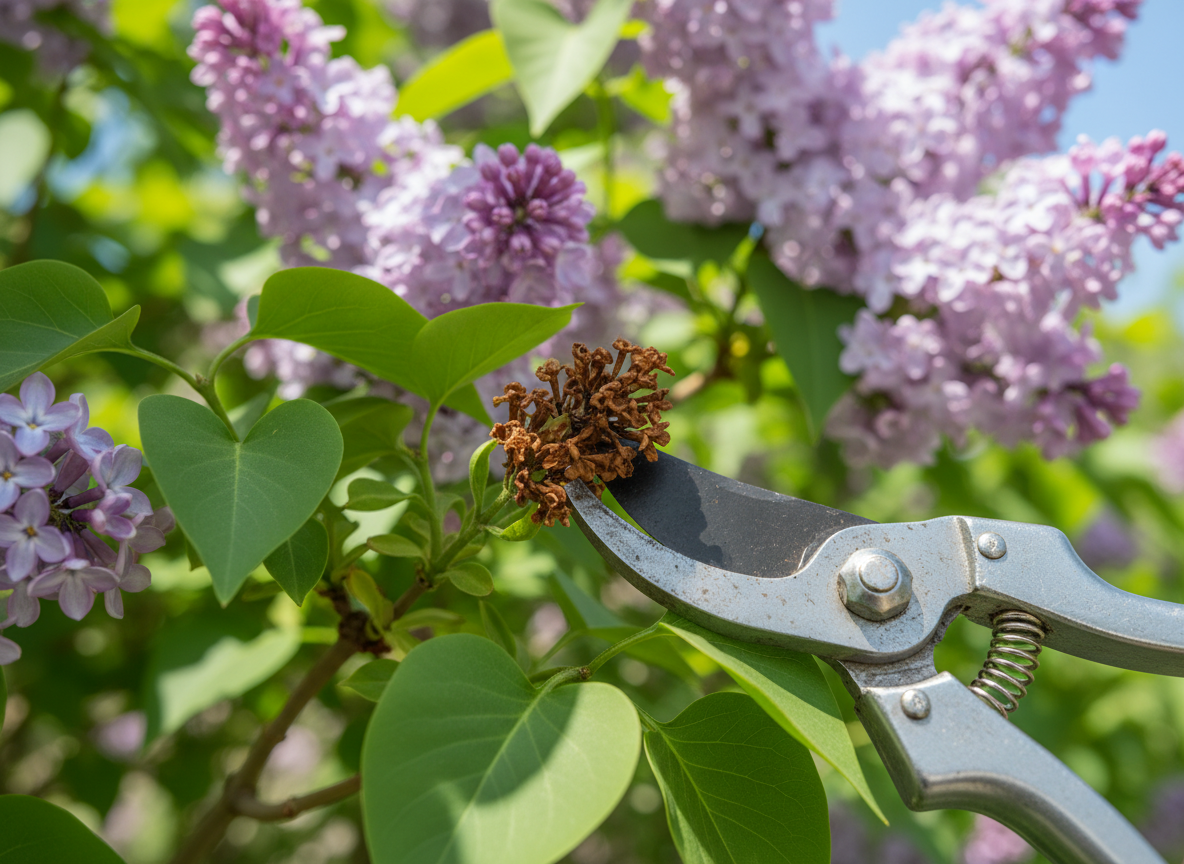 A close-up of pruning shears cutting a dead lilac flower — AI-generated illustration
The Cut That Matters Most: Deadheading
Before any structural work, the single most useful thing you can do for a mature lilac is deadhead it.
A spent lilac panicle is a calorie sink. Left alone, the plant will pour energy into ripening seed in those brown, dried clusters — energy that should be going into next year’s flower buds. Deadheading isn’t strictly required, and a lilac will survive without it, but consistently deadheaded shrubs flower more reliably and more abundantly than ones that are left to seed.
The technique is simple. As soon as the flower clusters turn brown and dry, snip each one off just above the first pair of leaves below the spent panicle. Those leaves are where this year’s new growth — and next year’s flowers — will emerge from. Cut too low and you remove the bud-producing wood. Cut too high and you leave an awkward stub that dies back.
On a young lilac you can deadhead every panicle. On a mature one with hundreds of flower clusters at head height and above, do what you can reach in an afternoon. Even partial deadheading shifts the plant’s energy in the right direction.
This is also the moment when you can spot any obviously dead, broken, or rubbing branches. Take those out at the same time. They’re easy to see now while the plant’s structure is fresh in your mind.
The Three-Year Rotation for Established Plants
Beyond deadheading, the most reliable structural pruning for an established lilac is the rule of thirds, applied over three years.
Each year, after flowering, identify the oldest third of the main stems — the ones that are thickest, greyest, and producing the fewest flowers. Cut those out completely, right back to the base or to a strong young shoot near the ground. Leave the rest alone.
In year two, the same. Year three, the same. By the end of the cycle, the entire shrub has been gradually replaced with younger, more vigorous wood, and you’ve never been without flowers along the way.
This is the technique that separates lilacs that bloom for decades from lilacs that gradually decline into a leafy thicket with a few sad blooms way up at the top. Old wood produces fewer and fewer flowers. The shrub keeps making new shoots from the base, but if you never remove the old, you end up with a tall, woody, half-blind plant.
A few specifics that matter:
- Cut at the base, not partway up. A lilac stem cut halfway up will sucker awkwardly. Cut right back to ground level or to a strong low branch fork.
- Use loppers or a pruning saw, not secateurs, on stems thicker than your thumb. Crushed cuts heal poorly.
- Don’t take more than a third in any single year. A lilac that loses half or more of its mature wood at once will sulk for two or three seasons before flowering well again.
 AI-generated illustration
The Hard Reset: Renovation Pruning
What about a lilac that’s been completely neglected — twelve feet tall, half-dead at the centre, with three sad flower clusters perched at the top?
You have two options. The slow option is the rule-of-thirds rotation above, applied patiently over three years. It’s the safer choice and the one I’d recommend for any lilac you actually like.
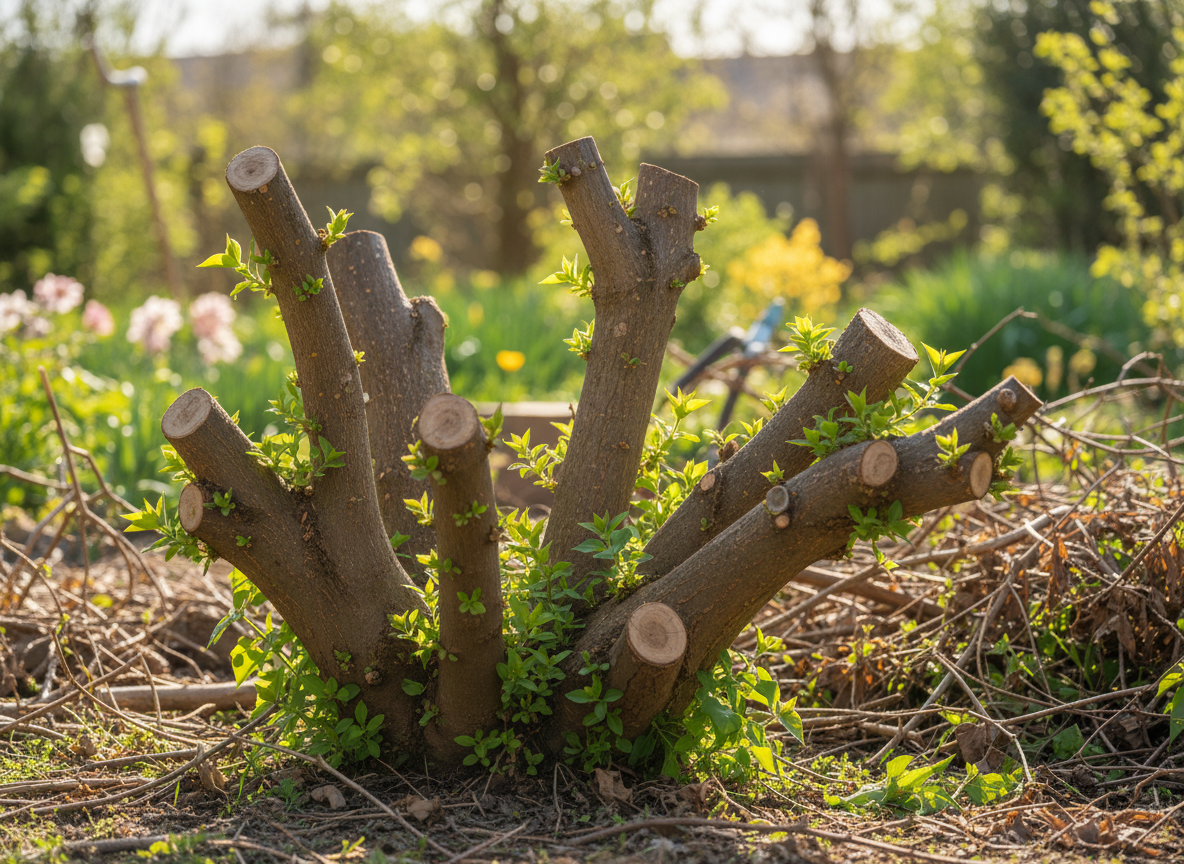
The hard option is renovation pruning. In late winter, before the buds break, cut the entire shrub back to about thirty centimetres from the ground. The plant will spend the following spring and summer pushing vigorous new growth from the base. You’ll get no flowers that year, and probably very few the next. By year three, you’ll have a fresh, healthy lilac at a reasonable size that will flower hard for the next two decades.
Two cautions on this approach. First, only do it on lilacs you’re confident are healthy and well-established — a renovation cut on a struggling plant can finish it off. Second, the timing is the opposite of normal pruning. You renovate in late winter, before bud break, not after flowering. You’re sacrificing the upcoming bloom in exchange for resetting the shrub. There’s no point doing this in late May; you’ve already missed the regrowth window for the season.
Reblooming and Dwarf Varieties Behave Differently
The classic advice — prune within two weeks of flowering, never later — assumes you have a traditional Syringa vulgaris or a similar single-bloom lilac. But the lilac aisle at every garden centre now includes a growing crowd of varieties that don’t follow the same rules.
Reblooming lilacs like the Bloomerang series flower in May, take a short rest, and bloom again from midsummer to autumn. They produce flowers on both old wood and new wood. Heavy pruning right after the spring bloom is fine, but you don’t need the same urgent two-week window — they’ll still flower on the new growth that follows. A light shaping cut after the spring bloom and again after the summer bloom keeps them tidy.
Dwarf lilacs like Syringa meyeri ‘Palibin’ and Syringa pubescens subsp. patula ‘Miss Kim’ bloom slightly later than common lilacs, often into early June. They’re naturally compact and rarely need structural pruning. Deadhead, take out anything dead or crossed, and otherwise leave them alone.
Tree lilacs (Syringa reticulata, the Japanese tree lilac) bloom in June rather than May, on a single-trunked tree form. They want minimal pruning — just removal of suckers from the base and any crossing branches. Heavy cutting ruins the elegant tree shape that’s the entire point of growing them.
If you’re not sure which type you have, the timing of the bloom is the easiest clue. Common lilacs bloom early-to-mid May, reblooming types flower again in summer, dwarfs are slightly later in spring, and tree lilacs come into their own in June.
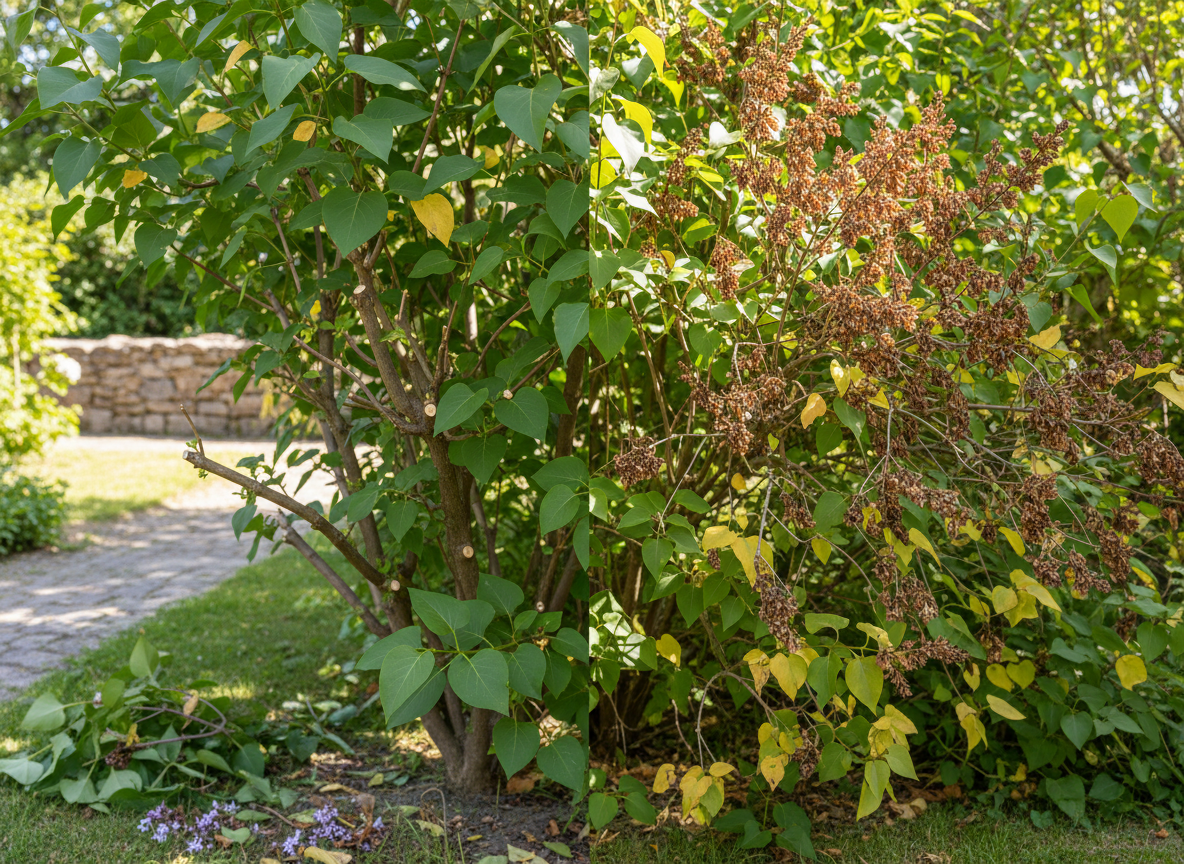 , showing a lilac bush with some branches pruned — AI-generated illustration
What Late Summer and Autumn Pruning Actually Does
The most common single mistake with lilacs isn’t a wrong cut. It’s a right cut at the wrong time.
A lilac that gets a tidy-up in August, September, or October has just had its 2027 flower buds removed. The plant will leaf out beautifully next spring and produce nothing — or one or two flower clusters at the very tips of branches that escaped the shears. The owner blames the weather, the soil, the pollinators. The actual cause was a thirty-second decision four months earlier.
The same applies to “winter tidying.” A lilac pruned in February or early March, before bud break, has lost the same buds. It looks neat but won’t flower.
If you find yourself in late summer staring at a lilac that desperately needs structural attention, the right answer is almost always to wait. Mark the worst stems with a piece of garden twine. Then come back the following May, immediately after flowering, and remove them properly. You’ll lose one season of slightly messy shape and gain decades of reliable bloom.
The Timing Question Cresco Was Built For
Lilacs are an almost perfect example of the kind of plant where timing is everything and technique is nothing. The cuts themselves are straightforward — anyone with a pair of loppers and a clear view of the shrub can do them. What’s hard is knowing exactly when “right after flowering” is for your specific lilac, your specific variety, and your specific spring.
In a year where the bloom comes early, the window opens in early May and closes by the end of the month. In a cold, late spring, you might still be cutting in mid-June. Nobody can tell you the right week from a generic calendar — it depends on what your particular plant is doing in your particular garden.
This is exactly the timing problem we built Cresco to solve. Instead of trying to remember which of your shrubs are old-wood bloomers and tracking when each one finished flowering, you get a prompt when your specific lilac has just dropped its last petals and the next two weeks of weather are right for the work. The app knows that your common lilac is on a different schedule than your Bloomerang and your Miss Kim, and that your renovation candidate needs a completely different time of year than your standard maintenance shrub.
For a plant where the difference between a two-week window and a missed window is an entire season of bloom, that kind of timing intelligence isn’t a nice-to-have. It’s the whole point.
What to Do This Week
If your lilac is in or near its final week of flowering, here’s the short version:
- Wait until the panicles have visibly faded — brown, dried, no longer fragrant
- Deadhead each spent cluster down to the first pair of leaves below it
- Identify the oldest third of the main stems and cut them out at the base
- Remove anything dead, broken, crossing, or growing inward
- Resist the urge to “shape” by trimming the outer canopy — you’ll cut next year’s flowers
- Mark the date on the calendar, because next year’s window opens at the same point in the bloom cycle
The lilac is one of those plants that asks for almost nothing and gives a lot in return — but the small thing it asks for, it asks for at a very specific time. Get the May window right and you’ll have a shrub that flowers reliably for the next forty years.
Want a pruning plan that knows when your specific lilacs have finished blooming and when the local conditions are right for the cut? Try Cresco at cresco-pruning.com.