The window is now, and it closes faster than you’d think
Walk past a herbaceous peony bed in the first week of May and you’ll see something most gardeners walk straight past: at the tip of every emerging stem there is one fat central bud, flanked by two, three, sometimes five smaller buds along the upper few centimetres of the stem. Right now, those side buds are roughly the size of a pea — green, hard, easy to pinch off between thumbnail and forefinger.
In ten days they’ll be the size of a marble. In three weeks they’ll be the size of a golf ball. By the time they’re golf-ball sized the plant has already committed photosynthate, water and stored carbohydrate to growing them, and removing them is wasted growth. The pea-stage window is the only point in the season where you can redirect the plant’s energy without losing any of it — and it’s the single biggest difference between a peony bed that produces “nice flowers” and one that produces the kind of single, enormous, stem-arching blooms that make people stop on the pavement.
Disbudding is one of those techniques that flower farmers and competition growers consider basic, and home gardeners almost never hear about. It takes about four minutes per established plant. Done at the right stage it costs the plant nothing. Done two weeks late it costs you a third of next year’s flower count.
This piece walks through what to remove, what to leave, why the maths works, what to do about the ants, when to put the support hoop in (it was last week — but you can still salvage it), and how to harvest at the so-called marshmallow stage so the bloom actually opens in your vase rather than shattering on day three.
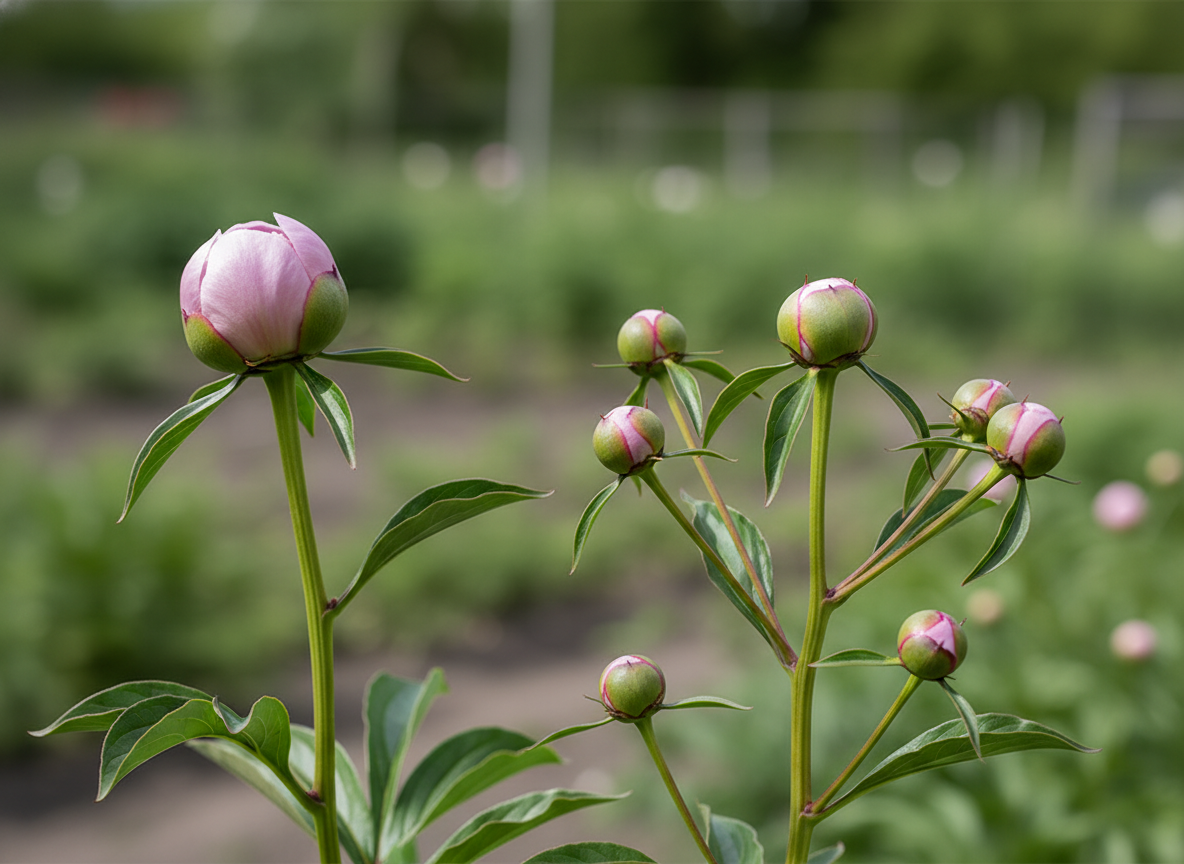 A large peony bud stands beside a stem with five smaller peony buds — AI-generated illustration
Why one terminal bud beats five medium ones
A peony stem produces one fat terminal bud at its tip and a small cluster of secondary buds — usually two to five, depending on variety — along the topmost 10–15 cm of stem. Each of those buds will, if left alone, develop into a flower. So instinctively you’d think more buds equals more flowers, which equals more value from the plant. That’s how cottage borders end up full of medium-sized peonies that flop the moment they get rained on.
The problem is that a peony stem has a fixed energy budget. The plant builds up that budget over a full growing season — the previous summer’s foliage stored sugars in the roots, the spring’s emerging leaves built more, and the stem now draws on the combined reserve to swell its buds. The size of the budget per stem is roughly fixed by genetics and last year’s growing conditions; it doesn’t expand to fit the number of buds you let it carry.
Split that budget across five buds and you get five medium-sized flowers, each between 8 and 12 cm across, each with a stem that bends under their combined weight. Direct the entire budget into one terminal bud and the same stem produces a single bloom 18–22 cm across — the kind of “dinner-plate peony” that flower farmers grow on purpose for weddings and that wins prizes at the RHS shows.
The energy maths works the same way as fruit thinning on apples. A King Edward apple tree thinned to one fruit per cluster ripens noticeably larger fruit than the same tree left to carry every set apple. Peonies aren’t fruit, but the principle is identical: limited resources flow to the remaining sinks, and a single sink absorbs more than its share.
There’s a second benefit nobody mentions. A solo terminal bloom on a properly disbudded stem opens evenly, holds its shape for longer, and lasts seven to nine days in the vase. A clustered stem with three or four buds opens unevenly — the terminal bud opens first and starts to drop petals before the lateral buds have even cracked, leaving you with a stem that looks half-spent the entire week.
What to remove, what to leave
Stand in front of an established peony in the first week of May and look closely at any one stem. From the top down you’ll see:
- The terminal bud — the largest, sitting right at the apex of the stem
- A pair of small lateral buds, set about 2–3 cm below the terminal, often nestled into the axils of the topmost leaves
- Sometimes a second pair another 5–10 cm lower down, smaller again, in the axils of the next leaf pair
For maximum bloom size, remove every bud except the terminal. Use thumbnail and forefinger; no secateurs needed. Pinch sideways and the bud snaps off cleanly with a satisfying soft click. The wound is the size of a pinhead and seals over within a day.
For a slightly less aggressive approach — if you want the show to last a bit longer rather than peak in a single week — leave the topmost pair of laterals and remove only the lower ones. The terminal will still be larger than it would have been with all buds in place, and the laterals will open four to seven days after the terminal goes over, extending the show without the unevenness of a fully clustered stem.
A few stems can be left fully clustered if you want a natural, unmanipulated look or if the plant is young (under three years old) and you’d rather give it a season to bulk up before you start asking it for show flowers.
The one rule that matters: do this before the buds get bigger than a marble. The standard from the cut flower trade — most explicitly stated by the team at The Peony Fields and the disbudding guide from Heirloom Soul Florals — is “pea size or smaller.” A pea-sized bud has cost the plant nothing meaningful to produce; a marble-sized bud has consumed real energy that you can’t recover.
Stake now, or apologise to the bed in two weeks
Disbudding alone won’t save a peony from flopping. A heavy double or bomb-form variety — ‘Sarah Bernhardt’, ‘Karl Rosenfield’, ‘Festiva Maxima’ — produces flowers so large that even a single terminal bloom on a stem will pull the stem over once it’s been rained on. The bloom hits the soil, the petals brown, slugs find them within a day, and the entire bed looks abused for a fortnight.
The fix is a support hoop installed before the foliage closes in. By early May the shoots are already 30–40 cm tall and the buds are visible; you’ve missed the easiest moment, which was when the shoots were 10–15 cm tall in mid-April. But you can still get the hoop in if you do it now and accept that you’ll have to thread the existing stems through the grid one by one rather than letting them grow through it on their own.
Three options work, in roughly descending order of how invisible they are by June.
Grow-through grid hoops — a circular grid on three or four legs, sat over the crown so the stems pass up through the grid as they grow. By the time the plant flowers the grid is invisible inside the foliage. The classic English option is heavy-gauge galvanised steel; cheaper versions in plastic-coated wire work for one or two seasons before they bend. Sized 35–45 cm across, depending on the cultivar.
Linked metal stakes — three or four stakes pushed into the soil around the crown, with hinged metal arms that link them at mid-stem height. The advantage is that you can install them late and adjust the height as the plant grows. The disadvantage is that they show until June.
The string corral — three or four canes pushed into the soil around the plant, soft string run twice round the perimeter at half-height and again just below bud height. Cheap, effective for a single season, but visible and slightly amateurish. Best used as a rescue when you’ve forgotten everything else.
What doesn’t work: tying individual stems to individual stakes. Peonies snap at the base when bent that hard, the tie chafes the stem under the weight of the bloom, and one heavy rain takes the whole arrangement down with the plant.
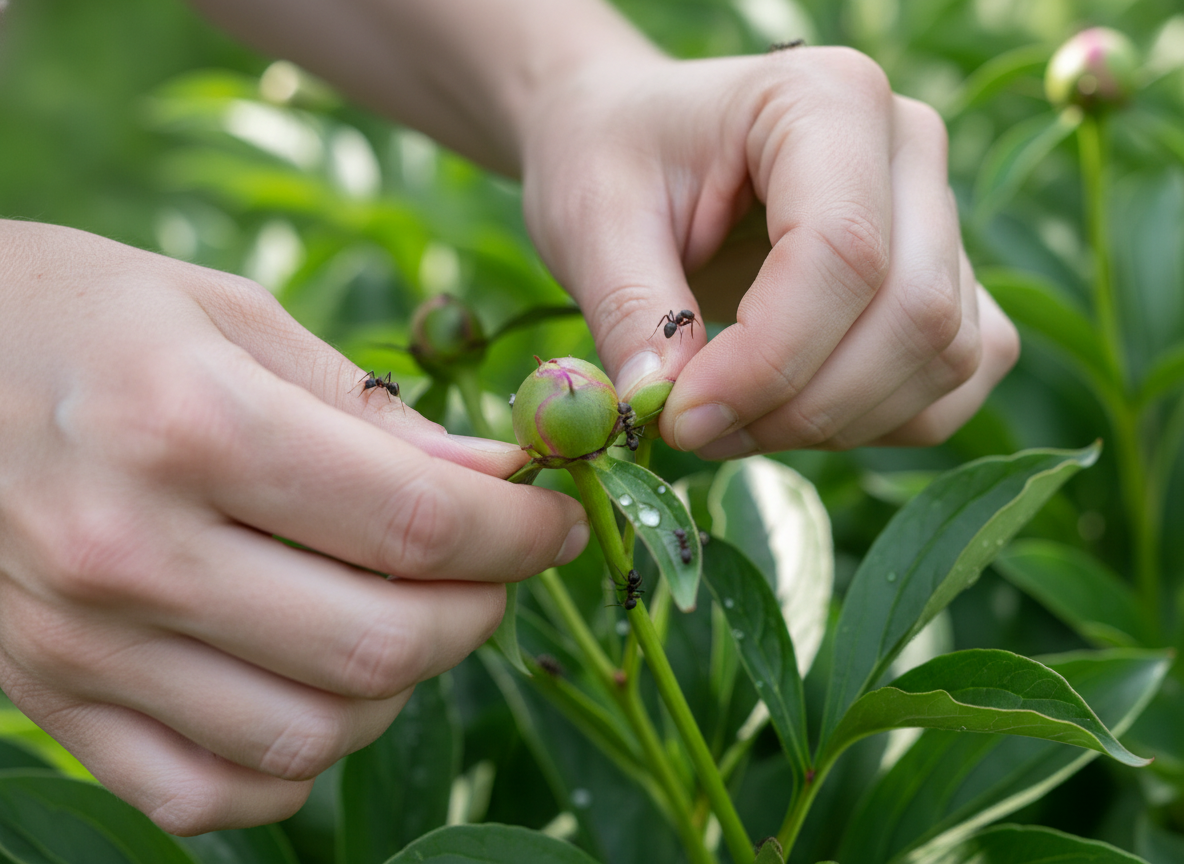 AI-generated illustration
The ants are not a problem
Every May, every garden centre in the UK and Netherlands gets the same question: there are ants all over my peony buds, what do I spray? The answer, supported by every reliable horticultural source I can find, is nothing.
Peony buds secrete a sweet, sticky nectar from extrafloral nectaries on the outside of the bud — visible as the slightly tacky, glossy coating you’ll feel if you press a thumb to a closed bud. Ants are attracted to that nectar. The relationship is technically a facultative mutualism: the ants get a sugar source, and in exchange they patrol the buds and physically eject other floral pests — thrips, small beetles, aphid colonies — that would otherwise damage the developing flower. The Missouri Botanical Garden’s IPM team and the UIUC extension service have both published guidance making the same point: the ants are net beneficial, and removing them is removing free pest control.
There’s an old folk belief that peonies need ants to open. They don’t. A peony bud will open whether or not ants are present; the ants are visiting because of the nectar, not because they’re tickling the petals apart. But the absence of damage is real — peony beds without ants do see slightly higher incidence of bud-feeding thrips in the southern UK and most of the Netherlands.
The only situation in which the ants matter is when you cut peonies for the house. Bring a stem indoors with ants on it and you’ll have ants on your kitchen table. The two clean fixes are covered in the harvesting section below.
The marshmallow stage: when to cut
The single biggest mistake people make when cutting peonies is cutting too late. A bud that’s already showing colour and beginning to crack open will keep opening in the vase for about thirty-six hours, then start to shatter. The petals fall off in handfuls; the stem looks bare by day four.
The correct stage is what flower farmers call marshmallow. Squeeze the bud gently between thumb and forefinger. A bud that feels rock-hard, like an unripe pear, is too early — it won’t open in water. A bud that feels soft like a fresh marshmallow, just enough give to compress slightly under finger pressure but still completely closed, is exactly right. From this stage the bud will open over 24–48 hours in a vase of clean water at room temperature, and the open flower will hold its form for seven to nine days.
If you wait until you can see the colour through the sepals, you’ve left it too late for maximum vase life — but it’ll still last four or five days indoors, which is fine for a single arrangement.
Cut early in the morning when the stems are turgid. Strip the lower leaves off, leaving only the top two or three to feed the bud. Plunge the stems into a deep bucket of cold water and leave in a cool dark spot for an hour before arranging — this hardening-off step makes the difference between a bloom that opens evenly and one that opens lopsided.
To remove the ants: hold each stem upside down over the kitchen sink and tap the stem sharply with a fingernail. The ants drop off in seconds. For absolute certainty, dunk the bud into a bucket of cold water for thirty seconds and lift; the ants float off the surface. Don’t crush them on the bud — the alarm pheromone they release attracts more.
The dry-storage trick that gives you peonies in July
This one belongs to commercial flower farmers and is rarely written down for home gardeners. A peony cut at the marshmallow stage and never put in water can be held in a fridge for up to three weeks and brought back into bloom on demand.
The procedure: cut at marshmallow stage in the early morning. Don’t put the stems in water. Wrap them in newspaper or kraft paper in bunches of five to ten, lay the bundles flat in a vegetable drawer of a domestic fridge — clear of ethylene-producing fruit like apples and bananas — and forget about them for up to three weeks. To bring them back, unwrap, recut about 2 cm off the bottom of each stem at a sharp angle, and place in a bucket of room-temperature water. They rehydrate over an hour or two, then open over the next 24–48 hours exactly as if they’d been freshly cut.
The technique works because the marshmallow-stage bud has stopped drawing on the plant’s reserves but hasn’t yet committed to opening. Without water and at fridge temperature it goes into a kind of suspended animation; warming and rehydrating restarts the process.
This is how you get peonies on a wedding table in late June, three weeks after your garden’s are over. It’s also how you give yourself a weekend’s worth of flowers in early July, well after the bed itself has finished. A healthy three-year-old peony in full bloom carries 25–40 cuttable stems; even cutting half of those for storage leaves plenty of plants in the garden.
After the bloom: deadhead, but never cut hard
A peony’s greatest vulnerability isn’t the spring; it’s the long second act of summer. The visible show is over by mid-June, the flowers shatter, and the temptation is to cut the whole plant back to ground level and tidy the bed.
Don’t. The leaves you’d be removing are the engine that builds next year’s flower count. From mid-June through to late October, peony foliage photosynthesises sugars and ships them down to the tuberous root system, where they’re stored over winter and drawn on next April to fuel the next round of growth. Cut the foliage off in July and you remove the photosynthate factory; the plant will survive but produce fewer and smaller buds the following year, and the effect compounds if you do it more than once.
The right routine after flowering is conservative. Snap or snip off each spent flower head at the first leaf below the bloom — usually 10–15 cm down the stem — but leave everything below that intact. The cut removes the developing seed pod (which pulls energy from the roots) without taking any meaningful amount of leaf area. The plant looks slightly less tidy than a hard cutback, but the trade is worth it ten times over.
Wait until the foliage has yellowed and frost has knocked it down — usually mid- to late October in the UK and Netherlands — before cutting the entire stem back to ground level for the winter. At that point the carbohydrate transfer is complete and the leaves no longer have anything to give. Burn or bin the cut foliage rather than composting it; peony botrytis overwinters on dead leaves and reinfects the new shoots in spring.
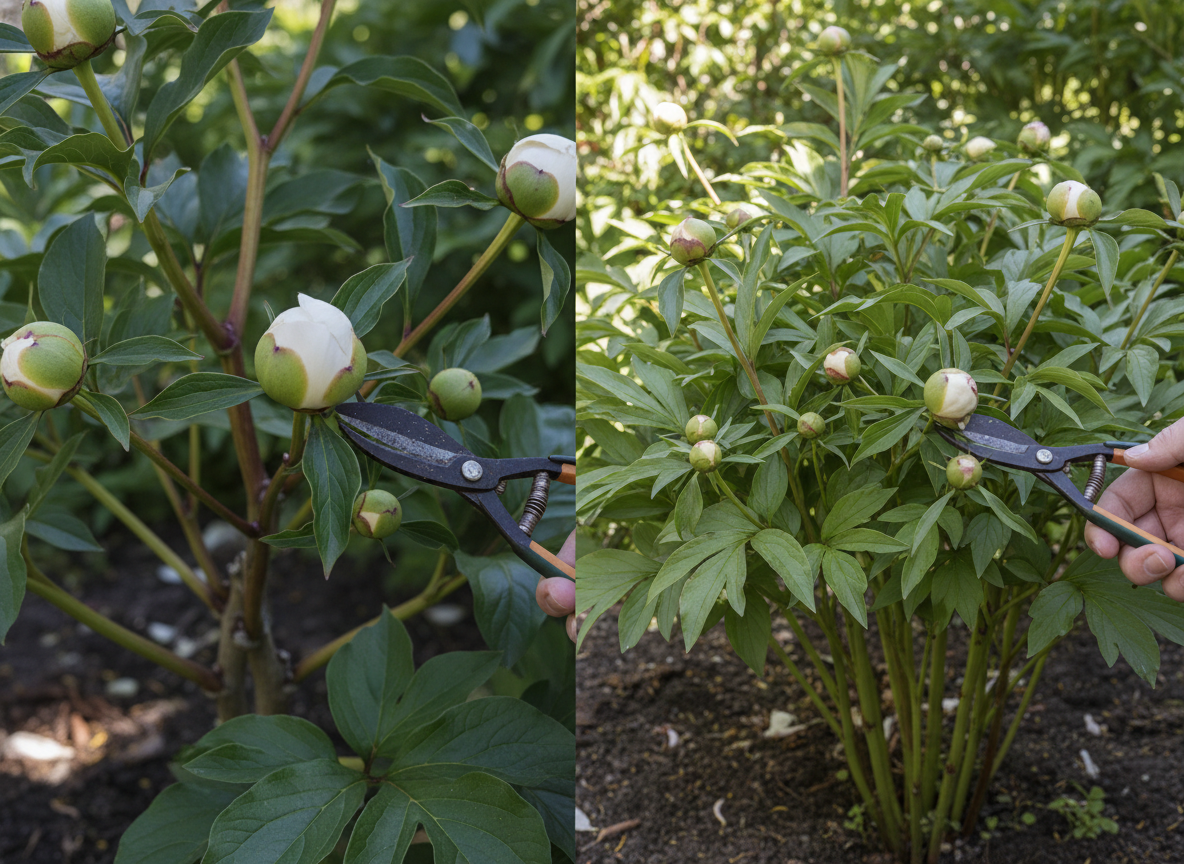 A person disbudding a tree peony and an Itoh peony — AI-generated illustration
Tree peonies and itoh peonies are different
Most of what’s been written above applies to herbaceous peonies — the Paeonia lactiflora and officinalis varieties that die back to the ground every winter. Two other groups behave differently and deserve a note.
Tree peonies (Paeonia × suffruticosa and the rockii hybrids) are woody shrubs that keep their stems through winter. They flower a fortnight earlier than herbaceous types — late April into mid-May in southern England, early to mid-May in the Netherlands — so by the time you’re disbudding herbaceous types, the tree peonies are usually already in or past flower. Disbud only if you want larger blooms on a young plant; an established tree peony’s stems are stiff enough that a clustered display sits well without flopping. Don’t cut tree peonies back hard at any point in the year; pruning is limited to removing dead wood and the very lightest shaping in late winter.
Itoh (intersectional) peonies — crosses between tree and herbaceous types, including ‘Bartzella’, ‘Cora Louise’, ‘Garden Treasure’ — flower from late May into June, a fortnight later than herbaceous varieties, and produce more buds per stem than either parent. Disbudding works on Itohs but the stems are stiffer than herbaceous peonies and rarely flop, so you can be less aggressive — leave the topmost pair of laterals on most stems and you’ll get an extended show with no significant loss of size on the terminal.
For both groups, the harvesting and after-bloom rules are the same as for herbaceous types: marshmallow stage, leave the foliage in summer, cut back only when the foliage gives up on its own.
Why this matters more in north-western Europe than anywhere else
Peonies are not a difficult plant; they’re an exacting one. They need the cold winter dormancy that the UK and Netherlands provide reliably — most of southern Europe and the warmer parts of the US south can’t grow them well because the roots never get cold enough to set buds for the following year. That makes them one of the relatively few classic ornamental groups that grow better in north-western European climates than in most of the world.
The trade-off is that the same climate produces wet springs and unstable May weather, which is exactly when the heavy buds need protection. A peony bed staked late, disbudded never, and rained on in mid-May ends up flat on the ground every season. The same bed staked in mid-April and disbudded in early May produces a fortnight of flowers that look as good as anything you’d see at Chelsea.
The investment per plant is small — four minutes of disbudding, ten minutes for a hoop, two minutes per harvest. The payoff is the difference between a peony and a peony.
How Cresco fits a peony into your year
Peonies are the kind of plant that punishes vague calendar advice. “Stake your peonies in spring” is technically correct and operationally useless, because the right week to stake depends on whether you’re in Devon or Drenthe, whether you had a warm March or a cold one, and whether the variety is herbaceous or Itoh. The same goes for disbudding, harvesting, and the after-bloom cut.
Cresco’s pruning and care scheduler reads the local weather conditions for your garden — soil temperature trends, growing degree days accumulated since 1 March, rainfall pattern over the past fortnight — and times each peony task to the actual development of your specific plants rather than to a generic month. The disbudding alert fires when the local-temperature model predicts your buds are pea-sized, not on a fixed date. The marshmallow-stage harvest reminder triggers based on the bud development model for the variety you logged when you photographed the plant.
The same applies to the hoop alert (which would have fired in mid-April if you’d registered the bed last autumn) and the autumn cutback alert (which fires after the first hard frost in your specific postcode, not on a calendar date).
The principle behind the app is the one running underneath this whole piece: generic gardening advice tells you what to do; a useful schedule tells you when your plant is ready for it.
The one-page peony checklist for early May
If you’ve read this far, here’s the version you can take into the garden now.
- Walk every herbaceous peony in the bed and look at the top of each stem
- Identify the terminal bud (largest, at the apex) and any laterals (smaller, in the axils 2–10 cm below)
- Pinch off all laterals between thumbnail and forefinger while they’re pea-sized
- For a longer display window, leave the topmost pair of laterals and remove only the lower ones
- Slip a grow-through hoop or three-cane corral over each clump if you haven’t already
- Leave the ants alone; they’re patrolling the buds for thrips
- When buds reach marshmallow stage in late May, cut early morning, strip lower leaves, hydrate in cold water
- Tap stems to dislodge ants; don’t crush
- For dry storage, wrap dry bundles in paper and refrigerate up to three weeks
- After flowering, snap off spent heads at the first leaf below the bloom
- Leave the foliage intact until October frost knocks it down
- Burn or bin the cut foliage; never compost peony leaves
Get the disbudding right in the first week of May and the same plant that gave you medium flowers last year gives you cathedral-sized blooms this year. Get the staking right in mid-April next year and you won’t even need to disbud as aggressively, because the structure holds the heavier load.
The difference between a peony and a peony is about ten minutes of work per plant, performed in the right week. This week.