The plant that asks you to throw away its first crop
Walk into any garden centre in Belgium, the Netherlands or southern England this week and the strawberry table looks the same: 9 cm pots and small trays of plugs, foliage already up, two or three open white flowers per plant, the stub of a runner pushing sideways out of the crown. The label says Fragaria × ananassa ‘Elsanta’ or ‘Cambridge Favourite’ or ‘Malwina’, and the plant looks like it wants to start fruiting tomorrow.
Almost every gardener who takes one of those plugs home will plant it, water it, watch the flowers turn into small green berries over the next month, and consider that a successful first season. They’ll pick maybe a punnet’s worth of fruit per plant in late June. They’ll go into next spring expecting a bigger crop and get one that’s only slightly bigger, sometimes smaller. By year three they’ll be wondering why their bed has fewer berries than the one a neighbour put in twelve months later.
The gap between those gardeners and the ones whose first-year plugs become a bumper crop the following June isn’t soil, fertiliser, or variety. It’s a single decision that gets made in the second and third weeks of May, in the planting year. The decision is to pinch off every flower the plant produces in its first season — including the open white flowers it came home with — and to cut every runner the crown sends out, as soon as you can see it. You sacrifice the entire first-year crop on purpose, and the plant rewards you with a root system, crown size and number of fruiting trusses next May that the unpinched neighbour will never catch up to.
It’s the kind of advice that feels wrong twice: once when you do it (you’re cutting flowers off a plant you just paid for), and once when you tell someone else about it (every fibre of common sense says fewer flowers means less fruit). The data, the university extension trials, and the working practice of every commercial strawberry grower in temperate Europe say the opposite. First-year flower removal is the single biggest yield lever in a domestic strawberry bed, and the window to use it closes at the end of May.
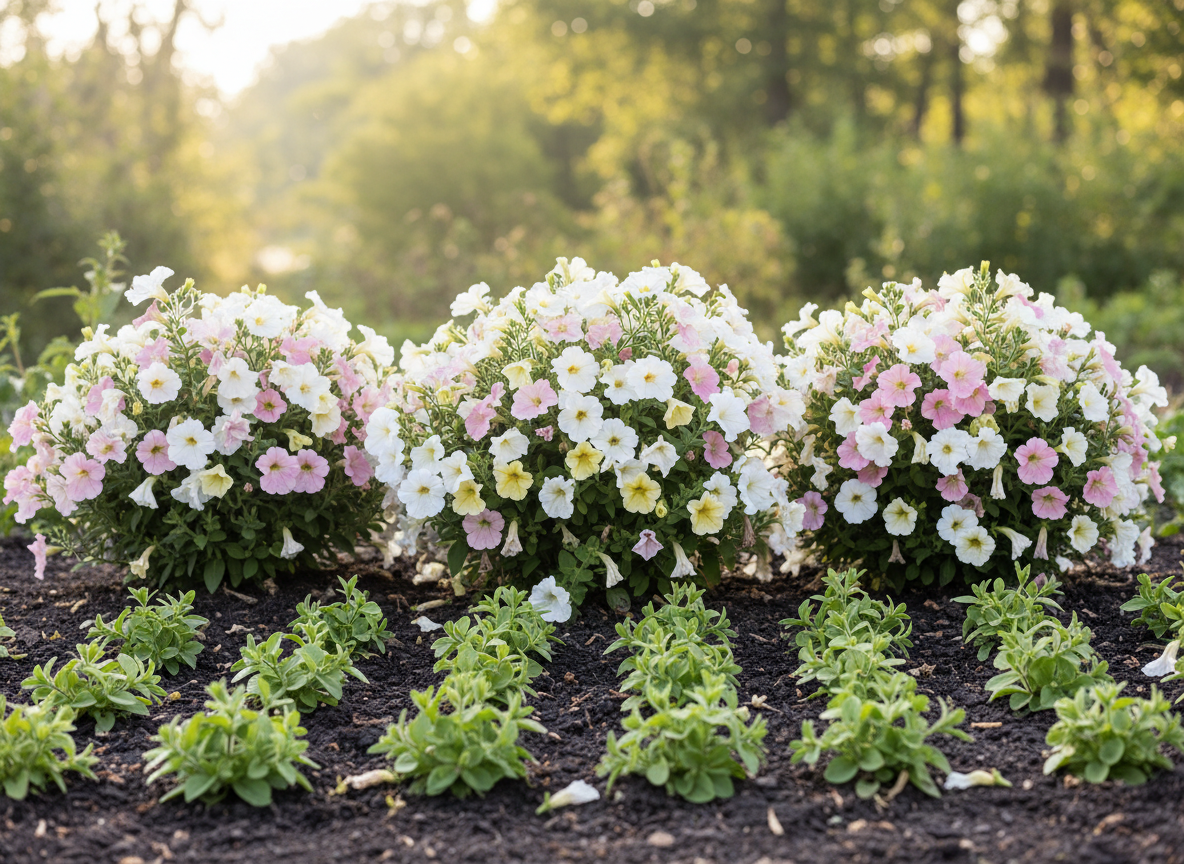 AI-generated illustration
Why pinching every flower this year triples next year
A strawberry plant in its planting year is doing two things at once with a finite carbon budget. It’s trying to flower and fruit, because that’s the program it inherits. And it’s trying to build the root system, the crown, and the leaf canopy that will determine its ceiling for every year that follows. Those two goals compete directly. Carbon spent on a developing fruit is carbon not spent on a third-order root or a new crown initial.
In a healthy second-year June-bearing plant, the trade-off doesn’t matter much — the root system is already deep, the crown is fat, and there’s enough photosynthetic surface to fund a heavy fruit set without robbing next year’s structure. In a first-year plug, it matters enormously. The plant arrives with a small crown, a shallow ring of fibrous roots that have been confined to a 9 cm pot, and barely enough leaf area to support its own respiration in full sun. Every flower it sets and every fruit it ripens this May and June comes out of the same energy pool that’s supposed to be drilling roots down to 30 cm and laying down the next ring of crown tissue.
Nourse Farms, the largest strawberry nursery in North America, sells the rule as “Pick flowers, not fruit” — the only year you should ever pick flowers off a strawberry plant is its first year, and you should pick all of them. The University of Connecticut extension service says it more plainly still: “all flower buds should be pinched off the first growing year.” The University of Minnesota’s home-garden guide and the RHS edible-fruit pages give the same advice in slightly softer language. The practical question isn’t whether to do it. It’s whether you do it once, walk past, and forget — or whether you do it every week for six weeks until the plant gives up trying.
The yield numbers are striking. A first-year plant allowed to fruit produces, on average, a small handful of berries in its planting summer and roughly the same again the following June — the energy debt carries over. A first-year plant kept blossom-free for the whole planting season produces nothing the first summer and, in trials reported across temperate Europe and the northern US, between two and three times the second-summer crop of its unpinched neighbour. The plant that “wasted” a season is the plant whose roots, by autumn, have reached the depth that lets it fund a 25-truss crown the following May.
How to read your strawberry bed in the second week of May
Before you do anything, kneel down at the edge of your bed and read what’s actually there. The right action this week depends entirely on which of three situations you’re in, and the difference matters.
The first-year bed (planted this spring or last autumn). Plants are small, often still showing the original plug shape. Crowns are thin — pencil-width or less. There may be open flowers, small green berries, and the first thin runner stubs starting to push out sideways. This is the bed where the pinching rule applies in full. Every flower comes off. Every runner gets cut at the base of the crown. The plant gets the whole season to build, not to fruit.
The second-year bed (planted spring 2025 or autumn 2024). Crowns are visibly fatter — finger-thick at the base, surrounded by a low ring of dark-green leaves. Multiple flower trusses are open or coming up. There may already be small green berries. This bed should not be pinched. This is the season the plant has been preparing for; let it crop. The runner question is more nuanced — see the next section.
The third-year-plus bed (older than that, or never replanted). Crowns are broad and woody. Some plants will have multiple competing crowns rising from one base. Flowers are present but often clustered on shorter, weaker trusses. Berry size is starting to drop compared with year two. This bed is on a different timeline. You’re now managing a slow renewal, and the May question is whether to selectively let runners root in to replace tired mother plants — or whether to dig the whole bed up after fruiting and start again with new plugs in autumn.
A five-minute walk along the bed with a hand fork and a mental note of which third you’re in tells you whether to pinch, to leave, or to plan a renewal. Doing the wrong action for your bed’s stage costs you more next summer than doing nothing at all.
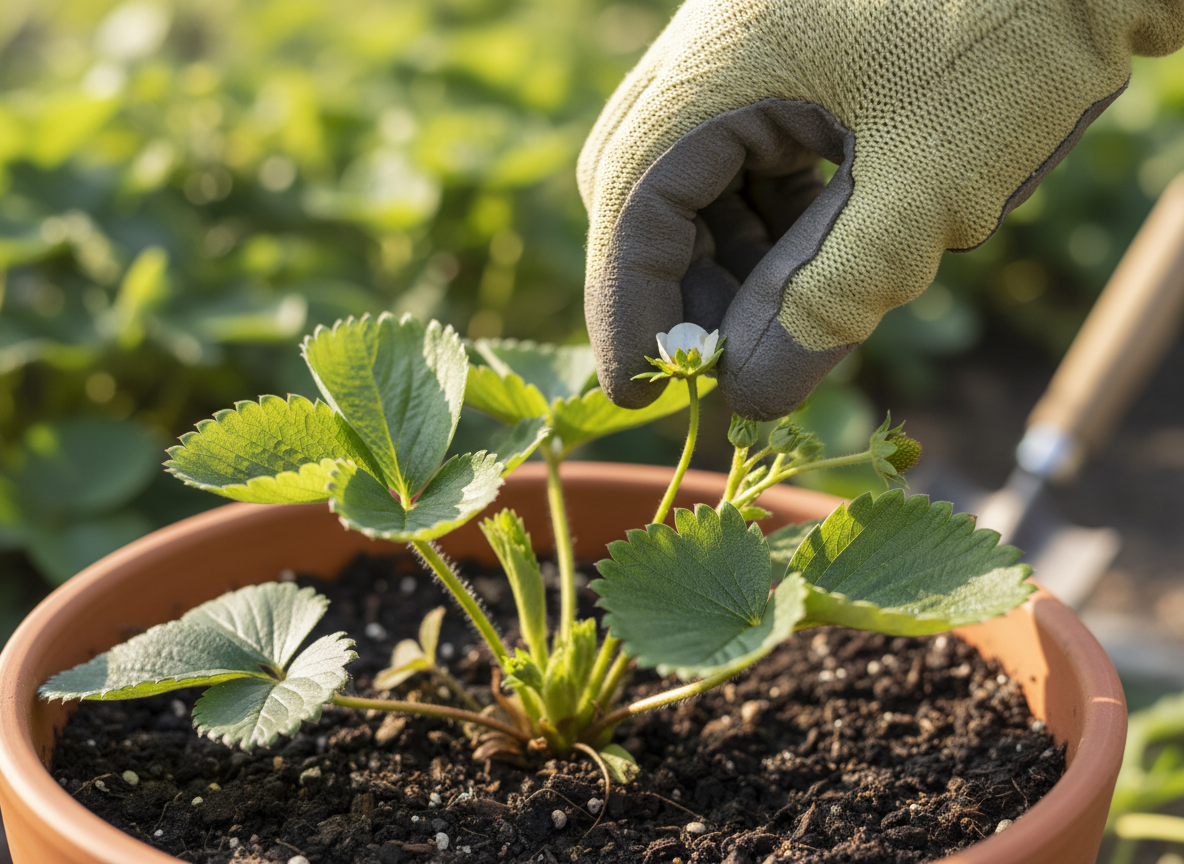 A gloved hand pinches a small white strawberry flower from a potted plant — AI-generated illustration
How to pinch a strawberry flower without damaging the crown
The pinch itself takes about two seconds per truss and is the small craft skill that separates a bed where the rule works from a bed where it half-works.
A strawberry flower truss rises on a thin green peduncle from the centre of the crown, branches once or twice, and carries between three and seven white flowers in a loose cluster. You don’t want to remove individual flowers — you want to remove the whole truss as close to the crown as you can reach without snapping a leaf petiole.
The right method is a fingernail pinch, not a cut:
- Trace the truss back to its origin. Follow the stem with a fingertip down through the leaves until you feel where it joins the crown — usually a small swelling 1 to 2 cm above the woody base.
- Pinch with thumbnail and forefinger in a sideways squeeze-and-twist. The peduncle is hollow and snaps cleanly under nail pressure if you hit the right spot. If it resists, you’re too low — move up a few millimetres and try again.
- Don’t pull. Pulling lifts the whole crown out of the soil and tears the crown’s surface, opening a wound that any of the soil-borne Phytophthora and Verticillium species in a normal Belgian or Dutch garden are happy to enter.
- Don’t cut with secateurs unless you’ve cleaned them. Strawberry crown rot moves between plants on dirty blades faster than almost any other garden disease. If you’re going to use a tool, dip it in a 70% isopropyl wipe between every plant.
Drop the pinched trusses into a small bowl and add them to the compost (they’re harmless if the plants are healthy). Pinch every plant in the first-year bed today, then walk the bed again next Sunday — and the Sunday after that, and the one after that. Strawberries push new trusses for roughly six weeks, and a single missed truss gives the plant permission to spend a fortnight’s worth of carbon on a fruit that doesn’t matter.
Runners: the fortnight rule, and the one exception
The runner — that long, thin red-tinged stolon snaking out sideways from the crown with a baby plant on the end — is the strawberry’s other big spring decision. It’s also where most of the conflicting advice on the internet comes from, because the right answer changes with the bed’s age.
For a first-year bed in May, the answer is the same as for flowers: cut every runner the day you see it. The same carbon budget that gets robbed by an unwanted fruit gets robbed harder by an unwanted daughter plant, because the mother plant funds the daughter’s roots and leaves until the daughter is independent — and an “independent” daughter is still pulling water and minerals back through the stolon for weeks. MDPI’s runner-removal trial on ‘Favori’ strawberries reported that bi-weekly runner removal increased total and marketable yield and the size of fruit on mother plants. In a first-year bed, the goal is to maximise mother-plant size; cut every runner at the base of the crown with a clean snip the moment the stolon hardens enough to grip.
The fortnight rule for first-year beds: walk the bed every two weeks from the second week of May to the end of August, and cut anything pencil-length or longer at the crown.
The exception — the bed where you actually want runners — is the third-year-plus patch you’ve decided to renew. From late June onwards, after the main fruit crop is in, you let the strongest two or three runners on each tired mother plant root down into the soil at the front of the bed, and you peg them into place with a piece of bent wire or a small stone. By September those daughters have rooted independently. In October you sever the umbilical stolons, dig out the old mothers, and you’ve effectively replanted the bed for free with selected genetic copies of the plants that performed best on your soil. That’s the one situation where every gardening guide that says “let your runners root” is right — and it’s the one situation a first-year gardener almost never finds themselves in this May.
The mistake to avoid: letting runners root in a first-year or second-year bed because the plants “look like they want to spread.” They do, because that’s their reproductive strategy, but you’re paying for it in next year’s crown size and fruit count. Cut now; let runners run only in renewal year.
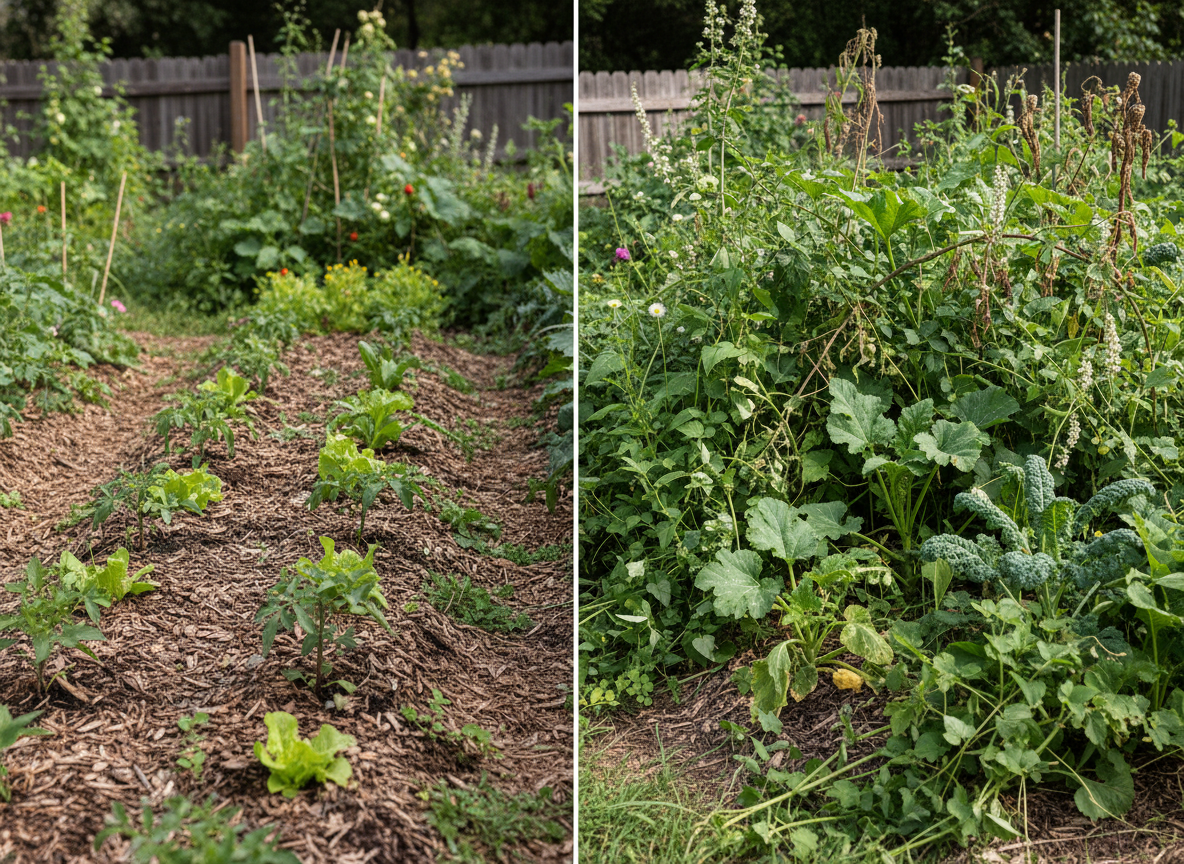 Two garden beds, one sparse with young plants and another overgrown — AI-generated illustration
Why second-year beds are a different problem this week
If you planted last spring or last autumn, your bed is in the year it’s been preparing for, and the May rule flips. Don’t pinch flowers. Don’t be tempted to “give the plants one more year to bulk up” — that’s an old myth that costs you the fruit you’ve been waiting twelve months for.
What you do want to do this week, around 9–15 May in a normal Northern European year:
- Get straw or a strawberry mat under each crown before the first berries swell and touch the soil. A swollen berry on bare wet soil is a slug magnet and a Botrytis (grey mould) entry point. Straw is traditional for a reason — it’s dry, it lifts the fruit clear, and it doesn’t transmit soil pathogens.
- Net the bed against blackbirds before the first berries blush pink, not after. Birds learn fast; the first ripe strawberry a bird tastes from your bed is the start of a six-week habit. A 20 mm mesh on a low frame is enough; horticultural fleece is not — birds tear through it.
- Thin the truss only if you have a variety prone to runt berries. Most modern garden cultivars don’t need this, but if you grow a heritage variety like ‘Royal Sovereign’ or a maincrop ‘Cambridge Favourite’ with a habit of setting eight or nine flowers per truss, pinch out the smallest two flowers in each truss now. The remaining berries grow noticeably bigger and ripen a few days earlier.
- Don’t feed with high-nitrogen fertiliser. A May nitrogen hit pushes leafy growth at exactly the wrong time and softens the berry skins, making them more Botrytis-prone. A potassium-heavy tomato feed every fortnight from now until the end of fruiting is what the plants actually want.
That’s the second-year list. It looks nothing like the first-year list, and applying the wrong list to the wrong bed is the most common single mistake a domestic strawberry grower makes in May.
Five mistakes that quietly halve next summer
- Letting first-year plugs flower because “the flowers came with the plant.” They did, and they’re still robbing the plant. Pinch every truss as close to the crown as your fingernail will go — including the open flowers in the pot when you bought it.
- Letting first-year runners root in. A first-year mother that supports two daughters is a mother plant whose own crown will be a third smaller next May. Snip every stolon at the crown for the entire planting season.
- Pulling instead of pinching. A pull lifts the whole crown out of the soil and tears the surface, and strawberry crown rot enters through tears. Use a fingernail squeeze-and-twist, or sterilised secateurs.
- Mulching with garden compost or fresh manure in May. Compost holds water against the crown and pushes leafy nitrogen growth; manure can carry Verticillium. A clean straw or a black plastic mat is the right mulch for a fruiting bed; save compost for the autumn top-dress.
- Replanting next year’s bed in the same patch as this year’s worn-out one. Strawberries are prone to soil-borne disease build-up, especially Verticillium and Phytophthora, after three years in one place. Move the new bed at least 1 m sideways, ideally into ground that hasn’t grown strawberries, tomatoes or potatoes in the last three years.
What Cresco does with the May reading
Strawberry beds are a plant where the right answer in your garden depends on three things a generic guide can’t see: which year your bed is actually in (the rule flips between year one and year two), whether you’re growing a June-bearer or a perpetual (the perpetual rule is closer to “pinch only the first flush, then let crop”), and whether your last fortnight’s weather has been the warm-dry kind that pushes flower trusses or the cool-wet kind that pushes runners and Botrytis.
That’s the reading Cresco gives you when you snap a photo of your bed in flower: the app identifies the cultivar, looks up your local soil-temperature and rainfall curve, and tells you whether you’re in the first-year pinching window, the second-year fruiting protection window, or the third-year renewal-planning window. For a plant that punishes the wrong action and rewards the right one this dramatically, knowing which window you’re in is more useful than any generic May checklist — and it’s the kind of plant-care decision that’s a long way from what a pure identification app can give you.
If you want a single rule to walk away with: in the second and third weeks of May, kneel down by your strawberry bed and decide which year it’s in before you decide what to do. The first-year bed wants every flower and every runner gone. The second-year bed wants a straw mat, a net, and to be left to fruit. Get those two right and the third-year decision is much easier when it comes.
Sources & further reading: