The seedlings the saints didn’t kill
Mamertus, Pancras and Servatius have just passed. Boniface is tonight, Cold Sophie tomorrow. By Friday morning the calendar version of the rule is over, and the back step of every gardener in northern Europe is going to look the same: a stack of seed trays, half-grown tomatoes leaning against a window, dahlia tubers shooting in pots, a tray of basil that’s been waiting for a month. The instinct after Ice Saints is to plant out. The conventional advice is to harden off first. Both are right, both are too vague, and the way most guides describe hardening off — seven to ten days, increasing time outdoors gradually — is the reason a third of those seedlings collapse in the first 48 hours after they hit open ground.
The mistake isn’t the duration. It’s the variable. Almost every hardening-off guide treats temperature as the thing the plant is acclimatising to. It isn’t. The plant has been sitting at 18 to 22°C indoors and is going outside into 12 to 16°C daytime air — that gradient is real, but it’s not what kills the seedling. What kills the seedling is wind, and the unhardened wax cuticle on the underside of every leaf, and a stomatal response system that has spent its entire life in the still, humid air of a windowsill. The first hour outside on a breezy May afternoon can take more water out of an unhardened tomato than its roots can pull in for the rest of the day. By sundown the leaves are silvered, by the next morning they’re crisped at the edges, and three days later you’re wondering why a plant that survived a frost-free week is dying in 14°C weather.
This is the part the textbook seven-day schedule doesn’t capture, because it’s not really a schedule problem — it’s a sequencing problem. Get the first six hours right, and a five-day hardening period works fine. Get the first six hours wrong, and ten days of “increasing exposure” won’t save the plant.
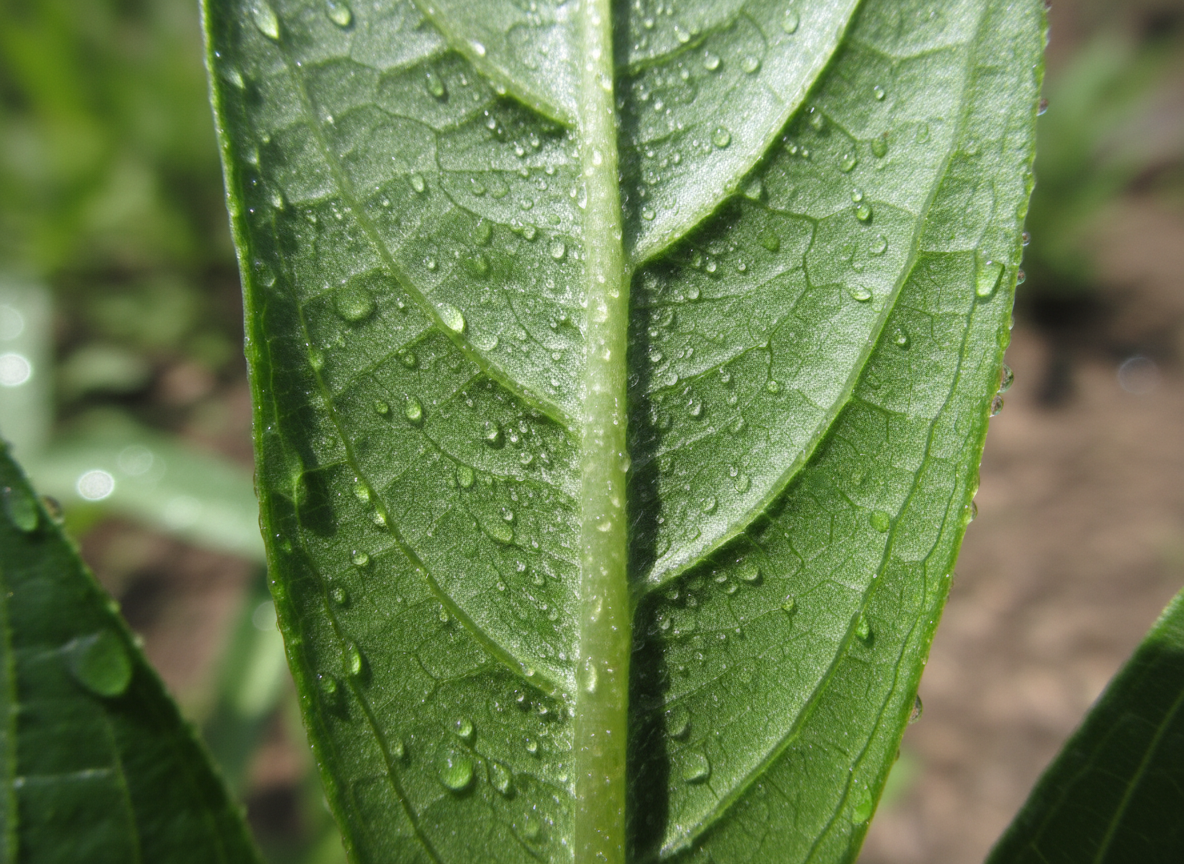 A close-up shot of a green leaf with water droplets on its surface — AI-generated illustration
What’s actually happening to the leaf
A leaf grown indoors under glass or under an LED panel is a different organ from a leaf grown outdoors. It’s thinner, it has fewer palisade cell layers, the chloroplasts are positioned for low light, and — the part that matters most this week — its waxy cuticle is roughly half the thickness of an outdoor leaf’s. The cuticle is the lipid layer on the leaf surface that prevents water loss when the stomata are open. Indoors, with humidity in the 50 to 70 percent range and air movement near zero, the plant doesn’t need much cuticle. It hasn’t built much. The leaves you can see in your tray right now are, structurally, leaves that were optimised for an environment that doesn’t exist outside your back door.
The second thing that’s underdeveloped indoors is the stomatal response. Stomata — the pores on the underside of the leaf — open and close in response to light, CO₂ and humidity. In the moving air of an outdoor environment, they snap shut quickly when the air dries out, because losing too much water too fast is fatal. In the still air of a windowsill, that response gets lazy. The stomata stay open longer than they should. Take that plant outside into a 15 km/h breeze and the stomata don’t close fast enough, the cuticle is too thin to compensate, and water flashes out of the leaf faster than the root can replace it. This is the desiccation crash. It can happen at any temperature. It will happen on a 16°C, sunny, breezy afternoon faster than on a 5°C, still, overcast morning.
The third thing — the part nobody mentions — is thigmomorphogenesis. That’s the response of plant tissue to mechanical stress, mostly wind and touch. A stem that has never been flexed has thinner cell walls, less lignin, and a much lower bending strength than a stem that’s been moving in the breeze since it germinated. A windowsill seedling that suddenly stands in a stiff breeze on day one of hardening off doesn’t fall over because the wind is strong — it falls over because the stem was never built for any wind at all. The good news is that thigmomorphogenesis is fast. A few hours a day of gentle movement starts thickening the stem within 24 to 48 hours. The bad news is that it’s an adaptive response, which means the plant has to be alive at the end of day one to start adapting on day two.
So when you read “harden off over seven to ten days, gradually increasing exposure,” what the plant is actually doing during that period is three things in parallel: laying down extra cuticle wax, recalibrating stomatal response time, and stiffening its stem against mechanical load. None of those processes are really about temperature. The reason the schedule works is that putting the plant outside reliably exposes it to all three stresses at once. The reason it fails — when it fails — is almost always wind.
The first six hours decide everything
If you remember nothing else from this post: the first morning out is the one that matters. Get the conditions wrong on day one and the plant spends the next four days recovering from cuticle damage instead of building the new cuticle it needs. Get them right and you’ve already done sixty percent of the work.
What “right” looks like for the first session:
- An overcast morning, not a sunny one. Bright direct sun on a tray of indoor seedlings is the second-worst stressor after wind. UV damage to thin cuticle shows up within hours as silvery patches on the upper leaf surface, and once the leaf is silvered it never makes useful sugar again — the plant has to push out new leaves to replace it. Pick the cloudiest morning of the week for session one. If every morning this week is sunny, set the tray in shade for the first session and only move it into filtered light on day two.
- Wind under 10 km/h, ideally under 5 km/h. Check the actual wind forecast at your postcode for the four hours you’re planning to leave the tray out. Buienradar, the Met Office app and Apple Weather all give you this. A gusty afternoon forecast means wait or use shelter (more on that below). The threshold is not “is it windy enough to feel” — by the time you can feel it on your face, it’s already too much for an unhardened tomato leaf.
- Air temperature 12 to 18°C. This is not the critical variable, but it’s worth respecting on day one because a cold-stressed plant has fewer carbohydrate reserves to spend on building cuticle. Below 10°C, photosynthesis slows enough that the plant’s recovery from any other stress slows with it.
- Two hours, not four. The classic schedule says “one hour on day one, two on day two.” That works in still, mild weather. In any breeze at all, an hour is enough to start the cuticle response without overshooting into damage. Four hours on day one is where most failures happen, because the gardener thinks “I’ll just leave it while I’m at work” and the wind picks up at midday.
- In the afternoon, not the morning. Counterintuitive but worth doing: if the morning was bright and the afternoon clouds over, do the first session in the afternoon. The plant has already done its main photosynthesis under glass; the outdoor session is just for stress acclimation, not for growth.
The two things that will undo a perfect first session are: leaving the tray out into the evening, when humidity drops and dew forms on cold leaves; and forgetting to water before the session, because a slightly water-stressed plant has stomata already half-closed and reads the wind exposure as catastrophic. Water the tray an hour before you take it out. The roots should be wet when the wind hits the leaves.
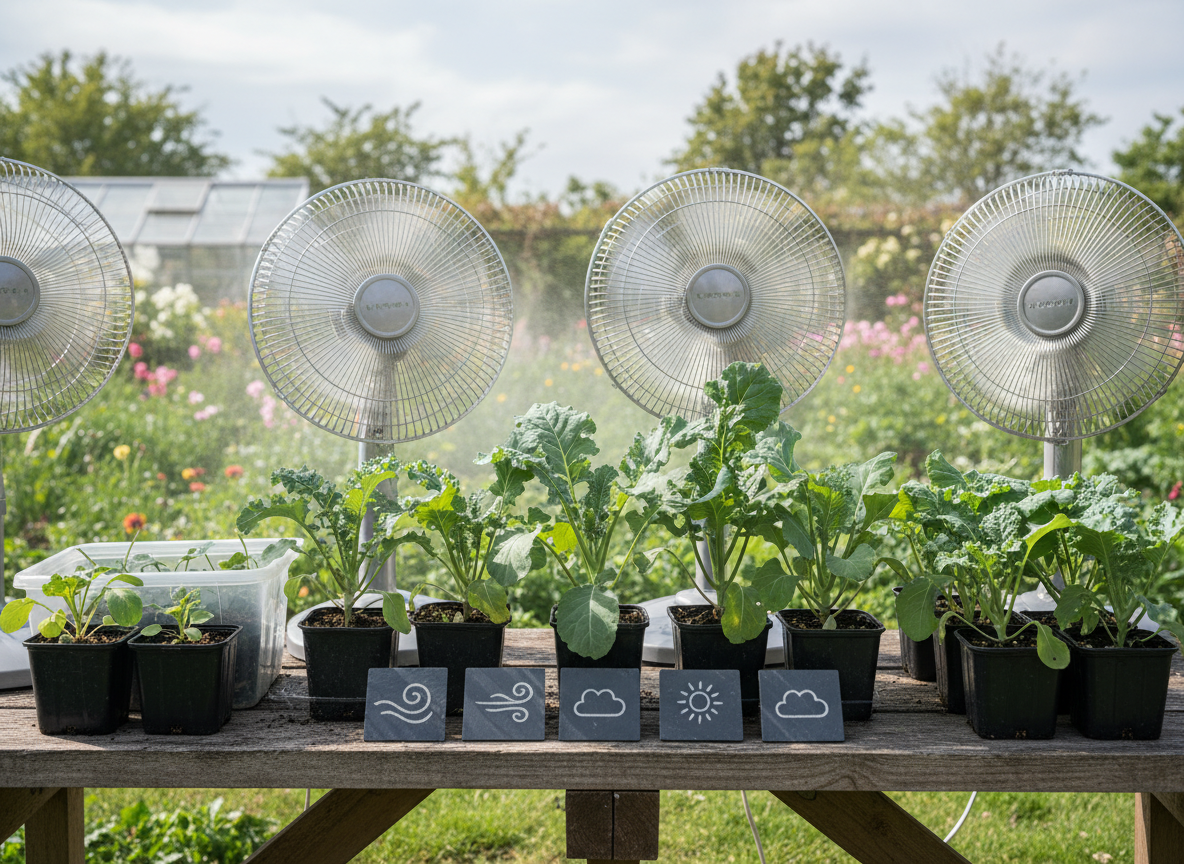 Various plants in pots are on a wooden table with several fans behind them — AI-generated illustration
A wind-first five-day schedule
This is the schedule that’s worked for me across hundreds of trays over the past six seasons. It assumes you’re starting on a Wednesday or Thursday, with the aim of planting out on the following Monday or Tuesday — i.e. you’re working with the week immediately after Ice Saints. Adjust the days, but keep the order.
Day 1 (afternoon, 2 hours). Overcast or in deep shade, sheltered from wind by a wall, fence or cardboard collar. Water the tray an hour before. Check the leaf surface when you bring it back in: if it feels normal and looks unstressed, you’re on schedule. If the upper leaf surface has any matte silvery cast at all, day two waits 24 extra hours.
Day 2 (morning, 3 hours). Same shelter, same shade or filtered light. Add a slight breeze if you can — a small open window above the tray, or a position where it gets occasional gusts but no constant wind. This is where thigmomorphogenesis starts working for you: a few minutes of leaf movement per hour is more useful than a constant flow.
Day 3 (morning to early afternoon, 5 hours). Move into dappled light, still wind-sheltered. By the end of this session the cuticle response should be well underway — you’ll feel the leaves being slightly waxier to the touch than they were on day one. That’s the new cuticle laying down.
Day 4 (most of the day, 8 hours). Out in the morning, into direct sun for an hour or two around midday, partial shelter from wind but no longer fully behind a wall. Bring in before evening if the night forecast is below 8°C.
Day 5 (full day plus first night out). Full sun, full wind, in the spot where it’ll eventually be planted. If the night forecast is above 8°C with no clear-sky frost risk (use the dew point check from the Ice Saints post — dew point above 4°C is your safety margin), leave the tray out overnight. If it’s not, bring it in one more night.
Day 6: plant out. Ideally in the morning of an overcast day with light wind, with the soil already watered the night before. Water the planting hole, not the surface, so the roots have a moist target to grow into.
This compresses the textbook ten-day schedule into five days because the bottleneck isn’t time, it’s the sequence of stressors. Wind first, then sun, then temperature swings, then the night out. Most ten-day schedules waste days two through five repeating “a bit more time outside” without changing the variable.
The shelter trick: cardboard, cold frames, north walls
There’s a tool every guide leaves out, which is the single most useful thing in your shed for this week: a piece of cardboard about 60 cm tall, folded into an L-shape and stood next to the tray. It cuts wind by roughly 80 percent without blocking light. You can move it as the tray progresses through the schedule — full L-shield on day one, just a back panel on day three, gone by day five. A cold frame does the same job but is fixed in one spot and overheats quickly on a sunny May afternoon (lift the lid the moment the sun hits it; an unvented cold frame can climb to 38°C in twenty minutes and cook everything inside).
A north-facing wall is the second-best shelter. Wind speed at one metre from a wall, on the leeward side, is typically a third of the wind speed in open ground. Place the tray on a slatted bench or upturned crate — directly on stone or concrete is too cold and the soil temperature in the pot drags downward overnight.
The single worst place to harden off is on a south-facing patio in front of a glass wall. The reflected light is brutal, the wall radiates heat that desiccates the tray, and the wind funnels along the wall line. People do it because it’s where the patio furniture is. Move the tray.
Reading the seedling for stress
The plant tells you when you’ve gone too fast. Learn to read three signals.
Silvering on the upper leaf surface. UV damage to thin cuticle. Once it’s there it doesn’t reverse — the leaf will stay silvered and lose photosynthetic capacity. Action: pull the tray back to deep shade for 24 to 48 hours, water, and resume the schedule from one step earlier. Severely silvered leaves will be shed within a week and replaced; don’t pinch them off, the plant will use them as carbon storage until the new leaves catch up.
Purpling along leaf veins or stems. Cold-stressed phosphorus uptake. Common on tomatoes and peppers when night temperatures are bouncing between 6°C and 18°C. Not fatal but it stalls growth. Action: bring in for warmer nights for two more days, then resume.
Leaf-edge curl, especially upward. Water loss faster than uptake. The plant is closing its leaf surface area to limit transpiration. Action: water immediately, move to shelter, leave for 12 to 24 hours. If the curl persists after watering, the root system has been damaged by cold soil — repot into a 2°C-warmer growing medium if you have it, otherwise just keep indoors for two more days.
Leaning, weak stems three days in. This is the opposite of a problem — it’s the plant telling you it’s adapting. The stem cells are deconstructing old structural tissue and laying down stronger lignified walls. The plant will look temporarily floppy on day three or four and then firm up by day five. Don’t stake. The flop is the response. Staking it now means the stem never builds the strength it needs.
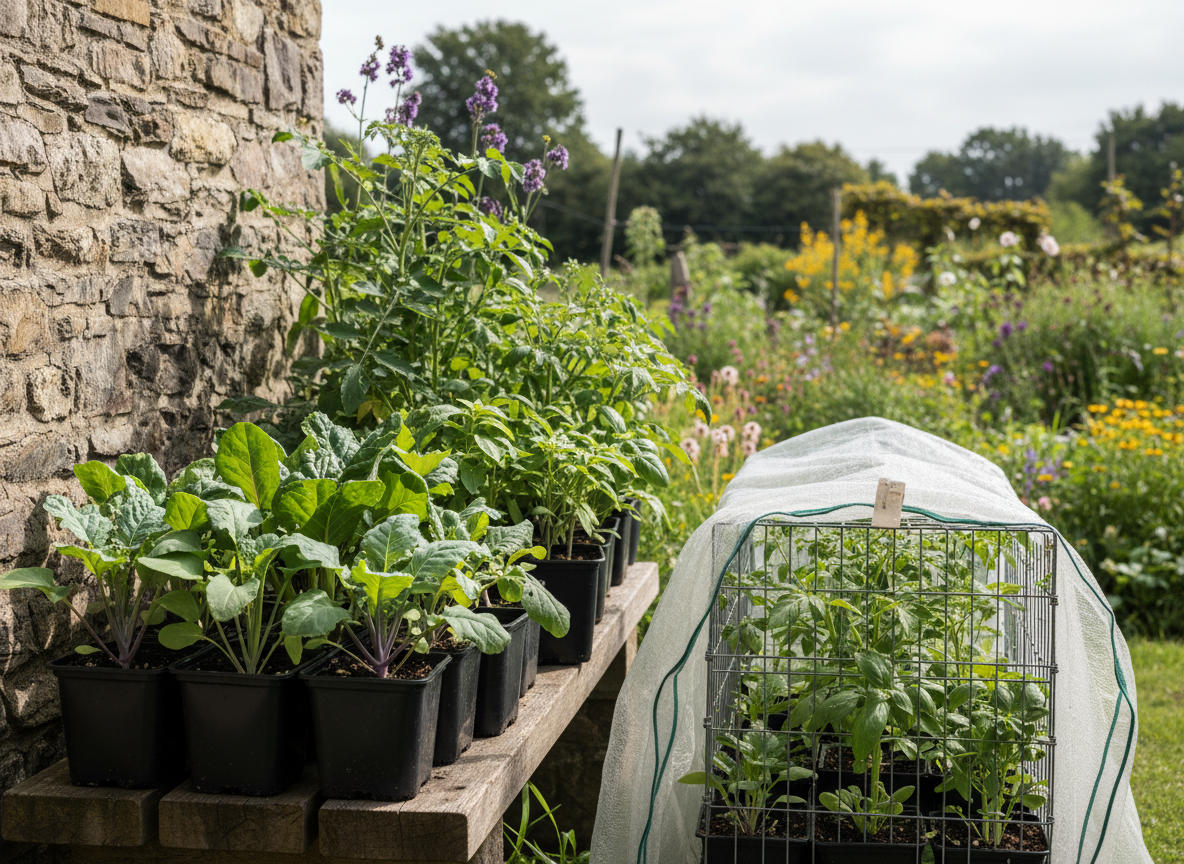 Various plants sit in pots on a wooden bench and under a netted cover — AI-generated illustration
When to skip hardening off (and when to extend it)
Not every plant in your tray needs the full five days. The rules:
Skip or shorten to two days: Anything that’s been raised in an unheated polytunnel or cold greenhouse with the door open during April. Those plants have already done most of the cuticle work. Two short outdoor sessions on consecutive days is enough.
Skip entirely: Most brassicas (cabbage, kale, sprouts) raised under cool conditions. They’re as hardy as the air they came from. Direct planting in the bed with a fleece collar for two nights is fine.
Standard five days: Tomatoes, courgettes, French beans, dahlias, cosmos, zinnias, marigolds. Anything raised on a windowsill or under lights at 18 to 22°C.
Extend to seven to ten days: Basil, peppers, aubergines, melons, cucumbers, ipomoea (morning glory). Anything that’s genuinely sub-tropical and that wants soil warmer than your borders are likely to be even by Friday. For these, layer the wind-first schedule above onto a longer timeline, and do not plant out until soil at 10 cm depth is stable above 14°C for three consecutive mornings — see the Ice Saints soil-temperature post for why this matters.
Extend to fourteen days: Anything you’ve raised under high-pressure sodium or LED panels with no air movement at all. Those plants have the thinnest cuticles of any seedling category, and the stomatal response is the most untrained. Start with a shorter day-one session — 45 minutes in deep shelter — and build slowly.
The day-three wilt after planting
Even if you’ve done everything right, expect a wilt on day three after you plant out. Not day one, not day two — day three.
Day one the plant has stored water from its last indoor watering. Day two the roots are still drawing on whatever soil moisture was around the root ball. Day three the original root ball has dried out and the new roots haven’t yet pushed into the surrounding soil. The plant droops, sometimes badly, in the early afternoon. Almost every gardener panics here and over-waters, which floods the new root zone, kills the fine root hairs that were about to extend outward, and starts a fortnight-long recovery.
The right response on day-three wilt: water deeply once, in the evening, around the plant but not on the stem. Then leave it alone for 48 hours. The wilt is the plant signalling “I need to grow roots,” and root growth is triggered by mild water stress, not by abundance. By day five the new roots have found the moisture in the surrounding soil and the wilt is gone.
This is also why a planting-hole watering — water in the hole before you set the plant — beats a surface watering after planting. The roots grow downward toward the moist patch instead of upward toward the dry surface.
Where Cresco fits in
The reason I built Cresco is exactly this kind of decision: not the calendar version of “when to harden off,” but the postcode-and-weather version of “given your forecast for the next five days, when does session one start, and when do you plant out?” If you snap a photo of your tray in the app, Cresco identifies the species, checks your local five-day forecast for wind, soil temperature trend and dew point, and tells you the actual window — not a generic schedule. The wind-first protocol above is built into how the app sequences advice for tender annuals after Ice Saints week.
If your trays have been sitting on the back step waiting for Cold Sophie to leave, the next 48 hours is when the work starts. Pick the calmest, cloudiest two hours you can find, water everything an hour before, and put session one in the bag. Five days from now you’ll be planting into warm soil with stems that bend in the wind instead of snapping.
The saints brought you here. The wind decides what happens next.