Pinching is pruning, just smaller
There is a hormone called auxin produced at the very tip of every growing shoot. While that tip is intact, auxin travels down the stem and tells every dormant bud below it to stay dormant. The plant’s energy goes up, into making the leader taller. This is called apical dominance, and it’s why an unpinched sweet pea grows into a single thin string with a few flowers at the top, an unpinched dahlia stretches into one tall stem that snaps in the first thunderstorm, and an unpinched cordon tomato turns into a five-foot pole with three trusses.
Remove the tip — that’s all pinching is — and the auxin signal stops within hours. The Frontiers in Plant Science group documented bud outgrowth detectable in pea seedlings four hours after decapitation. Lateral buds that were chemically suppressed start to swell, then break, then grow into shoots. Each of those new shoots ends in its own flower, its own truss, its own harvest unit. One stem becomes four. Four becomes a dozen. The plant gets wider rather than taller, sturdier rather than floppier, more productive in every direction.
This is a real prune, not a nice-to-have. It’s just the smallest one in the gardening year — done with a thumbnail, on tissue softer than a lettuce leaf — and the window for the three plants below is right now, the first two weeks of May.
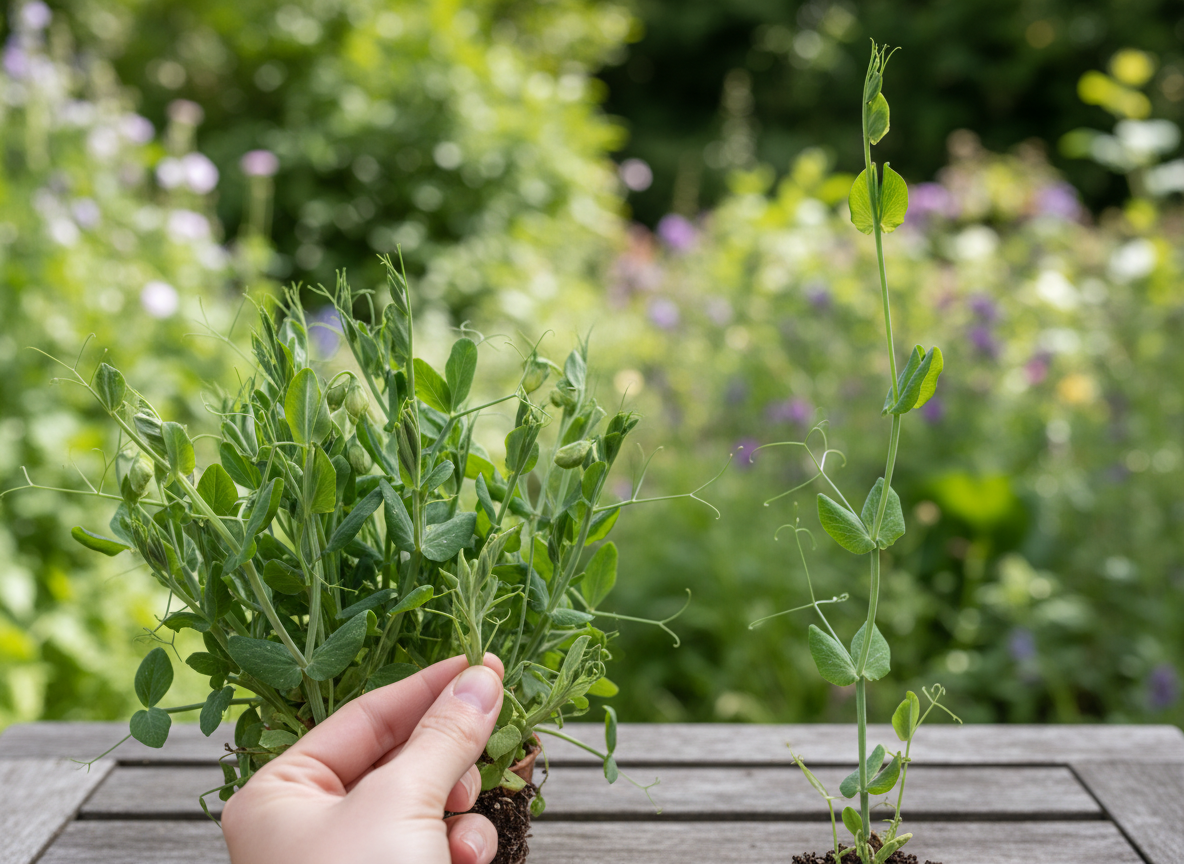 AI-generated illustration
Sweet peas: pinch at 10cm or accept a thin, single-stemmed plant
Sweet peas (Lathyrus odoratus) are the textbook example, and the reason the RHS keeps repeating the advice is that every spring a fresh wave of growers skips it and ends up wondering why their plants flower for three weeks instead of three months.
The rule is simple. Once your seedling has reached roughly 10cm and has produced three or four pairs of true leaves, pinch out the very top — the soft growing point and the smallest pair of leaves below it — between thumbnail and forefinger. You’re removing maybe 1cm of tissue. It feels brutal because the plant looks healthy and is putting on visible growth every day. Do it anyway.
Within a week you’ll see two, sometimes three, side shoots break from the leaf axils below the cut. Each of those becomes a flowering stem. Each one grows long, thick and full-flowered in a way the original leader was never going to manage. By June the plant is a column of bloom rather than a vertical line of disappointment.
Two timing mistakes to avoid. First, pinching too early — at 4 or 5cm, before the plant has the leaf area to recover quickly — slows the whole thing down by a fortnight. Second, pinching too late, when the plant is already 30cm and committed to its single leader, just removes flower-bearing growth without producing the wake-up effect. Sweet peas have a one-shot pinch. Get it in early May.
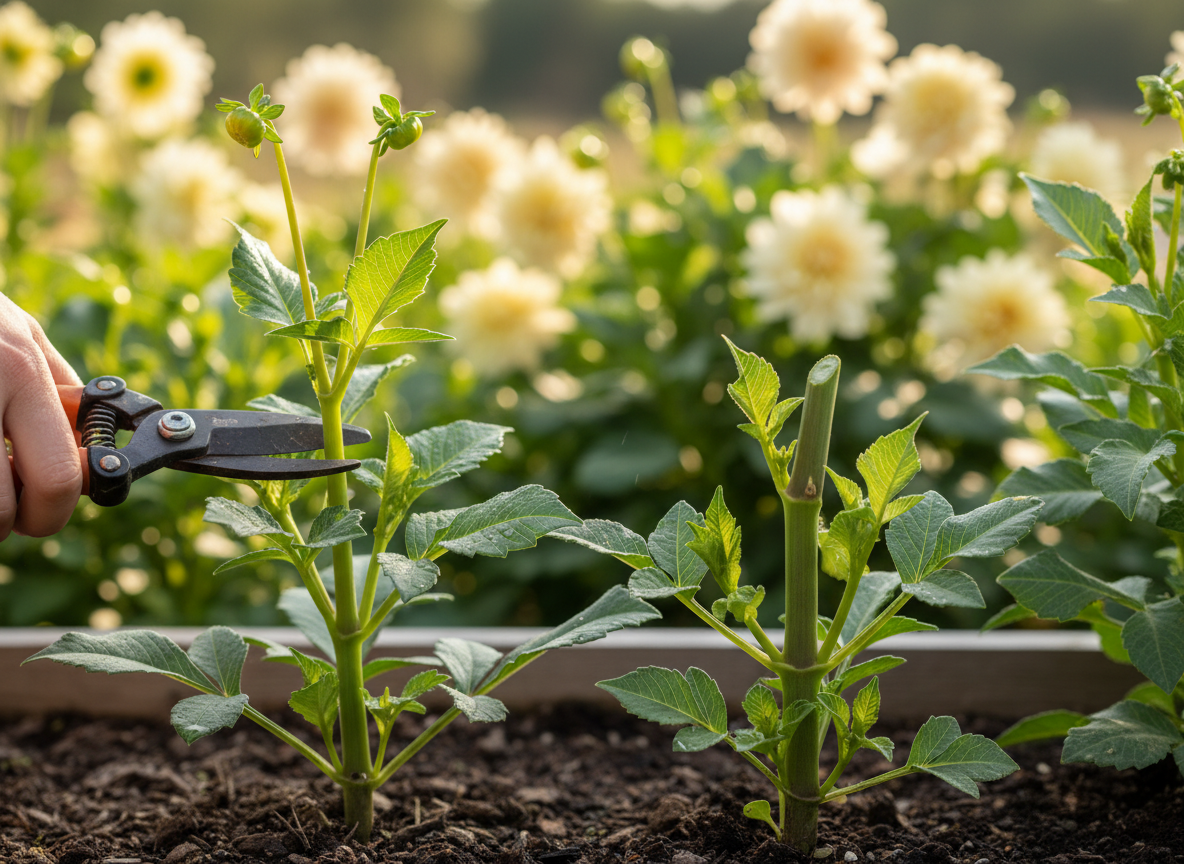 Hand pinching a dahlia plant above four leaf pairs — AI-generated illustration
Dahlias: wait for four leaf pairs, then take everything above them
Dahlias get pinched later — and harder — than sweet peas, and the difference matters. With sweet peas, you nip the very tip. With dahlias, you take a meaningful piece of stem.
The signal to act is the plant itself. Wait until the central stem is around 25–30cm tall and carries at least four pairs of leaves. Then pinch out the entire growing tip down to the topmost leaf pair you want to keep — typically removing 5–8cm of soft stem. With a tuber dahlia in early May this usually means waiting until mid-to-late May, because the plants are still pushing up through cool soil. With a rooted cutting that’s been growing under glass since March, the pinch can come as early as the first of May.
The reason for this larger cut is that dahlias have stronger apical dominance than sweet peas. A single-stemmed dahlia will keep all its energy in the leader and produce one or two enormous flowers on a stem that flops the moment a wind picks up. After pinching, every leaf axil below the cut wakes up and produces a side branch. The plant ends up with six to eight flowering stems instead of one, each carrying multiple buds, and the centre of gravity drops to where the canes can hold themselves up.
There’s a second reason to take more stem off a dahlia: the cut surface is wider, which means the energy the plant was spending on upward growth has nowhere to go but sideways. The wider the cut, the stronger the lateral response. This is also why a half-hearted pinch — taking just the soft tip — produces a half-hearted result on dahlias. Be decisive.
Two specific notes. Pompom and ball varieties respond especially well to pinching and to a second pinch a fortnight later, once the side shoots themselves reach four leaf pairs. Dinner-plate dahlias (the Café au Lait-style giants) can be pinched once but not twice, because each pinch costs flower size and these are grown for size. One mid-May pinch buys you a stronger plant; a second cut would trade away the dinner-plate effect.
Tomatoes: it’s not really a pinch — it’s a daily side-shoot edit
Tomatoes are the plant most gardeners get wrong, and the reason is that the word “pinching” is misleading. With sweet peas and dahlias you pinch the leading shoot to wake up the side shoots. With cordon tomatoes you do the opposite: you let the leading shoot keep going and you pinch out the side shoots every few days, because each side shoot wants to become a second main stem and steal energy from your fruit.
The side shoots — sometimes called suckers — appear in the V where a leaf branch meets the main stem. While they’re small (under 5cm) they snap off cleanly between thumb and forefinger, taking nothing else with them. Let them grow past 10cm and you’ll need secateurs and you’ll lose more leaf area than you wanted to. Walk past your tomatoes every few days in May and June and pop off anything in those leaf-axil V’s. That’s the whole job.
Two important caveats. First, this only applies to cordon (indeterminate) tomatoes — the ones grown up a single stake or string. Bush (determinate) tomatoes are bred to grow into a self-supporting bush; pinching out their side shoots will reduce your yield to almost nothing. Check the seed packet or label before you start.
Second, there is one place you don’t pinch a cordon tomato: the very top, until the plant has reached the height of its support or you’re four or five trusses up and the season is in late July. Then you stop the leader by pinching it out two leaves above the top truss, which redirects the plant’s energy from upward growth into ripening the fruit you’ve already set. Stopping early caps your harvest. Stopping in late July is exactly what produces ripe tomatoes in September instead of green ones in October.
 Two potted plants, one healthy and one wilting, sit in natural sunlight — AI-generated illustration
The mistakes that waste the technique
A few patterns I see again and again, in the photos people send when their pinched plants underperform.
Pinching with secateurs and leaving a stub. A clean nip with a thumbnail closes over within a day. A snip with secateurs that leaves a 5mm stub of dying stem is an entry point for botrytis and a slow-healing wound. Use your fingers. The tissue at this stage is softer than a runner bean.
Pinching wet plants. Tomato side-shoot wounds are a known infection route for bacterial canker. Pinch when the foliage is dry — late morning is ideal — and avoid handling several plants in succession if one is showing leaf spot.
Skipping it on bushy plants because they “already look bushy”. A young dahlia with three pairs of leaves looks bushy from above, but it’s still committed to a single leader. The bushiness you want comes from below the cut, not above it.
One-and-done thinking. Sweet peas need one pinch. Tomatoes need an ongoing edit through May, June and July. Dahlias often benefit from a second pinch on the side shoots themselves a fortnight after the first. Different plants, different rhythms — the one-size approach is what makes pinching feel inconsistent.
When Cresco pings you
The hardest part of pinching isn’t the cut. It’s noticing the moment your sweet pea has hit 10cm or your dahlia has unfurled its fourth pair of leaves, in a week when you’re also worrying about late frosts, hardening off and the lawn. That’s exactly the kind of plant-specific, growth-stage-dependent reminder we built Cresco to handle: snap a photo when you plant out, and the schedule it builds will nudge you in the right week — not on a generic May calendar reminder, but when your plant is actually at the stage where pinching helps. Combined with this month’s other timely jobs (the Chelsea chop on perennials and tying in climbing roses horizontally), pinching in early May is the smallest cut you’ll make all year — and one of the few that visibly doubles what the plant gives you back.