The two-week window most gardeners miss
If you walk past a rhododendron in the first week of May here in the Netherlands — or anywhere across northern Europe and the cooler parts of the US Pacific Northwest — you’ll see a shrub still covered in colour. Walk past the same plant ten days later and the trusses have collapsed into sticky brown clumps that look almost glued to the tips of every branch.
That brown clump is the moment. From the day the last petals fall, the plant has roughly two to three weeks to decide what to do with the energy stored in its leaves: spend it on producing seed, or push out new shoots that will set next year’s flower buds at their tips.
It can’t do both well. And whichever it commits to in mid-May is locked in by early June.
This is the same biology behind the daffodil-leaves rule and the two-week lilac window — but rhododendrons add two complications that catch even experienced gardeners out: a sticky resin that makes “tidying” the plant feel intuitive, and surface roots that punish anyone who reaches for the loppers.
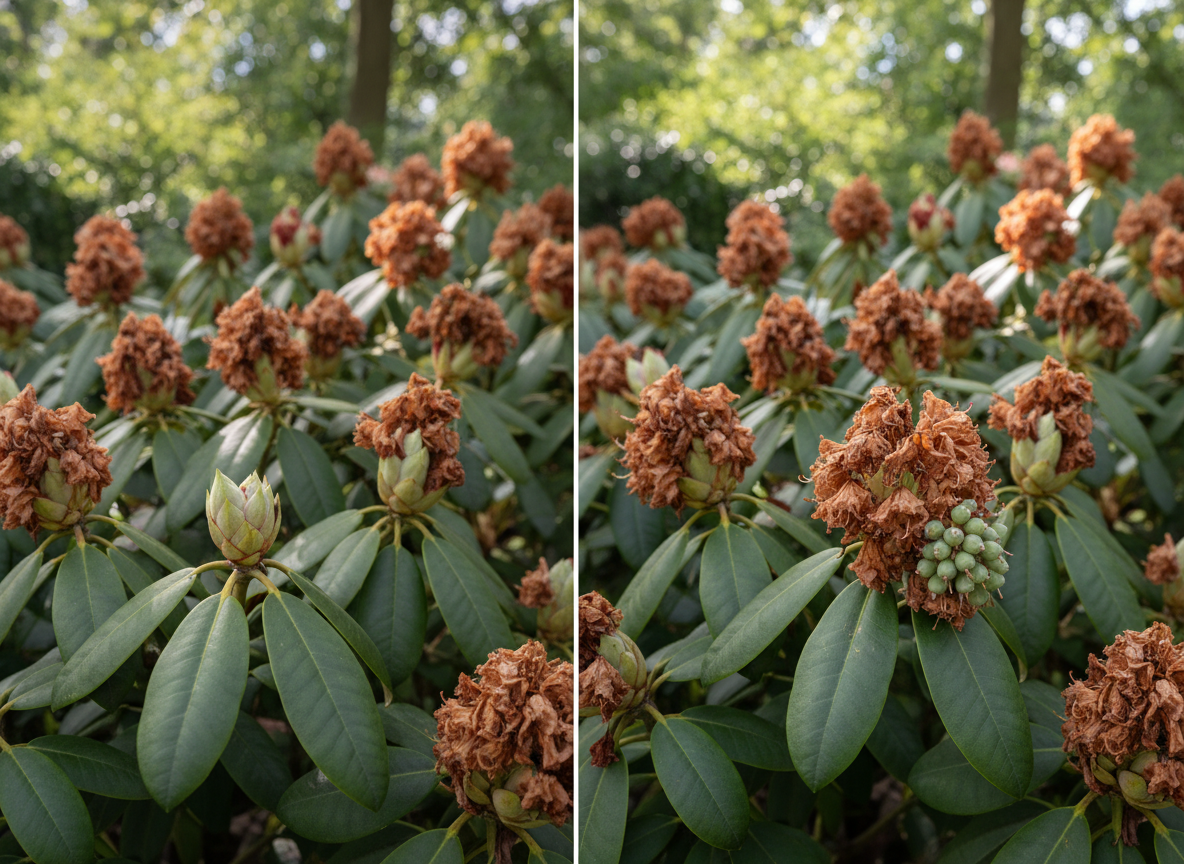 A split image shows rhododendrons with old blooms on one side and seed pods on the other — AI-generated illustration
Why deadheading matters more on rhododendrons than on most shrubs
A lot of plants will set flower buds whether you deadhead them or not. Lavender, hardy geraniums, most roses — they’re forgiving. Rhododendrons aren’t.
Three reasons:
- They flower on the previous year’s new growth. The shoot that pushes out from behind the spent truss in May is the exact piece of wood that will carry a flower bud next spring. Damage that shoot, lose that bud.
- They have one growth flush a year. Unlike a repeat-flowering rose, a rhododendron doesn’t get a second chance. Miss the May flush and you’ve missed the year.
- Seed production is metabolically expensive. A truss that’s left to set seed pulls so much energy that the plant often skips flowering the following year entirely — the classic “biennial bearing” pattern that gardeners blame on weather but is usually self-inflicted.
The American Rhododendron Society’s own guidance is blunt about this: deadhead promptly, and you can roughly double the number of flower buds set on a young plant compared with leaving the trusses on. On older shrubs the effect is smaller but still real, and it’s the difference between a steady performer and one that flowers heavily every other year.
Snap, don’t snip — and where exactly
Here’s the technique, and it’s almost embarrassingly low-tech: don’t reach for secateurs. Use your thumb and forefinger.
Look at a spent truss closely. The dead flower stalk sits on a short, slightly swollen knob — the receptacle. Tucked immediately behind that knob, on either side, you’ll see two or three pale, fat little points starting to elongate. Those are next year’s shoots. They look almost identical to the dead truss in colour and texture for the first week, which is why so many people destroy them by accident.
The move:
- Grip the spent truss between thumb and forefinger, above the knob.
- Bend it sideways — not straight up, sideways, parallel to the branch. It will snap clean off the receptacle with a tiny pop.
- Leave the swollen knob and the new shoot points completely untouched.
If you reach for secateurs, two things go wrong. First, the blades are wider than you think and you almost always nick or remove a developing shoot. Second, secateurs crush rather than snap; the cleaner break of a hand-pinch heals in about a third of the time.
The exception: if you’ve got a single very tall, very old plant where every truss is two metres up and out of reach, a long-handled grabber tool with a soft snipping head is fine. Just take your time and aim for the receptacle, not the green growth behind it.
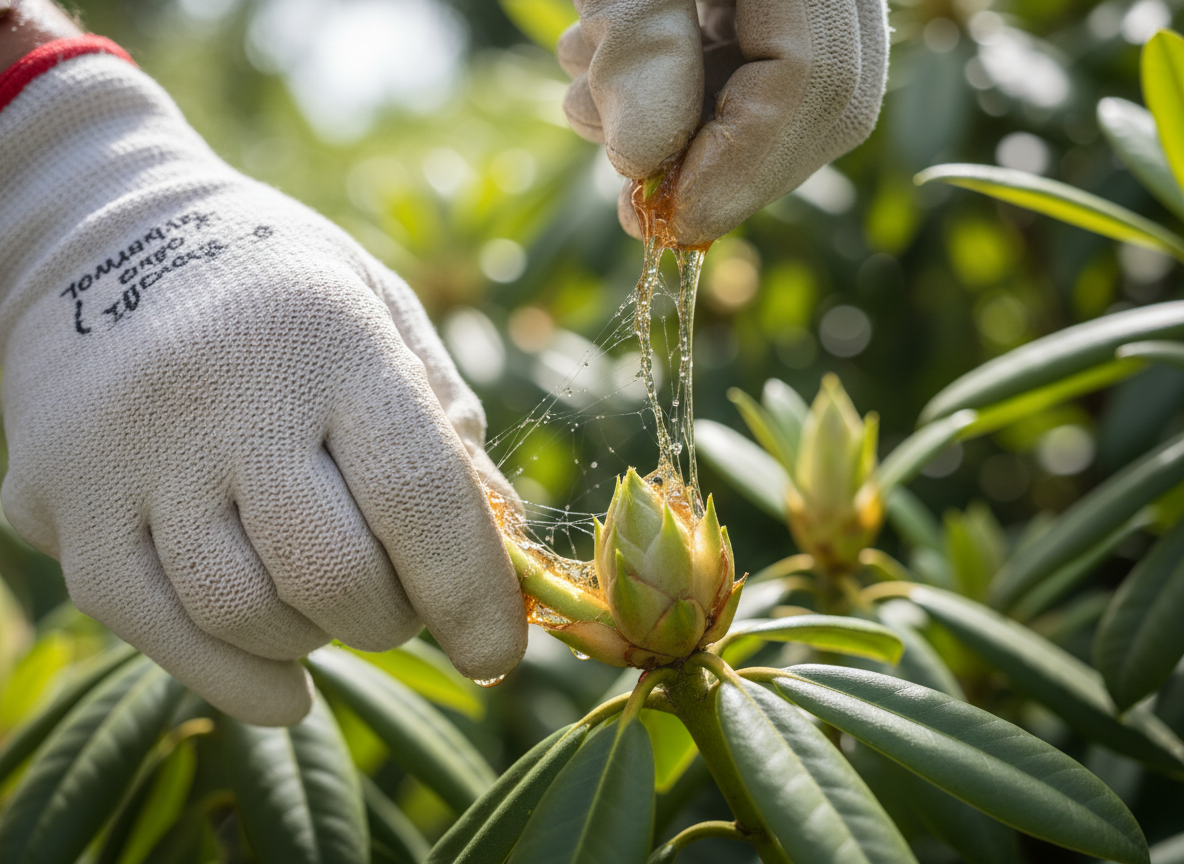 A gardener’s gloved hands remove a spent flower from a rhododendron, revealing sticky resin — AI-generated illustration
The sticky resin: what it is, and why it doesn’t mean “wash the plant”
Within an hour of starting, your fingers will be coated in a tacky, brown-yellow resin. That’s the rhododendron’s own pollination glue — it’s how the spent flower held together long enough to drop seed. It’s harmless, but it’s stubborn: soap doesn’t shift it well. Neither does white spirit. The thing that actually works is a coarse hand cleaner like Swarfega, or — if you don’t have any — a teaspoon of granulated sugar mixed with a few drops of cooking oil, rubbed over the hands like a scrub before you wash.
What the resin does not mean is that the shrub needs hosing down or “cleaning up” with a leaf blower. The resin will dry, crumble and fall on its own within ten days. Spraying water over a freshly deadheaded rhododendron is one of the fastest ways to spread petal blight (Ovulinia azaleae) — wet, bruised petals are exactly what the spores need.
Bag the spent trusses, don’t compost them, and put them in the household waste. Petal blight overwinters in the trusses themselves and a hot compost heap does not reliably kill it.
What about the leggy old shrub? The hard-prune question
Almost every gardener with a mature rhododendron reaches a point where the plant has gone bare at the bottom and all the leaves and flowers are stuck on the top metre. The temptation in May, with the loppers already out, is to cut it back hard.
Don’t, in May. Rhododendrons can be hard-pruned — they sit dormant on adventitious buds along the older wood and most species will break from bare brown trunks if you ask them to. But the right time for that is late winter, just as the buds begin to swell, not after flowering. Hard-pruning a freshly flowered shrub strips it of the leaves it needs to fund the next flush, and the plant often sulks for two full years.
In May, the rule is light only:
- Yes: deadheading, removing one or two damaged or crossing branches, snipping out the occasional whippy shoot that’s going somewhere awkward.
- No: any cut into wood thicker than a pencil. Save it for February.
The other thing to remember is that rhododendrons are surface-rooters. The fine feeder roots sit in the top 20 cm of soil and any compaction or trampling — the kind that happens when you stand inside the canopy to deadhead a big shrub — will set the plant back. Lay a plank to spread your weight, or work from a low stool at the drip line.
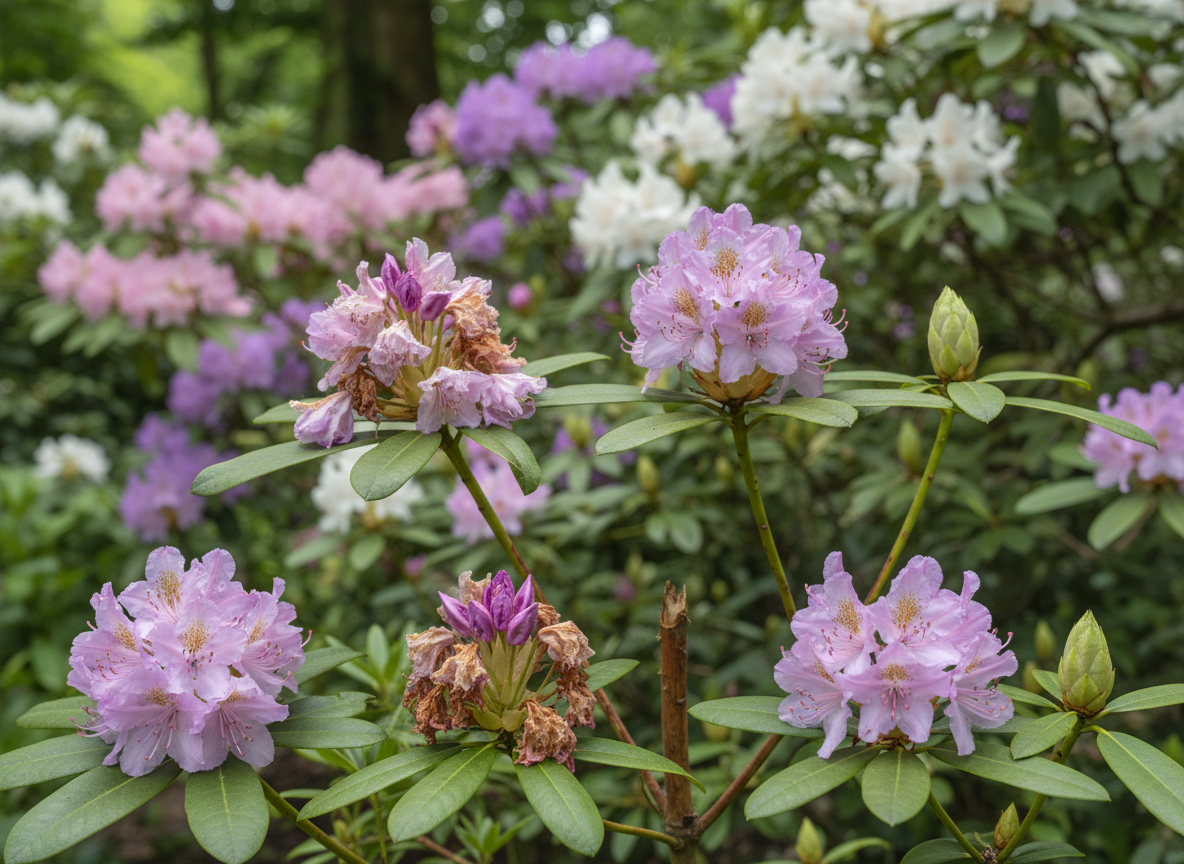 Pink rhododendron flowers in a garden, some with deadheaded blooms — AI-generated illustration
Five mistakes that quietly cost next May’s flowers
- Using secateurs because it feels neater. Snap with fingers; the plant heals faster and you preserve the new shoots.
- Deadheading too late. The window is the first two to three weeks after the petals drop. After early June the plant has already committed energy to seed and the gain from removing the trusses falls off sharply.
- Feeding immediately after flowering. A nitrogen-heavy feed in May pushes soft, sappy growth that won’t ripen in time to set flower buds. If you must feed, use a balanced, slow-release ericaceous feed in March, not May.
- Mulching with bark chip on top of the resin. Petal blight survives in fallen petals; a fresh mulch traps them against the soil and keeps them moist. Sweep up the dropped petals first, mulch second.
- Watering with hard tap water. Rhododendrons want a soil pH around 4.5 to 5.5. A summer of tap water in a region with limey water (most of the Netherlands, and large parts of southern England) will push the pH up enough to bronze the leaves and weaken bud-set. Use rainwater from a butt where you can.
How Cresco handles this for you
Rhododendron timing is one of those jobs where the calendar lies. The classic advice — “deadhead in May” — is roughly right for most of northern Europe most years, but the exact two-week window depends on the variety (early R. praecox finishes in mid-April; late R. yakushimanum hybrids can still be in flower in early June), on your local microclimate, and on the previous winter’s chill hours.
Cresco ties those variables together. Snap a photo, the app identifies the species or hybrid group, then it watches your local weather and your plant’s flowering history and pings you the day the deadheading window opens. No “is it time yet?” guesswork, no missed two-week gap, and a reminder a week later to bag the spent trusses before the petal blight spores get going.
If your rhododendron has been a one-good-year-then-nothing performer, May is almost certainly where the problem is. Get the next two weeks right and the plant will tell you the difference next spring — quietly, and in colour.