The window everyone forgets is happening right now
Walk past any wisteria in early May and you’ll see two things. The lilac- or white-purple racemes that drew you to the plant in the first place are already starting to go papery at the tips. And lower down, almost hidden under the canopy, the plant is throwing out new green shoots — fast.
Some of those shoots are the future flowering spurs. Some are runaway leaders that, if you leave them alone, will be three metres long by July, eat next year’s flower buds for energy, and end up needing to be hacked back in August anyway.
The two-prune system every guide describes — the RHS-recommended August summer cut and February winter cut — is real, and it works. But it skips over what happens in the four weeks immediately after flowering, which is the only time of year when the plant’s new wood is still flexible enough to bend horizontally without snapping. Miss that window and you’re committing yourself to August’s secateurs to fix what May’s hands could have shaped for free.
This is the same physics behind the horizontal-cane trick on climbing roses: water and growth hormones move differently through a horizontal stem than a vertical one. Bend a wisteria whip down to 30 to 45 degrees in May, and the plant reads it as “produce flowers along this stem”; leave it vertical and the plant reads it as “grow taller, faster”.
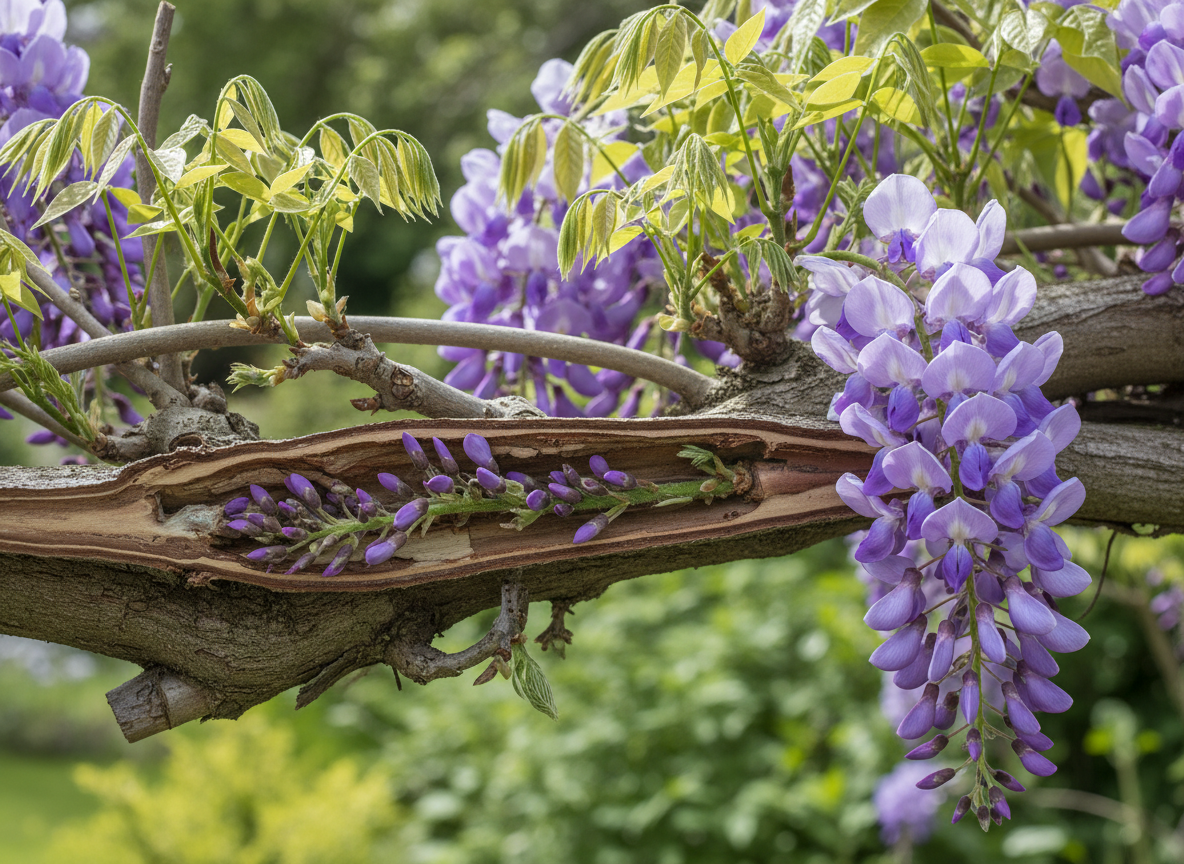 Wisteria branch with bark peeled back to show buds — AI-generated illustration
What’s actually happening inside the plant in May
The flower buds you’ll cut for a vase next May are already being decided by the wood the plant lays down between now and July. Wisteria sets its flower buds at the base of the previous year’s growth — so the short, knobbly spurs you see along an established wisteria are not random. Each one came from a side shoot that the plant ripened slowly over a summer, then triggered into flower the following spring.
Three things have to happen for a green May shoot to become next May’s flower spur:
- Slow it down. A shoot growing flat-out vertically will keep pushing leaves and tendrils right into autumn, and the wood never ripens. Bending it to horizontal slows the apical growth and re-routes the plant’s energy into thickening the wood.
- Get it sun. Spurs only form on wood that gets direct light for at least half the day. A whip buried under the canopy will produce a long whippy lead and no flower bud at the base.
- Keep it short — but not yet. August’s job is shortening to five or six leaves. May’s job is choosing which shoots are worth keeping at all.
What this means in practice is that the May intervention isn’t a prune. It’s a triage. You’re sorting next year’s flowering wood from this year’s wasted runners, and tying the keepers down before they get too brittle to bend.
How to tell a future spur from a future runner
Stand back from the plant and look at where each new green shoot is coming from. There are three places they emerge, and they tell you almost everything you need to know.
From an existing spur (knobbly, gnarled wood, where this year’s racemes hung): Almost always becomes next year’s flowering wood if you leave it alone. These are the shoots to keep, and the ones you’ll prune to five or six leaves in August. Tie them in if they’re going somewhere useful; otherwise leave them entirely and let them lengthen until late summer.
From a horizontal lateral or framework branch (smooth, two- to three-year-old wood): The most important category. These are the ones to bend down to 30 to 45 degrees and tie in along your wires. Done in May, they’ll set spurs along their length. Left vertical, they’ll be long whips by July with all the growth concentrated at the tip and nothing along the stem.
From the base of the plant or below the graft: Cut these out at source, immediately. Most named wisterias are grafted onto seedling rootstock, and any shoot from below the graft union belongs to the wild parent — which can take twenty years to flower, if it bothers at all. The same biology as rose suckers, and the same hard rule: tear them out if you can, don’t snip them off and leave a stub.
A useful field test for the third category: real wisteria shoots have alternate leaves, slightly bronzed when young. Suckers from the rootstock often look thinner, paler, and the leaflet count is wrong — the named varieties have between 9 and 19 leaflets per leaf depending on cultivar; rootstock shoots are often noticeably different.
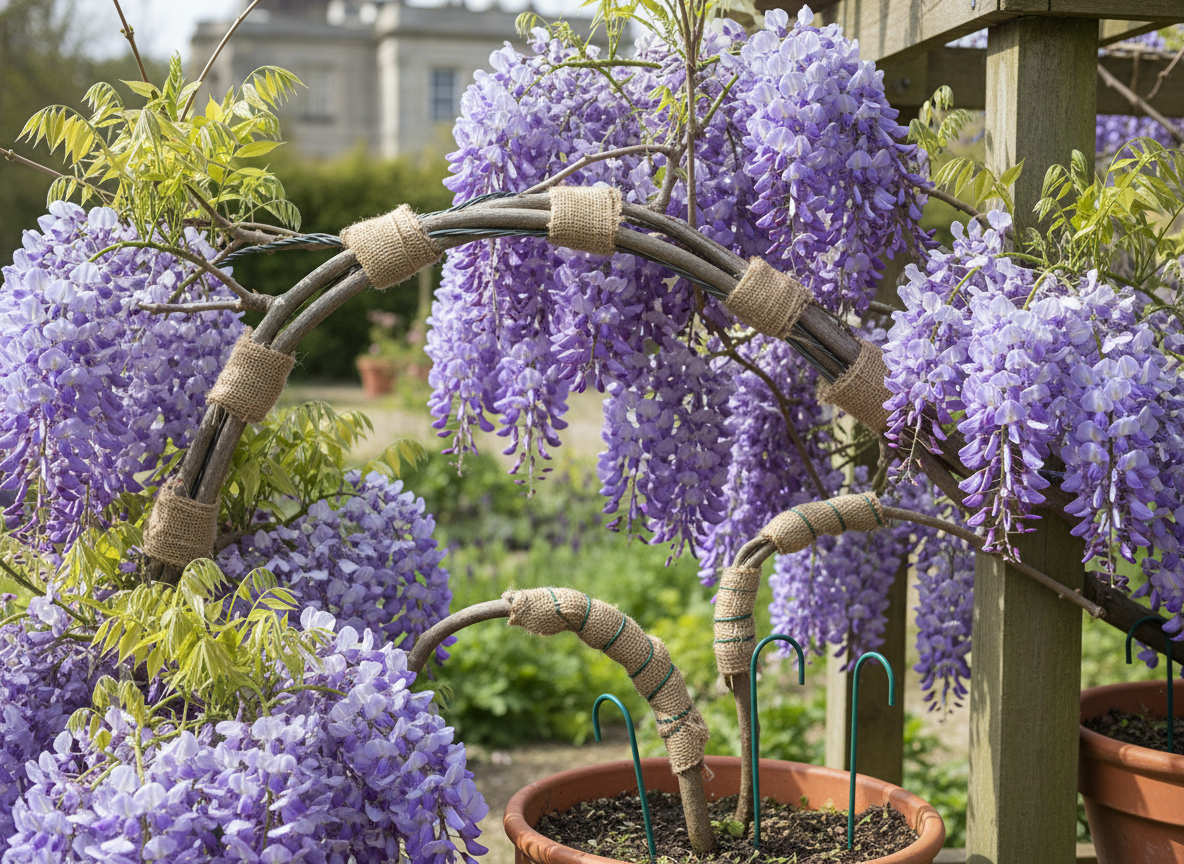 The wisteria plant is trained on a support structure in a garden — AI-generated illustration
The bending technique: when, how far, with what
The window for bending is roughly three weeks: from when the last racemes drop until the new wood starts to lignify at its base. In a normal Northern European May that’s about the 10th to the 30th. After that, the wood snaps audibly when you try to bend it. Before that — while the racemes are still hanging — the new shoots are too short and limp to be worth working with.
The technique itself is simple, and almost suspiciously gentle:
- Use soft tie material. Stretchy rubber tree ties or strips of old jersey fabric. Twine cuts into the new growth as it thickens; wire is a non-starter on green wood.
- Bend the whip down by about 30 to 45 degrees from vertical. Not horizontal — that often snaps a vigorous lead at the base. A 45-degree bow is enough to slow apical growth without breaking the cambium.
- Tie at two points minimum. One near the bottom (where the bend is) and one near the tip. Single-point ties pivot in the wind and damage the shoot.
- Do it on a warm afternoon. Cell walls are more pliable when the plant has been transpiring for a few hours. Cold morning wood snaps. Same plant at 3pm bends easily.
If the shoot is going somewhere you don’t want it — sideways onto a window, into a gutter, across a path — don’t try to bend it round a corner. Cut it off at source. Bending only works if the destination is a place the shoot would have been happy to grow anyway.
The August and February prune still happen — but they’re easier now
Here’s what most people miss: the May intervention isn’t a replacement for the August summer cut or the February winter prune. It’s a multiplier on both.
In a wisteria that hasn’t been bent in May, the August prune is a wrestling match. You’re cutting back two- and three-metre vertical whips to five or six leaves, and the plant is still in furious vegetative mode because nothing has slowed it down. By February, the same shoots have re-extended, you cut them back to two or three buds, and the plant has spent a year of energy on growing wood that you’ll throw away.
In a plant that was bent and tied in May, the August cut is a tidy-up. The shoots you tied are already producing short side spurs along their length, so the August five-or-six-leaf cut is shaping wood that’s already begun to flower-bud. The February cut to two or three buds then produces the classic short, knobbly flowering spur — the kind that throws three or four racemes in a single spring.
The RHS guidance on the two-prune cycle is sound. But it’s written for established, well-trained wisteria. If your plant flowered patchily this year, or threw most of its racemes near the top and left the bottom bare, the May fix is bending — not waiting until August to cut.
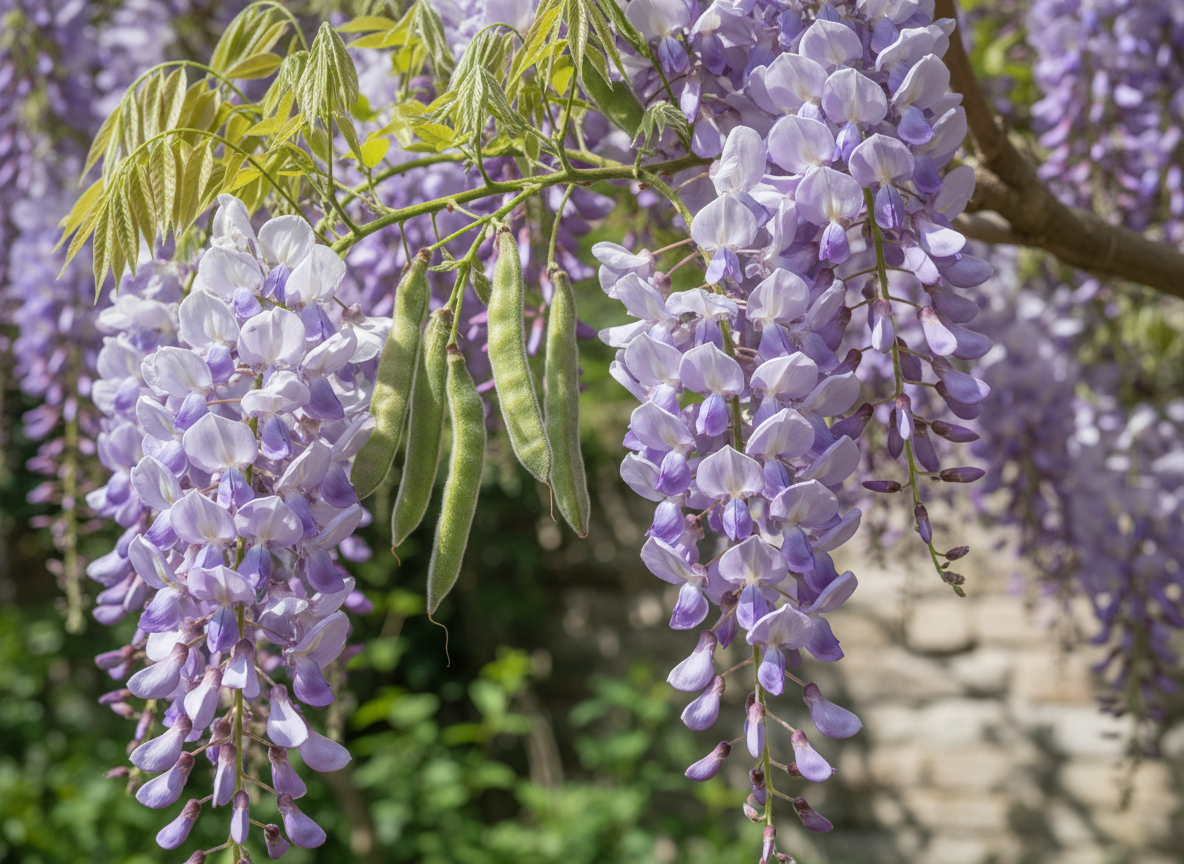 Close-up of wisteria flowers, leaves, and seed pods — AI-generated illustration
What about the racemes that didn’t open?
A common problem this year, especially after the warm March and the cold snap that hit a lot of Northern European gardens in early April: half the buds on the racemes browned and shrivelled before opening.
That’s frost damage at the bud-base, not pruning damage. Wisteria flower buds form at the base of the previous year’s growth, which means they sit close to the framework wood — exposed, low down, and vulnerable to a late frost long after the rest of the plant looks fine. There’s nothing you can do about it retroactively, but two May actions reduce the chance of a repeat:
- Don’t deadhead the failed racemes unless they’re hanging in your face. Removing them triggers a vegetative response, which is the opposite of what a frost-checked plant needs in May. Let them drop on their own.
- Water deeply through July. This is the period when next year’s flower buds are initiated, and a dry spell now is the single biggest cause of a flowerless May after this one. The RHS notes that buds will simply abort if soil moisture is low between July and September.
If you fertilised in spring with a high-nitrogen feed, stop. Nitrogen pushes the plant into vegetative growth at exactly the moment it should be slowing down for bud initiation. A high-potash feed (tomato food works) in late June and again in mid-July is the right intervention. A handful of sulphate of potash sprinkled at the drip line and watered in is the old-school version, and equally effective.
Five mistakes that quietly cost next year’s flowers
- Snipping the soft new whips off in May because they “look untidy”. They are next year’s flower bearers. Bend, don’t cut.
- Tying with twine or wire on green wood. Both girdle the shoot as it thickens through summer. Use stretchy ties, and check them in August.
- Letting suckers from below the graft become “extra” trunks. They never flower like the named variety, and within three years they outgrow it. Tear them off, low.
- Hard-pruning a non-flowerer in spring. It almost always responds with even more vegetative growth. The fix for a shy wisteria is rootpruning in autumn or potash in summer, not loppers in May.
- Forgetting to water in July. Next May’s flowers are decided in this July’s soil moisture. Mulch heavily after a good soak in late June.
What Cresco does with the May reading
This is the kind of decision that’s hard to make from a generic “prune wisteria in summer” article — because the right answer depends on the age of your plant, your climate zone, what its last two flowering performances looked like, and which of those green shoots are coming from where.
That’s the reading Cresco gives you when you snap a photo: the app identifies Wisteria sinensis or floribunda, checks your local weather and the soil-temperature curve for your postcode, and tells you whether you’re inside the bending window, past it, or still a week early. It’s also the reason we built around pruning specifically rather than identification alone — there are plenty of apps that can tell you what plant you have; far fewer will tell you what to do with a fistful of green whips on the second weekend in May.
If you want a single rule to walk away with: in the three weeks after your wisteria flowers, put down the secateurs and pick up some soft ties. The plant will thank you in two ways — once next May when it flowers along every lateral you bent, and again next August when the summer prune takes you ten minutes instead of two hours.
Sources & further reading: