The collapse you can set your watch by
The aquilegia week always comes. In a normal season across the Low Countries and southern England, columbines (Aquilegia vulgaris and its close cousins) start flowering in mid-May, peak around the Chelsea Flower Show, and collapse in the first ten days of June. Petals drop. The lower leaves go bronze, then grey. Within another fortnight those bottom leaves develop the pale stippled blotches of downy mildew, and by midsummer the whole plant looks like it died standing up.
This is not the plant being weak. It’s the life cycle of a short-day, cool-season perennial that has spent every reserve it had on a flowering display. What looks like decline in early June is actually the plant’s own cue for a complete foliage reset — if you let it happen.
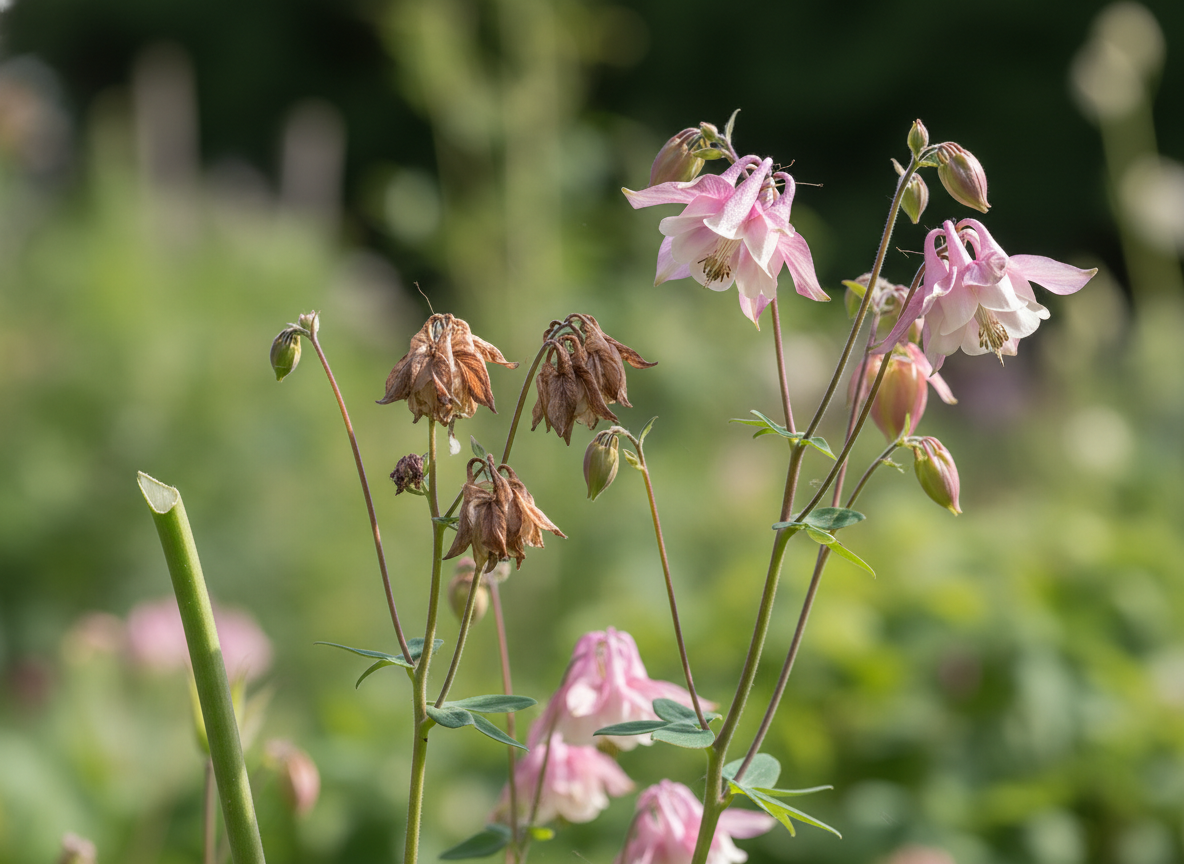 Pink aquilegia flowers and spent blooms in a garden setting — AI-generated illustration
What the cut does (three jobs at once)
The cut you’re going to make in the next ten days does three things at once, which is why so many gardeners stumble through it.
First, it removes the foliage before downy mildew (Peronospora aquilegiae) has a chance to sporulate. The RHS lists aquilegia downy mildew as a serious enough disease to warrant its own page (RHS Aquilegia Downy Mildew). The pathogen overwinters on infected leaf debris. Cutting and removing the lot in early June interrupts that cycle.
Second, it triggers a basal rosette. Aquilegia keeps a dormant cluster of crown buds at soil level all season. As long as the canopy of old leaves is shading them, those buds stay tight. Cut the canopy off and within a week those crown buds break into a low, fresh, ferny rosette that lasts cleanly through to autumn.
Third — and this is the one most people overlook — it stops indiscriminate self-seeding. Aquilegias cross-pollinate ferociously. Any named variety left to set seed in June will give you a hundred muddy-mauve seedlings in 2027 that look nothing like the parent. Removing the spent stems before the seedpods split is the only way to keep a named Aquilegia vulgaris ‘Nora Barlow’ or McKana hybrid looking like itself in three years’ time.
The window: from petal-drop to seedpod-split
The sweet spot is roughly the first ten days after the last petals have dropped. In a typical 2026 season for the Low Countries and southern England that lines up with the first two weeks of June.
The early bound: as soon as the central spike has finished. Don’t be tempted to cut while petals are still falling — bees and hoverflies are still working the last flowers, and you want them to. Aquilegia is one of the very few garden perennials whose long-spurred flowers feed long-tongued bumblebees that struggle on most other border plants in late May.
The late bound: before the seedpods turn brown and split. Each upright pod contains around a hundred seeds, and a brown-pod plant left another four days will broadcast them across a metre of border in a strong breeze. Once that’s happened, your June 2027 weeding bill goes up. The pods are easy to read — green and pointing skyward means safe to cut; pale tan and starting to crack at the top means you’re already too late for half of them.
The middle of that window — petals down, pods still green and upright — is where the cut belongs.
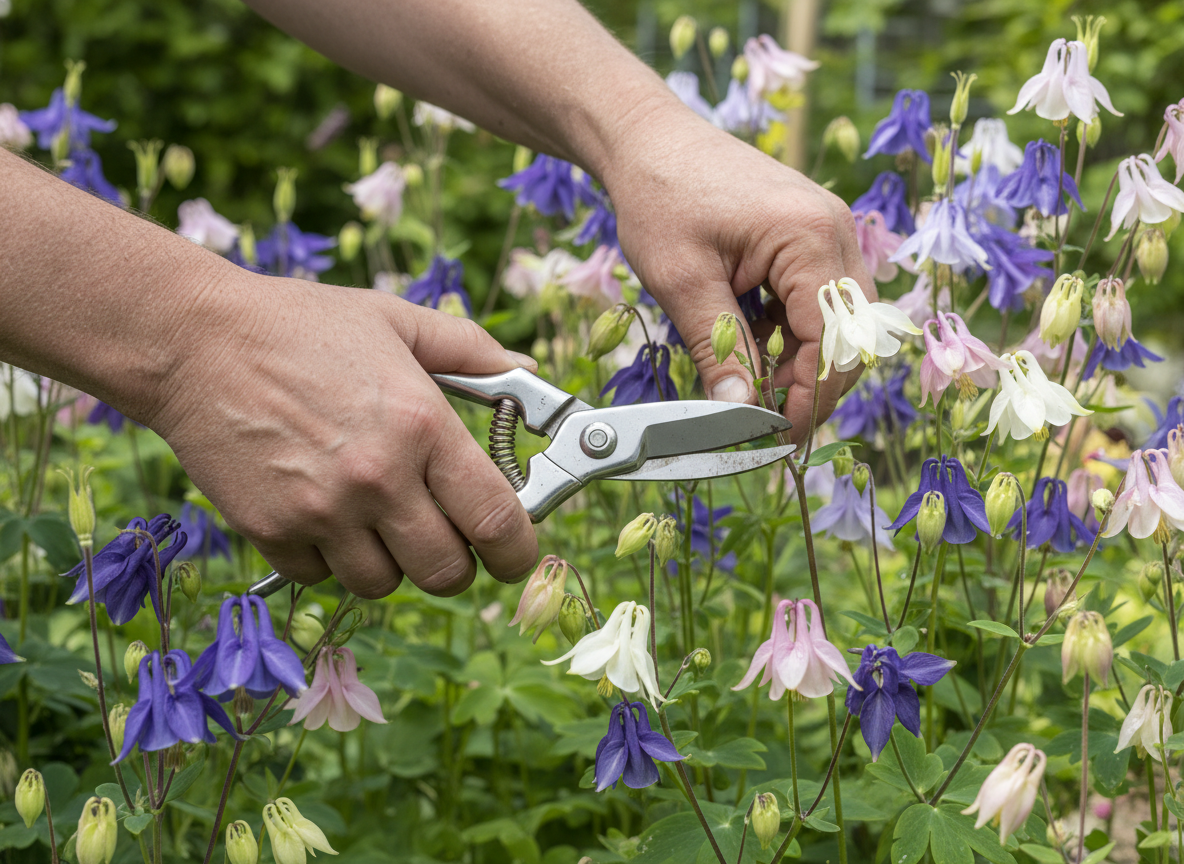 A person’s hands prune aquilegia flowers with secateurs in a garden — AI-generated illustration
The cut: hands and secateurs, no surgery
Walk up to the plant, gather all the flowered stems into a handful at about knee height, lift the bundle gently upward, and cut all the stems together about three centimetres above the soil. That’s it. No selecting individual stems, no following each one to a leaf node, no preserving green tissue “to feed the plant”.
Then go round the base of the plant and cut every remaining basal leaf off at the crown too — even the ones that still look healthy. The point is a clean, naked crown sitting at soil level. From a distance, the spot where the plant was now looks like a small patch of bare earth with a tight cluster of pale green buds in the middle.
Take everything you’ve cut straight to the compost bin or the council green waste — don’t leave it lying around the border. If any of the lower leaves were showing the pale blotches of downy mildew, the safer move is council green waste rather than home compost; the home heap rarely runs hot enough to kill the oospores.
A few practical notes on technique. Use clean, sharp bypass secateurs — aquilegia stems are wet and pithy, and a blunt blade crushes the crown bud you’re trying to preserve. If the crown looks waterlogged after a wet May, fork a handful of horticultural grit around it after cutting; that single change does more to prevent crown rot than any fungicide drench.
Hybrid worry: keep the seed, or kill the seed?
This is the one decision the cut forces on you. Aquilegia is one of the most promiscuous garden perennials. Any vulgaris type within a hundred metres will cross with any other, and the F1 seedlings rarely come true.
If you want a tidy named-variety border — the deep maroon of ‘Black Barlow’, the cleanly green-flushed ‘Lime Sorbet’, the apricot of ‘Tequila Sunrise’ — cut before the pods split. Every year.
If you want a self-sustaining cottage drift where every June you discover a new muddy purple-mauve seedling somewhere unexpected, leave three or four spikes uncut. Three is plenty: each spike carries thousands of seeds. Cut the rest. The plants are short-lived (three to five years in most gardens), and self-seeded replacements are how that cottage look maintains itself.
The mistake is no decision at all — letting every spike set seed because “it might be nice to have some seedlings”. You’ll end up with too many seedlings of the wrong colour, in the wrong places, and the original named plants will quietly disappear under the crowd in three seasons.
What three weeks later looks like
By the third week of June you should see a tight, low cushion of fresh ferny foliage no more than fifteen centimetres tall, the colour somewhere between mint and sage. It’s startlingly clean — none of the mildew blotches, none of the bronze-tipped tiredness of the old leaves. That foliage lasts cleanly into October and gives you a structural ground-cover layer in the border for the whole second half of the season, even though the flowers are long gone.
Plants that get the early-June chop reliably live two or three years longer than plants that don’t. The Sarah Raven nursery’s care notes on aquilegia describe the same effect: cutting back after flowering, watering in, and topping with compost is the closest thing the plant has to a longevity trick (Sarah Raven: How to grow aquilegia).
A general-purpose feed at this stage helps but isn’t essential. What matters more is water. If June 2026 turns dry the way May has trended, give each cut plant a deep watering can immediately after cutting and a second one a week later. That’s the whole aftercare programme.
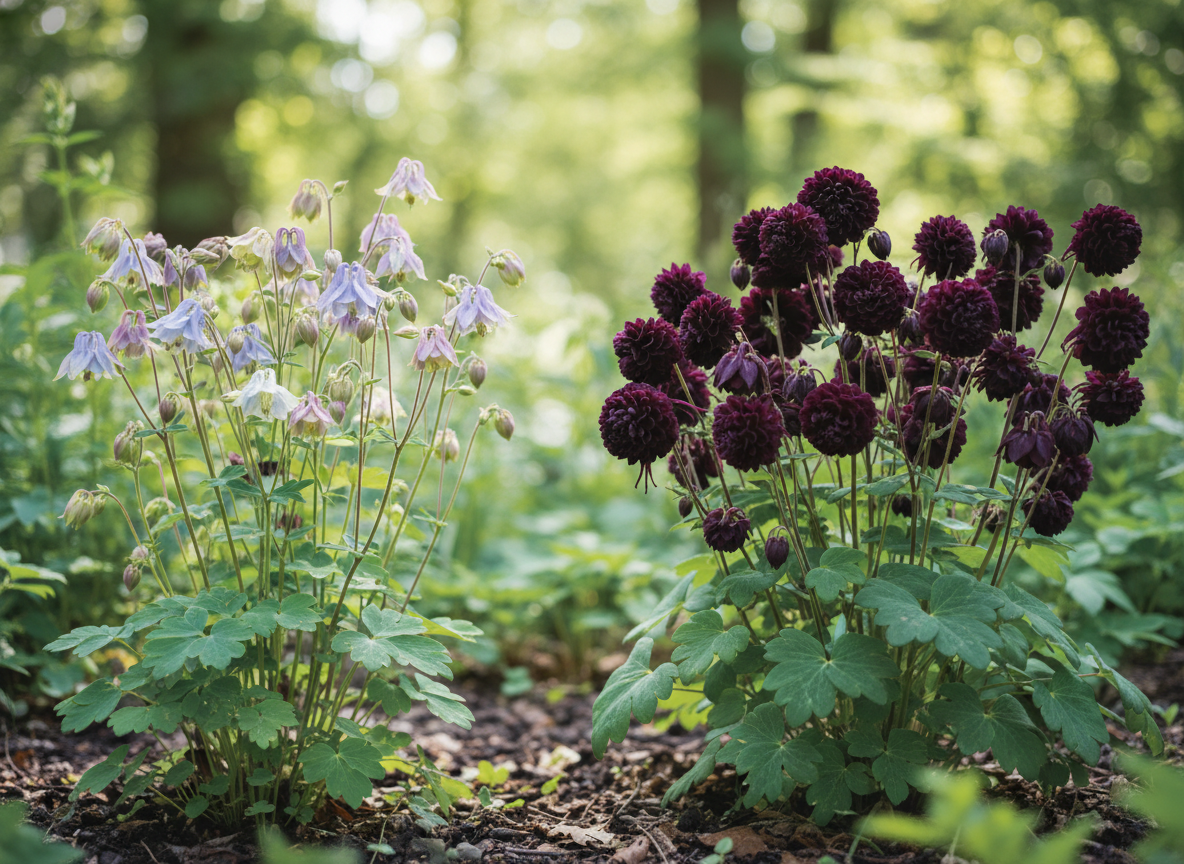 Two flowering aquilegia plants, one pale, one dark, in a dappled garden — AI-generated illustration
The two exceptions: young plants and double Barlows
Two cases where you don’t make the full cut.
First-year plants — anything you bought as a small plug or 9 cm pot this spring — should be allowed to keep their basal foliage. Cut the flowered spike off cleanly above the topmost leaves, but leave the rosette alone. The plant hasn’t built enough crown reserves to recover from a full crown shave in year one. You’ll get a proper clean cut from it next June.
Double-flowered Barlow types (‘Nora Barlow’, ‘Black Barlow’, ‘Christa Barlow’) are largely sterile and don’t seed reliably. You can be lazier with those — the seedling-prevention argument doesn’t apply — but the mildew and foliage-refresh arguments still do. Cut them on the same June timing for the same reasons, just without the urgency about pod-split.
Why this works for aquilegia and not for, say, hostas
A reasonable question: if cutting a perennial to the ground in June works this well, why don’t we do it to everything?
Because aquilegia has an unusual structure for a herbaceous perennial. Its leaves emerge from a tight basal crown rather than along the flowering stems. Every leaf is, in effect, a basal leaf — there are no stem leaves whose loss would set the plant back. Cut the entire above-ground plant off and you’ve removed almost nothing the crown can’t rebuild in three weeks.
A hosta, by contrast, photosynthesises through its single canopy of leaves all season. Cut a hosta in June and the crown has to draw on stored reserves to rebuild — fine once, damaging twice. The aquilegia approach works precisely because the plant evolved with a low rosette and brief, expendable flowering stems. It’s a structural quirk, not a general rule.
What Cresco does with this in your plant log
If you’ve added a columbine to your Cresco garden, the app already knows when its flowering window closes. From early June onwards it pushes a single reminder — “Aquilegia: cut to the crown within ten days” — and waits for you to mark the cut as done. Mark it, and the next reminder you’ll see for that plant is in early September: “Top-dress with compost ahead of dormancy.”
That’s deliberately the only two interventions the app asks for between now and autumn. Aquilegia rewards minimal intervention done at exactly the right moment, and our pruning planner is built around the same idea: fewer reminders, better timed, with the local weather already factored in.