What your deutzia has just finished — and what it’s about to start
For two to three weeks at the back end of May a well-grown deutzia is one of the prettiest things in any garden: an arching fountain of bell- or star-shaped flowers, white in Deutzia gracilis ‘Nikko’, soft pink-flushed in D. × hybrida ‘Mont Rose’, double-petalled and almost rosy in D. scabra ‘Plena’. Then the petals brown at the edges, drop in a small confetti drift, and the show is over.
What looks like the end is actually the start of the most important six weeks in the plant’s year. Deutzia, like its cousin the philadelphus and unlike a buddleia or a hardy fuchsia, flowers on second-year wood — the buds that opened this spring were laid down on shoots that grew during the summer of 2025. The shoots that will carry next May’s display are forming right now, pushing from buds tucked just below where this year’s flowers sat. Every week that the spent flower trusses stay on the plant is a week those new shoots wait for light and energy that’s being spent on seed set instead.
That’s why the cut happens now, in the fortnight after the petals drop, and not in autumn or, worse, in early spring. Wait until February and you’ll prune off exactly the wood you wanted to keep. Wait until late July and the new shoots will have grown too long and too soft to ripen into flowering wood before winter. The window is narrower than people think, and the calendar is no help — your deutzia opens and closes it on its own timetable, set by your local spring.
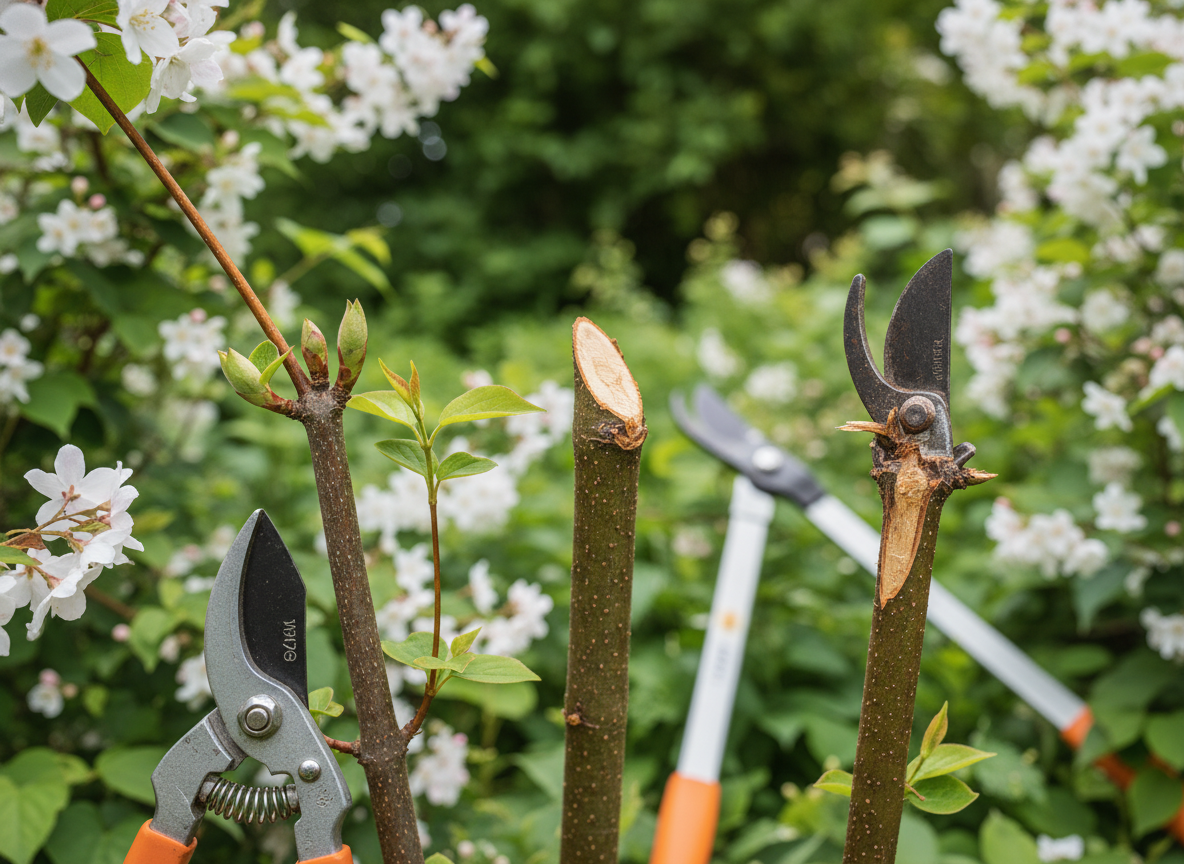 The photograph depicts pruning shears and deutzia plant stems with different cuts — AI-generated illustration
The two cuts that work — and the shear that doesn’t
Pick up a deutzia in any garden centre and you’ll see the same arching, vase-shaped habit: a tangle of slender stems coming up from a crown at the base, the youngest stems pale and supple, the oldest dark brown, gnarled and peeling. That structure is not an accident, and it tells you exactly how to prune it.
The shears-over-the-top approach — the same gesture you’d use on a box ball or a privet hedge — is what most people reach for, and it’s the worst thing you can do to a deutzia. Shearing leaves you with a half-domed lollipop of leaves, removes the very tips that would have made next year’s wood, and turns a graceful arching shrub into something stiff and ugly. The plant flowers feebly the following spring, and once you’ve started shearing it’s very hard to recover the natural shape.
What deutzia actually wants is two distinct cuts, made in the same session with the same secateurs but with different intent.
Cut one is the renewal cut, taken at the base. Find the oldest, thickest, darkest-barked stems coming up out of the crown — usually three to five years old, peeling, often a bit congested in the middle of the shrub. Take one stem in three of those right down to ground level, or as close as you can get the blades. On a small D. gracilis ‘Nikko’ that might mean two or three stems; on a mature D. scabra it could be four or five thick canes. This is the cut that prevents the shrub from turning into a hollow, twiggy crown — it forces strong, vigorous new shoots up from the base each summer, and those are the shoots that will be smothered in flower two springs from now.
Cut two is the heading cut, taken to a side shoot. On every remaining stem that just finished flowering, follow the spent flower truss back down the stem until you find a strong, healthy, outward-facing new shoot already pushing — sometimes only a centimetre long, sometimes already five or six. Cut the old flowered length off just above that new shoot, at a slight angle, so the cut sheds water away from the bud. You’re shortening the flowered stem by roughly a third to a half, never more than two-thirds, and you’re doing it to a clear destination — never a blind cut into bare wood. The Royal Horticultural Society’s shrub pruning guidance is explicit on this: for deutzia, philadelphus, weigela and their kin, cut flowered shoots back to a strong young replacement, then remove a proportion of the oldest stems entirely. Two cuts, one job.
Done together across the whole shrub, this is the same logic that drives the one-in-three cut that keeps a weigela flowering — which is no accident, because both shrubs share the same architecture and the same flowering wood. If you’ve already done your weigela this year, your deutzia takes about the same time and the same tools; the cuts just sit slightly later in the calendar.
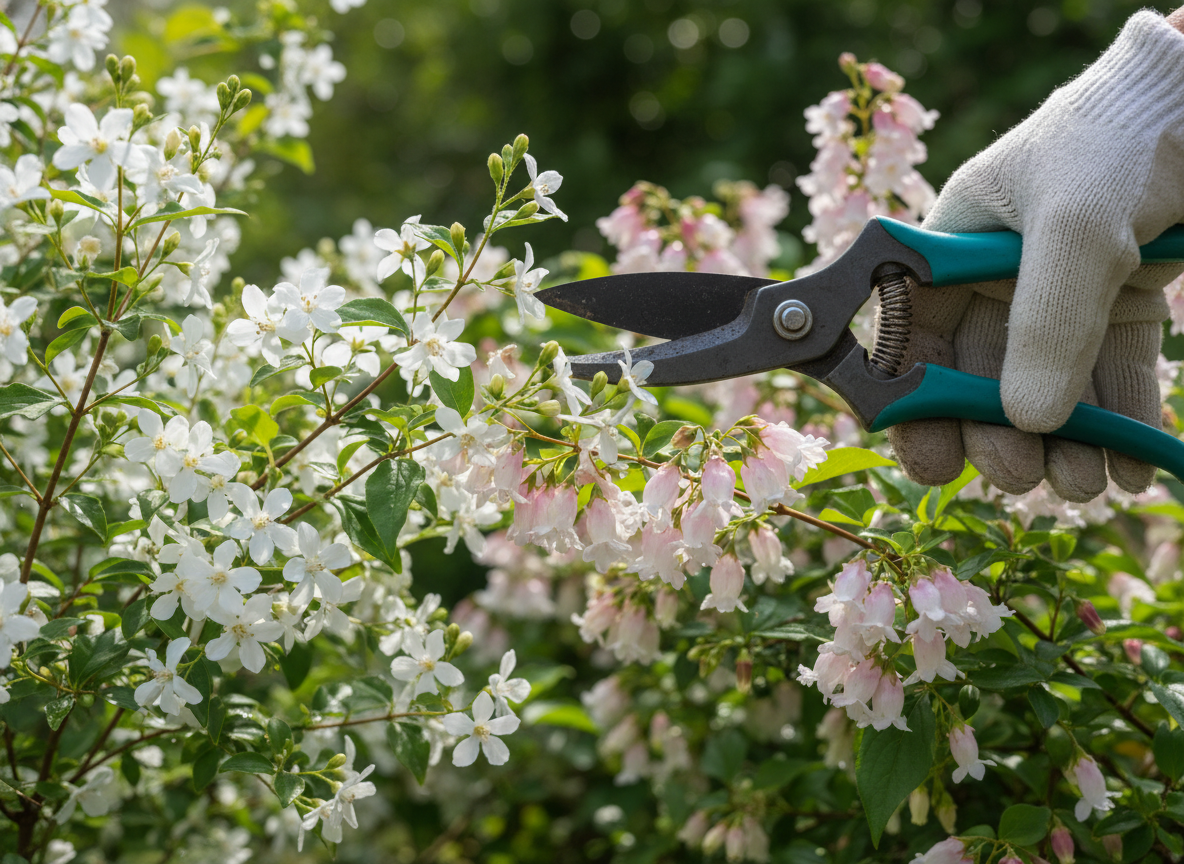 A hand in a glove holding secateurs near flowering deutzia plants — AI-generated illustration
Know which deutzia you’re holding the secateurs over
“Deutzia” covers around sixty species and a sprawling cast of garden hybrids, and although the basic rule — two cuts, just after flowering, to second-year wood — holds across the genus, the details shift enough to matter.
Deutzia gracilis and ‘Nikko’ are the compact ones: a knee-high, slowly suckering mound between 60 cm and a metre tall and wide, smothered in pure-white single flowers in mid- to late May. These don’t need a heading cut every year — a light tip-back to a new shoot is enough — and the renewal cut is gentler, one stem in four or five rather than one in three. They’re the deutzia most people grow at the front of a border, and they’re forgiving as long as you stay off the shears.
Deutzia × hybrida ‘Mont Rose’, ‘Magicien’ and ‘Strawberry Fields’ are the showy mid-sized hybrids, 1.5 m to 2 m, with larger pink-flushed flowers that overlap nicely with the early roses and the last of the late tulips. These are the ones the two-cut combo was designed for: shorten the flowered shoots by a third to a half, take one stem in three at the base, and you’ll have a vase-shaped shrub that flowers harder every year for a decade.
Deutzia scabra and its double-flowered ‘Plena’ / ‘Pride of Rochester’ are the giants — 2.5 to 3 m tall, ageing into a small thicket with characteristic peeling, papery brown bark. They flower a little later, often into June, and they tolerate — even reward — a slightly harder renewal. Don’t be afraid to take a quarter of the stems out at the base on a mature specimen each summer; without it, the inside of the shrub becomes a dead-twig museum that no longer flowers from the middle outwards.
If you’re not sure which one you’ve got, the leaf and the bark will tell you long before the label does: small narrow leaves and a low cushion shape mean gracilis; medium leaves on an arching 1.5 m shrub mean a hybrid; large, rough, sandpaper-textured leaves and peeling stems mean scabra. When in doubt, err on the side of the lighter cut — deutzia is far more often spoiled by a hedge-trimmer enthusiast than by an under-pruner.
 AI-generated illustration
When you’ve inherited a thicket — the rejuvenation deutzia actually welcomes
Here is where deutzia parts ways with the broom you can never cut back into the old wood or the ceanothus that dies if you try. Deutzia carries plenty of dormant buds at the base, even on stems that look impossibly old and woody — and that means an overgrown, gappy, half-dead-looking specimen can almost always be brought back.
The cleanest method is the staged renovation. In year one, cut a third of the oldest stems all the way to ground level — not shortened, not pruned to a side shoot, but removed completely. Leave the rest alone. By late summer you’ll see strong, often surprisingly fat new shoots pushing up from the crown where the old stems used to be. In year two, do the same again, taking out the next third of the oldest remaining stems. By year three the shrub is structurally new from the base up, you’ve kept some flowering wood every year, and you’ve never lost a spring’s worth of bloom.
The braver method is the one-shot hard cut: in mid-summer, just after flowering, take everything down to about 30 cm above the soil. You’ll lose all of next spring’s flowers — every one of them was on the wood you just removed — but the plant will respond with a thicket of fresh growth from the base, and by the second summer you’re back to a fully flowering, well-shaped shrub. This is the rescue move for a deutzia that’s become so leggy or so lopsided that staged work won’t fix the basic geometry. Reserve it for genuine emergencies, water and feed well afterwards, and don’t expect any flowers in spring 2027.
What you should never do — and this is the trap people fall into when they’ve ignored a deutzia for a few years — is shear the whole shrub over the top “to tidy it up” and then leave it. That gives you the worst of both worlds: no flowers next spring, no renewal from the base, and a dome of leaves that gets steadily uglier every season. If you’ve gone too long without pruning, choose between the staged renovation and the one-shot hard cut, and commit. Don’t compromise.
The window the calendar can’t see, and the day Cresco can
Notice the pattern in everything above: the cut isn’t pegged to a date. It opens the moment the last flowers fade, and that moment moves — by variety, by region, by the kind of spring you’ve just had.
A Deutzia gracilis ‘Nikko’ in a warm Surrey courtyard might be done by the third week of May. The same plant on a north Dutch coast is still going strong on the first of June. A double-flowered D. scabra ‘Plena’ in a Norfolk hedgerow doesn’t even start until the first week of June and finishes nearer the longest day. Add an unusually warm, dry April — like the one most of Northern Europe just had — and the whole sequence shunts forward by a fortnight; add a cold late spring and it slips back the other way. “Prune deutzia in early June” is a useful rule of thumb, but the plant in front of you is the only authority that matters, and on a shrub where the window for a clean two-cut combo is only about three weeks wide, getting that week right is the difference between a vase-shaped fountain of bloom next May and a tired, twiggy mound.
That’s exactly the gap Cresco is built to close. Photograph your deutzia and it identifies what you’ve actually got — a compact ‘Nikko’ versus a ‘Mont Rose’ hybrid versus a thicket-forming scabra — then reads your local weather and the way your spring has actually unfolded to tell you the week the after-flowering window genuinely opens on your plant, and reminds you again next year, because once you’ve started doing the two-cut combo annually you really don’t want to skip a season. For the bigger picture of what else is clamouring for the secateurs in the same fortnight, the month-by-month pruning guide shows where deutzia sits in the early-summer rush — and which other shrubs share the same flowering-wood logic, so one Saturday with the secateurs can sort out half the border.
The 30-second version
- Deutzia flowers on second-year wood — the shoots that will carry next May’s display are already pushing now, below the spent flowers.
- The window is the fortnight after the petals drop — too late in summer and the new growth won’t ripen before winter; too early in spring and you cut off the flower buds.
- Make two cuts in one session: take one stem in three of the oldest at ground level (renewal), and shorten every flowered stem to a strong new side shoot below (heading).
- Never shear it like a hedge — you’ll lose the arching habit, the flowers and the shape, often for good.
- Gracilis / ‘Nikko’ want a lighter touch; hybrida is the textbook two-cut shrub; scabra can take a slightly harder renewal each year.
- Overgrown deutzia can be renovated — either stage it over three years, or take the one-shot hard cut to 30 cm and sacrifice next spring’s bloom.
- Watch the petals fall, not the calendar — every garden’s window opens on a different day.