What your foxglove is doing the moment the bottom bells brown
A foxglove spike opens from the bottom up. The lowest tubular bells unfurl first, the next ring above follows a few days later, and the procession climbs the stem at roughly one tier every two to four days. By the time the top buds are about to break — usually somewhere in the first week of June in most of Britain and the Netherlands — the bottom third of the spike is already finished. The petals have dropped, and inside each spent bell a small green ovary is swelling. That is the moment the plant flips its job.
A common foxglove, Digitalis purpurea, is what botanists call monocarpic. It is programmed to flower once, set seed, and die. The trigger isn’t age or cold or exhaustion — it’s the chemistry of seed development itself. The instant those bottom ovaries start swelling into pods, the plant ramps up auxin signalling that pulls sugars out of the leaves and crown and pours them into seed. The rosette stops making new roots. The crown stops storing reserves. By August the whole plant is a husk standing over a dead crown, and the gardener says, “well, it’s a biennial, that’s what they do.”
It isn’t quite. Digitalis purpurea is facultatively monocarpic — which is the polite botanical way of saying it dies because it sets seed, not because it gets old. Cut the spike before the bottom pods ripen, and the death signal is never sent. The crown keeps its reserves, the rosette holds its leaves through winter, and you get another year, sometimes two, out of a plant the seed packet swore would die. That’s the whole reason for cutting now and not in July.
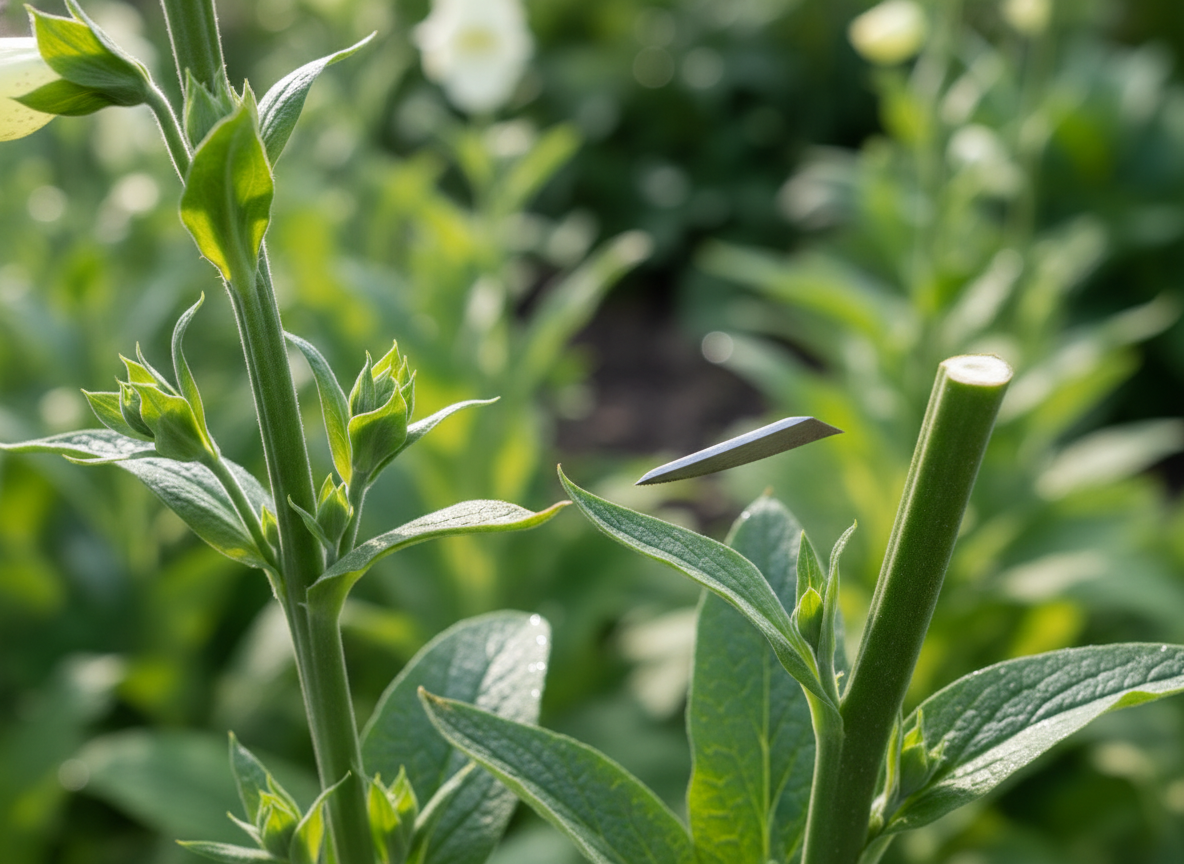 A cut foxglove stem with a newly severed piece of stem and a leaf — AI-generated illustration
The exact cut: just above a leaf, not at the base
Every foxglove I’ve ever rescued for a third year was cut the same way. Find the main flowering spike. Follow it down from the top, past all the spent bells, until you reach the first proper leaf on the stem — the leaves change here from the small papery bracts that subtend the flowers to a recognisably larger, ribbed, soft leaf. That leaf node is your target. Cut the spike about a finger-width above it, on a slight angle so water runs off, with sharp secateurs.
Two things matter about that point. First, the axil of that leaf — the little pocket where leaf meets stem — already contains a dormant lateral bud, pre-formed weeks ago, just waiting for the apical spike above it to be removed. Lose the leader and the bud breaks within seven to fourteen days. Second, do the same on every spike that has a leaf below the spent zone, and you usually find three to five viable leaf nodes per plant — which means three to five second-flush spikes per crown, not just one.
These second spikes are shorter — typically 40 to 60 cm against the main spike’s 1.2 to 1.8 m — and the bells are a little smaller. But there are several of them per plant, they keep coming through July and into August, and on a generous clump the total flower count often matches the original tower. A border of cut-back foxgloves in late July, when the rest of the cottage planting is starting to sag, is one of the quiet payoffs of this job.
The two mistakes that swallow the second flush both come from cutting in the wrong place. Cut too high, just below the spent zone but well above any leaf, and you leave a length of bare hollow stem with no axillary buds to break — the cut blackens, dies back, and nothing happens. Cut too low, snapping the whole spike off at ground level, and you have removed every single axil with it — same result, no second flush, just a tidy rosette. The leaf node is the whole point.
Why a cut turns a biennial into a perennial
It still feels like sleight of hand, so it’s worth pinning down what’s actually happening underground.
A foxglove crown carries a finite reserve of sugars and starches that it spent the whole of last year building. In year two — this year — it pours that reserve into the spike, the bells and, if you let it, the seed. By the time the first pods finish ripening in late June or early July, the reserve is gone. The rosette has nothing left to make new leaves with through the summer, the root system stops investing in fresh roots, and the plant dies back from the crown outward. That is the entire life cycle of Digitalis purpurea in three sentences.
Take the spike off before the pods set and the books don’t balance the way the plant expected. The big sink for sugar — developing seed — vanishes. The reserves it was going to throw into that sink get redirected, partly into the second-flush side spikes you’ve just triggered, but mostly back into the crown and roots. The rosette holds onto its leaves, photosynthesises through July and August, and by autumn the crown has rebuilt a partial reserve. It overwinters as a fresh green rosette, and the following spring it flowers again. Sometimes it manages it twice; on rich, free-draining soil with mild winters, I have seen the same crown flower for four seasons.
This is the same trick that works on a handful of other supposed biennials and short-lived perennials — Sweet William, several Verbascum species, some Lunaria — and it’s the reason knowledgeable gardeners say “I never bother resowing my foxgloves.” They aren’t growing different plants from you. They are cutting differently. If you’ve read why cutting the brown collapse of an oriental poppy to the ground in late May buys a second flush of fresh foliage, this is the same principle on a different timescale: intervene before the plant locks in its end-of-season programme, and the season keeps going.
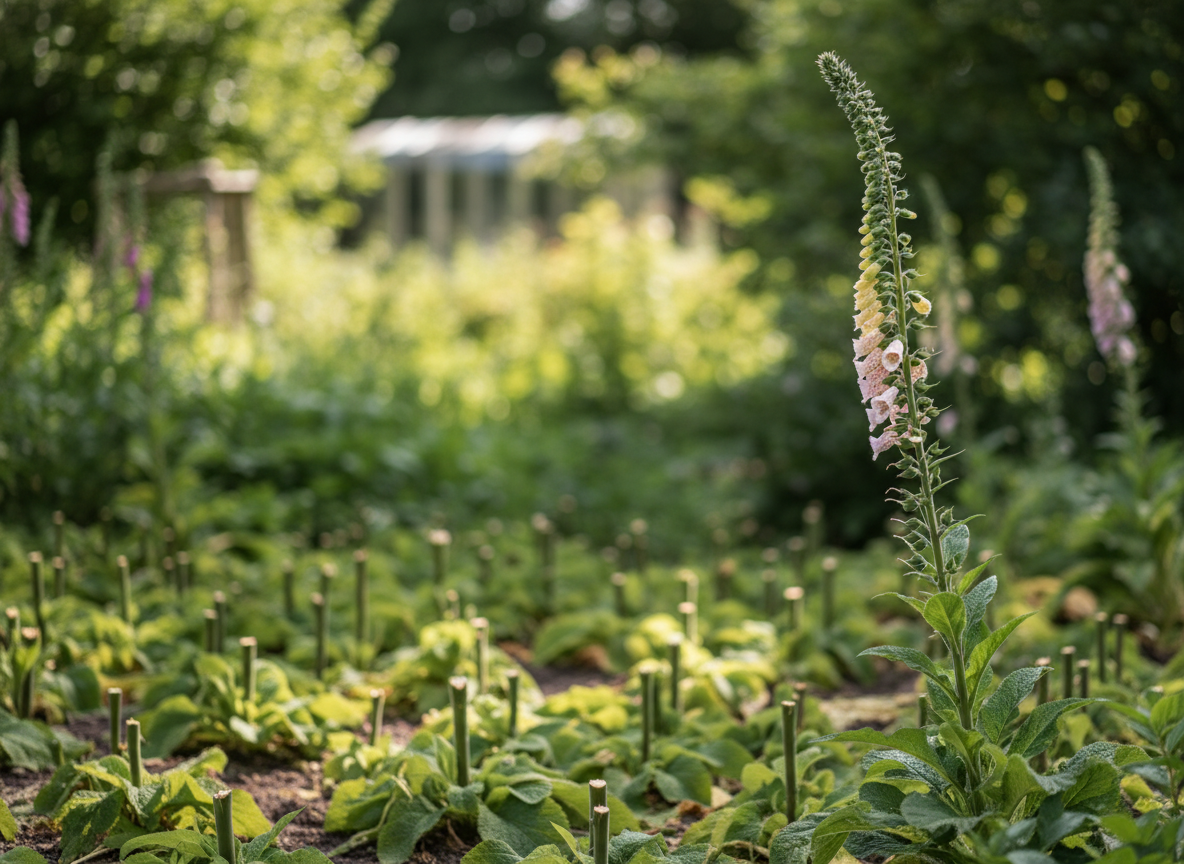 . A single foxglove in bloom stands among cut foxglove stalks in a garden — AI-generated illustration
The hybrid play: cut most, leave one to seed
There is an obvious problem with cutting every spike on every plant. Foxgloves seed themselves through your borders for free, and a garden that has been ruthlessly deadheaded for three years runs out of foxgloves. The fix is straightforward, and it is what I do every June.
Pick your two best-looking plants — the tallest spike, the cleanest colour, the one with the best pattern in the throat — and on each of them leave the main spike alone to finish, ripen and shed seed. Cut the side spikes off those plants once they fade, so the plant doesn’t exhaust itself on a long sideshow, but let the main tower set its pods. Cut every other plant in the border the way described above, just above the highest leaf. You get a strong second flush from most of the garden, and enough seed from the two reserved plants to keep next year’s seedlings coming.
A few practical numbers. One mature foxglove spike carries roughly 30 to 80 bells, and each ripe pod releases something between several hundred and well over a thousand of those famously tiny seeds — a single spike is easily ten thousand seeds. They need light to germinate, so they want surface-sown, not buried. The simplest method is the laziest: tip the ripe spike upside down over a patch of bare soil in late July, give it a gentle shake, and rake nothing in. The seedlings come through in August and September, overwinter as small flat rosettes, fatten through the following spring, and tower the year after. From a single reserved spike you can populate twenty square metres of border without ever sowing intentionally.
If you want to control where they go, snip the ripe pods into a paper bag, dry them upside down for a week, shake the seed loose, and scatter it where you actually want next year’s drift. Foxgloves prefer light shade and a slightly acid, leafy soil — woodland edges, the foot of a north wall, under a high-canopy tree — and the seedlings transplant well from autumn into spring as small rosettes, less well once the spike is starting to draw up.
Perennial foxgloves and the F1 hybrids play by the same rule
Not every foxglove is Digitalis purpurea, and the species genuinely matters here.
The true perennial foxgloves — Digitalis grandiflora (the soft-yellow large-flowered foxglove), D. lutea, D. ferruginea (rusty foxglove with its tight-packed bronze spire) and D. lanata — are not monocarpic. They live for years anyway, and they will flower without your intervention. But cut them in exactly the same way, just above the highest leaf as the bottom bells fade, and you still get a tidy second flush of side spikes that extends their season by four to six weeks. With the perennials the cut buys you flowers; with D. purpurea it buys you both flowers and another year of plant.
The modern F1 hybrids are the third case and the one most gardeners are now buying without realising it. The ‘Camelot’ series (Cream, Lavender, Rose, White) and ‘Dalmatian’ series flower in their first year from a January or February sowing — they are genuinely first-year-flowering and they behave more like short-lived perennials than biennials. Treat them like the perennials: same cut, same window, expect at least two seasons of flowering. Digiplexis ‘Illumination Pink’ and its newer siblings are sterile inter-generic hybrids of Digitalis with Isoplexis from the Canary Islands; they make no viable seed at all, which means there is nothing on them to interrupt by cutting — but the cut still triggers strong sideshoots and is the difference between a plant that flowers from June through to the first frosts and one that gives you a single tower and then sulks.
The one foxglove worth treating differently is Digitalis ferruginea. Its spire is so architectural — a slender bronze rocket two metres tall — that I generally leave the main spike standing through August even after the bells brown over, because it is still doing useful work in the border outline. Cut it in September instead, or never. Your choice.
If you aren’t sure what you’ve got, look at the leaves at the base. Purpurea has very soft, grey-green, woolly leaves that feel like a sage; grandiflora and lutea have smoother, shinier, narrower leaves; the F1 cultivars usually have a label tag still pushed in beside them somewhere. The cut is the same; the gain is different.
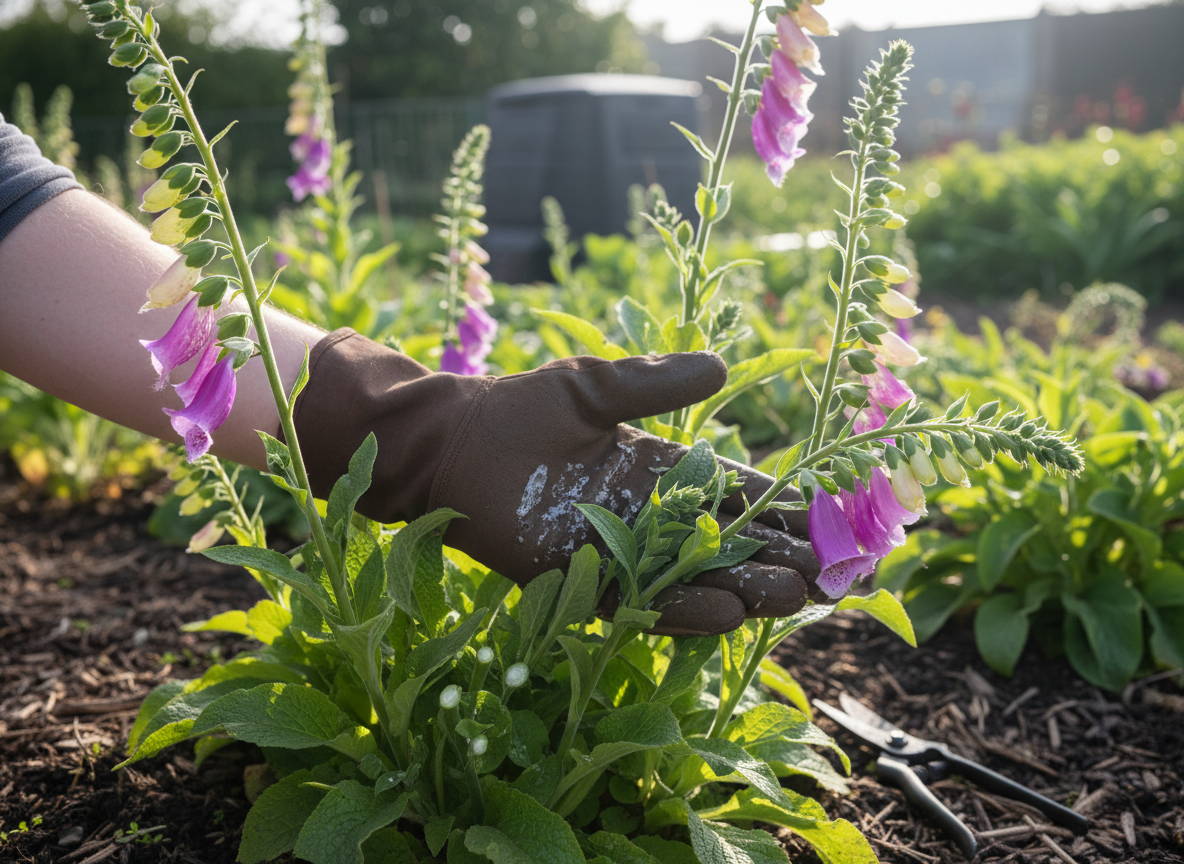 A person in a brown glove tending to blooming foxgloves in a garden — AI-generated illustration
Toxicity and how to handle the clippings
Every part of every foxglove contains cardiac glycosides — chiefly digitoxin and digoxin, the same molecules used (in extraordinarily measured doses) to treat heart failure. The therapeutic margin in medicine is famously narrow, and the dose in plant material is not measured at all. Sap on bare skin is not usually a problem for most people but can cause irritation; ingestion of even small amounts of leaf or seed can cause vomiting, irregular heartbeat and worse, particularly in children, dogs, cats, sheep and horses.
The handling rules are simple. Wear gloves; the sap on your fingers does no harm but you do not want to rub your eye an hour later with leaf juice on your hand. Bag the spent spikes and clippings rather than leaving them on a lawn where a curious dog can chew them. Don’t burn them on a bonfire — the smoke carries fine particulate that’s worth not inhaling. The clippings compost fine in a hot, closed heap; the glycosides break down within weeks once the leaf tissue rots. Avoid an open compost bay accessible to pets.
If you have foraging children, a livestock paddock, or a dog with a leaf habit, this is the kind of plant that benefits from a quick “where are the foxgloves” walk every June, so you know what’s gone where. They are far too good a plant to give up over the risk, but they are not lettuce.
The window is a week, not a month
What this whole job hangs on isn’t a date — it’s a stage of the spike.
The cut window opens when roughly the bottom third of the main spike has finished and the lowest pods are visibly swelling but still green, and it closes when the bottom pods turn brown and start to dry. That window is, in practice, about ten days long. In a cool spring it falls in the second and third weeks of June across most of Britain and the Netherlands; in a warm spring like much of Northern Europe has just had it can open in the very last days of May. Get in within that window and the second flush is reliable. Miss it by two weeks and you’ll get a thin, late, half-hearted re-bloom or none at all, because the death signal has already been sent and the reserves have already been committed to seed.
That is exactly the kind of moving, plant-specific window that Cresco is built to read. Photograph your foxglove and the app tells you whether you’ve got common purpurea, the perennial grandiflora or a first-year-flowering ‘Camelot’, then reads your local weather and the stage of your spike to tell you the week your second-flush cut actually opens — and reminds you again next year, because foxgloves move with the season and the calendar lies. For everything else clamouring for the secateurs right now — the late-May chop on hardy geraniums, the Chelsea chop on perennials, the light June trim on broom — the month-by-month pruning guide shows where the foxglove cut sits in the early-summer queue.
The 30-second version
- A common foxglove is monocarpic — it dies because it sets seed, not because it gets old. Cut the spike before the bottom pods ripen and the death signal is never sent.
- Cut the main spike a finger-width above the highest leaf, not at the base. Each leaf axil contains a dormant bud that breaks within 7–14 days into a second-flush side spike.
- A well-grown plant gives you three to five side spikes per crown, 40–60 cm tall, flowering through July and August.
- Cut too high (above bare stem, below the bracts) and the cut blackens with no break; cut too low (whole spike to ground) and you remove every axil. The leaf node is the whole point.
- The hybrid play: cut every plant for the second flush, but leave the main spike on your two best plants alone to set seed for next year’s drift.
- Window: roughly the second and third weeks of June, opening earlier in a warm spring. About ten days wide. Miss it by a fortnight and the re-bloom is poor or absent.
- Perennial species (grandiflora, lutea, ferruginea) and F1 hybrids (‘Camelot’, ‘Dalmatian’, Digiplexis) take the same cut — you gain side spikes rather than years.
- Every part is toxic to people and pets. Wear gloves, bag the clippings, don’t burn them on a bonfire.