The flop isn’t a watering problem
Walk past a border in the last week of May and the hardy geraniums tell you exactly where they are in the cycle. Until about the 20th of the month, Geranium ‘Johnson’s Blue’ is a humming, knee-high cushion of cobalt — bumblebees three to a flower, leaves still fresh green, no obvious mess. A week later, the same clump looks like you’ve been on holiday. Petals shattered into a confetti at the base, leaves rolling and going purple-red at the edges, stems half-collapsed onto whatever’s growing beside them.
The instinct is to read this as drought stress and reach for the watering can. It almost never is. Late May in the UK and the Low Countries has had enough rain to keep the soil moist below the top centimetre, and hardy geraniums put down a fibrous root mat that doesn’t care about a dry top layer anyway. What you’re seeing is the plant doing exactly what its calendar told it to do: pump out one big flush of flowers in three weeks, set a small handful of seed, then go into a tatty, half-shut-down state through high summer.
That tatty state is optional. Cut the clump hard now — to about five centimetres above the crown, every stem, every leaf — and within a fortnight you have a fresh mound of clean foliage; within four to six weeks, a second, slightly smaller flush of flowers that runs into August. Skip the cut and you get eight weeks of progressively worse mildew, a clump that goes into autumn weak, and no second show. The cut takes ten minutes per plant. The skip costs you the rest of your summer.
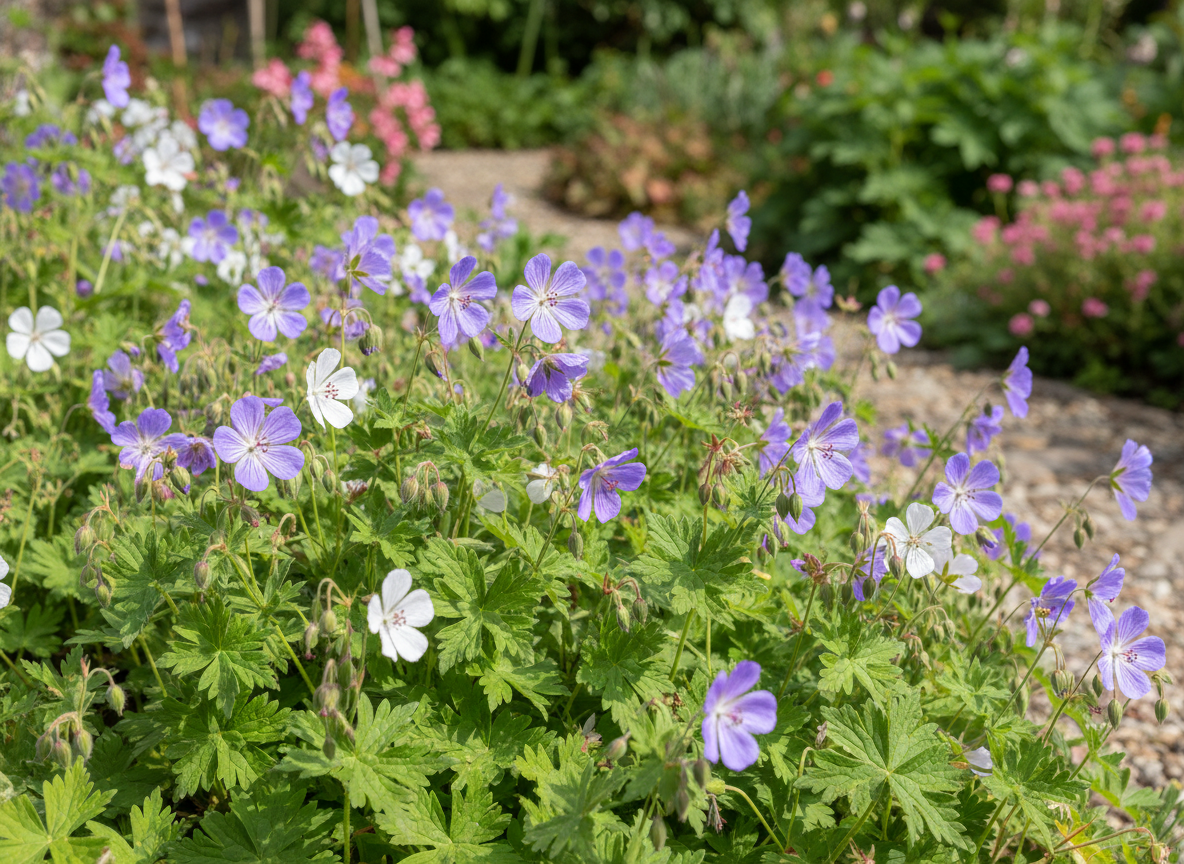 A bed of hardy geraniums with purple and white flowers — AI-generated illustration
Which geraniums this is actually for
This post is about the early-flowering cranesbills — the ones that put on one big May display and then visibly give up. The roll-call, in roughly the order they go down in a Dutch or south-of-England garden:
- Geranium phaeum (mourning widow, donkere ooievaarsbek). Earliest of the lot. Done flowering by mid-May, foliage hanging on but tatty.
- Geranium sylvaticum (wood cranesbill). Mid-May, flowers in violet-blue, finishes around the 25th.
- Geranium pratense (meadow cranesbill). The native British and Dutch hedge-bank species. Big sky-blue flowers in the second half of May.
- Geranium ‘Johnson’s Blue’. The classic hybrid. Mid- to late-May, the cobalt curtain that everyone wants.
- Geranium macrorrhizum (bigroot, balkanooievaarsbek). May into early June, semi-evergreen, the one with the sticky aromatic leaves.
- Geranium × magnificum (‘Rosemoor’, ‘Peter Yeo’). Late May, intense purple-blue, sterile, never sets seed but still benefits from the cut.
- Geranium ‘Brookside’. A ‘Johnson’s Blue’ relation, slightly later, but on the same chop calendar.
If any of these is in your border, look at it this afternoon. If two-thirds of the petals are on the ground and the leaves at the centre of the clump are starting to brown at the tips, you’re in the window. The window stays open for about ten days — miss it by a week and you’ve still done the right thing, miss it by a month and you’ve lost the second flush.
The four cultivars this post is not about are the long-bloomers that flower right through summer without help. ‘Rozanne’ (sterile, June to October on its own), ‘Mavis Simpson’, ‘Patricia’, and ‘Ann Folkard’. Don’t chop these in late May — they’re still building up to their main display. We’ll come back to them at the end.
The cut: shears, five centimetres, no exceptions
You want a pair of garden shears for this, not secateurs. A clump of Geranium ‘Johnson’s Blue’ in late May has somewhere between two hundred and four hundred stems. Snipping each one with secateurs takes twenty minutes and gives you tennis elbow; shears do the same job in two minutes and the slightly ragged cut doesn’t matter at all — the regrowth comes from the crown below, not from the cut stems.
Gather the clump up loosely in one hand, the way you’d gather a ponytail, lift it a few centimetres clear of the ground to expose the base, and cut horizontally across at about five centimetres above the soil. Drop the cut material onto the path or a tarp. Then go round the outside of the clump and trim off any low leaves or stems you missed — there are usually a few that ducked under your hand on the first pass. The whole job, on an established clump 60 cm across, takes between three and five minutes.
The cut should leave you with a green stubble that looks brutal for forty-eight hours. Don’t second-guess this. The five-centimetre stubs contain dormant buds at the leaf nodes, which are the source of the new flush. Cut shorter than three centimetres and you risk taking the crown buds with the stems; leave it taller than ten and the clump regrows lopsided around the old stem stubs and never looks tidy.
Two things to do the same afternoon:
- Water it in, even if you don’t think it needs it. The cut roughly halves the leaf area the roots are supplying, and a soaked clump pushes new shoots faster than a dry one. Five litres of water per established clump, poured slowly at the base, is plenty.
- Mulch with compost or leaf mould, two to three centimetres thick, over the cut crown but not piled against any remaining stem tissue. This keeps the crown cool, slows evaporation, and feeds the regrowth straight into the new shoots.
What you don’t need to do is feed it. Hardy geraniums are not heavy feeders, and a nitrogen hit at this stage produces soft, sappy regrowth that flops worse than the original and attracts aphids. The mulch does everything the plant needs.
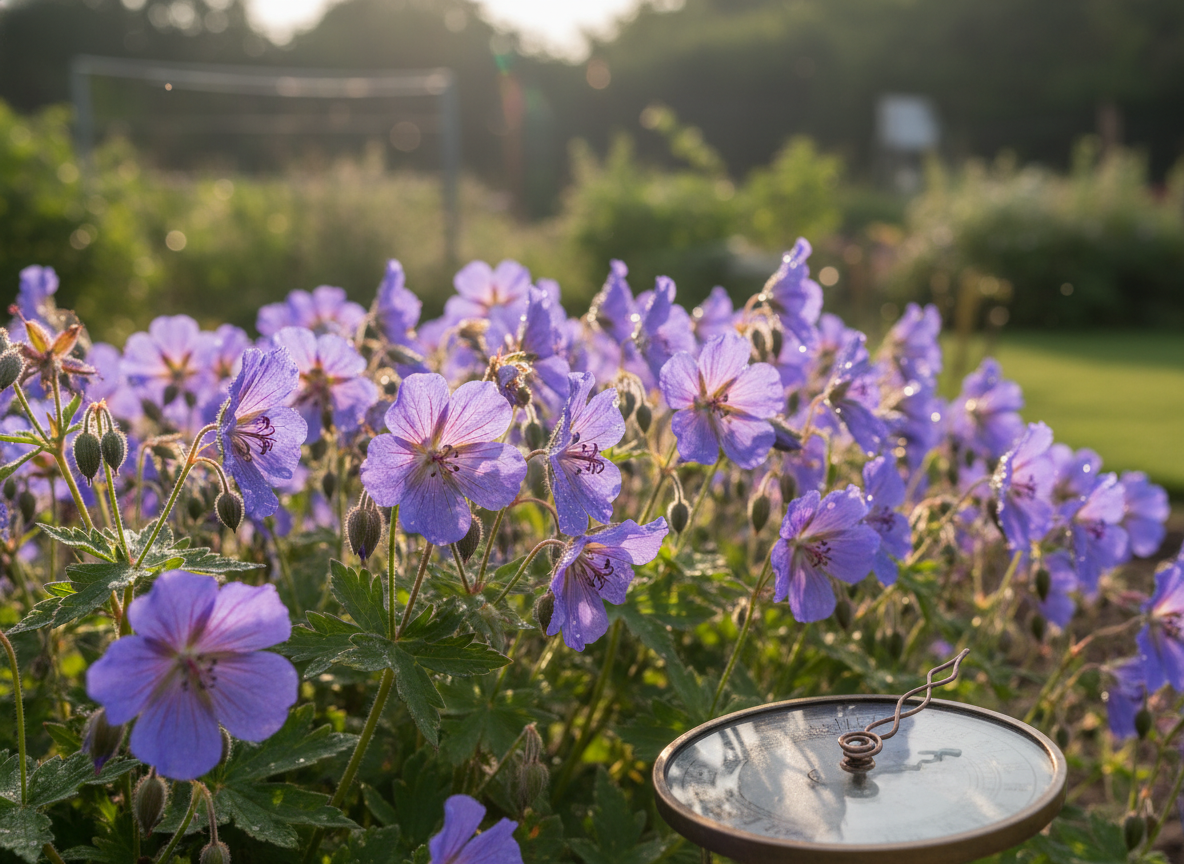 Hardy geraniums in bloom with a sundial in natural daylight — AI-generated illustration
The two-week clock starts now
The timeline after the cut is consistent across species and rarely varies by more than a few days:
- Day 3–5: First green points visible at the crown. They look like little asparagus tips pushing through the mulch.
- Day 10–14: A neat mound of fresh leaves, roughly half the size of the old clump. Foliage colour is noticeably brighter than what you cut off — fresh apple-green, no purple edges, no mildew.
- Day 21–28: Clump is back to about three-quarters of its pre-cut footprint, all of it new growth. First flower buds appearing on the early species (G. macrorrhizum, G. phaeum).
- Week 5–7: Second flush of flowers opening on the rebloomers. Smaller than the first show — roughly one-third to one-half the flower count — but the foliage is so much cleaner that the overall effect is often more attractive than the May explosion.
The second flush runs for about three weeks and then the plant settles down for a long, presentable, mostly-leaves phase through August and September. In a wet late summer you sometimes get a third, very small flush in early October on G. × magnificum and ‘Brookside’. Don’t bank on it, but enjoy it when it happens.
The mildew angle nobody talks about
Powdery mildew on hardy geraniums is the silent reason borders look tired by July, and it’s the single best argument for the late-May cut even on cultivars that don’t really rebloom. The fungus (Podosphaera fusca on most cranesbills) sits on the leaf surface as a fine white bloom, which gardeners notice in August and write off as “old leaves.” By then the spores have been on the plant for two months and have moved next door onto your asters, your roses and your acanthus.
The mildew starts colonising the geranium leaves around the time of the first flush of flowers — when the foliage is dense, the airflow inside the clump is poor, and the leaves are starting to lose their wax cuticle as they age. By the last week of May the spores are present but not yet visible to the eye. Cut the clump to five centimetres and you take roughly 95% of the spore load to the compost heap with the leaves. The regrowth comes from clean crown tissue, with three to four weeks of summer ahead of it before the spore population around your border builds back up.
The bag-it-or-burn-it question matters less than people think. Mildew spores survive composting unevenly, but they survive on uncut leaves around your border with perfect reliability. The cut is the win. If you have a hot heap (over 60 °C in the middle), the cut foliage is fine to compost; if your heap is a slow cold one, run the cuttings through the council green waste instead.
This is also the moment to look at G. macrorrhizum in particular. Its aromatic leaves are mildew-resistant when young but go reliably ratty by August if left uncut. A late-May shear takes a near-evergreen plant from “needs hiding behind something else by July” to “the tidiest thing in the border in September.”
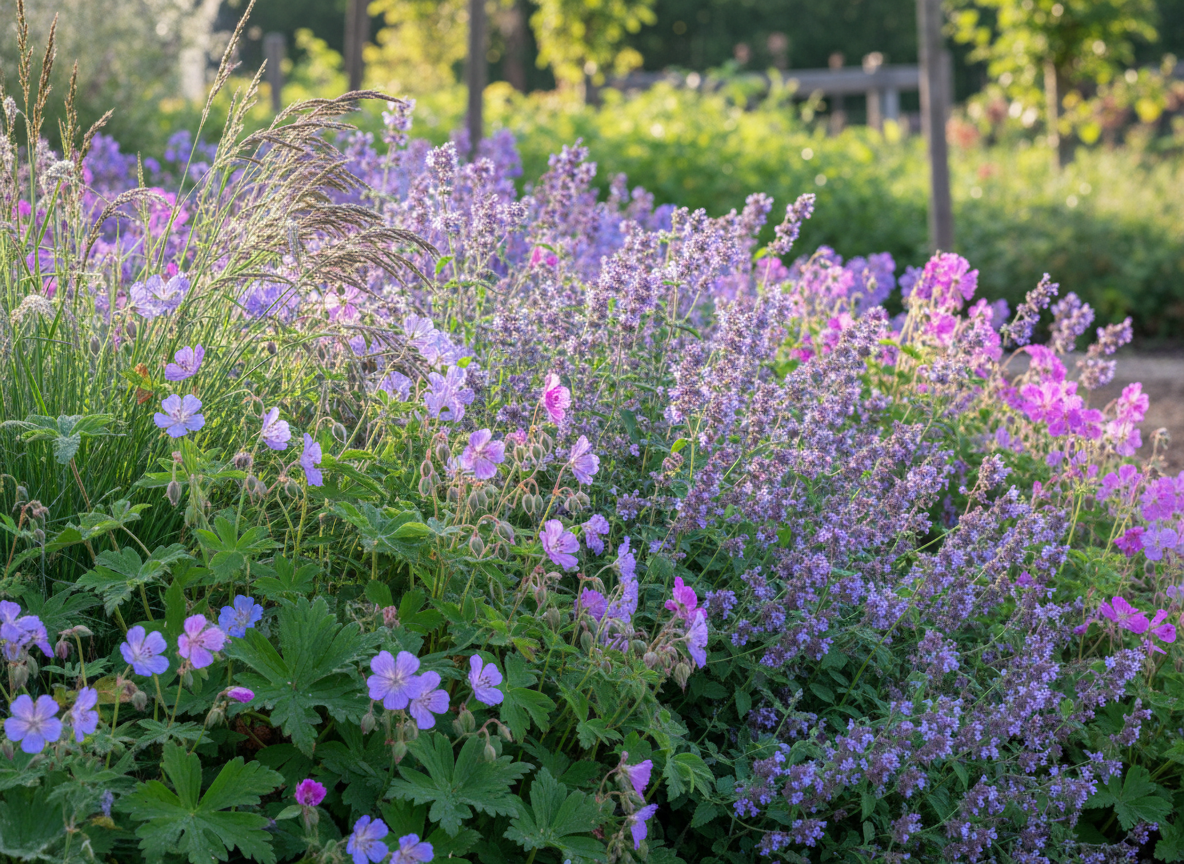 Hardy geraniums and other plants growing closely together in a garden — AI-generated illustration
What to plant alongside so the gap doesn’t show
A 60 cm clump of ‘Johnson’s Blue’ that you’ve just cut to five centimetres is, for the next ten days, a stubble pad the size of a dinner plate. If your geraniums are at the front of a border, the gap is right where every visitor’s eye lands. Three planting tricks solve this completely:
- Plant the rebloomers behind the long-bloomers. A row of ‘Rozanne’ at the front, Geranium ‘Johnson’s Blue’ or G. pratense immediately behind. When you cut the back row in late May, the front row is just coming into flower and visually carries the spot for the fortnight the back row needs to regrow. By the time ‘Rozanne’ is in full swing in June, the back row is back to fresh foliage and providing a green backdrop.
- Use a low-spreader that’s still in growth. Alchemilla mollis (lady’s mantle) is the classic answer — chartreuse foam of flowers from late May, takes its own light chop in late June for a second show, hides everything. Erigeron karvinskianus (Mexican fleabane) does the same job in a sunnier, drier spot and never stops flowering.
- Slide a tall airy plant just behind for a screen. Verbena bonariensis doesn’t really get going until June but the wiry stems are tall enough by the end of May to break up the view down into the gap. Same trick with Stipa gigantea (golden oats), which is at its peak in early June precisely when the chopped geraniums are at their stubbliest.
The gap is also visually shorter than it feels. In a border where you stand back two or three metres, the eye reads “fresh foliage, slightly low” rather than “missing plant” within about a week of the cut.
The four common mistakes
After half a dozen years of doing this on a mixed border with twelve or so hardy geranium varieties, the failure modes are predictable. None of them is catastrophic — hardy geraniums are about the toughest perennial in the UK and Dutch trade — but each one costs you the second flush.
Cutting too early. People who heard about the Chelsea Chop chop all their perennials in the third week of May, hardy geraniums included, regardless of whether they’ve finished flowering. If your geranium is still in full bloom you’re cutting off the show you waited all year for, and the plant doesn’t push a fresh flush from a still-flowering base — it sulks for three weeks. Wait until at least two-thirds of the petals are on the ground.
Cutting too late. Equally common. The clump goes tatty in early June, the gardener notices, intends to cut it “next weekend,” forgets, and ends up shearing in mid-July. By then the plant has gone into its proper summer dormancy and the cut produces a small flush of leaves and no second flowers at all. The window is short: roughly 25 May to 5 June for most early hybrids in northern Europe, a week or so earlier in a warm spring.
Cutting too low. A hedge trimmer or a strimmer gets you down to two centimetres, which sounds neat but takes the crown buds with it. The clump still regrows — hardy geraniums are stubborn — but from deeper, slower buds, and you lose two weeks of regrowth speed. Shears, hand height, five centimetres.
Forgetting to water. Especially on free-draining soils in a dry late May. A cut clump that goes into a dry week pushes a thin, slow flush and may not flower again at all. Water it in once, mulch, and the rain will do the rest unless June is exceptionally dry.
The long-bloomers don’t want this — and what to do with them instead
A quick word on the four cultivars to leave alone in late May, because doing the wrong thing to a ‘Rozanne’ is a real disappointment when you find out.
‘Rozanne’ is sterile — it produces no viable seed — and flowers continuously from late June to the first hard frost without any input from you. It doesn’t have a tatty mid-summer phase to recover from, because it never had a synchronised flush in the first place. If you shear it in late May you’re cutting off the building-up phase of the season’s only flowering wave, and the plant will spend the next month rebuilding to where it was. You’ll still get flowers, but you’ll get them a month later and the total count will be roughly halved.
The same applies to ‘Mavis Simpson’ (paler pink, slightly less vigorous than Rozanne but the same flowering pattern), ‘Patricia’ (magenta with a black eye, June to October), and ‘Ann Folkard’ (purple-pink, lime-green foliage, sprawls through neighbouring plants).
What these four do benefit from is a light tidy in mid-July — pull out any flopping or browning stems, snip back the longest sprawlers by a third, and they reward you with a clean second wave that runs to October. That’s a different post for a different month.
Cresco can tell you which week is yours
Hardy geraniums are the perfect case for a calendar that pays attention to what your plants are actually doing rather than what the date says. The chop window is real, it’s short, and it varies by species, cultivar and weather — G. phaeum might need cutting on 15 May in a Surrey garden after a warm spring; G. macrorrhizum in the same border won’t be ready until 5 June.
This is what Cresco’s pruning planner is built for. Snap a photo of the clump, and it identifies the species or hybrid, looks at the last fortnight of temperatures and the forthcoming forecast, and tells you which week to put shears to it — and which of the long-bloomers in the same border to leave alone. It does the same for the wisteria summer pruning that’s three weeks away, the lavender shape-up in September, the buddleia chop next March, and the forty-odd other right-week-not-right-month decisions across a season. The kind of thing that’s obvious to a head gardener with thirty years’ practice, and not at all obvious if you’re still learning your border.
If your ‘Johnson’s Blue’ is looking ragged today, this is your week. Shears, five centimetres, water, mulch. Ten minutes per clump, then walk away. Two weeks to fresh leaves, six weeks to a second flush, and a border that looks better in late July than the unchopped one next door.