What’s happening underground right now
By the third week of May, your tulip flowers are gone, the stems are turning straw, and the leaves look like they’re sulking on purpose. The temptation is to tidy. Don’t.
Underneath, the bulb you planted last October is dead. It used itself up producing this spring’s flower. What’s there now is a cluster of new daughter bulbs, formed at the base of the leaves, and they are the only thing that can flower next year. Every gram of starch they need to reach flowering size has to come from the foliage above ground, photosynthesising in the warmth of late May and early June.
Cut the leaves now and you’ve cut the supply line. The daughter bulbs are still there — they just won’t be big enough to make a flower. They’ll throw up a single thin leaf next April and skip the bloom entirely. Gardeners call this “going blind”, and almost every case of it traces back to a tidy-up done somewhere between the first and the fifth of June.
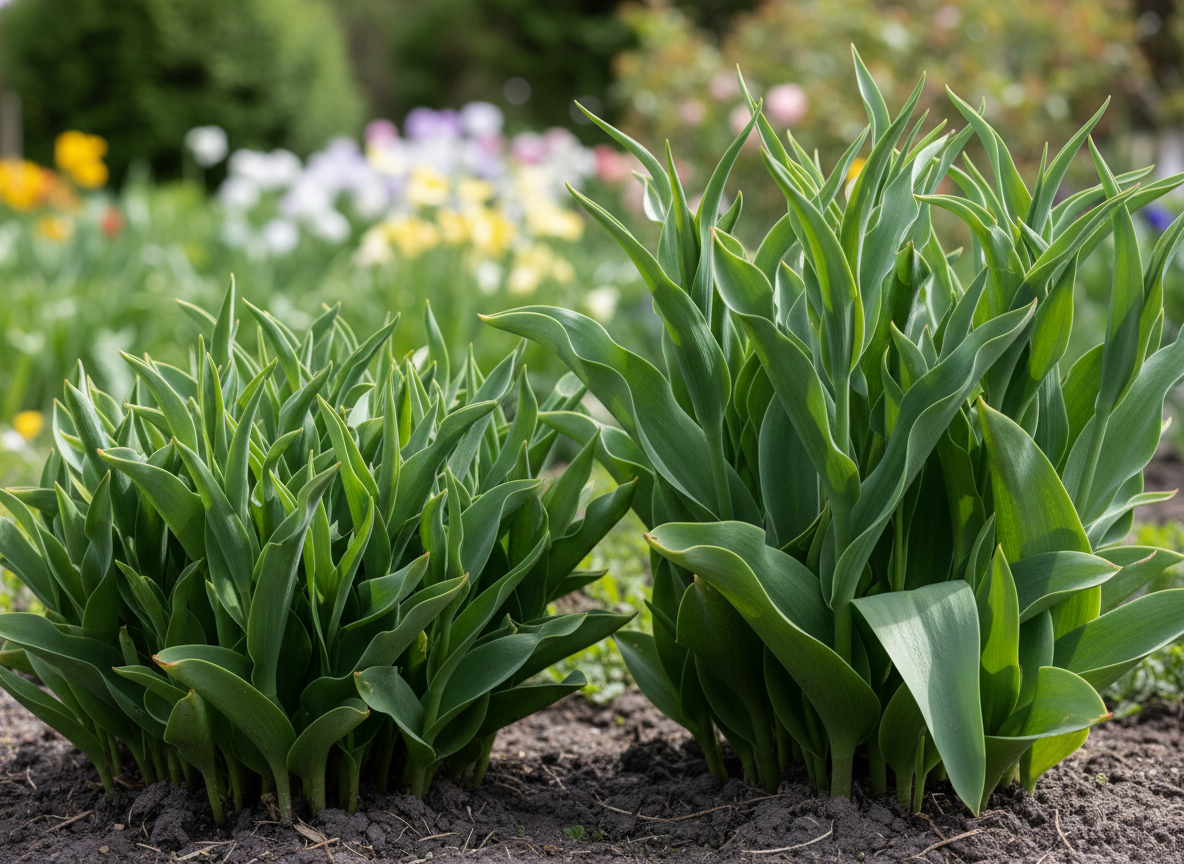 Two groupings of green tulip foliage in a garden bed — AI-generated illustration
Eight weeks, not six
The advice for daffodils is six weeks of foliage after flowering. For tulips, it’s eight. The reason is in the architecture of the bulb itself.
A daffodil bulb is perennial: the same bulb flowers year after year, growing slightly larger each season. Tulips replace themselves entirely. Where a daffodil only has to top up an existing bulb, a tulip has to grow a brand-new one from a tiny initial of tissue. That’s a much bigger metabolic job, and it needs roughly a third more time in leaf to finish.
Mark the date your tulips finished flowering — for most of the UK and the Low Countries in 2026, that was around the second week of May — and count eight weeks forward. You’re looking at the first or second week of July before the leaves are doing their job. If you’ve cut them in May, you’ve stolen six weeks of the bulb’s working life.
Deadhead the flower. Never the leaves.
There’s one thing you absolutely should cut in late May, and that’s the spent flower head. Once a tulip is pollinated, it pours energy into making seed — and tulip seed takes seven years to reach flowering size, which is no use to anyone with a border to fill. Pinch the seed pod off cleanly, about a centimetre below where the petals were, and you redirect every joule of that wasted seed production back into the daughter bulbs.
Leave the stem and the leaves. The stem is green too — it photosynthesises along with the foliage, and the bulb counts it as part of the engine. Cutting the flower head is roughly a five-second job per plant, takes care of the messy look that drives most gardeners to over-prune, and is the single highest-return tulip task of the year.
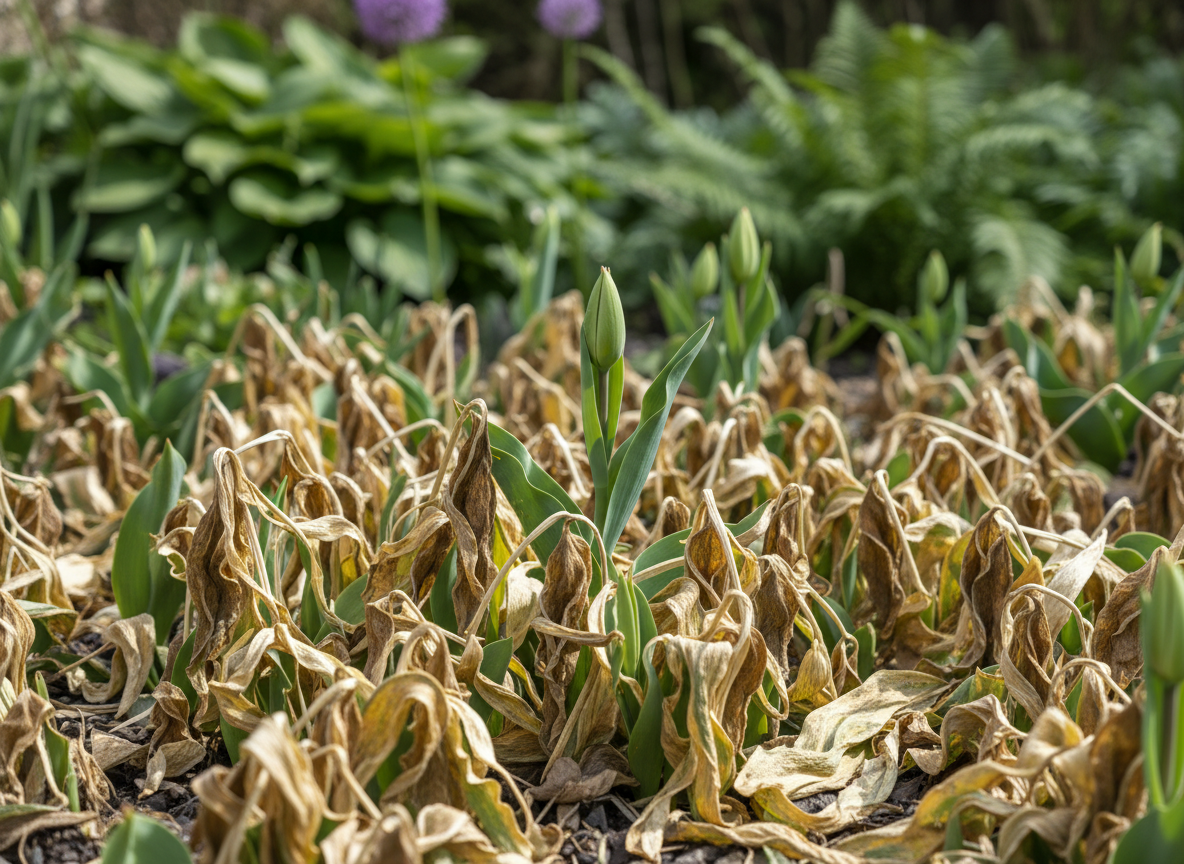 Tulip foliage, some green and some dried, in natural daylight — AI-generated illustration
Not all tulips are built to come back
Before you commit to the eight-week wait, it’s worth knowing which tulips in your border actually have a shot at perennialising. The trade plants several broad groups, and they don’t behave the same way.
Darwin hybrids are the ones bred for return performance. Varieties like ‘Apeldoorn’, ‘Pink Impression’ and ‘Golden Apeldoorn’ will reliably re-flower for five or six years if the leaves are left alone. Single late tulips and species tulips (the small wild forms — Tulipa tarda, T. clusiana, T. sylvestris) are even better; species can naturalise for decades.
Parrot tulips, double late and most fringed and lily-flowered types are bred for visual drama, not longevity. They’ll often manage one repeat year, then dwindle. Triumph tulips sit in the middle — some perennialise, some don’t, and the only way to know is to mark a clump and watch it.
If your spring border is mostly parrots and doubles, the eight-week vigil is still worth doing, but go in with realistic expectations. You’re buying a second year, not a decade.
To lift or to leave
The late-May decision splits two ways, and your soil makes the call.
Free-draining, sunny, sandy soil: leave them in the ground. Tulips are native to the dry slopes of central Asia. They need a hot, dry summer baking to ripen the new bulbs — the same conditions you’d give a stone fruit. If your border drains fast and sits in full sun from June to September, the bulbs will get exactly that, and lifting only causes them stress.
Heavy, wet, or shaded soil: lift them. Damp summer ground rots the new bulbs before they ever flower again. Wait until the foliage has yellowed (early July, in line with the eight-week rule), lift gently with a fork, separate the daughter bulbs from the spent mother, brush off the soil, and dry them in a single layer in an airy shed for two weeks. Store in paper bags somewhere cool and dark until October planting.
The mistake is lifting in late May while the leaves are still green. You’ll get clean bulbs and zero flowers next year, because you’ve interrupted the only part of the cycle that matters.
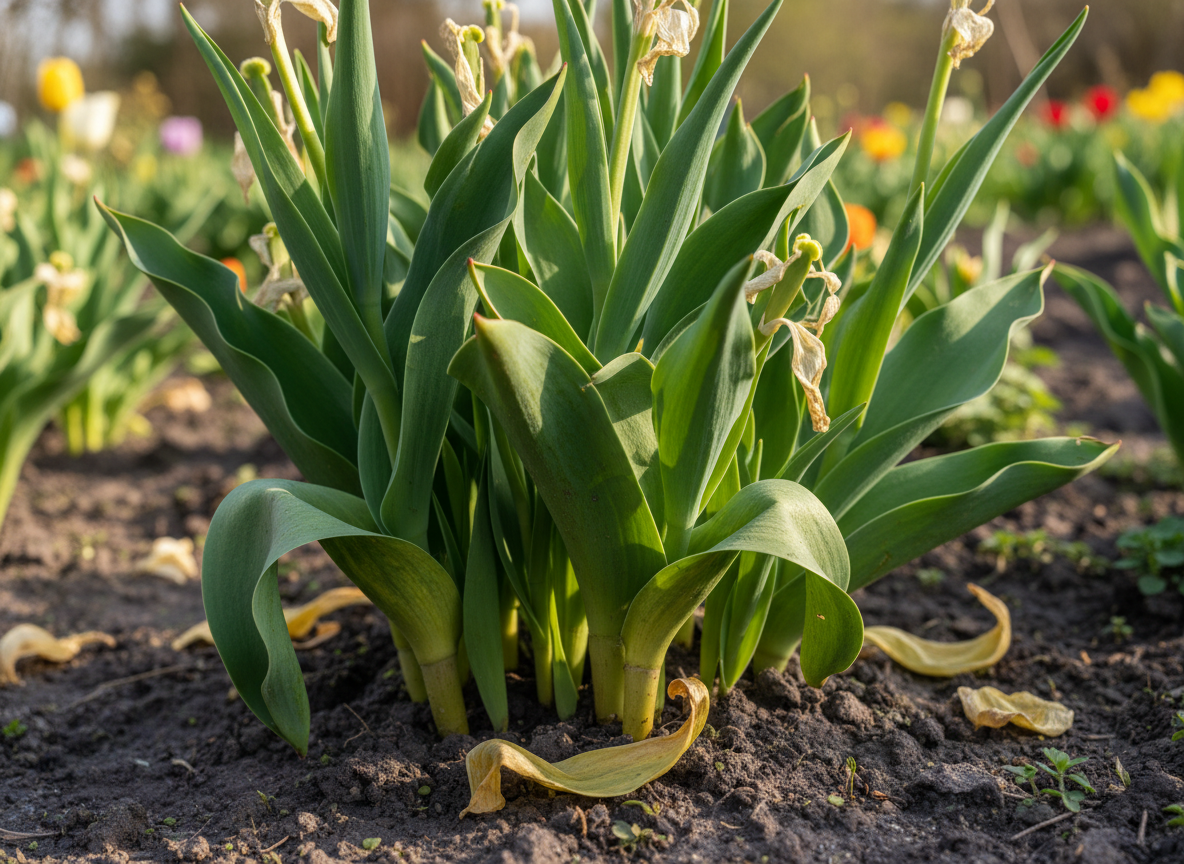 Yellowed tulip foliage ready to lift by hand — AI-generated illustration
What “ready to cut” actually looks like
The eight-week rule is a rough guide. The real test is on the plant itself. Foliage that’s truly done has three signs:
- The colour is gone. Not yellowing, not pale green — properly yellow, with brown tips creeping down from the apex.
- The leaf is limp at the base. A gentle tug at the lowest point of the leaf and it should come away with almost no resistance. If you have to twist, it’s not ready.
- The stem is hollow when pinched. A finger-press near the base meets no resistance; the tissue is empty.
When all three are true — usually first to second week of July in most British and Dutch gardens — you can lift the leaves off by hand. No secateurs needed. If you find yourself reaching for shears, the bulb hasn’t finished its job.
The long game: site, depth, and feeding
If perennial tulips are the goal, three things matter more than the late-May cleanup.
Planting depth: 20 cm minimum, measured from the base of the bulb to the soil surface. Shallow bulbs split into many small offsets that take years to flower. Deep bulbs stay as single large ones, more like the wild Asian forebears.
A summer feed: a light dose of sulphate of potash (about a tablespoon per square metre) scratched into the soil around the foliage as soon as the flowers fade. Potassium is what the bulb uses to build storage tissue; nitrogen at this stage just feeds the leaves and delays bulb ripening.
Sun, not shade: tulips that get morning sun and afternoon shade rarely perennialise. They need a full day of light on the foliage for the eight-week window to do its work. If your tulips are under a deciduous tree that leafs out in May, accept that they’re a one-year plant and move on.
How Cresco helps
The hard part about the eight-week window isn’t knowing the rule. It’s remembering to leave the plants alone when everything else in the border is being cut back, deadheaded, or staked. Cresco builds a custom care calendar from photos of your actual plants, and the tulip entries are date-locked: if you planted Darwin hybrids in October, the app won’t let you mark “tidy foliage” as done until the first week of July. It’s a small piece of friction, but it’s the friction that turns a one-year tulip into a five-year one.
Snap a photo of your borders now, log the varieties you can identify, and the late-May reminders will arrive on the right date next year — together with the deadheading and feeding tasks that double the odds of a return display.