The cut that almost everyone gets wrong
Pick up any general pruning book and the instructions for Philadelphus read the same: “Prune after flowering. Cut flowered stems back by a third to a healthy outward-facing bud.” It sounds sensible. It is also the reason so many mock oranges turn into leggy, top-heavy bushes with flowers only on the outer skin.
The problem is the phrase “back to a bud”. A bud on a Philadelphus stem can mean two very different things. It can mean a dormant axillary bud — a small green pip in the leaf axil that will, eventually, push out a side shoot. Or it can mean a new shoot that has already broken, sometimes 10 or 15 cm long by the time the petals fall, sitting halfway down the flowered stem. Cut to the dormant bud and you are asking the plant to start a new shoot from scratch in late June, with three months of summer left. Cut to the new shoot that’s already growing and you are giving that shoot the whole top of the stem to develop into next year’s flowering wood.
The difference, by next June, is enormous. Stems pruned to the dormant bud produce thin, late-starting shoots that don’t ripen properly before autumn — and don’t flower the following year, or flower sparsely at the tip. Stems pruned to an existing new shoot produce long, ripe, woody growth by August, with flower buds set in every leaf axil. That’s the wood that gives you a Philadelphus drowning in white scented blossom in late May.
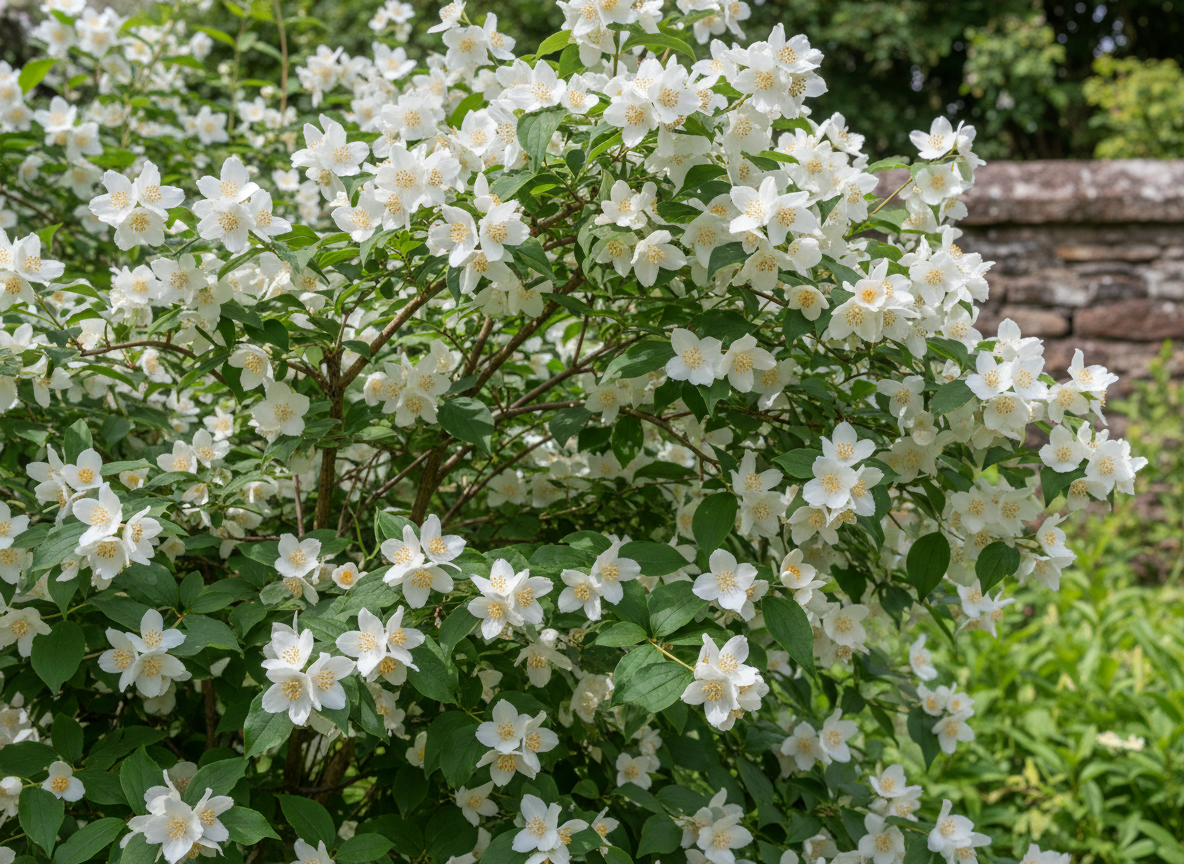 AI-generated illustration
Why Philadelphus is built this way
Mock orange — Philadelphus coronarius, P. × virginalis, P. × lemoinei and their cultivars ‘Belle Étoile’, ‘Manteau d’Hermine’, ‘Virginal’, ‘Beauclerk’ — flowers on side shoots from one-year-old wood. Not on the current year’s growth (so you can’t treat it like a buddleia and cut in March), and not on three- or four-year-old wood (so you can’t leave it forever and expect it to keep flowering). The plant has a strict one-year cycle: shoot grows this summer, ripens in August, sets flower buds in the leaf axils, sits dormant through winter, opens in late May, then the spent stem is supposed to be replaced.
Watch a Philadelphus carefully in the second half of May, while it is still in flower, and you will see what the plant is already preparing. Halfway down each flowered stem, sometimes lower, a fat new shoot is already pushing out — sometimes a single shoot, often two or three, often green and soft and 10–20 cm long even before the petals drop. That shoot is the plant’s replacement. The flowered tip above it is finished work. The plant’s plan is for the new shoot to take over and become next year’s flowering wood.
Your job at pruning time is to confirm that plan: take the spent tip off, leave the new shoot to grow on. It is the simplest cut in the garden once you can see it.
Where exactly to make the cut
Pick up a stem that has just finished flowering. Run your eye down it from the dead flower truss at the tip. Within 30–60 cm of the top, on most stems, you will find one or two soft new shoots growing out of the leaf axils, angled upwards. The strongest is usually the lowest of the new shoots — sometimes well below the flowers, in the middle third of the stem.
Place the secateurs just above that new shoot, on a slight angle sloping away from it, and cut. The angle takes water off the cut surface and keeps the bud underneath dry; the position — just above the new shoot, not into it — leaves a stub of about 5 mm that will dry back without affecting the shoot below.
Three things to check before you cut every stem:
- Is the new shoot strong? It should be at least pencil-thick at the base and showing real elongation, not a tiny green nubbin. If the only new growth is a couple of dormant green pips, cut higher — to a fatter, more developed shoot if one exists nearer the top — and accept slightly less renewal this year.
- Is it pointing where you want a stem next year? Choose an outward-facing or upward-facing shoot, not one pointing into the centre of the bush. The shoot you keep will become a main stem in twelve months.
- How far down does that put the cut? If the strongest new shoot is in the bottom 30 cm of an old stem, taking the cut down to it is exactly the renewal cut a tired Philadelphus needs — you are removing two-thirds of the stem. Don’t be timid. That is the cut that keeps the bush flowering low and full.
Don’t try to leave a tidy outline. A Philadelphus that has been cut to the new shoots in May looks slightly ragged for two weeks and then disappears under a wave of fresh growth.
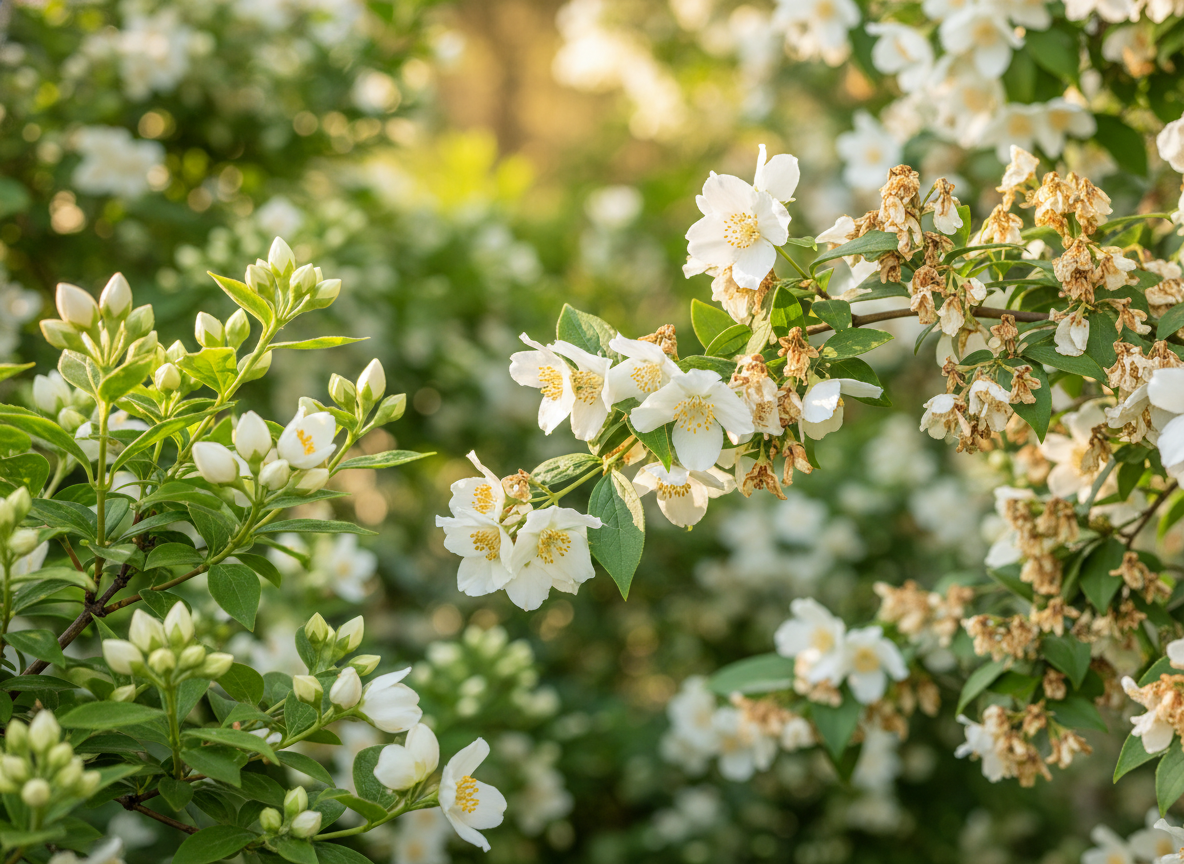 Mock orange flowers, buds, and spent blossoms on branches — AI-generated illustration
The window: when to start, when to stop
Philadelphus is a touch more forgiving than Weigela on timing — but only a touch. The biology is the same: anything cut after mid-July eats into next year’s flowering wood, because the shoots you kept in June need the rest of the season to ripen and set buds.
For most gardens in southern England, the Low Countries and northern France, the window opens in the last week of May with the early cultivars — ‘Belle Étoile’ and ‘Manteau d’Hermine’ tend to finish first — and closes around the longest day for the late ones like ‘Virginal’ and ‘Beauclerk’. Up north, or after a cold spring, the whole window shifts ten to fourteen days later.
Watch the plant, not the diary. The cue is straightforward: when the petals are starting to brown and fall when you brush past, and you can see new shoots already 10 cm long below the flowers, the window is open. When the last brown trusses are crisp and the new shoots are 20 cm or more, you are at the heart of it. Once the new shoots reach 30 cm and start to look like proper branches, you have ten days to finish or you start chopping off the new ripening wood itself.
The single date to write down: end of June is the hard deadline. After that the cost of pruning rises sharply, because the shoots you take off are no longer just spent flowering tips — they are the new wood that would have carried 2027’s flowers.
Renovating a neglected mock orange
If you have inherited a Philadelphus that hasn’t been touched in five years, or that has been sheared like a hedge, the shoot-by-shoot method won’t fix it on its own — there isn’t enough usable new growth to find. You need a proper reset.
The phased route is the safer one. This year, in late May or early June, take a third of the oldest stems right down to 15 cm from the ground. Choose the thickest, darkest, most lichen-marked ones — those are the four- or five-year-old stems that have stopped contributing. Leave the rest alone for now. Repeat next year and the year after. By year three, every stem in the bush is younger than four years old, the centre is open to light, and the plant has resumed its proper rhythm.
If you can’t bear the thought of a partial bush for two years, the one-shot reset works on Philadelphus better than on many shrubs. Cut the whole plant down to 30 cm in the last week of May. You will lose 2027’s flowers entirely, get a forest of new shoots from the base over summer, and have a full bush of flowering wood for 2028. The shrub is tough enough to take it — but feed and mulch immediately afterwards (a handful of balanced 7-7-7 and a 5 cm layer of compost around the base) and water in dry weeks through June and July. A renovated mock orange has no reserves and will sulk if it dries out.
Either way, don’t renovate after mid-June. The new shoots from a hard cut need the whole summer to ripen. Cut in July and they go into winter green and soft, and a sharp frost kills the lot.
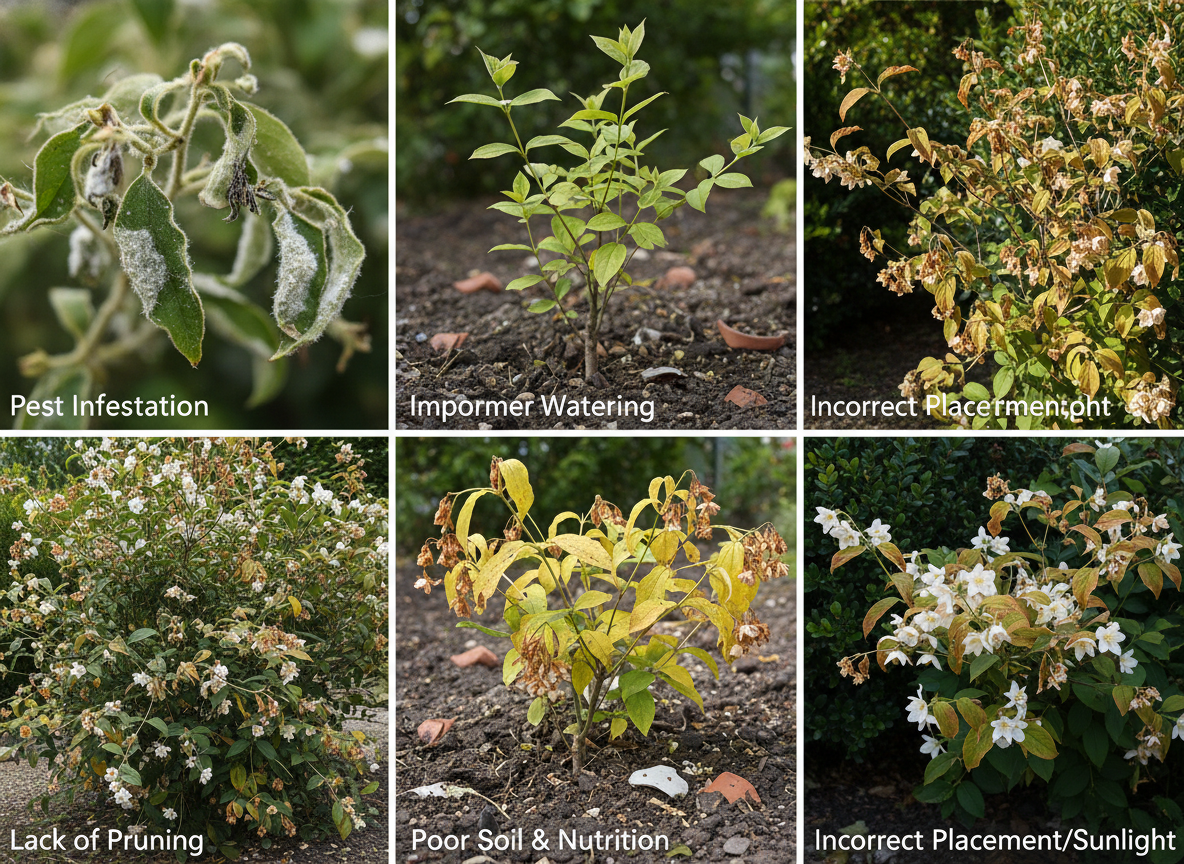 A mock orange plant exhibits signs of common growth issues in a garden setting — AI-generated illustration
Five mistakes that keep coming up
Trimming to a tidy outline. A Philadelphus is not a privet. Putting a hedge trimmer to it removes next year’s flowering wood, leaves the old centre untouched, and turns a fragrant shrub into a leafy lump. If you only have time for one tool, use bypass secateurs and follow the stems individually.
Pruning in winter or early spring. This is the second-most common error and usually comes from gardeners who treat every shrub like a buddleia. Late-winter pruning works for shrubs that flower on the current year’s growth. Philadelphus flowers on the previous year’s growth. Cut it in February and you cut off every flower bud the plant has built up. If you inherit a mock orange in spring and you can see the flower buds swelling, leave it alone until after flowering.
Cutting to a dormant bud rather than an existing new shoot. Already covered, but it bears repeating: a green pip in a leaf axil is not the same as a 15 cm shoot that’s already growing. The first will give you a thin, late-starting replacement; the second is already half a year ahead and will flower next May. Spend the extra ten seconds per stem to find the new shoot.
Leaving the prunings under the bush. Philadelphus leaves can carry powdery mildew spores, and any bark left on the soil surface is an open invitation for honey fungus on susceptible sites. Get the prunings out of the bed and into a council green-waste bin or hot compost heap. Don’t pile them at the base “for mulch”.
Feeding heavily after the cut. Tempting, especially after a hard renovation, but a high-nitrogen feed in June pushes soft growth that won’t ripen properly. A single handful of balanced fertiliser per square metre and a compost mulch is plenty. Save any heavy feeding for next March, before the new season really gets going.
Quick reference
- When: within four to six weeks of the last flower fading — for most gardens, late May to the longest day.
- What to look for: the strongest new shoot already growing out of a leaf axil somewhere on the flowered stem.
- Where to cut: 5 mm above that new shoot, on a slight outward angle. Cut even if it means removing two-thirds of the stem.
- What to leave: every shoot of this year’s new growth — that’s what flowers in 2027.
- What never to do: shear the outline, prune in winter, or cut to a dormant pip when an active shoot is available below.
- After: light feed, compost mulch, water in dry weeks through June and July.
Get the new-shoot habit going this season and within two years your mock orange has flowers low on the bush as well as at the top, the scent reaches further, and you stop wondering why the plant “isn’t what it used to be”. Cresco will watch your specific cultivar and your local last-frost and bloom data, and tell you the week your window opens — so the cut happens while the new shoots are still where the plant wants them.