The window that opens with the last petal
Walk along any south- or west-facing wall in the second half of May and the story is the same: a Clematis montana that was a four-metre wave of pink or white two weeks ago is now starting to look tired. The flowers are going papery. New green whips — long, soft, leafy, with three-lobed leaves and that faint reddish tint at the petioles — are already pushing out past the spent racemes.
That moment is the start of the only pruning window montana respects. It runs from the day the bulk of the flowers fade until the longest day, roughly. After midsummer, every cut you make is a cut into next April’s flowers, because by then the plant has already begun laying down the buds it will open next spring.
Most gardeners don’t realise the window has opened. They wait. The plant looks fine, even a little ragged in a romantic way, and there are a hundred other May jobs. By the time they get round to it — August, after the brambles take over, or February when they’re cleaning up — they prune the wood that should have flowered, and next spring there’s nothing but leaves.
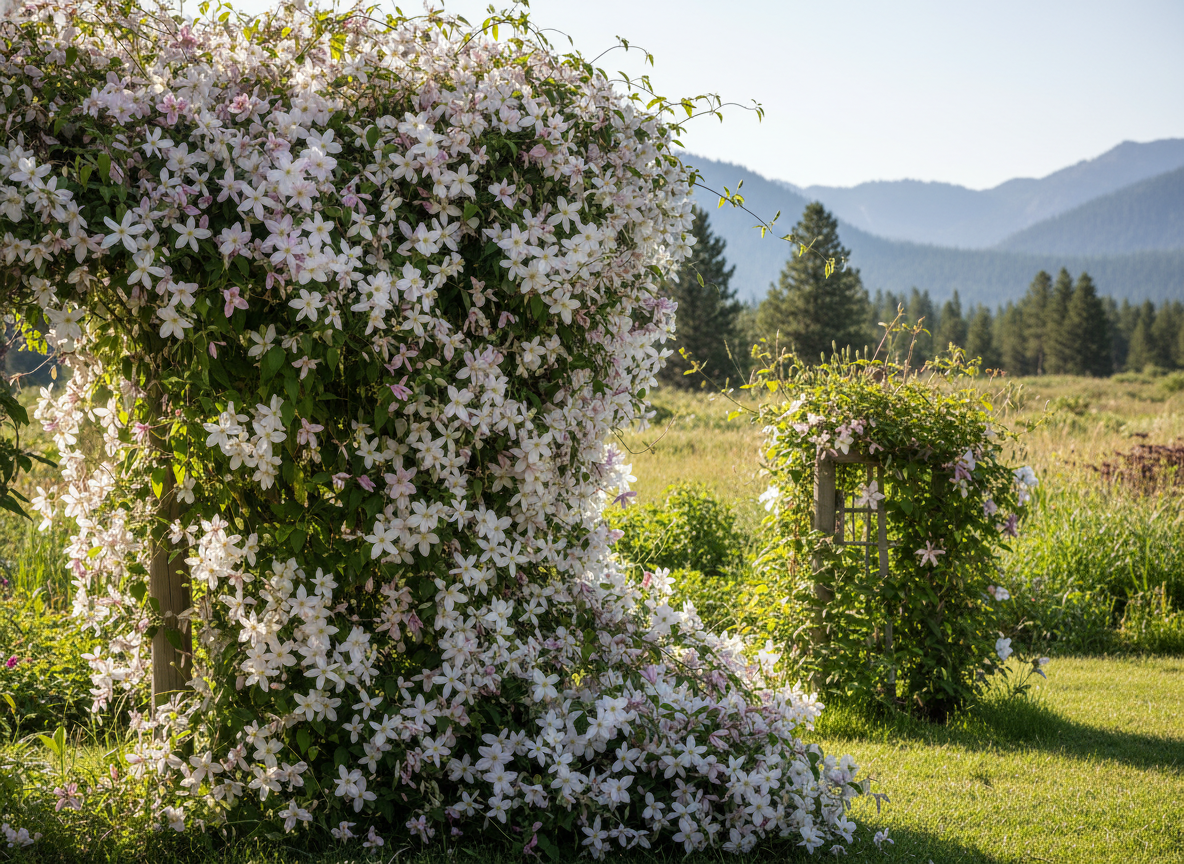 An abundance of clematis montana flowers covers a large structure in a garden — AI-generated illustration
Why montana is its own pruning group
Clematis are sorted into three pruning groups, and the difference matters more than the names suggest.
Group 1 flowers on wood made the previous year. Montana, armandii, alpina, macropetala. You prune them lightly, after flowering, and only if they need it.
Group 2 flowers in late spring on last year’s wood and again in late summer on this year’s wood. The big-flowered hybrids — Nelly Moser, The President, Niobe. You give them a light prune in February or March, just back to a healthy pair of buds.
Group 3 flowers in summer and autumn entirely on this year’s growth. Viticella, jackmanii, tangutica. You cut them down to 30 cm in February and they rebuild from scratch every year.
This matters because every piece of generic clematis advice you read in February — “cut back hard,” “down to a strong pair of buds,” “30 centimetres” — is written for Group 3. If you apply it to a montana, you are removing every stem that was going to flower for you. The plant survives. It throws out whips, makes leaves, looks lush by August, and produces almost nothing the following April.
Group 1 plants are pruned at the opposite end of the year from Group 2 and 3, and with the opposite logic. Less is more. Late spring, not late winter.
What “after flowering” actually means
The phrase trips up a lot of people. It does not mean “when the very last bloom fades on the very last whip.” On a montana that’s a moving target — there’s always a straggler tucked into the wall somewhere.
It means: when the bulk of the flowers are spent and the plant is visibly putting its energy into new green growth rather than holding the flower display open. In southern England and the lower Netherlands, that’s usually somewhere between 10 and 25 May for a C. montana var. rubens; up to two weeks later for C. montana var. grandiflora; later still in colder gardens or after a slow spring.
The window you have is roughly four weeks. The earlier inside that window you prune, the more time the plant has to grow, set buds, and harden off the wood that will flower for you next April. By the end of June it’s already too late to do anything radical without paying for it next year. Anything you do in July, August, autumn or winter is straight subtraction from next spring.
If you’re staring at a montana right now (mid- to late May 2026), you’re squarely inside the window. Don’t wait for the weekend; the next dry hour is fine.
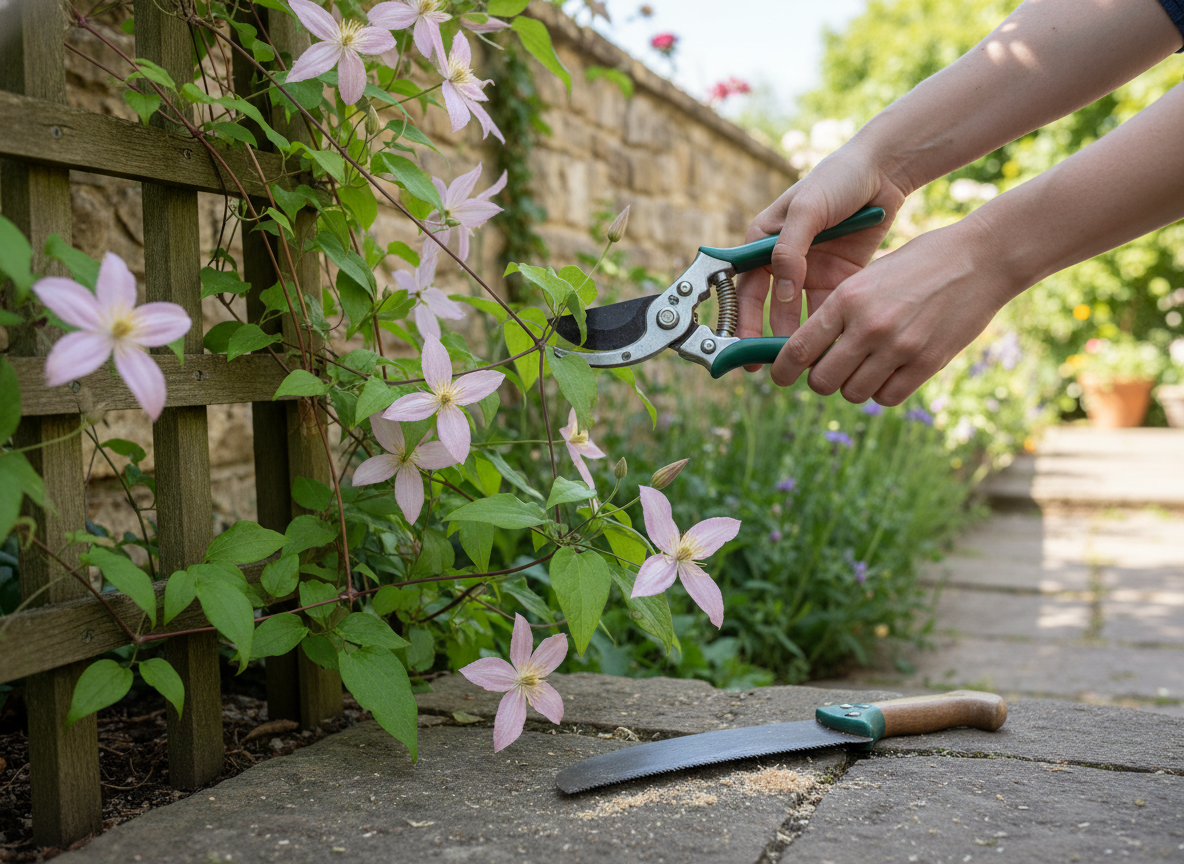 A person pruning a clematis montana vine with shears next to a saw — AI-generated illustration
The shear, not the saw
Healthy montanas don’t need a pruner. They need hedge shears.
The job is not to cut the plant back, it’s to comb it out. You walk the length of the wall or pergola with shears and trim the surface of the plant the way you’d trim a hedge — only deeper, taking off the top six to twelve inches of soft new growth across the whole face. The aim is to:
- shorten the leafy whips that would otherwise turn into three-metre runners by July
- expose the older, woody framework that will carry next year’s flowers
- redirect the plant’s energy from racing outward into setting flower buds along the existing stems
Where the shears can’t reach — into the tangle around a downpipe, behind a trellis batten — use secateurs and follow individual stems back to a strong leaf joint.
You’re not trying to reveal bare wood. A montana that’s been correctly sheared in late May should still look full and leafy from a few metres away. You’ve taken the floppy fringe off, not the framework.
What to keep and what to lose
The stems that flowered for you this spring are the stems you want to keep. They’re older, woodier, slightly grey-brown, and they’re where next April’s buds will form along short side shoots later in summer.
The stems you can be ruthless with are this year’s growth — the soft green whips with the reddish petioles, racing out past the canopy. They will not flower next spring (they’re too young, and they’ll be too long and bare by then). Their job in the plant’s economy is to extend the plant’s territory. If your montana has already reached the territory you want it in, those whips are surplus, and shortening them tells the plant to put energy into ripening the wood it already has.
The single most useful diagnostic: kneel down, look up into the plant, and find a stem that flowered. Trace it out. Anything beyond the last spent flower cluster on that stem is fair game to shorten by half. Anything earlier on that stem — back towards the woody framework — leave alone.
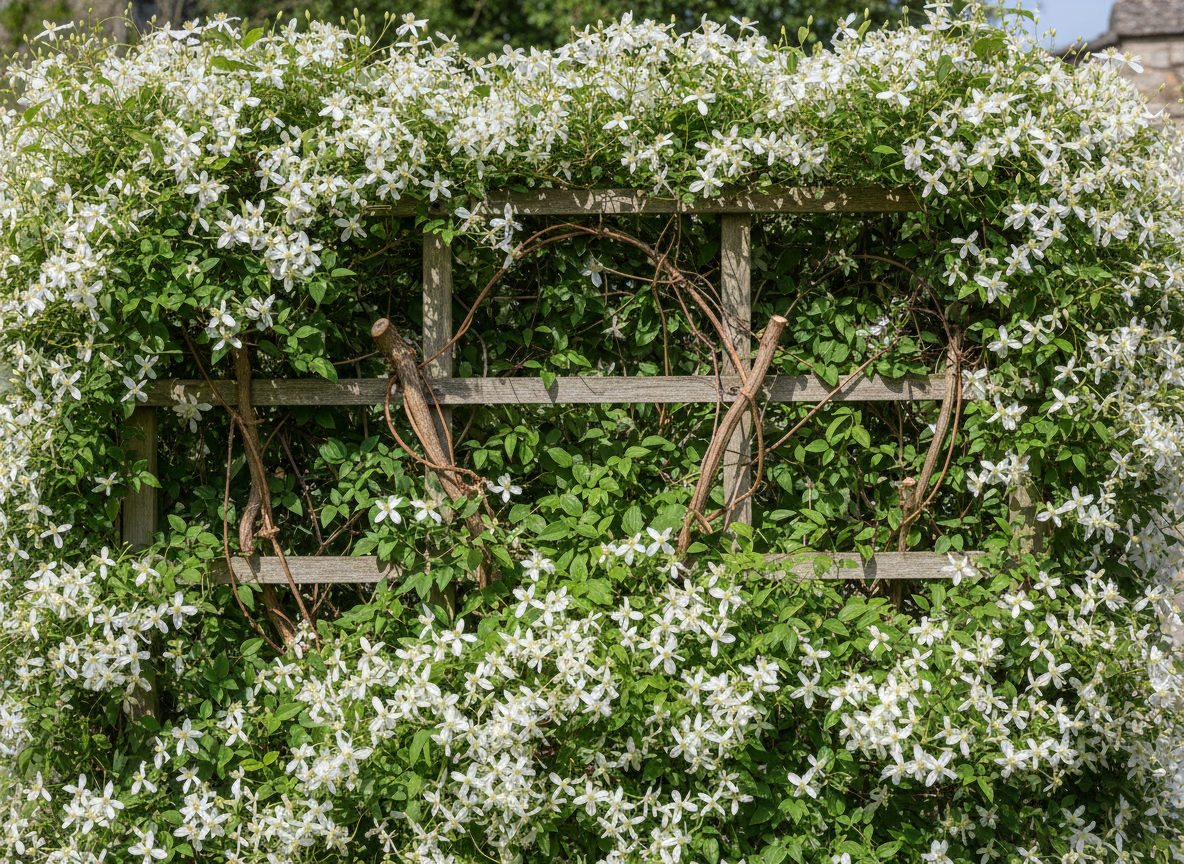 Here is a photorealistic, editorial-style garden photograph illustrating the four cuts that cost you the curtain in the context of… — AI-generated illustration
The four cuts that cost you the curtain
There are four ways gardeners regularly destroy next spring’s display without realising. Worth knowing them by name.
1. The February tidy. Someone reads “prune your clematis in February” in a generic gardening calendar and applies it to the montana. Every cut in February removes flower buds that are already there in embryo form, even if you can’t see them. Result: a green wall in April, no pink.
2. The autumn cleanup. The plant looks straggly after summer, you tidy it. Same problem — by September the buds are set inside the stems. You’re shearing them off.
3. The hard renovation in one go. A montana has eaten the shed and you cut it back to two feet of stump in late May. Montana usually survives this — it’s a tough plant — but you lose two springs of flowers (this year is already half over and next year’s wood is gone). There’s a better way to renovate; see below.
4. The “just the top” cut at the wrong time. Hedge-trimming the obvious whippy growth in July or August looks tidy. But by then the plant has already started setting the structure of next year’s flowering side shoots along those very stems. You’re cutting them off when the damage is invisible.
The common thread: every one of these mistakes is a cut at the wrong time. The cut itself is fine. Late May to mid-June is the only window where you can make these same cuts and not pay for them.
Renovating an overgrown montana: the three-year fix
If your montana has eaten the shed, the garage, the neighbour’s fence and is starting on the chimney, the temptation in late May is to take it all the way back to a knee-high stump and start again. Plenty of gardening forums will tell you the plant survives this. Most do.
But you’ll lose flowers for two springs minimum — the one currently winding down (cut now, no point) and the next one (no old wood left to flower from). And there’s a real risk on an older plant that the hard cut doesn’t trigger strong regrowth from the base. C. montana is more forgiving than most woody climbers in this regard, but it isn’t bombproof.
The cleaner approach is to phase the renovation across three seasons:
- Year one (this May): identify the three or four oldest, woodiest, least productive main stems coming out of the ground. Cut one of them all the way back to about 40 cm. Leave the rest. Tidy the surface of the plant with shears as normal.
- Year two (next May): cut a second old main stem back to 40 cm. The one you cut last year will already be throwing strong young growth from low down.
- Year three: cut the last old stem. By now you’ve completely renewed the base of the plant from the ground up, without ever losing more than a third of the flowering wood in any one season.
In each of those three years, the plant carries on flowering on the stems you haven’t touched. You get a fully renewed montana, on a clean framework, with no missing spring.
A quick reference for late May 2026
If you remember nothing else, remember this:
- C. montana is Group 1. It flowers on last year’s wood.
- The pruning window is the four weeks after the last petal falls — roughly 15 May to 15 June in most of Northwest Europe this year.
- Use shears, not secateurs. Tidy the surface; shorten the soft whippy growth; leave the woody framework.
- If the plant is overgrown, take one old main stem at a time, over three years. Don’t hack the lot.
- Anything you cut in July, August, autumn or February is a direct subtraction from next April’s flowers.
The whole job, on a healthy plant on a four-metre wall, takes about twenty minutes once a year. It’s the lowest-effort, highest-return clematis pruning of all three groups. The price of admission is just knowing which two weeks of the year to do it in.
Want a reminder when your plants are ready for their next prune? Cresco builds a personalised pruning calendar from a photo of your garden and your local weather — so the next time the montana window opens, you’ll know.