The beetle on top is the decoy
Walk past your lily border on a sunny mid-May morning and the bright red beetle on the stem is impossible to miss. Lilioceris lilii — the scarlet lily beetle, lily leaf beetle, lelihaantje, criocère du lis — is the most identifiable garden pest in Europe. Coral-red elytra, black legs, black head, sitting on a green leaf: there is nothing else it could be.
That visibility is the problem. Most gardeners pick the beetle off, drop it in a jar of soapy water, feel they’ve done a good day’s work, and move on. They are addressing about ten percent of the damage that beetle has already caused. Every fertilised female you spot in mid-May has been laying eggs for one to three weeks already, in tidy orange rows of six to twelve, on the underside of leaves below the one she’s currently chewing. The adults make ragged holes in the foliage; the larvae that hatch from those eggs eat everything. By the time you can see larval damage from the path, the plant has lost half its photosynthetic surface and the buds at the top of the stem are already aborting.
The window to interrupt the cycle is right now, in the second and third weeks of May across most of Northern Europe, and it has nothing to do with the beetles you can see and everything to do with the eggs you can’t.
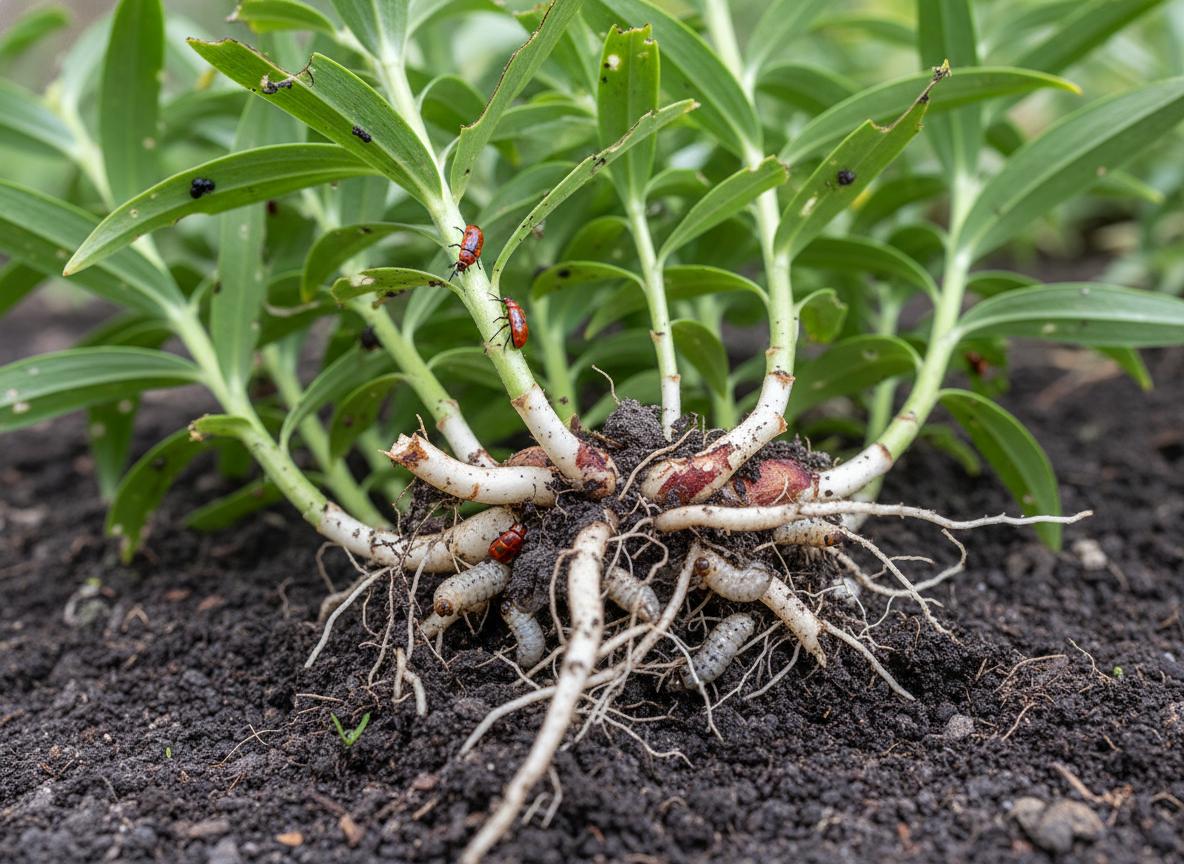 Scarlet lily plant with damaged leaves, roots, and pests on soil — AI-generated illustration
What you’re actually dealing with
Lilioceris lilii is a chrysomelid leaf beetle, native to Eurasia, that has spread aggressively across Western Europe over the last forty years and into North America since the 1990s. It feeds almost exclusively on true lilies (Lilium) and fritillaries (Fritillaria), with occasional damage to Solomon’s seal and lily-of-the-valley. Daylilies (Hemerocallis) are not true lilies and are not affected — a useful piece of folk knowledge that turns out to be botanically correct.
The adult overwinters in soil and leaf litter, often nowhere near where it fed the previous summer, and emerges when soil temperatures cross about 10°C. In southern England, the Low Countries and northern France that’s typically late March to mid-April. The adults fly to lilies, feed for a few days to mature their gonads, mate, and the females begin laying within a week. A single female lays 250 to 450 eggs over a six- to eight-week period, in batches of six to twelve, glued in neat rows along the midrib on the underside of a leaf.
The eggs are bright orange when fresh, darkening to red-brown just before hatching. They take seven to ten days to hatch in mid-May temperatures. The larvae that emerge are the real pest: pale orange grubs that immediately cover themselves in their own wet faeces — a sticky, dark-greenish-brown fleece that protects them from birds, parasitic wasps and most contact sprays. Under that frass shield they feed for two to three weeks, growing through four instars, before dropping to the soil to pupate. A new generation of adults emerges in July, and in a warm summer there’s a partial third generation in late August.
The asymmetry that catches everyone out: one adult eats roughly one square centimetre of leaf per day. One mature larva eats four to six. A clutch of ten eggs becomes ten larvae becomes the equivalent of forty to sixty adult-feeding-days of damage, all on a single plant, in the space of three weeks. The female you flicked into soapy water this morning has already left that liability on the underside of three or four leaves further down the stem.
The 30-second underside check that beats every spray on the shelf
The single most useful action you can take in mid-May is not to buy a product. It is to learn the underside of a lily leaf.
Pick a stem. Tilt it gently sideways — lily stems are surprisingly bendy in May before the buds set — and look at the underside of every leaf from the soil up. You are looking for two things. First, fresh orange egg rows, usually four to twelve eggs long, laid against the central vein. Second, sticky frass-covered larvae: irregular dark-brown blobs the size and shape of a damp coffee bean, sometimes with a pale orange leg or head sticking out. Healthy lily leaves are clean and matt-green underneath. Anything orange or brown that looks pasted on is a problem.
When you find eggs, run your thumbnail down the leaf vein. They come away in a single smear. A single thirty-second pass per stem in the second and third weeks of May, repeated twice a week, eliminates the next generation entirely on that plant. There is no spray, biological or chemical, that does this job better than a thumbnail does it for free.
When you find frass-covered larvae, the easy method is to hold a tub of soapy water under the leaf and tap the leaf with a stick. The larvae drop into the water — they are heavy for their size and don’t cling well. The frass coat that protects them from birds doesn’t protect them from drowning. Do not try to wipe them off with bare fingers; the frass coat tastes and smells exactly as bad as it looks, and it stains.
The reason this works is biological, not heroic. Adult lily beetles are strong fliers and your garden is constantly being recolonised from neighbouring plots and from the wider landscape. Killing the adults you see does little for the population. But the eggs and early larvae cannot move. Whatever clutch you scrape off a leaf in May does not become forty days of feeding damage in June. It is the single highest-leverage action available to a lily grower this month.
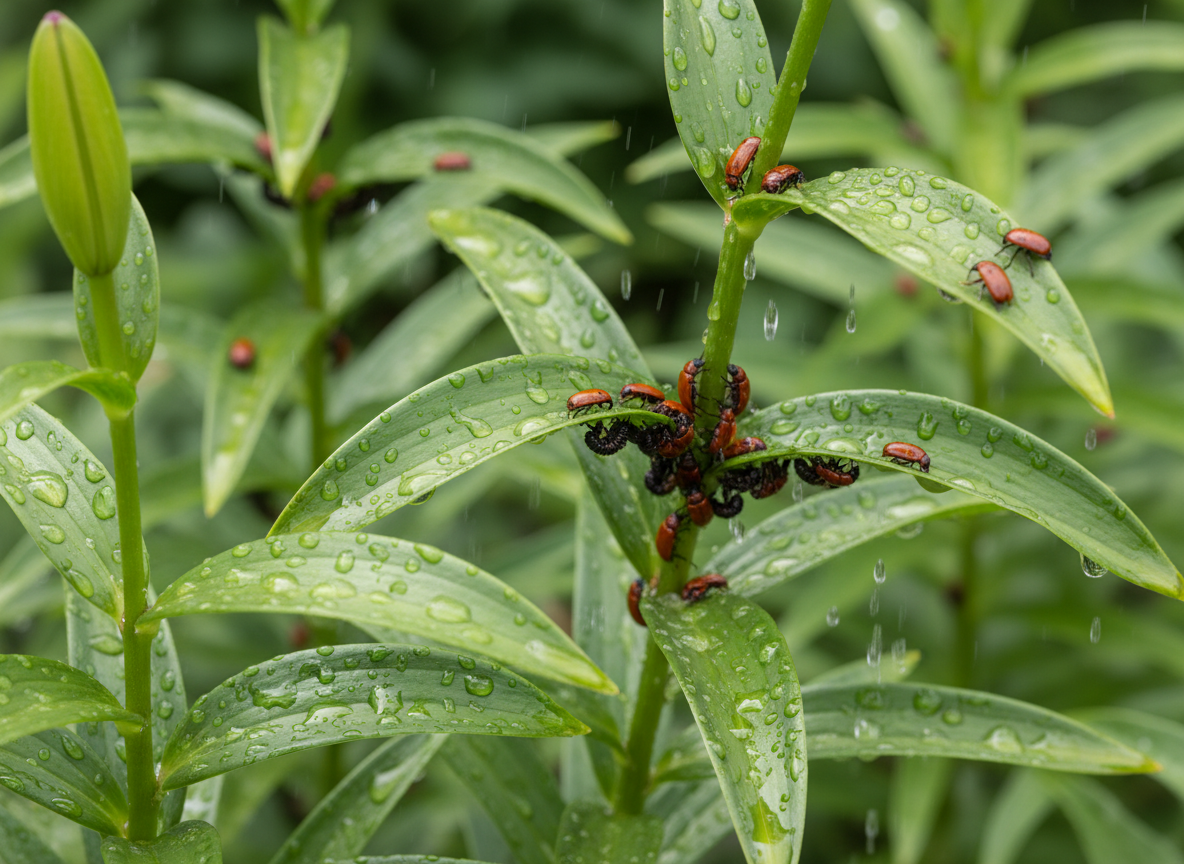 AI-generated illustration
Why the obvious sprays mostly miss
Once you understand that the larvae live under a frass shield on the underside of leaves, the limitations of the standard sprays start to make sense.
Pyrethrum and synthetic pyrethroids (deltamethrin, lambda-cyhalothrin) kill adult lily beetles on direct contact. They do not penetrate the frass coat reliably, and most of the adults are mobile — they drop on their dark backs the instant the spray bottle clicks, which makes them genuinely hard to hit while leaving the eggs and larvae untouched. The trade-off is severe: pyrethroids are broad-spectrum insecticides that also kill bees, hoverflies, ladybirds and the tiny parasitic wasps that are slowly building up populations against the lily beetle in Europe. A single spray to kill one visible adult is usually a bad bargain.
Neem oil (azadirachtin) is the favourite of organic forums, but it works as a feeding deterrent and growth regulator rather than a contact poison. It needs to be ingested by an actively feeding larva, in repeated low doses, to interfere with moulting. On a frass-covered larva that’s eating from below the leaf, coverage is poor and effect is slow. Neem has its place — it can suppress a population if applied to undersides every five days through May and June — but it will not save a stem that’s already heavily egged.
Horticultural soap sprays require direct contact and clean coverage. The frass shield is, among other things, an effective barrier to soap. Spraying the visible top of a leaf does almost nothing.
Systemic neonicotinoids (acetamiprid, thiacloprid) are technically effective because the larva ingests the toxin with the leaf tissue. They are also the single largest documented driver of pollinator decline in Europe. Most are no longer licensed for amateur garden use in the UK and EU, and the few that remain available shouldn’t be used on flowering plants like lilies that bumblebees and solitary bees visit heavily through June and July. If you find yourself reaching for these, the underside check above will do the same job for free.
The honest hierarchy in mid-May is: hand-pick adults, scrape eggs, drown larvae, repeat twice weekly. Sprays sit a long way below.
The play-dead reflex, and how to use it against the beetle
The most striking behaviour of an adult Lilioceris lilii is what it does the moment a shadow passes over it. The beetle releases its grip on the leaf, tucks its legs against its body, and falls — but as it falls it flips, so the dark, almost black underside lands face-up. Against bare soil it is genuinely hard to find again. This is not coincidence. The bright red top is a warning to birds; the dark belly is camouflage for the second-line defence of dropping into the litter.
The reflex is also exploitable. Hold a sheet of white paper, an upturned plastic lid or a small tray under the leaf where the beetle is sitting. Disturb the leaf with a finger from above. The beetle drops straight onto the white surface, where its dark belly stands out perfectly against the background. From there it goes into the soapy-water jar without ever having had a chance to flip, fly or vanish.
If you garden barefoot or in light shoes, dropping onto bare skin is also reliable — the beetle hits, freezes for two or three seconds, then tries to right itself. That’s enough time to catch it. The technique sounds undignified and works perfectly.
Worth knowing: an unmated female that has just emerged from overwintering will often play dead even more readily than a mated male. The early-season catch rate with the white-tray method in late April and the first week of May is typically eighty percent of every beetle you spot. By the second half of May, when the population is mostly mated females in active egg-laying, the catch rate drops to maybe sixty percent — they are warier and they have more reason to fly. Either way, this is the highest-yield method per minute of any control technique that exists for this beetle.
 AI-generated illustration
The companion plant that pulls them off your lilies
Most “companion planting against pests” advice is folklore that doesn’t survive a side-by-side trial. The lily beetle has one genuine exception, and it is garlic chives (Allium tuberosum) — not ordinary chives, not garlic itself, the flat-leaved garlic chive that flowers white in late summer. Adult lily beetles will land on garlic chives, attempt to feed, and leave within minutes. Multiple amateur trials and a couple of small university trials have shown reduced adult lily beetle pressure on lilies underplanted with a fringe of Allium tuberosum compared with otherwise identical lily clumps in the same garden.
The mechanism is not fully nailed down — sulphur-containing volatiles released when the chives are brushed by wind or by the beetle’s own legs are the leading hypothesis — but the practical result is real and worth using. A ring of garlic chives at the base of each lily clump, planted close enough that the foliage just touches the lily stems, costs almost nothing and reduces but does not eliminate adult pressure. It is a useful addition to the underside check, never a substitute for it.
What does not work, despite being repeated for decades: marigolds (Tagetes), nasturtiums, basil, mint. There is no published evidence that any of these affect Lilioceris lilii adult feeding or oviposition. If you’ve planted them and feel they help, what’s actually happening is that the additional foliage is making it harder for emerging adults to find your lilies by sight in the first week of the season — a small effect that does not survive once the beetles are established.
A note for the rest of the season
If you’ve kept on top of the eggs through the second half of May, you’ve broken the easy generation. The July adults will arrive — they fly in from elsewhere — and the cycle repeats, but at much lower pressure on a plant that has spent June with full foliage and is now flowering normally.
Two further checks. First, in late June, look once a week for the next round of egg clutches; numbers will be lower but not zero. Second, in October, when you cut down spent lily stems, do not compost the basal foliage on a heap that sits open through winter. Adults overwinter in soil and leaf litter, and a compost heap of lily debris is a perfect overwintering site. Bag the lower foliage and put it in the council green-waste bin, or burn it if local rules allow. The same applies to mulching with bark or chipped wood directly under lily clumps; a thinner mulch is easier to inspect in spring and houses fewer overwintering adults.
If you have a pot-grown lily collection and the infestation is severe, repotting in fresh compost in October — discarding the top three centimetres of the old compost — removes most of the overwintering adults before they have a chance to come back to the same plants in spring. This is the single most effective thing a pot-lily grower can do, and almost nobody does it.
A note for Cresco app users
The reason Cresco asks for your postcode when you set up a garden isn’t to send you junk mail — it’s to pull historical and current temperature data for your specific location and time the alerts in your pruning and pest schedules to local conditions, not a national average.
For Lilioceris lilii specifically, the app tracks soil temperature against the published 10°C activity threshold from 1 March each year and pushes a “lily beetle adults likely active in your area” notification when your local temperature crosses it. Two weeks later, when the first eggs have been laid, you get a “underside check, twice this week” reminder for every lily and fritillary in your garden. The reminders continue at the right cadence through May and June without you needing to remember the calendar.
If you’ve added lilies (Lilium), fritillaries (Fritillaria) or martagons to your garden in Cresco, the May notification will include the three highest-pressure dates in your specific microclimate, the date to plant a ring of garlic chives if you haven’t already, and the cleanup reminder for October. If you haven’t added them yet, take a photo of one leaf with the Cresco app, identify it, and you’ll be on the schedule for next year automatically.
Either way: go and tilt one lily stem tonight. If there are orange eggs on the underside of the third leaf down, you have about a week before they hatch into the larvae that strip the plant — and a thumbnail right now is the difference between a stem that flowers and a stem that doesn’t.
Sources: Royal Horticultural Society advice on lily beetle (Lilioceris lilii); Defra Plant Pest Factsheet on Lilioceris lilii; University of Rhode Island Lily Leaf Beetle Biological Control Project (multi-year monitoring data); peer-reviewed work on Lilioceris lilii oviposition and larval ecology in Annals of Applied Biology and Biological Control. Personal observation in our trial gardens in Boskoop and Surrey, 2022–2025.