There is a moment, usually in the second half of May, when a mature Ceanothus stops being a shrub and starts being a wall of light. The flowers — those impossibly saturated blue clusters that look almost artificial — last about three weeks, and then they’re done. The plant fades back to a slightly dull, leathery-leaved evergreen, and the gardener thinks: time for a tidy.
That tidy is what kills it.
Ceanothus is one of the few common garden shrubs that does not regenerate from old wood. Cut a branch back to a point where there are no green leaves, and that branch is finished. Not “it’ll take a year to come back”. Finished. And because the shrub is fast, dense, and often planted against a wall where it inevitably outgrows its space, the temptation to cut hard is constant. Most dead Ceanothus in British and Dutch gardens were not killed by cold winters. They were killed by secateurs.
This post is about the one rule that matters, where exactly the line falls on a stem, and what to actually do in the late-May window when light shaping is not only safe but genuinely useful.
What’s Happening Inside Ceanothus Right Now
To understand why the timing is so narrow, look at what the plant is doing in mid-May.
Spring-flowering Ceanothus — the evergreen ones most gardens have, like C. ‘Concha’, C. ‘Puget Blue’, C. ‘Skylark’, C. thyrsiflorus var. repens — flower on wood that grew last year. The flowers you’re seeing now were physically formed inside buds that overwintered. As those flowers fade, the plant immediately starts a second job: pushing new green shoots from the current season’s growth points. Those new shoots will harden over summer, set buds in autumn, and become next May’s flowers.
There’s a roughly three-week window, from the end of flowering through the first flush of new growth, when the plant tolerates light pruning well. Cut now and the new shoots redirect into a tidier shape. Wait until July and you’re removing the buds you wanted. Wait until winter and you’re cutting into wood that won’t push.
But within that window, where you cut matters far more than when. And here Ceanothus is unusually unforgiving.
 Ceanothus flowering along a roped garden path with lush green foliage — AI-generated illustration
The One Rule: Stay on the Green Side of the Line
On any Ceanothus stem, run your finger from the tip back toward the main trunk. You’ll feel the texture change. Near the tip, the stem is soft, green, and covered in leaves. Further back, it stiffens, the bark turns grey-brown, and the leaves thin out. Keep going and you’ll reach bare wood — no leaves at all, just thickening branches that lead back to the framework.
That transition — the last point with healthy leaves — is the line.
Every cut you make should be on the leafy side of that line, ideally a few centimetres above the lowest pair of leaves on the stem you’re shortening. Cuts on the bare side of the line do not regenerate. The shrub will not push fresh shoots from old wood. The pruned branch will die back to where it joins something living, and you’ll be looking at a brown gap for the rest of the plant’s life.
This is the single fact that separates gardeners who keep their Ceanothus for fifteen years from gardeners who replace it every four. There is no advanced technique. There is only the line.
How to Find the Line on a Real Stem
In practice, finding the line takes about five seconds per branch, but it helps to know what you’re looking for.
Start with a single representative stem on the outside of the shrub, somewhere you can see clearly. Hold it loosely between thumb and forefinger near the tip and slide your hand back toward the trunk. Three things change as you move from tip to base.
First, the bark. New growth is green or pale tan and smooth. As it matures, it tans, then greys, then thickens. The shift from green to tan typically happens within the first 15 to 25 centimetres of the tip on a healthy ‘Concha’ or ‘Puget Blue’. The shift from tan to grey marks the beginning of older wood.
Second, the leaves. On the green section, leaves are dense and freshly extended. Through the tan section, the leaves are last year’s, still functional but darker and tougher. Once you cross into grey wood, the leaves thin out fast — and within another few centimetres, they vanish entirely.
Third, the buds. On living wood you’ll see small green or pinkish buds tucked into the leaf axils. These are the points the shrub will push new growth from after pruning. Past the bare grey wood, those buds are dormant or absent. They will not wake up.
The cut should land roughly one centimetre above the lowest healthy leaf on the stem you’re shortening. Slightly higher is safe. Lower — into the leafless zone — is not.
If a stem has no leaves below a certain point, you cannot shorten that stem to a length below that point. There is no workaround.
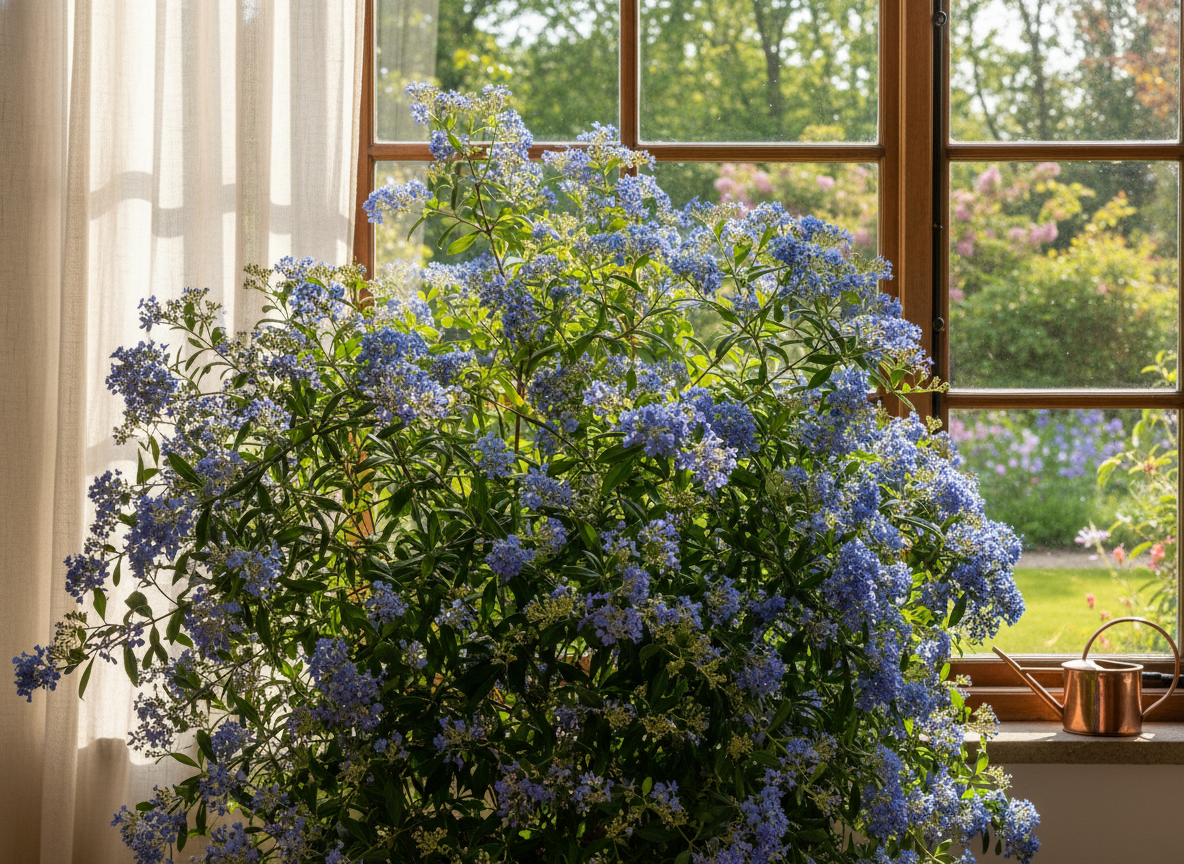 Ceanothus flowering in a window with natural light — AI-generated illustration
Light Shaping in the Late-May Window: What’s Safe
Within the rule, there is real work you can do in the next two to three weeks, and it makes a noticeable difference to next year’s shape and flowering.
Tip-prune the longest extending shoots. After flowering, you’ll see shoots that have shot ahead of the general outline — single branches sticking out 15 to 30 centimetres beyond the bulk of the shrub. Cut these back to within the leafy zone, anywhere along their length where you still have green leaves below the cut. This rebalances the shape and encourages branching at the cut point.
Remove the spent flower trusses where you can reach them. The faded blue panicles will turn into small dry seed clusters if left. They’re not harmful, but they’re slightly ugly and they consume energy that could be going into the new shoots. Snip each spent truss off just above the next pair of leaves below it. On a large wall-trained Ceanothus this is a half-hour job if you only do the ones at eye level, and that’s fine.
Thin congested growth in the centre. Wall-trained Ceanothus particularly tend to build up a tangle of crossing twigs against the wall. You can pull out small dead twigs by hand and snip out obviously crossing growth, again staying within the leafy outer shell. Don’t dive in deep — the wood inside the shrub is mostly bare and you cannot regenerate from there.
What you should not do, even within the window: a hard “shape-up” cut across the whole shrub. Shears taken across the top of a Ceanothus will inevitably cross the line in places. Use secateurs, one stem at a time, and accept that the silhouette will be slightly irregular. A Ceanothus is not a yew hedge.
Evergreen vs Deciduous: Two Different Plants Under One Name
If your Ceanothus flowers in late summer rather than May, you may be reading the wrong post — and the wrong rules.
The Ceanothus in flower right now, in mid-May, are the evergreens. They keep their leaves year-round, flower on old wood, and follow the no-old-wood pruning rule above. C. ‘Concha’, C. ‘Puget Blue’, C. ‘Skylark’, C. ‘Yankee Point’, C. impressus, C. arboreus ‘Trewithen Blue’ — all spring evergreens.
The deciduous Ceanothus — C. × delileanus ‘Gloire de Versailles’, ‘Topaze’, ‘Henri Desfossé’ — drop their leaves over winter and flower on the current year’s growth, in July and August. These can and should be pruned hard in early spring, cutting last year’s stems back to a low framework, much like a Buddleia. They tolerate it cheerfully because they only need this year’s wood to flower.
Mixing up the two rules is one of the more common ways to kill a healthy plant. If your shrub is bare in winter and flowers later in summer, the hard March cut is fine. If it’s green in winter and is flowering right now, the rule on the previous page applies: never cut beyond the leaves.
A quick check: if you can see flowers on your shrub today, and there are still leaves on it when you check in February, it’s an evergreen and the no-old-wood rule applies.
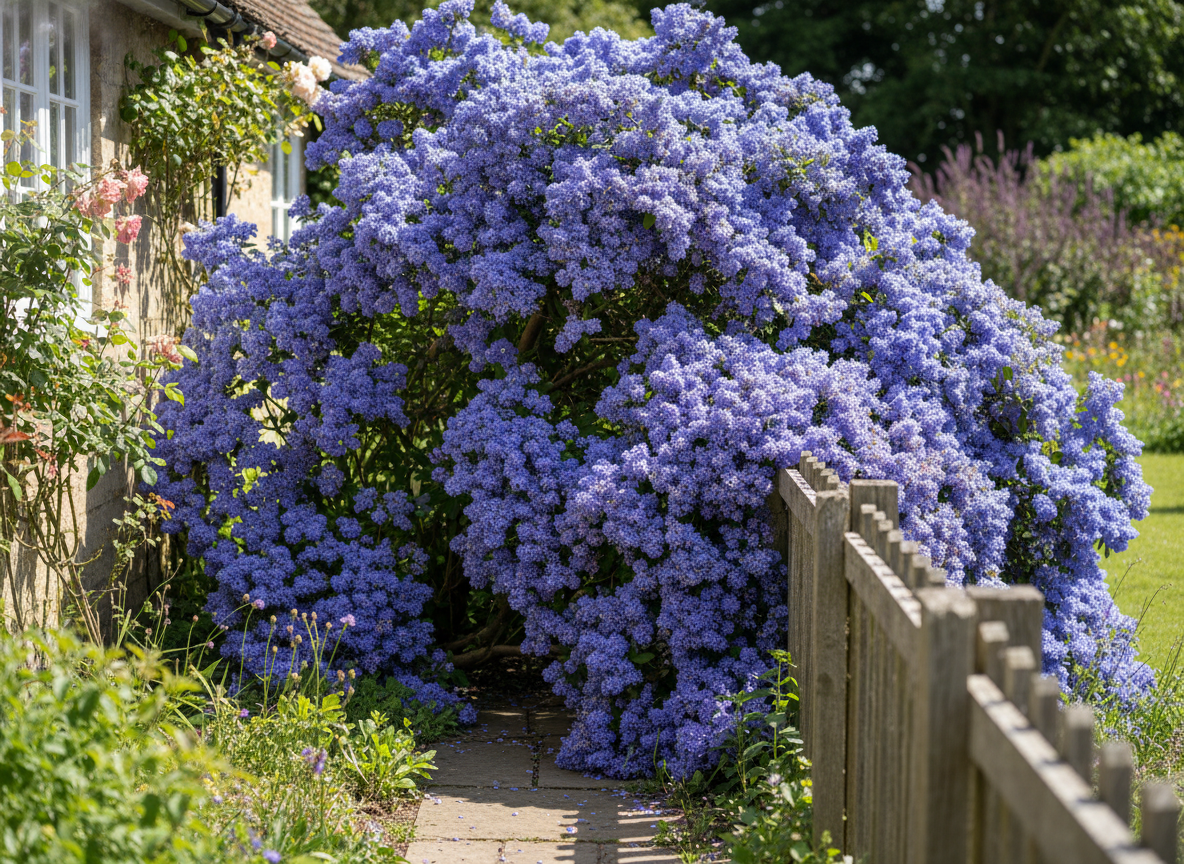 A large, flowering ceanothus shrub overflows its garden space next to a house — AI-generated illustration
When the Shrub Has Already Outgrown Its Space
The honest answer here is the hardest one. An evergreen Ceanothus that has outgrown its space cannot be cut back. There is no rejuvenation pruning for these plants the way there is for lilac or buddleia or hazel.
In practice, this means three things.
If the shrub is only slightly oversized, the tip-pruning approach above will hold it for another year or two. You’re nibbling at the outer green shell. You won’t reduce the overall footprint by much, but you can keep it neat.
If the shrub is significantly oversized — pushing past gutters, blocking a path, swallowing a neighbour — the realistic plan is to accept the next two seasons as terminal. Enjoy this year’s flowers and next year’s flowers, then replace. Trying to cut a mature Ceanothus down by half almost always results in a shrub that dies back unevenly over the next eighteen months, looking progressively worse, until you replace it anyway. The plant is generally cheap, fast-growing (a metre a year on a well-sited specimen), and back to flowering within three years from a new planting. Starting again is often the right move.
If you must reduce it now — because of a wall repair, a new fence, a structural reason that can’t wait — the best a Ceanothus can offer is a slightly above-the-line cut combined with patience. Take it back to the lowest point where you still have meaningful leaf cover, accept that the cut branches will not regenerate behind that point, and live with whatever silhouette you end up with. Some specimens surprise you and push from semi-dormant buds. Most don’t.
The Common Mistakes, in Order of Frequency
The first mistake is the one above: cutting into bare wood and expecting it to regrow. It won’t.
The second is timing. Even a correct cut, made in the wrong season, is a problem. Pruning in late summer or autumn removes the wood that holds next May’s buds. Pruning in winter exposes fresh cuts to frost on a plant that is borderline hardy in much of northern Europe to begin with. The window is the three weeks after flowering — typically late May into early June in most British and Dutch gardens — and almost no other time.
The third is shears across the top. Even gardeners who know the rule sometimes reach for hedge shears to neaten the silhouette. Shears do not respect the line. They cut wherever they happen to fall, and on a Ceanothus that often means into bare wood at the back of the shrub where the foliage is thinner. The result is a hedge-like top with a dying interior. Use bypass secateurs and accept the time it takes.
The fourth is feeding it. Ceanothus is a Californian chaparral plant adapted to lean, fast-draining soil. Rich feeding produces lush, soft growth that doesn’t flower well and is more vulnerable to winter wet. The right feed is none. The right soil is the one it’s already in. The right care, beyond the late-May tidy, is to leave it alone.
A Note on Wall-Trained Specimens
The standard advice for wall-trained Ceanothus adds one rule to the no-old-wood principle: tie in, don’t cut out.
Where a long shoot grows out from the wall, the instinct is to remove it. The better move, in most cases, is to bend it back against the wall and tie it in with soft twine, ideally to existing horizontal supports or wires. The shoot stays alive, photosynthesising, and over time fills out the wall-coverage rather than being cut off and lost.
Cut only where tying in is impossible — usually shoots growing straight out from the wall at an angle that can’t be redirected. For those, prune at a leafy point, on a section where the cut won’t leave a visible gap.
Wall-trained Ceanothus that get hedge-pruned every year tend to develop a thin outer shell and a hollow, dead interior. Tied-in specimens stay denser longer and live two or three times as long.
Where Cresco Fits
Cresco doesn’t replace the line. You’ll still need to find it on your own shrub. But what Cresco does, for a plant like Ceanothus, is pin the window: based on your location, your specific cultivar, and how this spring’s temperatures have actually played out in 2026, the app tells you the two-to-three-week range when pruning is safe — not a generic “May” but the dates that apply to your garden.
For shrubs where the timing window is short and the consequences of missing it are large, that’s the kind of thing that matters. You can read the rule once and remember it. Remembering when, on your specific Ceanothus, the safe window closes — that’s what the app is for.
Get the pruning calendar for your Ceanothus →
Ceanothus rewards being left mostly alone. The late-May tidy, done lightly and within the leafy zone, is the only annual intervention it needs. Skip the bigger cuts, skip the autumn tidy, skip the winter rescue. Find the line, stay above it, and a well-sited specimen will give you fifteen years of electric blue.