A pest with a postcode
There are several reasons a broad bean row can fail in June, but only one of them shows up overnight: a black ring of Aphis fabae — the black bean aphid, the blackfly of every allotment story — wrapping itself around the top ten centimetres of every plant. Stems that were green at sundown look like they’ve been dipped in soot by breakfast. The first instinct is always to spray. The second is usually to swear. The right move, almost always, is the one you should have made a fortnight ago: pinch the growing tip off, before the aphid arrives at an address that is now suddenly missing.
Blackfly do not, as a rule, just turn up. They have a postcode, they have a flight plan, and in the second half of May in north-west Europe they are coming off their winter host — the spindle bush, Euonymus europaeus, growing in the hedge a field or two away — in a series of winged migratory generations that the Rothamsted suction-trap network has tracked for sixty years. They are not looking for a broad bean plant in the abstract. They are looking for the soft, nitrogen-rich growing tip at the top of one. Take the tip away and the address simply does not exist anymore.
This is why mid-May is the moment. By the time the lower flowers on a broad bean plant have set their first small pods — about now, on autumn-sown ‘Aquadulce Claudia’ and on April-sown ‘Witkiem Manita’ alike — the migratory winged females are already on the wing and the colony you’ll have on the row by the first week of June is already, in a quiet biological sense, on its way. You don’t have many days. You have one, maybe two evenings with secateurs, and the entire shape of the harvest changes depending on whether you take them.
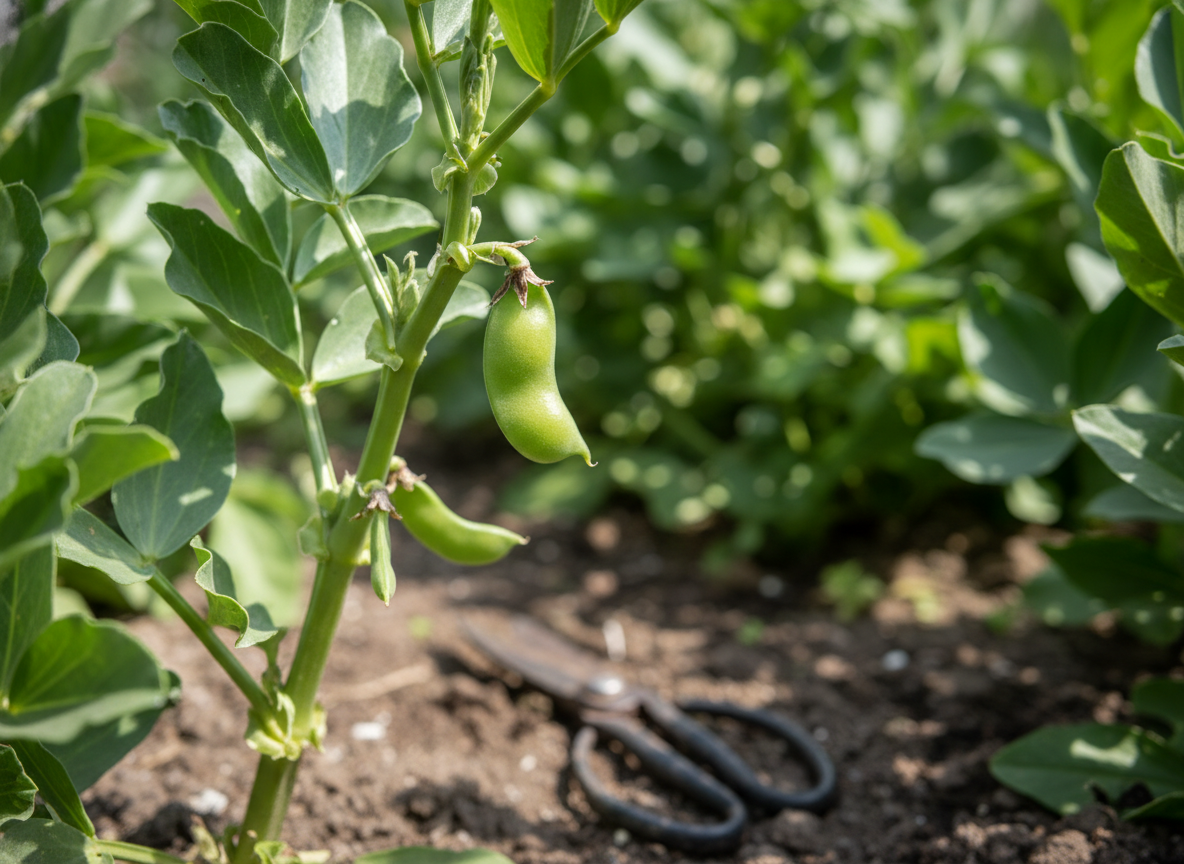 . A fava bean plant with its first pod and a pair of shears on the ground — AI-generated illustration
Why the first pod is the trigger, not the calendar
The traditional advice is to “top broad beans when they reach about a metre” or “top them once they’re flowering well.” Both versions are widespread, both are partly right, and both miss the only signal on the plant that actually corresponds to the aphid’s biology: the moment the lowest flower truss has set its first pods, recognisably pod-shaped, somewhere between 1 and 3 cm long.
That moment matters because two unrelated clocks both run out at it. The first is the plant’s clock. Broad beans are determinate-ish at the lower end and indeterminate at the top — they keep adding flower trusses upward as long as the apical bud is intact, but they only set pods in the lower trusses once the upper truss flowers have opened and the lower ones have been pollinated. Once the lowest pods are visible, every gram of carbohydrate the plant has spare needs to go into filling those pods, not into adding another two trusses of flowers that won’t have time to set before the season turns. The growing tip, which was useful in April, is now a drain on the harvest. Pinching it off is the same logical move that disbudding a peony or pinching out a tomato side-shoot is — you are telling the plant where to spend its sugar.
The second clock belongs to the aphid. Aphis fabae migration off the spindle bush peaks in north-west Europe between about 10 and 25 May in a normal year, two to three weeks later in a cold spring and a week or so earlier in a warm one. The RHS guidance on blackfly is clear that the winged females arriving on a broad bean row do not settle anywhere on the plant — they settle on the very softest, most actively dividing tissue available, which is the cluster of unopened leaflets at the apical tip. The chemistry up there is right for them: high free amino acids, low secondary defence compounds, thin cuticle. The rest of the plant is fine but second-best. Remove the tip, and the migratory female who lands on what’s left will, on average, take off again and look for a softer row down the path.
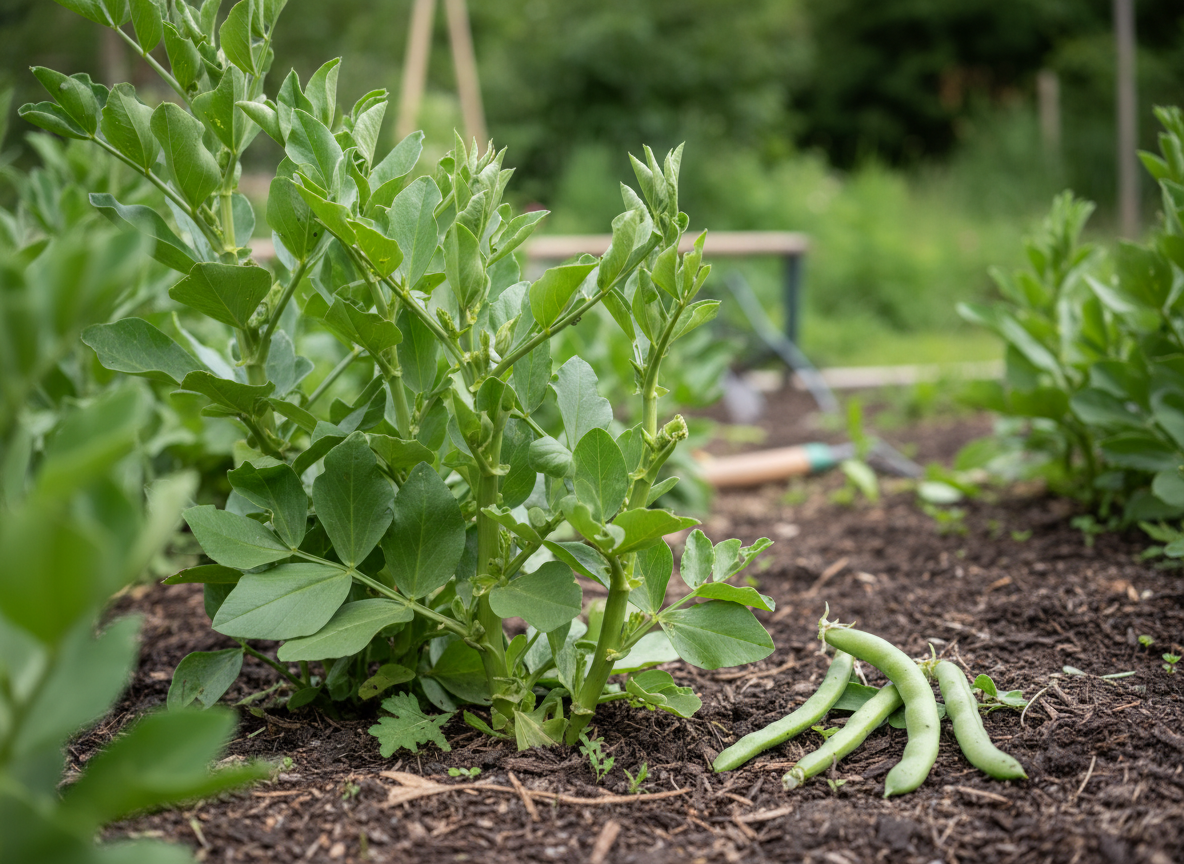 Plants growing in soil, with harvested pods nearby — AI-generated illustration
The five-centimetre rule
The number that matters when you actually do it is small: five centimetres, taken off cleanly, leaving the plant looking almost unchanged. Most gardeners, told to “top” a broad bean, take off the top fifteen or twenty centimetres on the theory that more is more. It isn’t. The blackfly preference is for the unopened apical cluster — the rosette of three or four immature leaves wrapped tightly around the still-elongating growing tip. That cluster is the top three to five centimetres. Everything below it is already fully unfurled, slightly thicker in the cuticle, and not the destination on the aphid’s map.
Take off too much and you also take off a working pair of leaves whose photosynthesis was about to fund the pods further down. There is a clean five-centimetre snap with thumb and forefinger that removes the rosette and the very top of the stem and nothing else. The plant looks like it did the day before, minus its haircut. Within twenty-four hours the highest remaining pair of leaves takes over as the new apex, but it is fully unfurled tissue — too tough, too low in free amino acids, too thoroughly defended — for a winged blackfly to bother settling on. The plant has lost a growing tip it didn’t need anyway, and the row has lost the only address blackfly were going to write down.
There’s also a culinary upside. The pinched tips are the most tender thing on the plant. They taste like a cross between pea shoots and very young broad beans; they wilt in thirty seconds in olive oil and a clove of garlic; they are wasted on the compost heap. Most experienced kitchen gardeners pinch into a colander, not onto the path. A row of fifteen plants produces enough tips for a side dish for four.
What the aphids are actually doing up there
It helps to know what you’re disrupting. Once a winged migratory female finds a soft tip she settles, inserts her stylet into the phloem, and within a day or two starts producing daughters parthenogenetically — no male required, no eggs laid, just live wingless nymphs born one at a time. Each of those nymphs is, by week two, producing daughters of her own. The Wikipedia summary of the species’ biology is unromantic but accurate: each female produces up to thirty offspring in a fifty-day adult life, and under May–June conditions a colony doubles every three to four days.
That is why the ring of black at the top of the stem appears overnight. It doesn’t, really. It builds for two weeks where you didn’t look — six aphids on Monday, twelve on Wednesday, fifty on Friday, four hundred on the following Wednesday — and then on Saturday morning the colony has spilled out of the apical rosette and is visible from across the garden. By that point the population pyramid below the visible layer is heavy enough that picking, blasting, or squashing buys you a day at most, because every leaf node still has reproducing females.
The pinch interrupts this at the very first step. There is no soft apical rosette for the migratory female to settle on. There is no founder colony. There is no pyramid. The handful of winged aphids that land on the row anyway will mostly fly off again within hours; the few that stay will start a colony on a fully unfurled leaf, where their reproduction rate is slower, where ladybirds and hoverfly larvae can find them more easily, and where the damage they cause is cosmetic rather than structural. You have not eliminated blackfly. You have made your row a worse address than the neighbour’s.
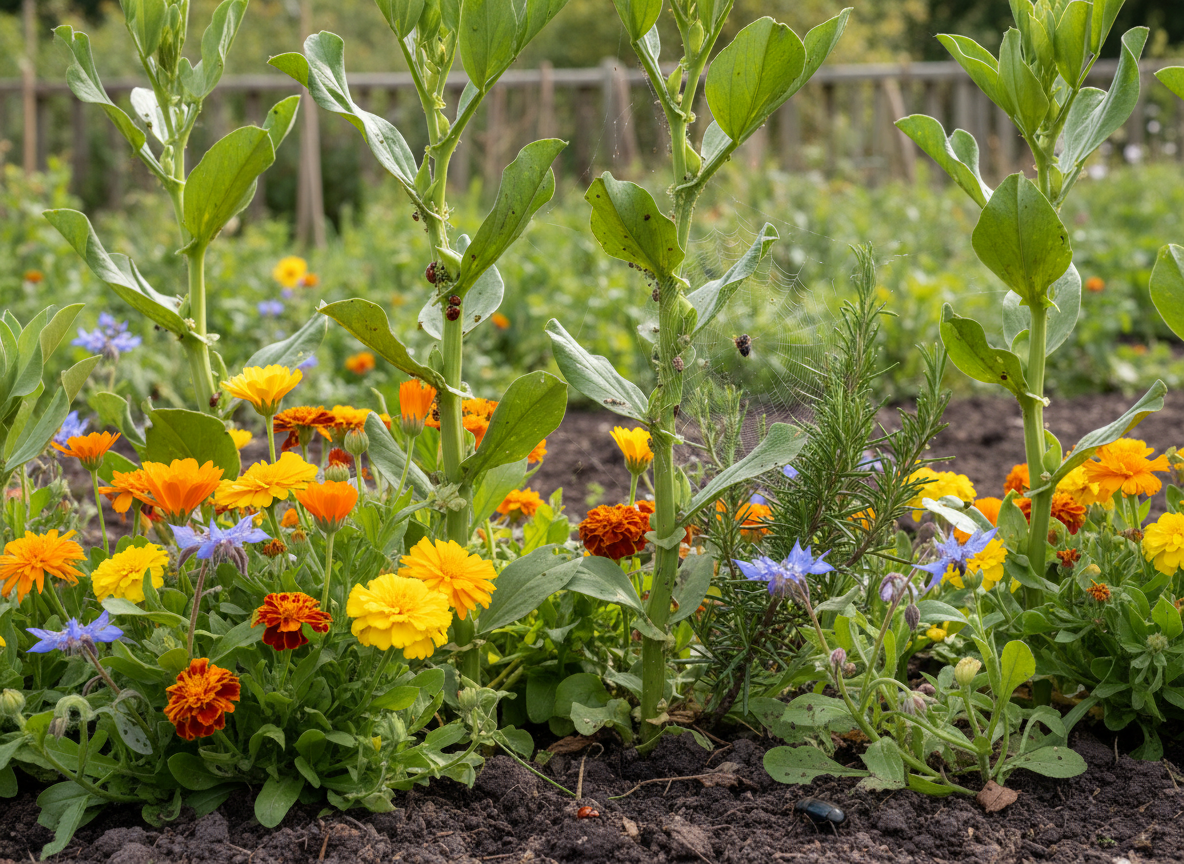 AI-generated illustration
The companion-and-predator angle, honestly
Every guide to blackfly on broad beans eventually arrives at the companion-planting list: nasturtiums as a trap crop, summer savory as a repellent, alyssum and yarrow and tansy and dill as nectar plants for hoverflies and lacewings, ladybirds released from a punnet of larvae bought online. The list is not wrong. It is, however, almost always written as if the pinch were optional and the companions were the main event, and the order of operations is the other way around.
In a row where the tip has been removed at the right moment, the predator base — the resident ladybirds, the seven-spot adults that have just come out of hibernation, the hoverfly larvae from the alyssum drift along the path edge — has weeks to build up before the aphid population on the row reaches numbers that matter. A few aphids settling on a tougher mid-stem leaf is, in fact, the ideal scenario for a hoverfly female: she lays her eggs amongst them, the larvae hatch and clean the colony out, and the row never tips over the threshold at which you’d notice damage. The pinch buys time. The companions and predators use it.
In a row where the tip was left intact and the apical rosette is now a black sock, the predators are arriving at a wedding cake. A single seven-spot ladybird eats around fifty aphids a day; a colony of two thousand laughs at her. Spraying with soft soap or blasting with rainwater works at this point only if you do it every day for a week, and it kills the predator larvae alongside the aphids. The honest version of the companion-planting story is that it is brilliantly effective in a system where the gardener has already removed the worst of the initial colonisation. It is much less effective, on its own, as a rescue mission.
What to do this week
Walk the row this evening with a head torch if the light has gone. Look at each plant in turn from the side — not the top — and count the flower trusses with visible small pods at the bottom. If the lowest truss has set even one pod the size of your fingernail, that plant is ready. If the lowest flowers are still open but no pods are forming yet, give that plant another four to seven days and come back.
When you pinch, do it cleanly with thumb and forefinger or with a pair of sharp snips, and aim to take off the top five centimetres including the cluster of unopened leaflets. Don’t bother trying to be neat about it; the snap point on a broad bean stem at this stage is obvious, and the plant heals over within a day. Drop the tips into a colander rather than onto the path. If you’ve left it slightly late and there are already three or four aphids on the rosette, the pinch is even more urgent — you’re now removing the founder colony before her daughters arrive.
If the row was sown in October as ‘Aquadulce Claudia’ or ‘Super Aquadulce’, the plants are tall and the lowest pods are well advanced; these are usually ready to top by 10 May in the south of England and the Low Countries, slightly later further north. If the row was sown in late March or early April as ‘Witkiem Manita’, ‘The Sutton’, or ‘Stereo’, the timing is right now in the second and third week of May. If you sowed in May for a late crop, you’ll be topping in early to mid-June and will face a heavier wave of aphids that have already built up colonies elsewhere — the pinch will still help, but the predator base is the main defence by then.
Don’t top a row that hasn’t yet set lowest-truss pods. If you remove the tip on a plant that is still in pure flowering mode, you risk losing the lower trusses to abortion because the plant suddenly has no upper sink for its sugars and the hormonal balance shifts away from pod fill. The pod is the trigger. Without the pod, the pinch is premature.
How to tell, in late June, whether you got it right
The diagnostic is the colour of the top three nodes of the plant when you go to pick pods in the third week of June. A row that was topped at the right moment shows pale-green, fully unfurled foliage all the way up, with a slightly stubby silhouette where the apex used to be and a cluster of fat, well-filled pods on every truss below. There may be a small smear of blackfly on one stem in twenty, normally being attended to by ladybird larvae you can see from a metre away. The pods are heavy in the hand, the beans inside are large and pale, and the row stands upright without leaning.
A row that wasn’t topped, or was topped too late, looks different at the same date. The top fifteen centimetres are still black, or sticky with the honeydew the colony has shed even after the aphids have moved on; the leaves below are dull and stippled with sooty mould growing on the honeydew; the upper trusses have aborted; and the pods on the lower trusses are smaller than they should be, because the plant spent its sugar fighting the aphid and feeding it instead of filling its own pods. The crop is not lost, but it’s a half-crop in a season that should have given you a full one.
Cresco’s pruning and care planner handles this kind of moving-target timing the way it does the Chelsea chop or the second potato hilling — by reading the actual phenology of your row against local soil temperature and the spindle-bush flight forecast from the nearest aphid suction-trap, and surfacing the pinch reminder in the week the lowest pods are actually setting on your variety, not on a generic calendar. The five-centimetre rule is universal; the date your row hits it shifts by ten days year to year. The reminder wants to shift with it.
Topping a broad bean takes about ninety seconds per row of fifteen plants. There is no other pinch in the vegetable calendar with a comparable leverage: a minute and a half of work, at the right moment, removes the only welcome mat Aphis fabae lays out at your door. The plant doesn’t miss the tip. Your salad bowl gets the tender shoots. The blackfly migrate down the path to a row whose gardener wasn’t reading this. And in the third week of June, when the pods are heavy enough to bend the stems, you’ll know which version of May you chose.