The hedge-trimmer instinct, and why it quietly empties the bush
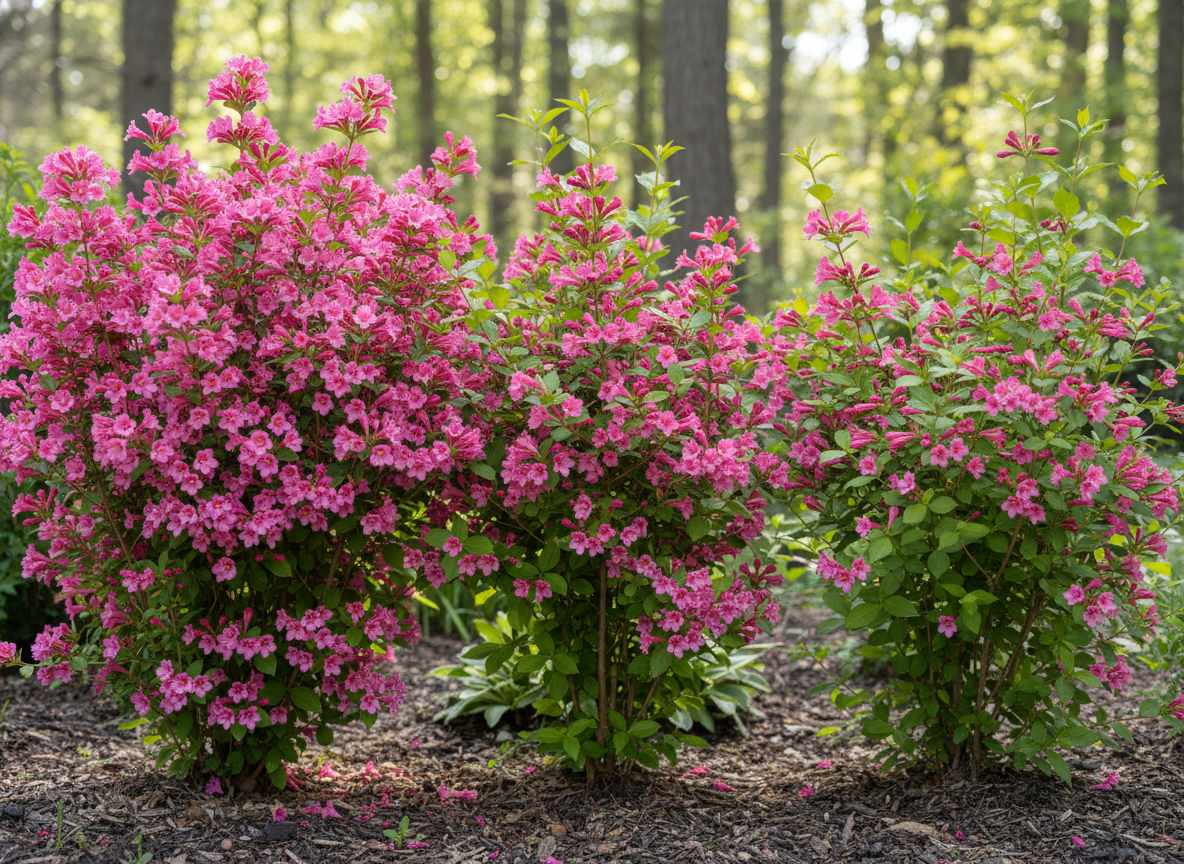
Walk past any front garden in late May and you can spot the weigelas that get sheared every year. They are dome-shaped, smooth on the outside, hollow in the middle, and the flowers — when they appear — sit in a thin band around the surface like icing on a cake. From a metre away they still look like a shrub. Up close, the structure is gone. Half the branches inside are dead.
That happens because Weigela florida (and the popular cultivars ‘Bristol Ruby’, ‘Nana Variegata’, ‘Wine & Roses’, ‘Sonic Bloom’) flower on wood that was made the previous summer. Not all of it. Specifically, on side shoots from one- and two-year-old branches that received good light all summer long. Anything older than three or four years stops flowering well, and anything inside the bush that gets shaded out by an outer shell of growth simply gives up and dies back.
A hedge trimmer keeps the outer shell intact, cuts back the new growth that would have carried next year’s flowers, and shades the centre of the plant a little more every season. After four or five years you have a leafy dome that flowers for a fortnight and then sulks.
 AI-generated illustration
What weigela actually asks for: the one-in-three rule
The fix is the same renewal technique the RHS recommends for almost every deciduous shrub that flowers on the previous year’s wood: take out the oldest third, leave the rest, and you reset the clock without losing the shape.
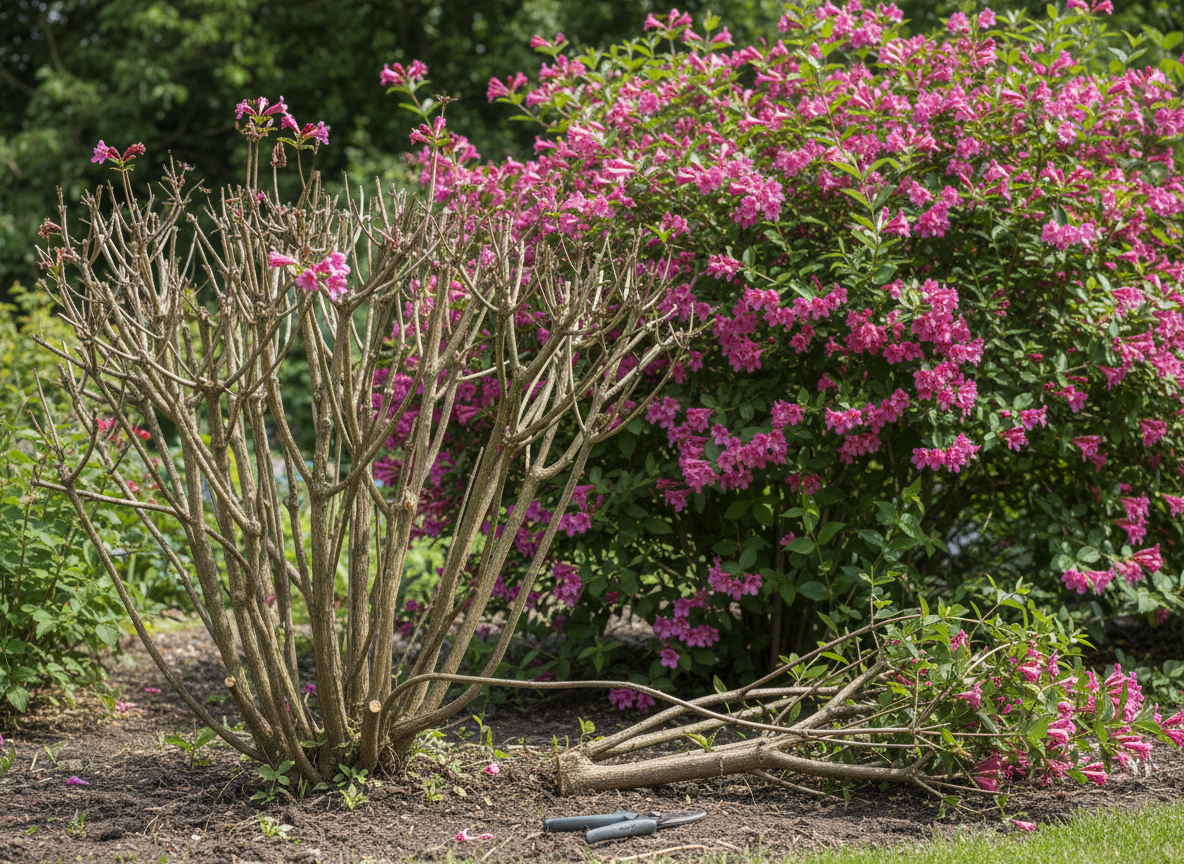
The rule, in one paragraph: each year, after flowering, identify the three or four oldest stems coming out of the ground or out of the main framework. Cut them off at the base, or back to a strong young side shoot low down. Leave everything younger alone. You have just removed roughly a third of the bush’s volume, but only the third that was about to stop flowering anyway. The shrub responds by pushing new shoots from the base, and those new shoots become next year’s flowering wood.
Done correctly, the bush never gets older than three years in any given stem. It keeps the same overall size, the same outline, and a centre full of young wood that can flower next May.
How to spot the oldest stems
This is the bit most guides skip. “Cut out the oldest third” only works if you can actually tell which is which. With weigela the clues are obvious once you know what to look for:
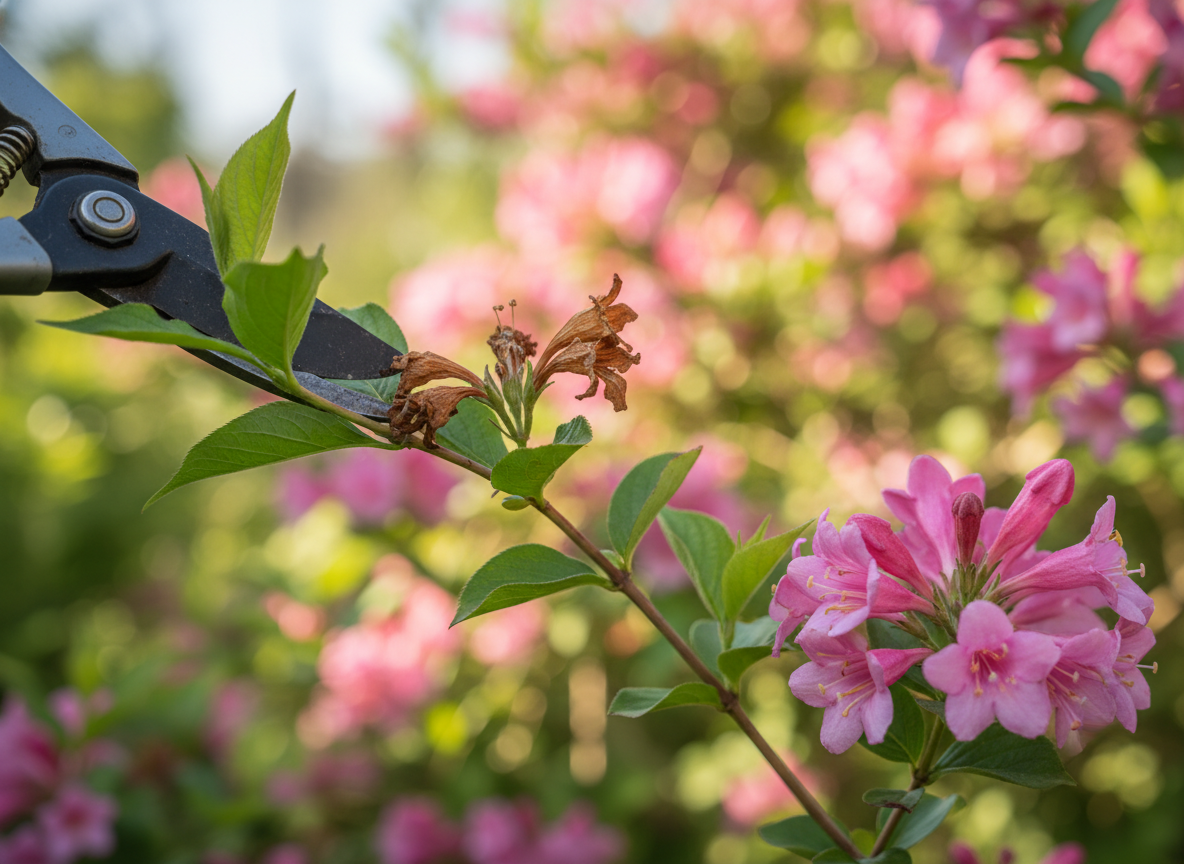
- Bark colour and texture. First-year stems are smooth and pale, often with a green tinge. Two-year-old wood has thin, papery grey-brown bark. Three-year-old wood is darker, rougher, and starting to split lengthways. Anything older than that is grey, fissured, sometimes with patches of lichen — those are your targets.
- Side-shoot density. Old stems have fewer, weaker side shoots. The new wood you want to keep has plenty of vigorous laterals each carrying a cluster of leaves and (this May) a fading flower spike.
- Where the flowers were. Run a hand back along any stem that flowered well this spring. If you can trace it back to the base and the whole length is dark, rough bark, that is a stem on its last legs. Cut it.
Mark them with a loop of garden twine before you start cutting. It sounds fussy, but the second you put the secateurs down and step back, every stem looks identical and you lose your place. Three loops of twine, then three cuts, then step back.
 A branch of flowering weigela is pruned with hand shears — AI-generated illustration
Where to make the cut
Two valid options, depending on what you want.
Option one — cut to the base. Drop the chosen stem right down to ground level, or to the swollen knuckle where it joins the main rootstock. The shrub will throw new shoots from that knuckle within four to six weeks. This is the cleanest option for a bush that has been getting too wide and you want some of that energy redirected.
Option two — cut back to a strong young side shoot. Trace the old stem upward until you find a vigorous one-year-old branch coming off it, ideally 30–60 cm from the ground and pointing outward. Cut the old stem just above that side shoot, at a shallow angle. The side shoot takes over as the new main stem and you keep more of the framework intact. This is the better option when the bush is already in a tight spot and you don’t want it to regrow from scratch.
Don’t leave stubs. A weigela stub above a side shoot dies back, rots, and lets disease in. Cut flush with the joint, leaving a tiny collar.
The window is narrower than you think
Weigela needs the cut within four weeks of the last flower fading. Miss that window and you start eating into next year’s flowers.
Here is why the calendar matters. New shoots that emerge after pruning need the rest of the summer — roughly June, July, August — to grow, ripen, and form flower buds in their leaf axils. Those buds sit dormant through autumn and winter, then open as flowers next May. If you prune in July, the new shoots have only six weeks of growing season before the days shorten, the wood doesn’t fully ripen, and the buds either don’t form or get killed by the first hard frost. Prune in autumn or late winter and you cut off the wood that was going to flower in May.
For most weigelas in southern England, the Low Countries, and northern France, that means a window roughly between the third week of May and mid-June. Up north, or after a cold spring, the window shifts a fortnight later. Watch the bush, not the calendar: when the last few flowers are brown and the petals fall when you brush past, the window is open. When you can find a clean new shoot already 15 cm long emerging from the base, it is fully open.
Get the cut done before the longest day if you possibly can. A few stragglers can wait, but the one-in-three should be done while the soil is still warm and there is summer left to use.
 AI-generated illustration
Already a bald, hollow weigela? Renovation pruning, not the one-in-three
If your bush has been sheared every year for a decade and the centre is a graveyard of dead stems, the one-in-three rule won’t fix it on its own — there isn’t enough young wood left to keep. You need a harder reset.
Two ways to do it. Phased renovation is the safer route: this year, cut half the stems hard back to 30 cm. Next May, cut the remaining half down to match. You lose one flowering season but keep the other half of the bush flowering while the cut-back half regrows. One-shot renovation is the brave version: cut the whole bush down to 30–45 cm in late May or early June. You will get a lot of regrowth from the base over the summer, no flowers next year, but a full flush the year after that.
Either way, feed and mulch immediately after the cut. A handful of slow-release fertiliser (a balanced 7-7-7 is fine) and a 5 cm layer of compost around the base gives the bush the energy to push new wood. Water in dry spells through June and July — weigela copes with drought once established, but a freshly renovated bush has no reserves.
Three mistakes that keep coming up
Shearing the outline. Already covered, but worth repeating because it is the single most common error. A weigela is not a Buxus. Putting a hedge trimmer to it removes next year’s flowering wood and leaves the dead centre untouched. If you only have time for one tool, use loppers and take out three stems, not the surface of the dome.
Cutting in February or March. This is the second-most common error and it usually comes from gardeners who treat every shrub like a buddleia. Late-winter pruning works for shrubs that flower on the current year’s growth. Weigela flowers on the previous year’s growth. Cut it in March and you have just cut off May’s flowers. If you inherit a weigela in spring and you can see the flower buds swelling, leave it alone until after flowering.
Leaving the prunings under the bush. Weigela leaves and stems can carry leaf-spot fungi, and weigela is also one of the hosts for honey fungus in some gardens. Get the prunings out of the bed and onto the compost heap or into a council green-waste bin. Don’t pile them at the base.
Quick reference
- When: within four weeks of the last flower fading — for most gardens, late May to mid-June.
- What: the oldest three or four stems, identified by dark, fissured, lichen-marked bark.
- Where to cut: to the ground, or back to a strong young side shoot 30–60 cm up.
- What to leave: everything younger, plus the bulk of this year’s new growth — that’s what will flower next May.
- After: light feed, mulch, and water through dry spells in June and July.
- What not to do: shear the outline, prune in winter, or leave the cuttings under the bush.
Get the one-in-three habit going this May and within three years your weigela has zero stems older than four years, the centre stays open, and you stop noticing the “bare patch low down” that bothered you every June. Cresco will set a reminder for the week the last flower fades on your specific cultivar and your specific postcode, so the window doesn’t slip past while you are dealing with something else.