Pick up almost any general pruning calendar and it’ll tell you the same thing about fruit trees: apples and pears get the winter cuts, stone fruit gets pruned “in summer”. That single word does a remarkable amount of damage. “Summer” sounds optional, like a preference — when in fact it’s the only window where you can put a saw to a plum, cherry, damson, gage, apricot or almond without rolling the dice on silver leaf disease. The window opens around mid-May, peaks through June and July, and starts closing as August arrives. We’re right at its leading edge.
The disease that wrote the calendar
Silver leaf is caused by a fungus called Chondrostereum purpureum. It infects through fresh wounds — pruning cuts, broken branches, splits from a heavy crop — and then travels into the wood, blocking the vessels that move water up to the leaves. The classic symptom is exactly what the name says: the leaves on one or two branches turn a metallic silver, weeks or months later. By the time you see it, the fungus is already inside the trunk. There is no spray. There is no cure. You cut the affected branch out 15 cm past any brown staining in the wood and hope you caught it in time. (RHS)
The reason the May-to-July window exists is straightforward: the fungus releases its spores in cool, damp conditions, mostly between September and April. Cut a plum in February and the wound sits open for weeks in spore-rich air. Cut the same plum in late May and the wound calluses over inside a fortnight, in air that’s almost free of viable spores. Same cut, completely different gamble. (Ashridge Trees)
This isn’t a folk rule. It’s the reason the RHS, every reputable UK nursery and the EU plant health guidance all say the same thing: never prune Prunus species — that includes ornamental cherries and flowering almonds, not just the fruiting ones — between September and April. (RHS plum pruning)
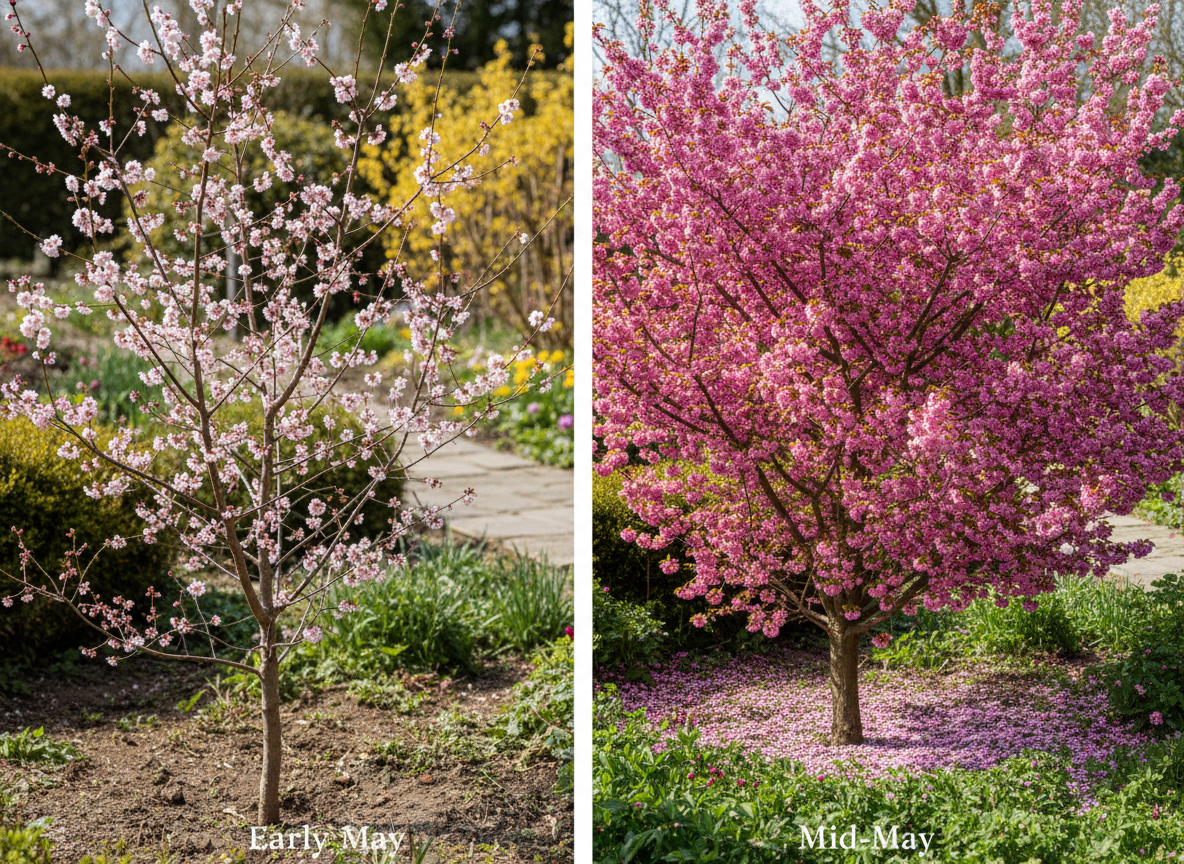 Two plum cherry trees in early and mid-May — AI-generated illustration
Why mid-May, not early May
You’ll see some sources stretch the window earlier, to “after the leaves fully open” — which can mean early May in a mild south. The reason I lean to mid-May and later in the season is sap pressure. Plums and cherries are heavy bleeders in spring; cut a finger-thick branch on the 1st of May and you’ll get clear sap weeping for days, sometimes amber gum oozing for weeks. By the third week of May the tree has finished the explosive push of leaf expansion, the sap is moving steadily rather than racing, and wounds close cleanly.
The other thing that’s happened by mid-May: you can finally see what the tree is doing. Pruning before the leaves are fully out is guessing — you can’t tell which buds woke up, which spurs are flowering, where the new wood is going. Wait until the canopy has filled in and the choices make themselves.
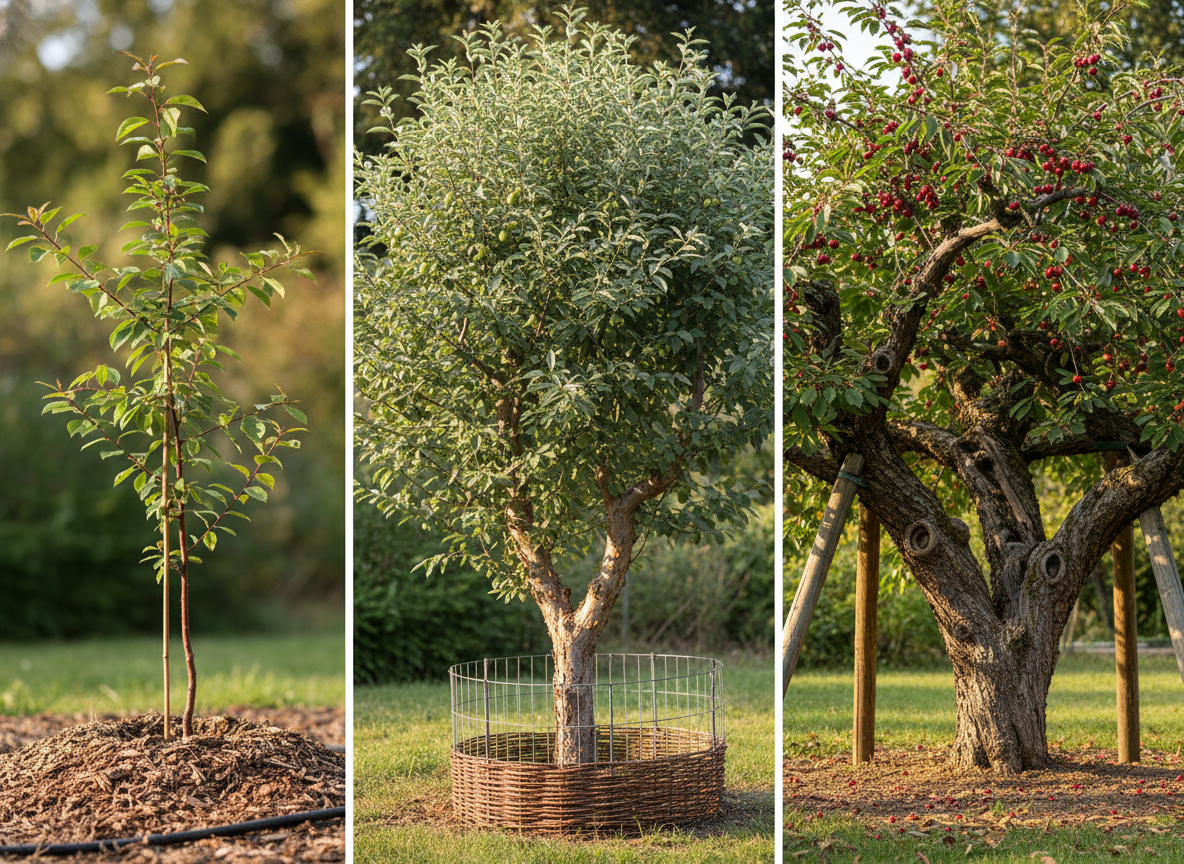 A plum cherry tree is shown at three different ages — AI-generated illustration
What to actually do, by tree age
The single biggest mistake gardeners make with stone fruit is treating “summer prune” as a synonym for “winter prune, done later”. It isn’t. The cuts you make in May, June and July are not the same cuts you’d make on an apple in January.
Young trees (years one to four). This is formative pruning — you’re building the shape of the tree, usually an open-centred goblet for plums and cherries, occasionally a fan against a wall. Pick three to five well-spaced branches as your permanent scaffold and shorten everything else. Cuts up to about thumb-thickness heal easily in May. Don’t be afraid to take material off; a young tree wants to be pushed into shape now, while wounds close in two weeks.
Established trees (year five onwards). Once the framework is set, the job changes entirely. You’re now thinning, not shaping. Look for:
- Dead, broken or rubbing branches — out at the collar, no stub.
- Crossing growth in the centre — out, to keep the goblet open to light and air.
- Vertical water shoots from the main scaffold — out at the base. These never fruit and just clutter the canopy.
- The occasional whole branch that’s tipped over with age — cut back to a strong, outward-pointing replacement.
Resist the urge to head back the tips of fruiting branches. Plums and cherries flower on two-year-old wood and on short spurs along older wood. If you snip every tip, you snip every flower bud for next year.
Cordon and fan-trained trees. These get two prunings: a structural one now in late May to mid-June (taking out anything growing forward off the wall, and shortening side shoots) and a tidying-up in August, before the window shuts. Fans want everything growing flat to the wall; anything sticking out at right angles is wasted wood.
How to make the cut
Three rules, in order of how much they actually matter.
One: clean tools. Wipe the blade with isopropyl alcohol or a quick dunk of diluted bleach between trees. The fungus moves on infected wood and dirty steel as readily as it moves through air. If you’ve recently pruned a tree that already had silver leaf, do not touch a healthy Prunus with the same secateurs until you’ve sterilised them.
Two: cut to the collar, never flush, never with a stub. The collar is the slightly swollen ring of bark where the branch joins the trunk — find it, leave it intact, and cut just outside it. Flush cuts strip the collar of its natural defence chemistry; stubs die back and become a fungal motel. A clean, properly-placed cut on a vigorous May tree will be sealing visibly within ten days.
Three: ignore the wound paint. This is one of those rules that gardeners over fifty grew up with — paint every cut on a stone fruit to “seal out” the disease. It doesn’t work, and it can actively make things worse by trapping moisture against the wood. The RHS has been clear about this for over a decade: leave wounds open in summer and let the tree’s own callus do the job. (RHS pruning guide)
A small caveat: if you’re cutting a branch thicker than your wrist, use the three-cut method. Undercut a third of the way through about 30 cm out from the trunk, then top-cut a few centimetres further out so the weight breaks off cleanly, then make your final cut at the collar. Two seconds extra, no torn bark, no stripped trunk.
Common late-May mistakes
A tour of what I see most often when people send me photos this time of year.
- Pruning the day before rain. Wet wounds and wet bark are open invitations. Check the forecast — you want at least 48 hours dry after the cut. Late May usually obliges; if it doesn’t, wait.
- Taking off more than a quarter of the canopy. Even in the safe window, hard cuts stress the tree. If you’ve inherited a neglected plum that needs a full restoration prune, spread it across two or three summers, not one.
- Leaving the heavy crop on. This sounds counter-intuitive, but it’s related. A plum that’s set a punishingly heavy crop will split a branch under the weight in July; that split is a textbook silver-leaf entry point. Thin the fruit now to one plum every 5–7 cm of wood, and you’ve prevented the wound rather than treating it.
- Confusing flowering cherries with the rule. “It’s just an ornamental, it doesn’t matter.” It does. Ornamental cherries (Prunus serrulata, P. subhirtella, etc.) get silver leaf just as readily as fruiting ones, and they’re harder to replace because they’re slower to mature. Same window, same rules.
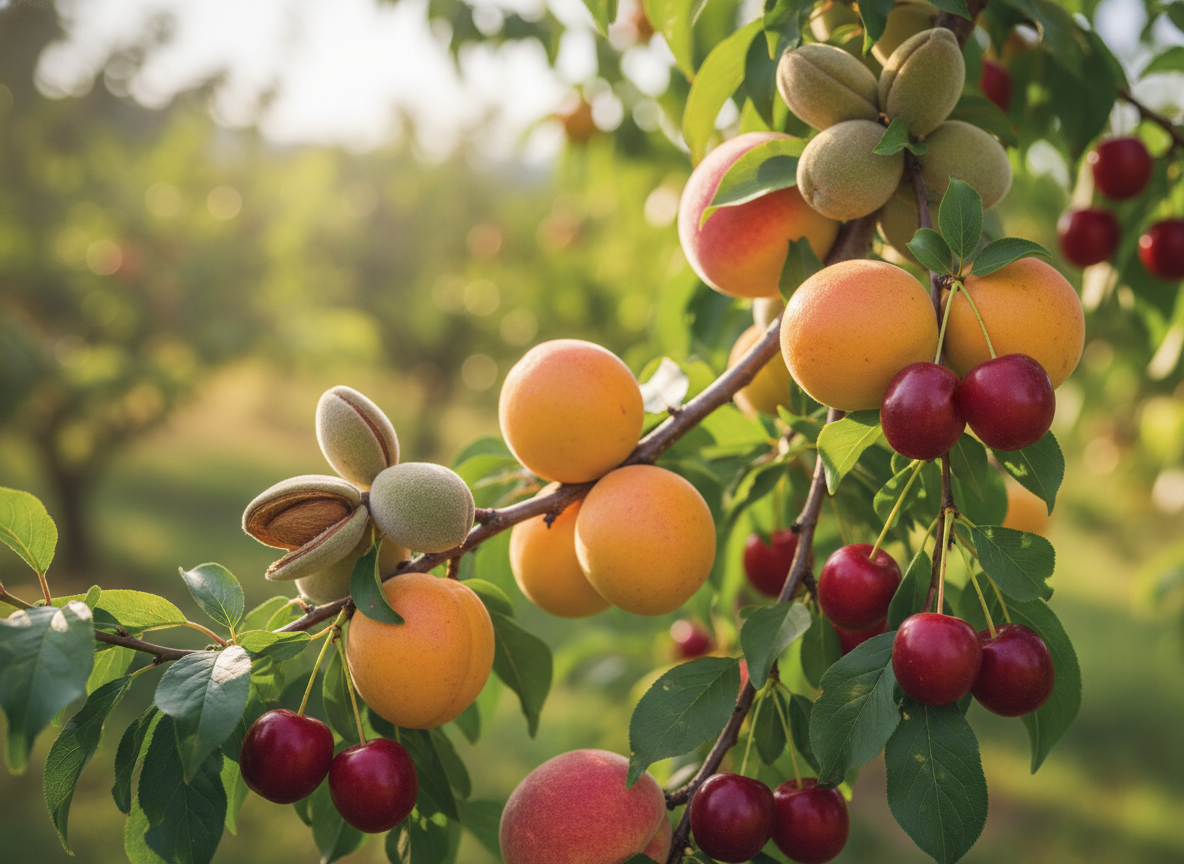 Plum cherry, apricot, peach, and almond fruits growing on branches — AI-generated illustration
What about apricots, peaches and almonds?
Anything in the genus Prunus. Apricots (P. armeniaca), peaches and nectarines (P. persica), almonds (P. dulcis), sloe and blackthorn (P. spinosa), cherry laurel and Portuguese laurel (P. laurocerasus, P. lusitanica) — all of it goes by the same calendar. Hedge-trimming a laurel in November is technically a risk; the difference is that on a fast-growing hedge, infection rarely takes hold before you’ve cut the wound back off in next year’s shaping. On a fruit tree, you only get one trunk.
Peaches and apricots have one extra wrinkle: they fruit on one-year-old wood, so the summer prune is also when you encourage the replacement shoots that will carry next year’s crop. Cut back fruited shoots to a strong new side-shoot near the base after the harvest, ideally before the end of August.
How Cresco handles this
The whole reason I built Cresco is that calendar rules like this one are easy to state and hard to live with. Mid-May to August is a four-month window with two distinct phases — the structural cuts now, the fruit-thinning and post-harvest tidy in July and August — and it shifts a fortnight earlier or later depending on where you garden. Cresco watches your local soil and air temperatures, knows which Prunus species are in your garden, and tells you not “prune your plum in summer” but “this Saturday is dry, your Victoria plum is in active growth, and you have three weeks of safe pruning weather ahead”. That’s the difference between a calendar rule and a plan.
If you’ve been putting off a plum or cherry job because you weren’t sure when, the answer is this week or next. Sharpen the secateurs, wipe the blades, wait for a dry afternoon, and use the window the tree is giving you.