The yellow heap is the plant doing its job
If you have a clump of oriental poppies (Papaver orientale) in your border, you know the rhythm by now. Late April, the bristly leaves push up. Mid-May, the hairy buds split and a single crepe-paper flower the size of a saucer unfurls in one morning. For two weeks the border has a colour you couldn’t paint if you tried — Patty’s Plum in mauve, Beauty of Livermere in blood-red, Princess Victoria Louise in pale salmon. And then, almost overnight, the petals shatter, the stems flop, the leaves go yellow at the tips, and what was the showpiece of your May garden looks like someone tipped a wheelbarrow of compost on it.
This is the moment most gardeners do one of three things. They ignore it and hope it sorts itself out (it doesn’t — it gets worse and then powdery mildew arrives). They pick over it apologetically with secateurs, cutting off only the obviously dead bits (which leaves a half-dead plant looking exactly as bad). Or they decide the poppy has died and dig it out (and lose a plant that would have lived for thirty years).
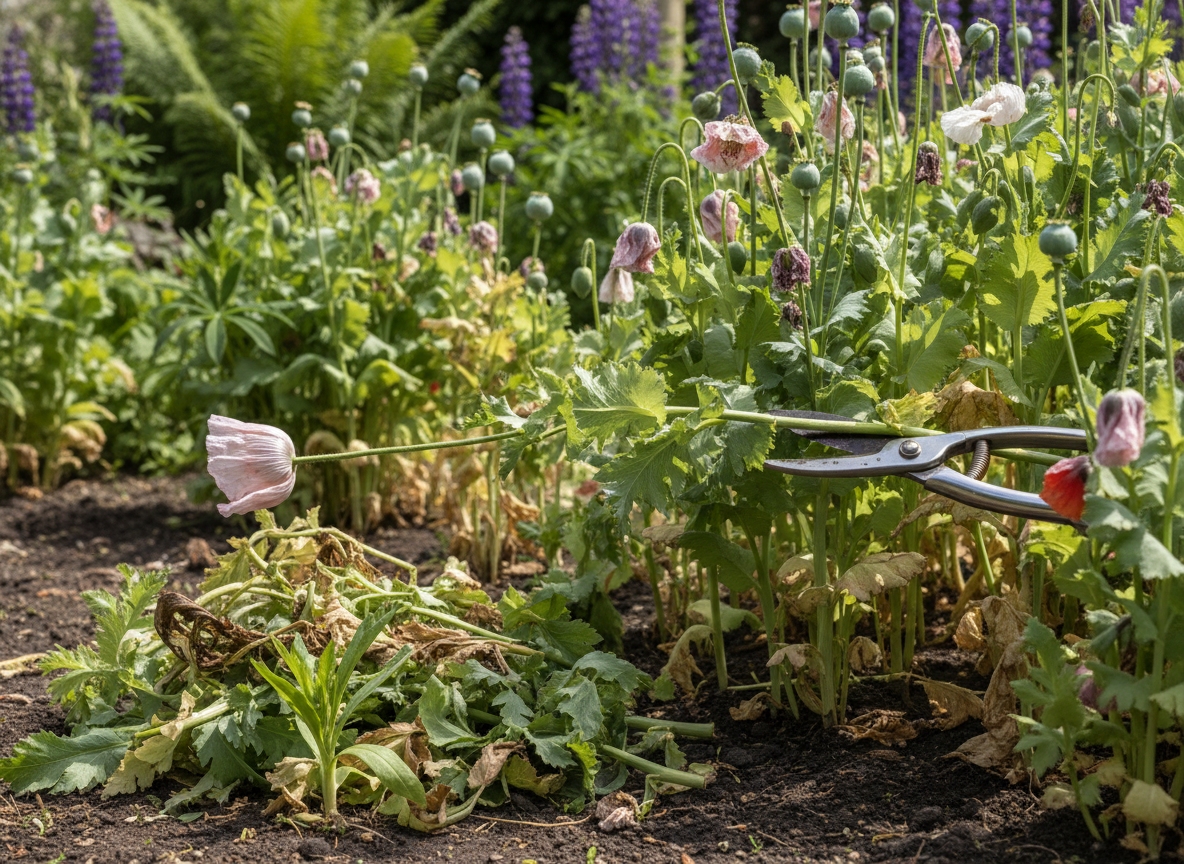
The right answer is the one almost no one does at home, and that every head gardener at every National Trust property does on cue around the third week of May: shears to the ground, every leaf, every stem, no exceptions, and on to the next clump. The plant isn’t dying. It’s going into summer dormancy — which it would do whether you cut it or not. The cut just removes the ugly intermediate stage and gives the plant a clean slate to put up its second flush of leaves from.
This piece walks through what oriental poppies are actually doing in late May, why the hard cut works, exactly how to do it (and what tool to use), what to plant alongside so the gap doesn’t yawn at you all summer, which cultivars reliably give a second flush of flowers in September, and the seed-head warning that catches everyone out the first year.
 AI-generated illustration
Why hard cutting is the kindest thing you can do
Oriental poppies evolved in the dry steppes of Turkey, Iran and the Caucasus. The strategy that works there is: leaf up in April when the snowmelt is still in the soil, flower in May before the heat arrives, go dormant for the dry months of July and August, push a second flush of low rosette leaves when the autumn rains come, and overwinter as that rosette. Your border in Devon or Drenthe or Drontheim doesn’t behave like the Anatolian plateau, but the plant’s clock doesn’t know that. It will go dormant in late May no matter what the weather is doing.
When the plant goes dormant it pulls every usable molecule out of the leaves and stems and parks it in the tap root, which is fleshy, white inside, and can run forty centimetres down into the soil. The yellowing isn’t decay — it’s the plant emptying its solar panels before throwing them away. By the time the leaves look properly horrible, the transfer is essentially complete. Cutting them off doesn’t deprive the plant of anything it was still using.
What the cut does do is three things at once. It removes a large mat of yellowing tissue that’s about to become a powdery-mildew hotel and infect everything within two metres. It signals to the plant that the second flush of basal leaves is needed sooner rather than later, which it will produce within ten to fourteen days. And in cultivars bred for repeat-flowering, the cut tells the plant there’s still a season ahead and triggers a smaller, secondary flush of buds in September — sometimes only three or four flowers per clump, but they arrive at a time of year when nothing else in the border is doing anything new.
The often-quoted alternative — “just let it die back naturally and tidy as you go” — is what gardening writers print when they don’t want to commit to a recommendation. In practice it gives you eight weeks of mess, a mildew problem you didn’t need, no second flush, and a clump that goes into autumn weaker than it should. Hard cut, mulch, water, done in ten minutes.
The cut: shears, ground level, no exceptions
Take a pair of garden shears — not secateurs, not a hedge trimmer, and definitely not your hand pulling at clumps of leaves. Shears give you the right balance of speed and control, and the leaves are too tough and fibrous to pull cleanly. Pulling tears the crown and leaves a wound that can sit wet for weeks.
Cut every leaf and every stem at about two centimetres above the soil. Don’t try to “save” the few leaves at the centre of the clump that still look greenish — they’re on the same dormancy clock as the yellow ones, just a week behind, and leaving them sets up an awkward second cut in mid-June. Don’t leave the spent flower stems standing either, even if the seed heads look interesting. We’ll come back to the seed heads in a moment, but the short version is: those seed heads are the reason a single poppy you planted in 2022 is now coming up in cracks in your patio.
The cut clump will look brutal for forty-eight hours. Within a week you’ll see new pale-green leaves pushing up through the cut crown. Within two weeks those new leaves will be the size of teaspoons and the whole clump will look like a small, neat, bristly green rosette. Within three weeks you have a recognisable plant again — smaller, much tidier, and ready to either sit out the summer or push a second flush, depending on cultivar and weather.
Two follow-up actions are worth doing the same afternoon. Pull a layer of compost or well-rotted manure right over the cut crown — five centimetres is plenty. This keeps the crown cool, slows evaporation around the tap root, and feeds the regrowth. And water the clump in if the soil is dry, which in late May it usually is. After that, leave it alone. No feed, no extra watering, no tinkering. The plant has done this every year for fifty million years.
 A vibrant garden with red poppies and various companion plants — AI-generated illustration
The gap problem, and the companion plants that solve it
The honest objection to the hard cut is that an oriental poppy in full mid-May glory occupies about eighty centimetres across, and in mid-June that footprint is a brown patch under a thin layer of mulch. If you’ve put your poppies along the front of a border, the gap is highly visible for about six weeks until the regrowth catches up — and even then, the rosette of basal leaves is only twenty centimetres tall.
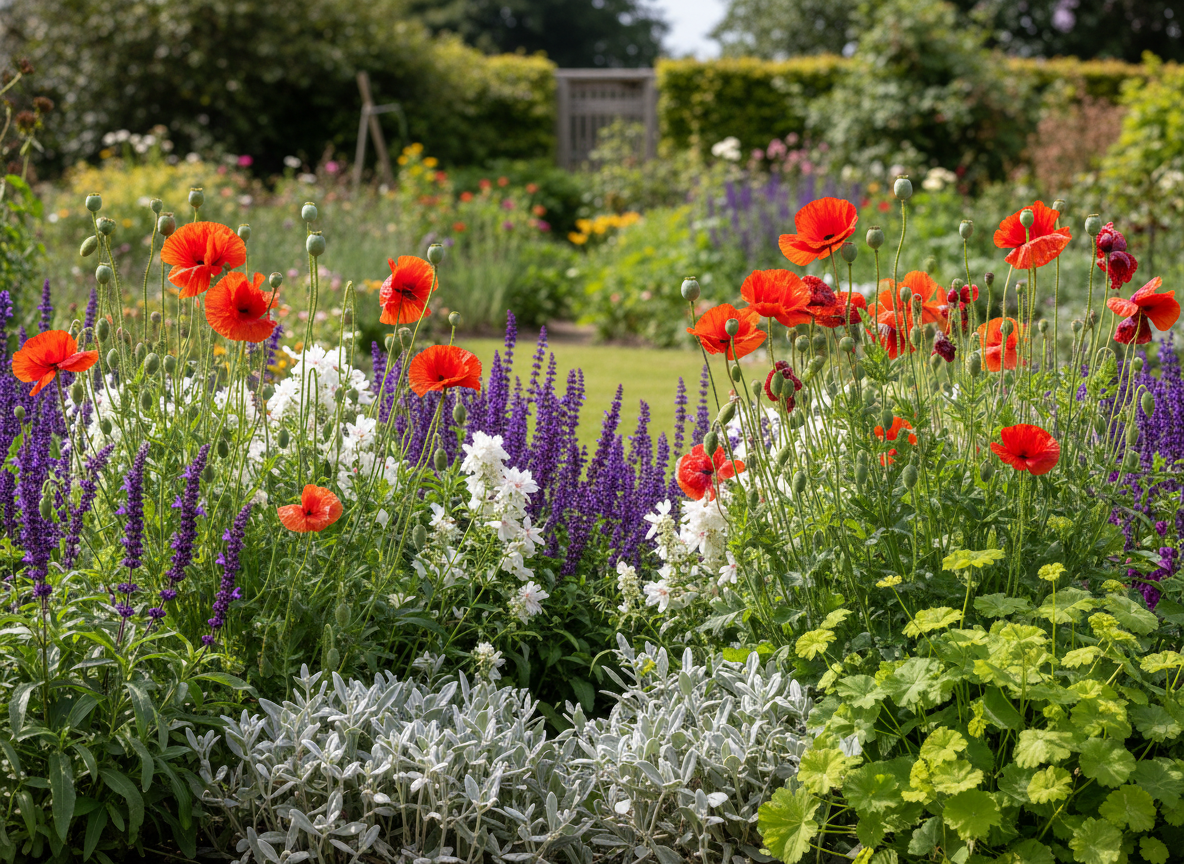
The trick that experienced perennial gardeners use is to plant the poppy at the back or middle of the border, not the front, and let something else flow forward over the gap. Three companions do this particularly well, and any one of them will hide the brown patch entirely by mid-June:
- Hardy geraniums (the cranesbills, especially Geranium ‘Rozanne’ or G. × oxonianum ‘Claridge Druce’). Plant them in front of the poppy clump. They start flowering in late May just as the poppy collapses and they keep going until October. Their loose, sprawling growth will tumble forward over the cut poppy crown without smothering it.
- Gypsophila paniculata (baby’s breath). The classic late-Victorian solution. It comes into leaf late, around the time the poppy is going down, and by July throws up a cloud of tiny white flowers exactly where the poppy used to be. Christopher Lloyd planted them together at Great Dixter for this reason.
- Catmint (Nepeta ‘Six Hills Giant’ or ‘Walker’s Low’). Cut it back when it starts to look tired in late June and it’ll do a full second flush. It also flops forwards naturally, which is exactly what you want.
The thing none of these do is replace the poppy. They cover for it for ten weeks. The poppy crown is still down there, still alive, and when the autumn rains come it’ll push up its basal rosette of leaves right through whatever’s grown over it. By the time you cut the geranium or catmint back in November, the poppy rosette is there to take over the winter slot.
The cultivars that actually give you a second flush
Not every oriental poppy reblooms in September. Most of the older garden varieties — the ones bred for the size and saturation of their May flowers — go down and stay down until next April. If you want the September bonus, you need a cultivar bred for it, and the breeding work that produced reliable rebloomers is mostly from the last twenty-five years.
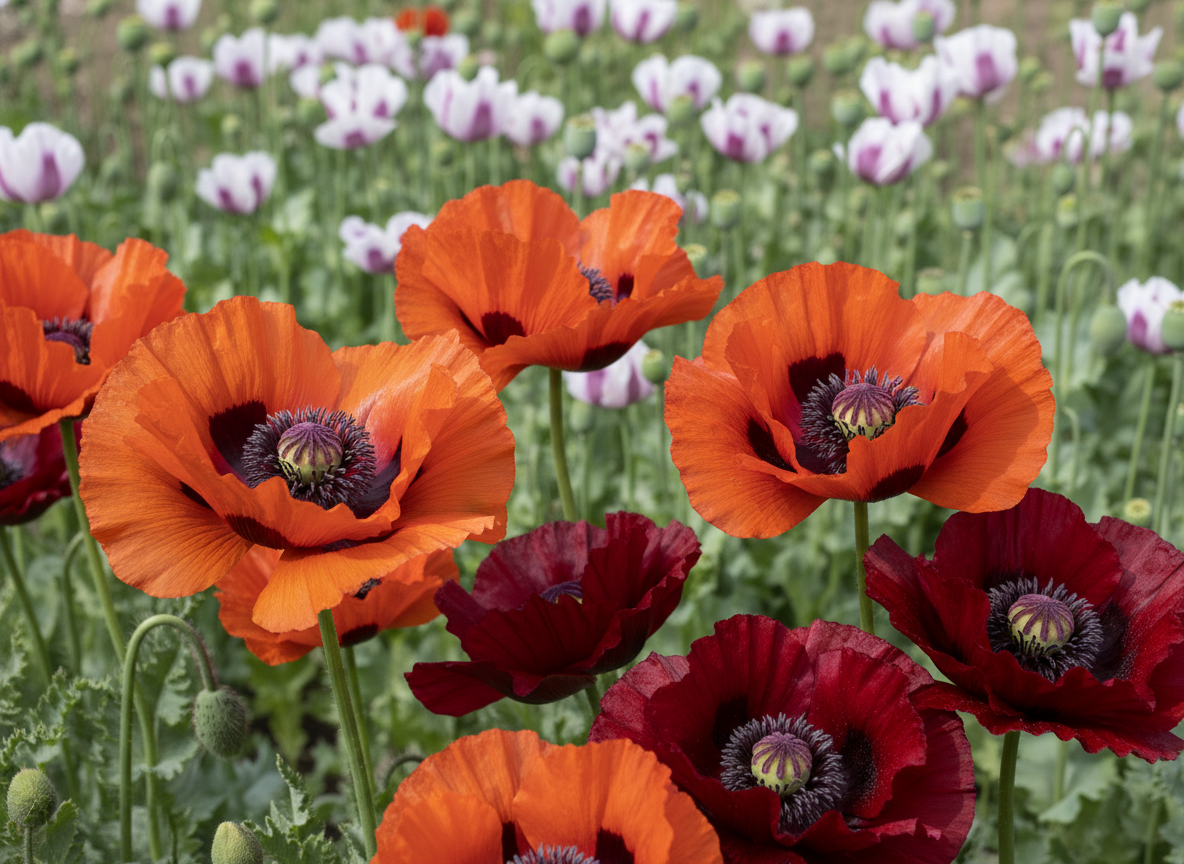
The two most dependable repeat-flowering cultivars in the UK and Northern European trade are ‘Karine’ (clear pink with a dark blotch, compact at 60 cm) and ‘Beauty of Livermere’ (deep red, taller at 90 cm, by far the most commonly sold). Both will throw a smaller secondary flush in September if you cut them hard in late May and the summer hasn’t been a complete drought. ‘Patty’s Plum’, the dusky-mauve cultivar everyone wants, occasionally reblooms but isn’t reliable. The old single scarlet Papaver orientale ‘Goliath’ rarely reblooms at all.
The second flush is genuinely smaller — three to six flowers per established clump versus the twenty-plus you got in May — and the flowers themselves are slightly smaller and on shorter stems. But in mid-September, when most herbaceous borders are starting to lean on a few dahlias and asters to carry the show, three blood-red poppies coming up unexpectedly in a clump of catmint is a small moment of the kind that makes people remember a garden.
If your clump has been in place for more than five years and has never reflowered after a hard cut, you don’t have a rebloomer. That’s fine — the May flush is the main event regardless. Just don’t keep cutting harder and feeding more in the hope you can force it.
 Oriental poppies in shades of orange and dark red with opium poppies in the background — AI-generated illustration
Don’t confuse perennial poppies with the ones you should leave alone
This cut applies to the perennial oriental poppy and nothing else. The two poppy species you’re most likely to mix it up with both want to be left strictly alone:
Field poppies (Papaver rhoeas, the Flanders poppy and its garden form ‘Mother of Pearl’/Shirley series) are hardy annuals. They flower in June and July, set seed, and die. There is no plant left to cut back to — that’s the entire life cycle. If you want a repeat performance next year, the only thing to do is let two or three of the seed heads ripen and self-sow. Cutting an annual poppy back at any point in summer just kills it earlier.
Opium poppies (Papaver somniferum) are also annuals, also seed-grown each year, also no cut-back required. They’re the big glaucous-leaved poppies with the salt-shaker seed heads that you see in Sissinghurst’s white garden. Treat them exactly like field poppies — let some seed, pull the rest in July when they’re done.
The visual tell at this time of year is in the leaves. Oriental poppies have long, narrow, deeply lobed, bristly leaves with stiff white hairs on both surfaces — running a finger along one feels like a cat’s tongue. They form a defined low clump that returns from the same spot every year. Annual poppies have smoother, often glaucous (blue-grey) leaves and don’t form a returning crown — they’re growing from a seedling that germinated this spring. If you can pull the plant up by hand without much resistance, it’s an annual and you’ve just killed it. If the roots go down into the soil like a parsnip, it’s an oriental and your shears were the right tool.
The seed-head trap — don’t compost what you cut
Oriental poppy seed heads are gorgeous. They look like a little salt-shaker on a stalk, they dry to a papery beige, and they hold their structure into autumn — which is exactly the problem. A single mature seed head contains somewhere between one and three thousand seeds, each one a poppyseed-on-a-bagel-sized speck that can stay viable in your soil for several years. Run them through your home compost heap, which rarely gets above 55 °C in the middle and is much cooler around the edges, and the seeds will survive. Two springs later you’ll find oriental poppies coming up in your lawn, your gravel paths, the cracks of your patio, your neighbour’s vegetable patch and any container of bought-in compost that contains last year’s homemade stuff.
The cure is to bag the cut flower stems separately from the rest of the cut material. Leaves and stems go in the heap as normal — they break down in a few months. Anything with a seed head, even a green not-yet-ripe one, goes in council green waste (which composts hot enough to kill seeds) or, if you don’t have that, in the general rubbish.
If you actually like the look of a few seed heads on the plant and want them to ripen for indoor displays, leave them on three or four stems, cut everything else hard, and harvest those three or four heads in late June into a paper bag before they crack open at the top. The moment those little vents at the crown of the seed head open is the moment the seeds start dispersing — and once they do you’ll be pulling oriental poppy seedlings out of awkward places for the next four years.
Cresco can tell you which week is yours
The third week of May is the average window for cutting back oriental poppies in the UK and the Low Countries, but “average” is doing a lot of work in that sentence. A cool spring like 2024 pushes the cut back two weeks; a warm one like the spring we’ve just had pulls it forward by ten days. The reliable cue isn’t the calendar — it’s when roughly two-thirds of the leaves on the clump have gone yellow at the tips and the first flower stems have started to flop. Miss the window by a week and you’ve still done the right thing. Miss it by a month and the mildew has moved in.
This is the kind of “right week, not right month” decision that Cresco’s pruning planner is built for. Snap a photo of your border, and it identifies your oriental poppies (and distinguishes them from the annuals next to them), checks your local weather and your last fortnight of temperatures, and tells you which week the cut-back is yours, what to mulch with, and which companion plants to underplant for the gap. It does the same for the next forty-odd things in your garden that have a similarly narrow window — the wisteria second cut in August, the lavender shape-up in September, the buddleia chop next March — so you don’t have to keep a calendar in your head.
If you have oriental poppies and they’re going down now, this is your week. Shears, ground level, mulch, water. Ten minutes per clump. New leaves in a fortnight, a tidy border by mid-June, and — if you have the right cultivar — three blood-red flowers in September to remind you why you planted them in the first place.