What your broom is doing the moment the gold drops
For three weeks in late spring a broom is the brightest thing in the garden — a fountain of pea-flowers in yellow, cream, bronze or that improbable two-tone red-and-gold, packed so tight you can barely see the stems. Then it’s over, the petals brown and drop, and the plant goes quietly to work on the job you don’t want it doing.
Broom is a legume. Every one of those flowers it just dropped is now trying to become a seed pod — a small, flat, pea-like pod that ripens through summer, blackens, and eventually splits with an audible crack to fling seed several feet. Setting those pods is the single most expensive thing the plant does all year. It pours sugars and energy into seed instead of into next season’s flowering wood, and on a short-lived shrub that already has no time to waste, that’s the difference between a plant that flowers hard for a decade and one that’s exhausted and bare-legged in five.
That’s the first reason the cut happens now, in the fortnight after flowering: you’re stepping in before the pods set, redirecting that energy back into growth. But there’s a second, deeper reason — and it’s the one that makes broom unlike almost every other shrub in your garden.
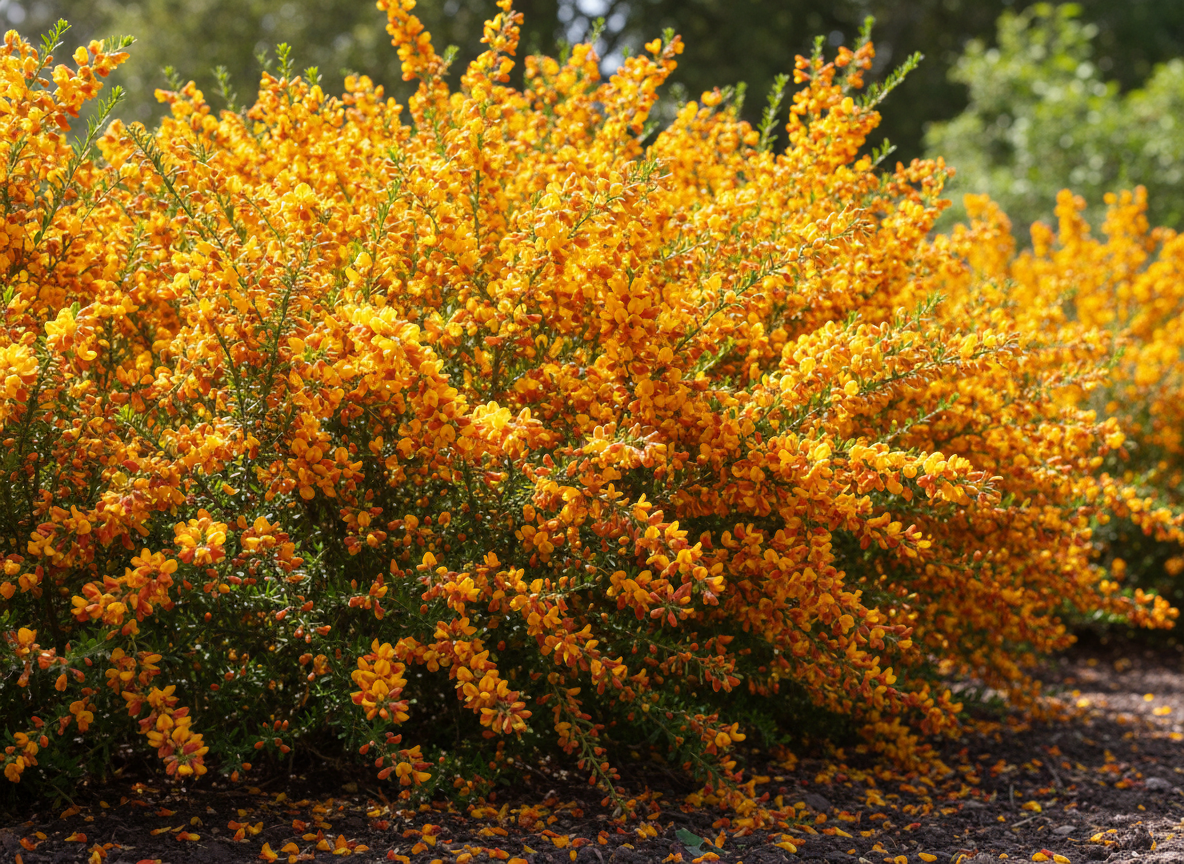 A flowering broom shrub with yellow and orange blossoms in a garden — AI-generated illustration
The one rule that separates broom from every other shrub
Most flowering shrubs forgive you. Cut a forsythia, a dogwood or a weigela too hard and it shrugs, pushes a flush of dormant buds out of the old framework, and rebuilds. That generosity is exactly what lets you renovate an overgrown shrub — the one-in-three renewal cut that keeps a weigela flowering works precisely because there are live buds waiting in the old wood.
Broom has almost none. The old brown stems near the base carry few to no dormant buds, and they very rarely break into new growth when cut. Saw a leggy broom back to bare wood “to bring it down to size” and you don’t get a smaller, bushier plant — you get a stump that sits there, sulks, and dies. The Royal Horticultural Society puts it plainly in its broom growing guide: cut back the flowered growth, but never into the old wood, because it won’t reshoot from there.
This is the same hard limit that governs its cousin the California lilac — and if you’ve read why cutting into old wood kills a ceanothus, broom is the same trap with a shorter fuse. There is no renovation prune for a broom. There is only the light annual trim, taken every year before the plant ever gets the chance to go woody and bare. Miss that window for a few seasons and your only real option is the spade.
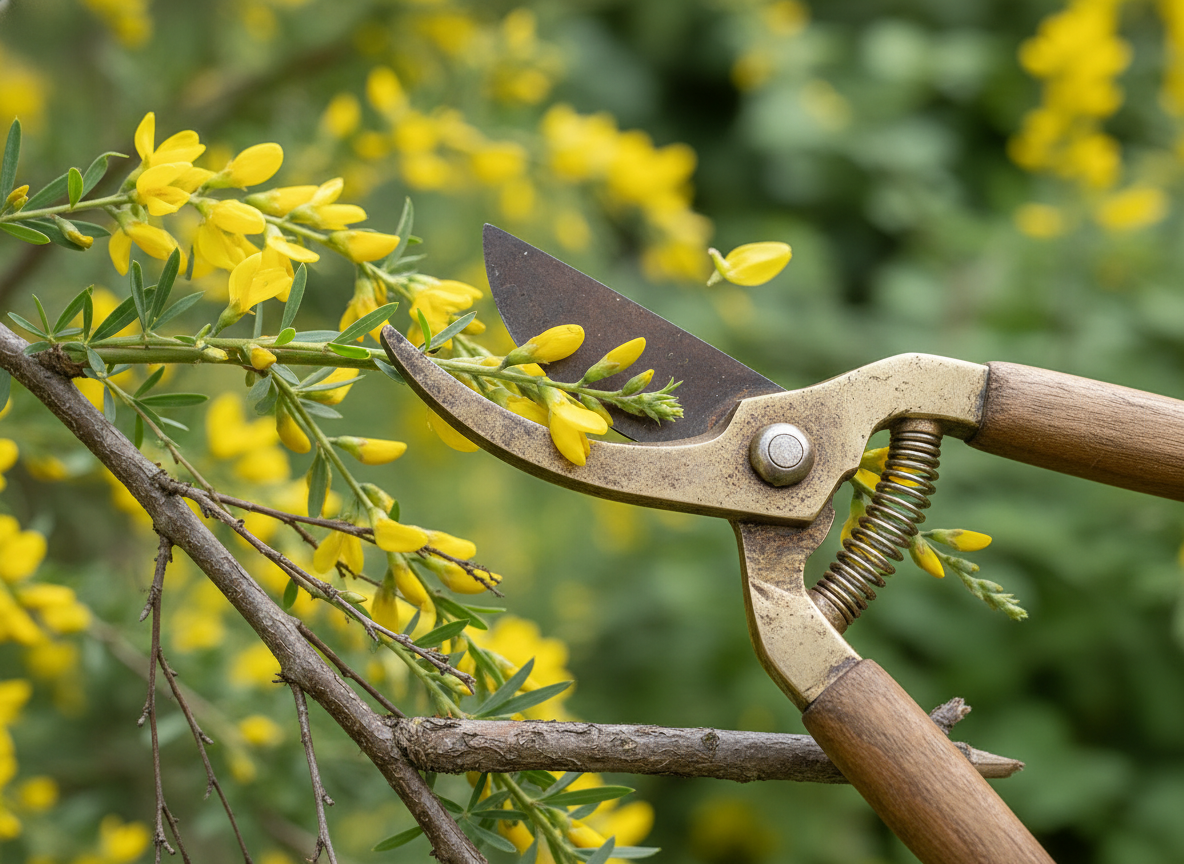 Pruning shears cutting a branch of a flowering broom plant — AI-generated illustration
The cut: a third off the green, never a sliver into the brown
Once you accept that you can only ever work in the young wood, the actual job becomes simple — almost relaxing.
Run your hand along any stem. Near the tip it’s green, supple, this season’s growth; trace it back toward the base and it stiffens, browns and turns properly woody. Every cut you make lives in the green. The job is to shorten the shoots that just finished flowering, taking them back by up to about a third — some gardeners go to two-thirds on the most vigorous stems — to a point where there’s still green growth and a visible new shoot or bud below your cut. Snip just above that. You’re never reaching down into the brown, and you’re never removing more than roughly a quarter to a third of the plant’s foliage in a single year.
Done across the whole shrub, this does three things at once. It removes the spent flowers before they can set those draining seed pods. It keeps the plant tight, dense and dome-shaped instead of letting it bolt outward into a sparse, leggy tangle. And because broom flowers on wood made the previous year, the fresh growth you trigger now is exactly the wood that will be smothered in flower next spring — so a light trim today is, quite literally, next year’s display.
A few practical notes. Use sharp, clean secateurs or shears; broom stems are wiry and a blunt blade crushes rather than cuts. The whippy growth of a vigorous Cytisus scoparius can be sheared over lightly, almost like a lavender, which makes quick work of a big plant. And although broom isn’t a skin irritant the way euphorbia sap is, the whole plant is mildly toxic if eaten — it contains the alkaloids cytisine and sparteine — so bag the clippings and keep them away from grazing pets and livestock rather than leaving a pile where a curious dog or pony can reach.
Why “every year, from year one” is the whole game
Here is the part most people get wrong, and it isn’t about technique — it’s about timing across the life of the plant.
Because broom can’t be cut back into old wood, the only way to keep it compact is to never let it get leggy in the first place. That means pruning lightly every single year, starting the year you plant it — even when the young shrub looks perfectly tidy and the cut feels unnecessary. Each annual trim keeps the flowering zone close to the framework. Skip a few years and the bare, flowerless wood creeps outward and upward; the flowers retreat to the very tips of long, naked stems; and you arrive at the dead end we’ve already met — a plant you can’t cut back and can’t fix.
It helps to be honest about the lifespan, too. Broom is fast and generous but genuinely short-lived: ten to fifteen years is a good run, and many gardeners replace them sooner once they start to gap at the base. That’s not a failure of care — it’s the nature of the shrub. Treat broom as a brilliant decade-long performer rather than a permanent fixture: prune it faithfully each year to get the best of that decade, and have a young replacement coming on before the old one collapses. A broom that’s pruned from the start earns its place; one that’s never touched becomes the thing you apologise for by year four.
One bonus from the annual trim: deadheading before the pods ripen also stops broom seeding itself around. In milder regions Cytisus scoparius self-sows enthusiastically and is treated as an invasive weed in parts of the world — so cutting now is good manners to your neighbours’ gardens as well as good for the plant.
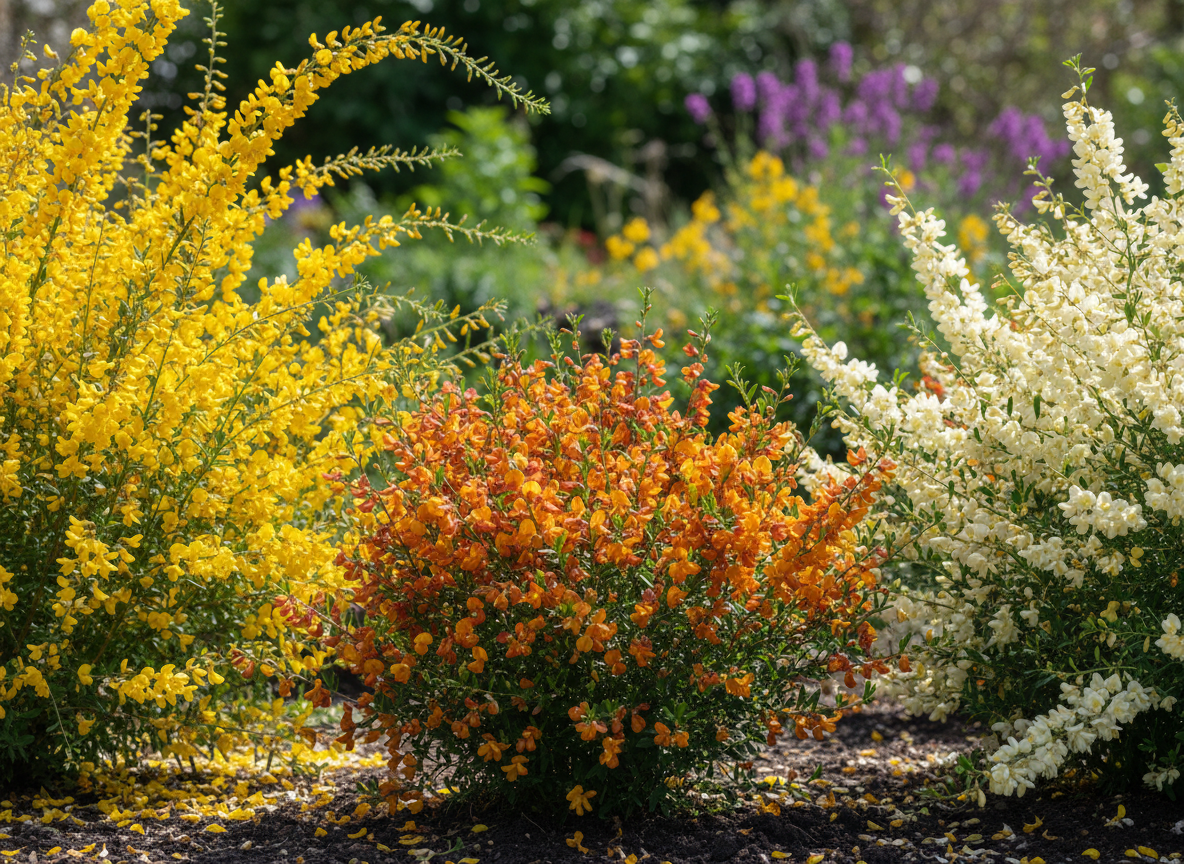 Three flowering broom shrubs in a garden — AI-generated illustration
Not all “brooms” want the same cut
“Broom” covers a few related shrubs, and they don’t all behave identically — worth a moment before the blades close.
The compact early hybrids — Cytisus × praecox (Warminster broom, the cream ‘Albus’ and butter-yellow ‘Allgold’) and the low Cytisus × kewensis — flower in April and May and ask for the lightest touch of all: a quick shear over the faded flowers to keep the mound neat, nothing more. The bigger, later Cytisus scoparius and its colourful named forms (‘Boskoop Ruby’, ‘Lena’, ‘Andreanus’) are the ones you can shorten more confidently by up to a third — still never into old wood. Genista (including the Mount Etna broom and the dyer’s greenweed) plays by the same no-old-wood rule and generally needs even less intervention.
The one genuine exception is Spanish broom, Spartium junceum — taller, later-flowering into summer, and the only broom-by-name that actually tolerates a harder cut. It can be shortened by about half in early spring to keep it from getting top-heavy. If you’re not certain which you’ve got, default to the conservative cut: light, in the green, straight after flowering. You’ll never kill a broom by trimming it too gently.
The window is the plant’s, not the calendar’s
Notice what this whole job hangs on: not a date, but a signal. The cut opens the moment the flowers fade, and that moment moves.
A broom in a hot, sheltered, south-facing spot finishes a fortnight ahead of the same plant in a cold corner. An early hybrid is done in May; a scoparius runs into June; Spanish broom is on a different clock entirely. And the warm, early spring much of Northern Europe has just had pulls the whole sequence forward. “Prune broom in June” is a useful rule of thumb, but the plant in front of you is the real authority — and on a shrub this unforgiving, getting the week right matters more than with almost anything else, because there’s no hard cut to fall back on if you miss it.
That’s exactly the gap Cresco is built to close. Photograph your broom and it identifies what you’ve actually got — a fussy praecox hybrid versus a robust scoparius versus a Spanish broom that breaks all the rules — then reads your local weather to tell you the week your after-flowering window genuinely opens, and reminds you again next year, because with broom the every-year habit is the whole point. For the bigger picture of what else is clamouring for the secateurs right now, the month-by-month pruning guide shows where broom sits in the early-summer rush.
The 30-second version
- Broom flowers on last year’s wood and rushes to set energy-sapping seed pods straight after — so trim within a fortnight of the flowers fading.
- Never cut into the old brown wood. It has almost no dormant buds and won’t reshoot — there is no renovation prune for a broom.
- Shorten this year’s green shoots by up to a third, to a visible bud or new shoot. Never remove more than about a quarter to a third of the foliage in one year.
- Prune lightly every single year, from the year you plant it. Letting it go leggy is a one-way trip to the compost heap.
- Compact praecox hybrids want the lightest shear; scoparius takes a firmer third; Spanish broom (Spartium) is the exception that tolerates a harder spring cut.
- Bag the clippings — broom is mildly toxic if eaten and scoparius self-seeds where it isn’t wanted.
- Treat broom as a brilliant ten-to-fifteen-year shrub and have a replacement coming on. Watch the flowers, not the calendar.