What a firethorn is actually doing in June
The flowers you enjoyed in late May are already turning into pinhead-green beads. That matters, because it tells you where the berries come from — and where they don’t.
Pyracantha flowers, and therefore fruits, on wood that is at least a year old. The clusters sit on short, stubby side growths called spurs, which branch off two- and three-year-old framework wood. At the same time, the shrub is throwing long, soft, leafy new shoots — this year’s extension growth — that race outward and upward at the speed that makes a firethorn look shaggy by midsummer.
Those new whips carry no berries this year. None. But next year, if you treat them correctly, their bases thicken into the spurs that do. So in June a firethorn is holding three different kinds of wood at once: the older framework, the spur wood that’s setting berries right now, and the soft new growth that’s all promise and no fruit. The entire skill of pruning a pyracantha is telling them apart before the blades close.
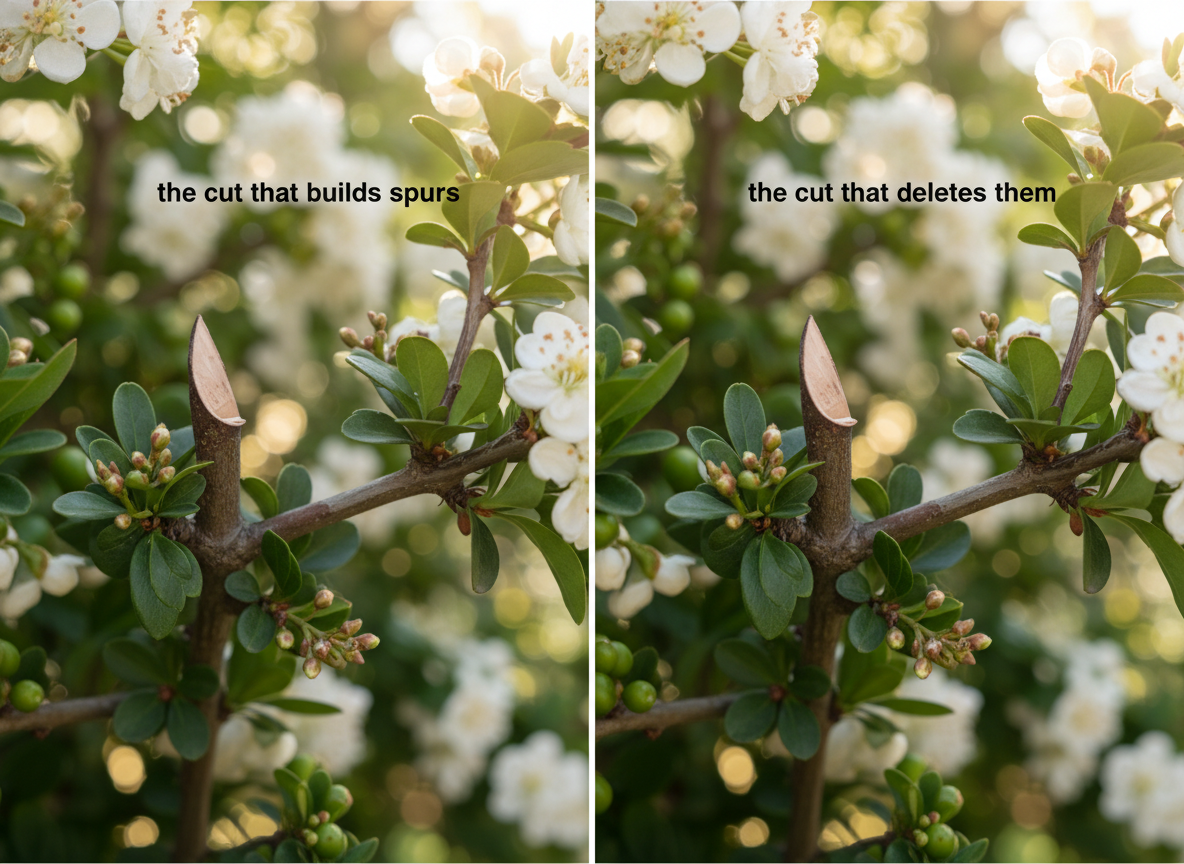 Two pyracantha branches with blossoms, one demonstrating a cut that builds spurs and one that deletes them — AI-generated illustration
The cut that builds spurs — and the cut that deletes them
The hedge-trimmer instinct is to shear the whole shrub to one flat plane. It’s fast, it looks decisive, and it’s why so many firethorns are all leaf and no berry.
A flat shear takes the tips off the spur wood — exactly where this year’s berries are forming — and lops away most of the just-flowered clusters along with the leafy whips. You’re left with a neat green shape in June and a near-bare framework in October. Worse, you do it again every year, so the shrub never builds the older spur wood that a heavy crop depends on.
The right cut is selective and, honestly, quicker than it sounds once your eye is in. Shorten each long new extension shoot back to two or three leaves — two to four buds — from the framework branch it sprang from. That short stub does two jobs: it becomes a fruiting spur for next year, and shortening it now opens up the berry clusters already swelling on the older wood behind it.
The RHS guidance is blunt about the priority: retain as much two-year-old wood as you can, because that’s where next year’s flowers — and the year after’s berries — live. Cut the soft, keep the spurs. If you remember nothing else, remember that.
Read the shoot before you close the blades
You don’t need to identify cultivars or count years. You need to read a single branch, and every branch tells the same story.
Run your eye from the framework outward. Near the base you’ll find short, congested, slightly woody side growths — some carrying a tight cluster of green pinhead berries. That’s spur wood. Leave it completely. Keep moving out and the shoot changes character: it turns pale green, fast and floppy, with widely spaced leaves and a soft, whippy tip. That’s the part to shorten.
Cut just above a leaf, two to four buds out from the spur zone. If a new shoot is heading straight in toward the wall or fence, or crossing back through the middle of the plant, take it right out at its base — it’ll never fruit usefully and it only crowds the airflow you want for disease (more on that below).
Once you’ve done three or four branches this way, the pattern locks in and the rest of the shrub goes fast.
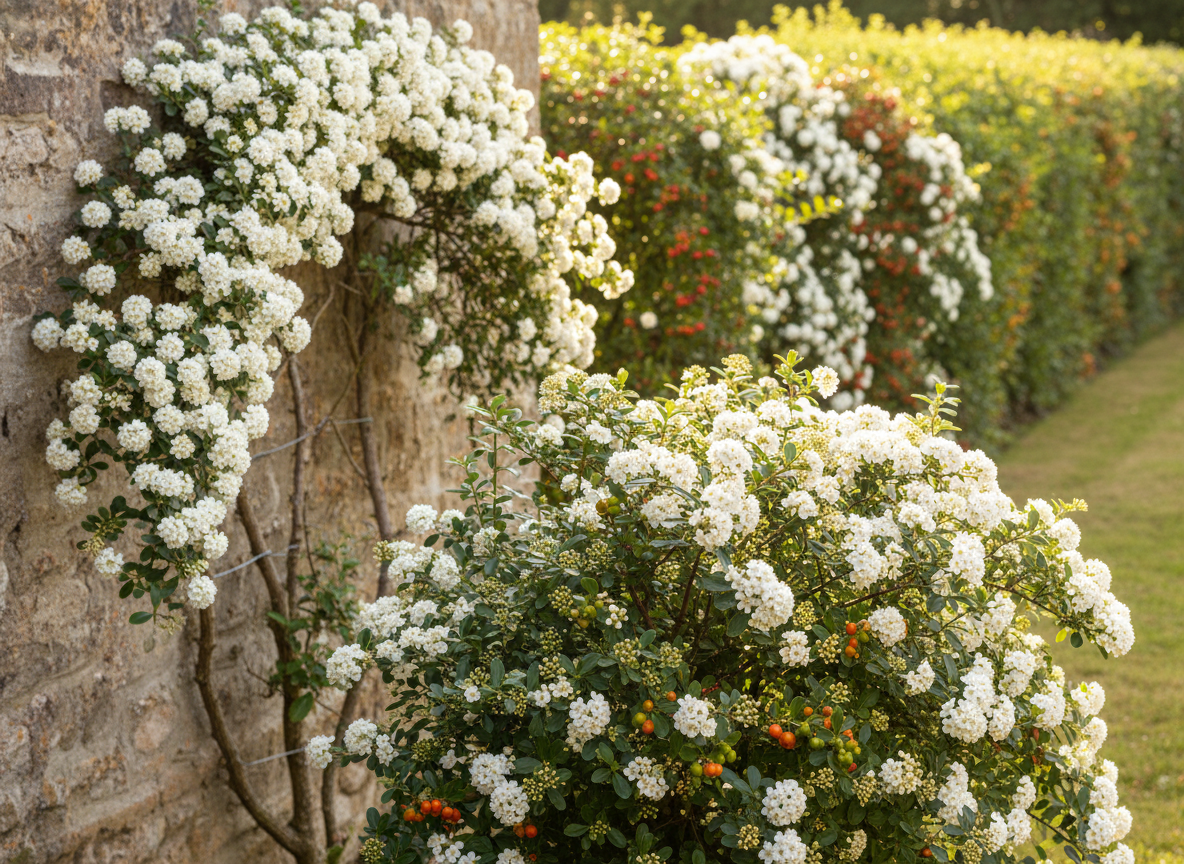 Pyracantha flowering on a wall and as free-standing shrubs with berries — AI-generated illustration
Wall-trained, free-standing, and the late-summer second pass
How hard you go depends on what the firethorn is being asked to do.
Wall-trained plants are pruned every year right after flowering. Shorten the side shoots to within two to four buds of the permanent framework, and remove anything growing inward toward the wall or outward into the path. The goal is a flat, well-spurred lattice of fruiting wood pinned close to the brick — not a hedge bulging off the wall.
Free-standing shrubs and informal screens want a lighter hand. Thin out the longest new whips, shorten the rest, and resist the urge to round it into a ball. A firethorn allowed to keep some structure berries far more heavily than one clipped tight.
Then — and this is the step most people skip — expect to come back. By late summer the plant will have pushed a fresh flush of leafy growth that quietly buries the now-colouring berries again. A second, light pass in August or September, shortening only the new shoots back to the berry clusters, re-reveals the display without touching fruiting wood. This is the same logic behind the one-in-three renewal that keeps a weigela flowering: two light, well-timed cuts always beat one hard shear.
Respect the thorns — and the wounds they leave
Pyracantha does not earn the name firethorn for decoration. The thorns are long, hard, and tipped to punch through a thin glove without slowing down.
They’re also more than a scratch hazard. Firethorn puncture wounds have a reputation for turning inflamed and slow to heal, and an embedded thorn fragment can trigger a localised reaction that occasionally needs a doctor to dig it out. Treat a pruning session like the job it is: gauntlet gloves that reach past the wrist, eye protection — a stooping cut puts a thorn at exactly eye height — long sleeves, and a rake or grabs to gather the prunings rather than scooping them with your hands. Bag the clippings; a stray firethorn shoot in a lawn finds a bare foot months later.
The “it’s only a quick tidy” mindset is precisely how people end up with a thorn behind a knuckle.
 AI-generated illustration
Prune dry: fireblight and scab
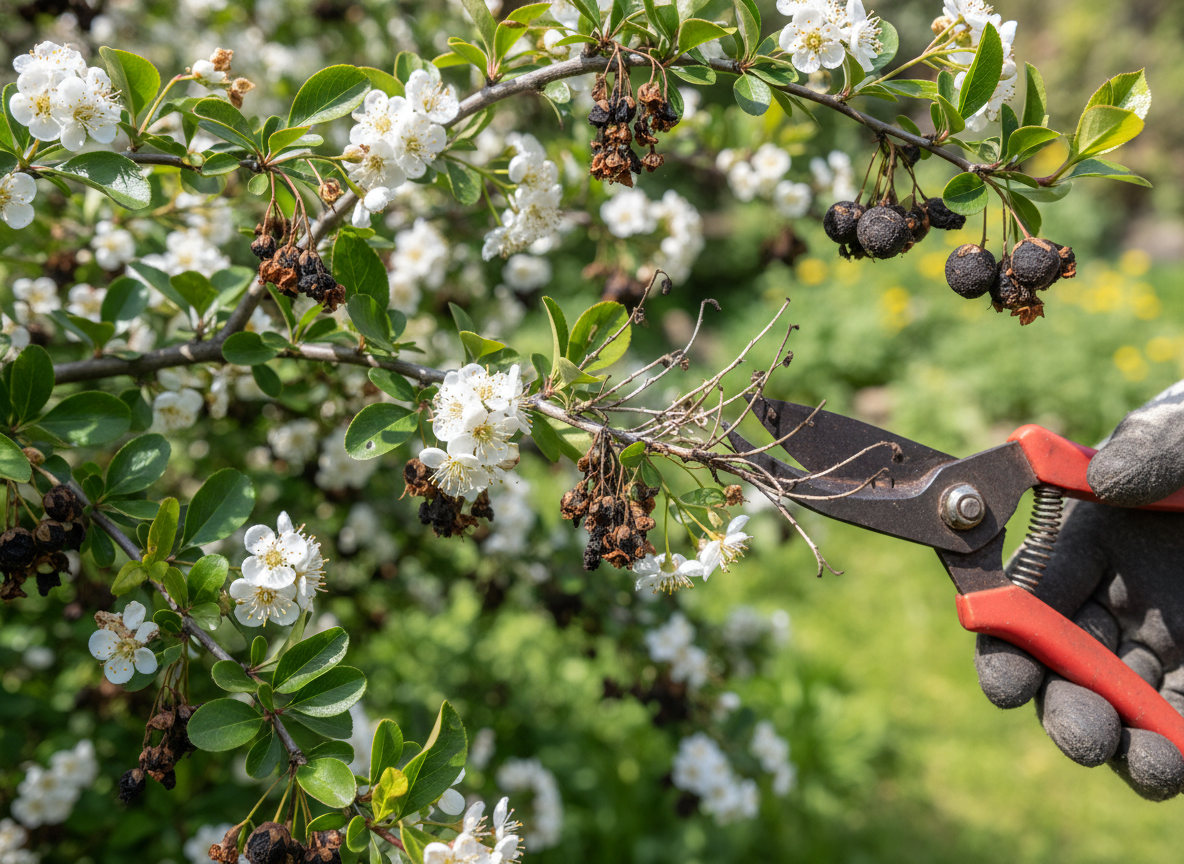
Pyracantha sits in the rose family, and it inherits the family’s worst disease: fireblight (Erwinia amylovora). The bacterium enters through blossom and fresh wounds in warm, humid weather, then kills shoots from the tip downward, leaving a scorched, blackened crook of dead growth that looks exactly as the name suggests.
Two rules follow directly. First, prune in dry weather, not during a warm wet spell when the bacteria are on the move and every cut is an open door. Second, wipe your blades with disinfectant between plants, and if you cut out any blackened shoot-tip dieback, bin or burn it — never compost it — and disinfect again. This is the same caution that governs the silver-leaf window on plums and cherries: with the worst pathogens, when and how clean matter as much as where you cut.
The other disfigurer is pyracantha scab, which turns berries a sooty grey-brown and strips leaves — heartbreaking after you’ve done everything else right. Scab is more a cultivar problem than a pruning one, but good airflow from the selective cut above genuinely helps. If you’re planting new, the ‘Saphyr’ series (Saphyr Rouge, Saphyr Orange, Saphyr Jaune) and similar modern selections carry strong scab and fireblight resistance — worth knowing before you hand a wall over to one shrub for the next twenty years.
The window is your wall’s, not the calendar’s
Here’s the part no national pruning calendar can tell you: there is no fixed date for this job.
A firethorn on a hot, south-facing wall finishes flowering and starts setting berries a fortnight ahead of the identical cultivar on a cold north-east corner. A mild spring — like the one most of Northern Europe has just had — pulls the whole sequence earlier still. The cut window doesn’t open on a calendar square. It opens when your flowers fade to green pinheads. That’s the signal. Watch the plant, not the month.
Get it right and the shrub that bored you green all summer ignites in October — scarlet, orange or amber, depending on the cultivar — and holds that colour through to the new year, feeding blackbirds, redwings and fieldfares straight through the cold. Get it wrong with one careless shear and you wait another twelve months for a second chance.
This is exactly the kind of plant-and-place timing Cresco is built for. Photograph your firethorn and it reads the cultivar and your local weather to tell you the week your after-flowering cut actually opens — then nudges you again for the late-summer pass, so the berries you pruned for are the berries you get. If you want the wider context first, the month-by-month pruning guide maps where firethorn sits among everything else clamouring for the secateurs right now.
The 30-second version
- Pyracantha berries form on spurs off year-old wood — never on this year’s soft new shoots.
- After flowering (late May into June), shorten new extension shoots to two to four buds from the framework. Don’t shear the whole shrub flat.
- Keep all the two-year-old spur wood — that’s next year’s flowers and berries.
- Come back in August or September for a light second pass to re-expose the colouring berries.
- Prune dry, prune clean — fireblight enters through wounds in warm, humid weather.
- Gauntlet gloves and eye protection, always. The thorns are not a joke.
- The right week is when your flowers turn to green pinheads — not a fixed date.