Why the calendar rule still beats the May guess
The “Derby Day” rule has been quoted in head gardeners’ diaries since the Edwardian era: don’t put shears to your box (Buxus sempervirens) until the first Saturday of June. Charming as the origin story is — staff used the day off from the racing to clip the parterres — the rule survives because the timing is genuinely correct.
Three things have to be true before box will take a cut cleanly:
- The first flush of new growth is fully expanded. In a normal British or Dutch spring, that’s done by the last days of May. Cut earlier and you take off half-formed leaves that scar instead of regrowing.
- The risk of a late frost has passed. Fresh box growth blackens at -2 °C. The Ice Saints (May 11–15) and the Cold Sophie are the historical cut-off, but in cooler years a frost can still slip through to the third week of May.
- The hedge has enough summer left to push a second, harder flush. Cut in early June and you get six to eight weeks of regrowth that hardens off in August. Cut in late July and the new shoots are still soft when the first October frost arrives.
Derby Day — Saturday 6 June in 2026 — sits exactly in that window. It’s not magic. It’s the latest date that still leaves the plant the most recovery time.
 A gardener checks weather conditions near roses and a horse pasture — AI-generated illustration
The four-day weather check before you cut
The single biggest cause of scorched box hedges isn’t pruning timing — it’s the weather in the four days after the cut. A freshly clipped box leaf has lost some of its waxy cuticle along the cut edge, and full sun on those edges, with no rain to wash off the dust and sap, turns the outer 5 cm of the hedge bronze within a week.
Before you clip, look at the forecast and find a window that looks like this:
- Cut day: overcast, ideally with light drizzle in the afternoon. 15–20 °C is perfect. Above 24 °C, postpone.
- Day +1 and +2: cloudy or showery. Anything that keeps direct sun off the cut surface.
- Day +3 and +4: sunshine is fine by now — the cut leaves have started sealing.
If you can’t find a four-day window before mid-June, take the cut anyway and shade the hedge with horticultural fleece pegged loosely over the top for 48 hours. It looks ridiculous. It works.
Sharp shears beat the hedge trimmer (and the blight question)
There is a long argument about hand shears versus electric or petrol hedge trimmers on box. Resolved properly, it isn’t really about the cut quality on day one. It’s about box blight (Calonectria pseudonaviculata).
Hedge trimmers crush as much as they cut. The bruised tissue takes longer to seal, stays wet longer in dew, and is the entry point for blight spores. On a healthy hedge with no blight history within a kilometre, that’s a marginal risk and a trimmer saves hours. On a hedge that has had a previous outbreak, or in a wet region with a known local strain, sharp hand shears are the safer choice every time.
If you do use a trimmer, two rules matter more than the model:
- Clean and sterilise blades between separate plants or hedge sections. Wipe with a cloth dipped in 70 % isopropyl, or a 1:10 household bleach solution if you don’t mind the smell. A single infected leaf carried on a blade across a parterre can start a season-ending outbreak.
- Replace blunt blades, don’t sharpen worn ones to the wire. A worn blade tears the leaf edge. You can spot a torn cut at arm’s length two weeks later — the cut surface goes brown instead of healing pale green.
Hand shears, kept sharp enough to cut a sheet of newspaper held in the air, leave a clean slice that scabs over in a single day. For anything below shoulder height and under four metres of run, they’re faster than people think.
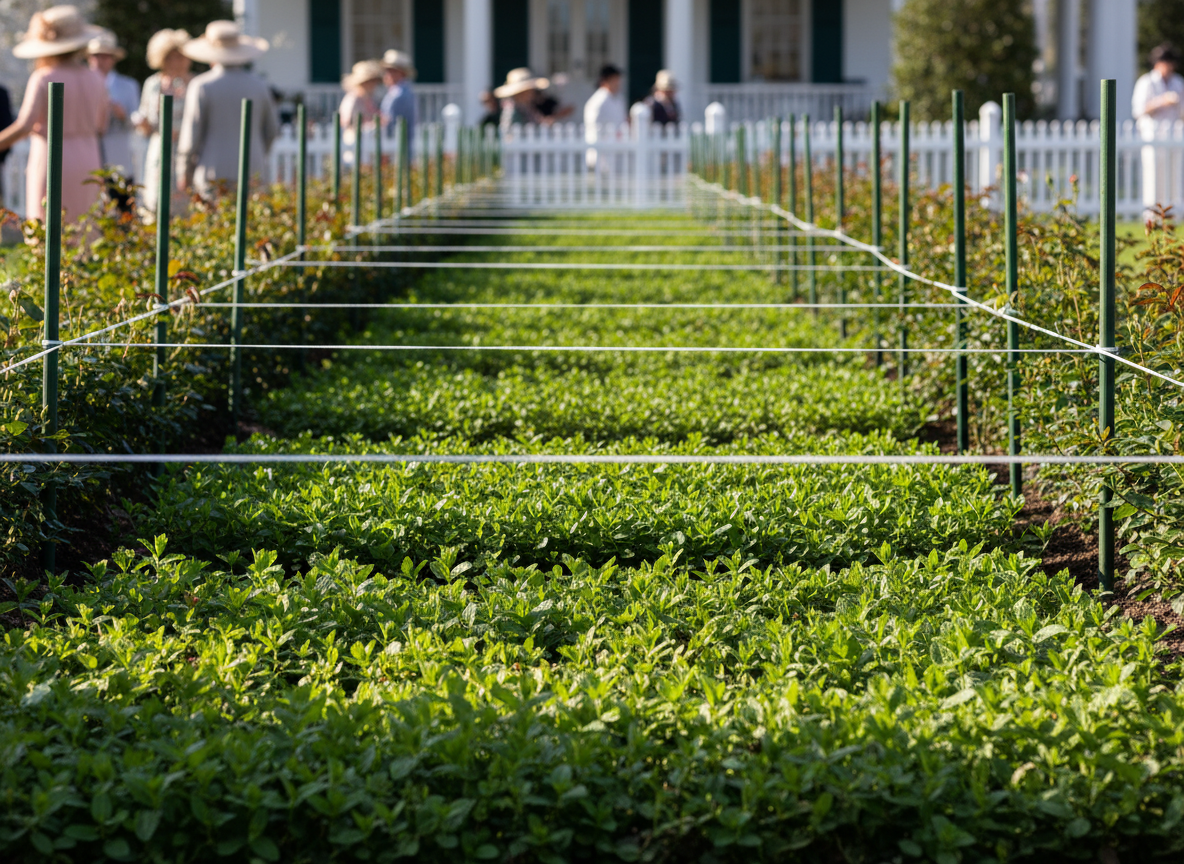 Rows of small plants in a garden with stakes and string — AI-generated illustration
The string-and-stake trick for level tops
Free-handing the top of a long run of box is how slightly wobbly hedges become very wobbly hedges, one millimetre a year. The cure is twenty minutes of preparation.
Drive a thin bamboo cane at each end of the run. Stretch builder’s line taut between them at the height you want the top to finish — not where the top is now, but where you want it. Walk the line. Anywhere the existing growth pokes above the string by more than 5 cm, that’s where you’ll need to cut into older wood (which box tolerates well, unlike yew or conifer).
For the sides, the same trick works on a smaller scale: cut a wooden template — a thin batten the height of the hedge with the cross-section profile you want — and slide it along as you clip. A good template makes the difference between a hedge that looks crisp from ten metres and one that looks crisp from one metre.
What to do in the four weeks after the cut
A trimmed box hedge is briefly a stressed plant. Three small jobs in the month that follows make the difference between a hedge that flushes back densely and one that goes patchy.
- Sweep up every clipping. Don’t compost them, don’t leave them in the base of the hedge. Box clippings are the single most common way blight spreads from a neighbour’s hedge to yours. Bag them and bin them.
- Water deeply, once. Five days after the cut, give the root run a slow, deep soak — roughly 20 litres per running metre for an established hedge. New shoots need that water to push through. Mains-pressure spraying with a hose for thirty seconds doesn’t reach the roots.
- Top-dress with a balanced feed in mid-June. A handful of fish, blood and bone per metre, scratched into the surface, is enough. Avoid high-nitrogen lawn feed — it pushes soft growth that gets hit by autumn frosts and is a magnet for box caterpillar moths laying their second brood.
If you’re in a region with box tree caterpillar (Cydalima perspectalis) pressure — most of southern and central England, most of the Netherlands and Belgium — check the inside of the hedge for the second-generation webs from mid-June onwards. We covered the early-season check in the May box caterpillar post; the second wave is harder to spot because it’s hidden inside denser regrowth.
 Derby hat with pruning shears in a garden with blooming roses — AI-generated illustration
When not to trim, even if it’s Derby Day weekend
Three situations that override the calendar:
- Visible blight. Bronze leaves, black streaks on stems, dropping foliage in patches. Trimming spreads it. Cut out and burn the affected sections only, sterilise tools between every cut, and skip the general trim entirely until next year.
- A drought week. If the soil is dry to 10 cm depth and there’s no rain in the seven-day forecast, water deeply for two days and only then cut. A drought-stressed plant losing leaves to a cut at the same time can drop 30 % of its outer foliage and not recover until the following spring.
- A newly planted hedge in its first season. Don’t shear box that’s been in the ground less than twelve months. Pinch out the leading tips by hand if you want it to bush out, and wait for the first full year of root growth before any shears come near it.
How Cresco handles your hedge timing
The Derby Day rule is a UK heuristic written for a particular climate. Cresco does the same calculation for your postcode every day: it looks at the last frost in your local weather history, the current 14-day forecast, and the species you’ve added to your garden, and it nudges you on the morning that the cut window opens — not three weeks before, not after the heat has set in.
If you’ve got box, yew, hornbeam or beech in your garden plan, the timing card for each will shift forward or backward by a week or two depending on the year. In 2026, with the cold May that’s just passed, most of central England and the Low Countries are looking at a cut window from 6–14 June. After that, the dry, warm fortnight in the forecast moves the calculation toward “wait, water, and try again in early July.”
Trim on the right day, with sharp blades, on an overcast morning, and you’ll get one cut a year instead of two — and a hedge that holds its line into October.
Sources: