The faded dome, and the snip that misses the point
Right now, across thousands of gardens, the same small mistake is being made with a pair of scissors. The big lime-green domes on the Euphorbia characias by the path have gone soft and murky — somewhere between chartreuse and the colour of a teabag left too long — and the tidy-minded gardener does the obvious thing. Snip off the faded flower heads. Step back. The plant looks neater for a fortnight, then sits there as a thicket of bare green stalks for the rest of the year.
The snip isn’t wrong because it’s too much. It’s wrong because it’s too little, in the wrong place. On the big evergreen euphorbias, the stem that just flowered is finished — not tired, not in need of a trim, but biologically done. It will never carry another flower. Cutting off its top leaves a dead man standing. The correct cut follows that whole stem down to the ground and removes it, and the reason why is the single most useful thing to understand about this plant.
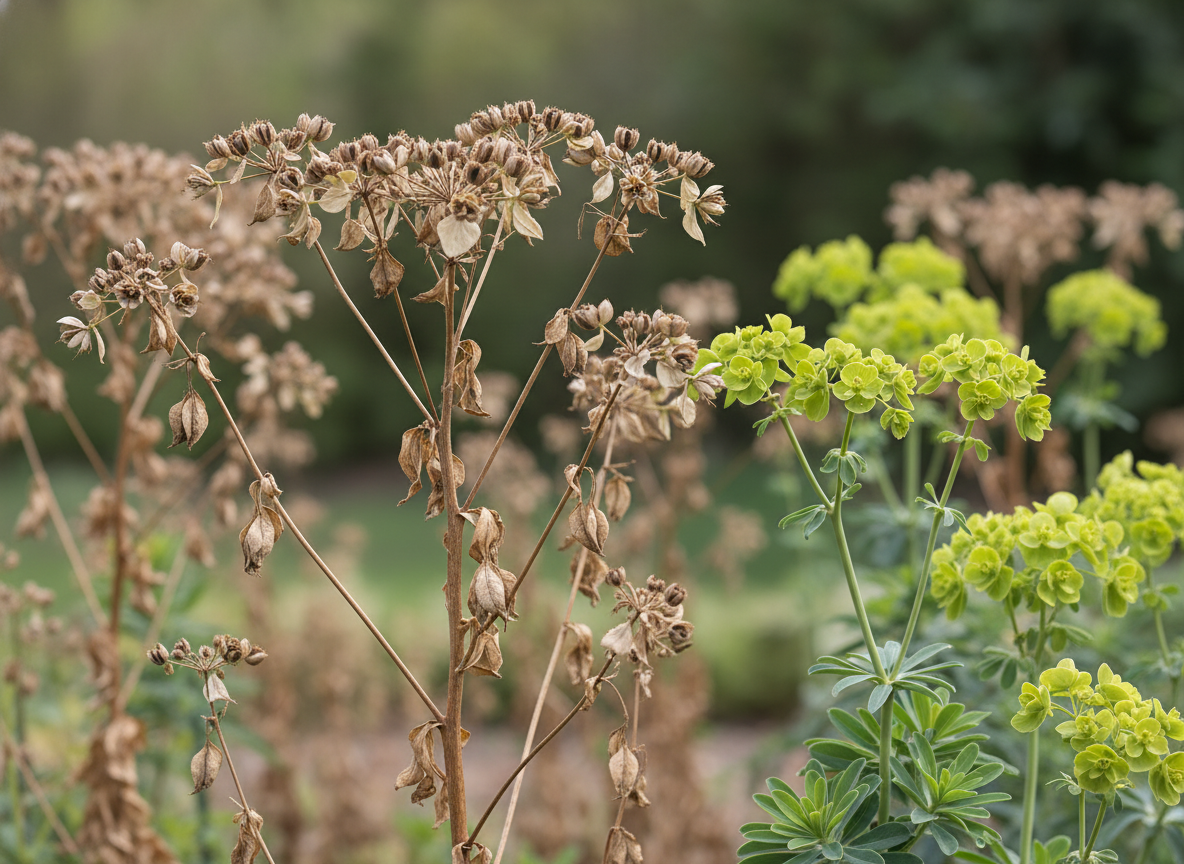 Spent brown euphorbia stems standing beside fresh lime-green new growth — AI-generated illustration
Why the spent stems will never flower again: the biennial habit
Euphorbia characias — and its showier subspecies wulfenii, plus the popular hybrid Euphorbia × martinii and the woodland E. amygdaloides — grow their stems on a two-year clock. The technical word is biennial stems, and it works like this.
In year one, a shoot pushes up from the base and does nothing but grow leaves. It’s a fat, blue-green, leafy column with no flowers at all. It overwinters as a standing stem. In year two — this spring — that same stem produces the great domed cluster of lime bracts at its tip, sets seed, and then declines. Once it has flowered, it is spent. It does not branch out and flower again next year. Its job is over.
So at any moment a healthy euphorbia is carrying two completely different populations of stems: the ones that flowered this spring (year-two stems, now finished) and the ones that came up this season and have not flowered yet (year-one stems, next spring’s display). They look broadly similar at a glance, which is exactly why the snip-the-tops approach causes such trouble — it treats both kinds the same.
The whole craft of pruning a euphorbia is learning to tell those two populations apart, then removing one and protecting the other.
Find the new shoots first — they’re already standing there
Before you cut anything, get down low and look at the base of the clump. You’re hunting for this season’s new shoots, and on an established plant they’re unmistakable once you’ve seen them: shorter, very upright, densely packed with fresh blue-green leaves all the way up, and — the giveaway — no flower at the top. They often sit in a ring around the outside of the clump, or push up through the middle between the older stems.
Those are the stems that flower next spring. Everything you do from here is in service of them.
Now follow a flowered stem with your eye or your hand. It’s taller, more arched, woodier and barer toward the base, and it ends in that fading dome of bracts. Trace it all the way down. In a crowded clump the flowered stems are usually the ones leaning outward and shading the new shoots — which is the second reason to take them out. They’re not just spent; they’re in the way. A young shoot that spends June and July under the shade of a dying stem doesn’t ripen properly and gives you a weaker flower next spring.
So the mental model is simple: the arching, flowered, leaning-out stems go; the upright, leafy, flowerless shoots stay. Once you can see that, the cutting takes ten minutes.
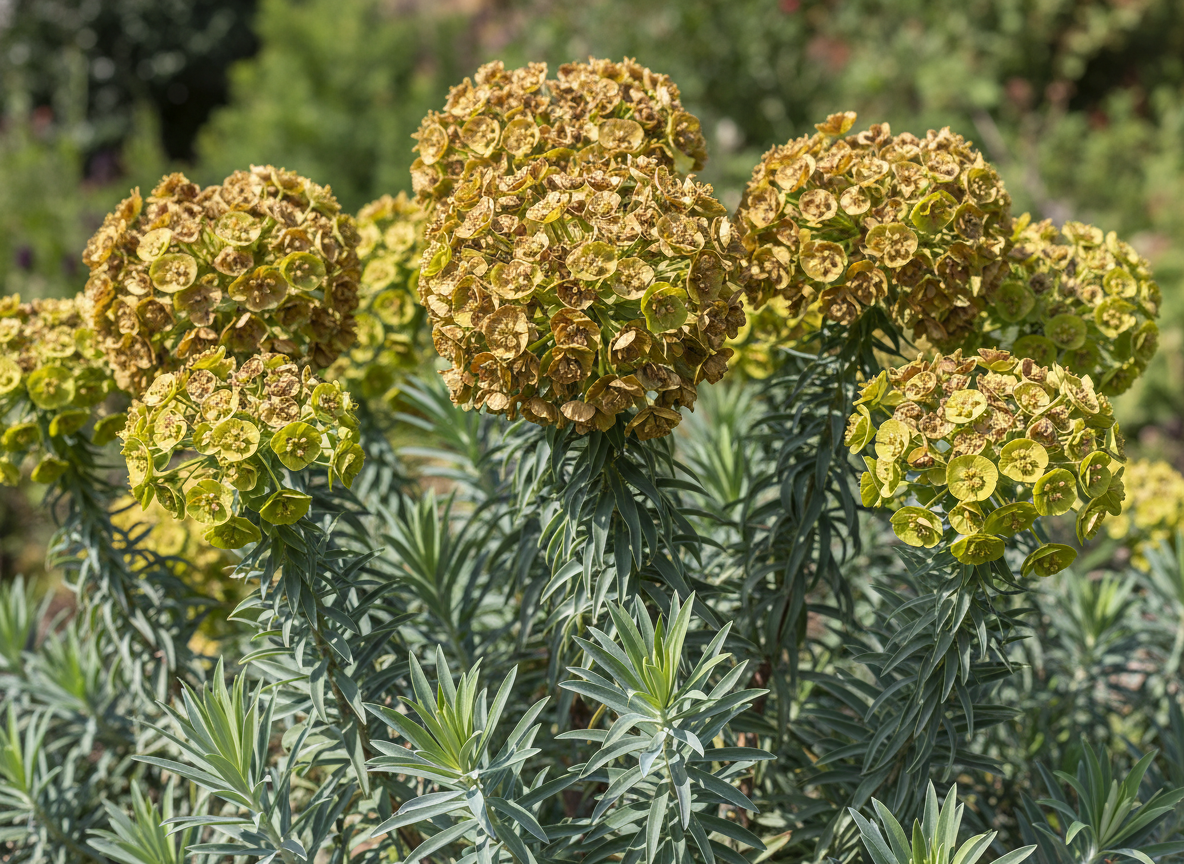 Euphorbia characias bracts fading from lime-green to tea-brown as they go over — AI-generated illustration
When the window opens: bracts the colour of weak tea
Don’t cut while the bracts are still a clean lime green — the plant is still feeding off them and they’re still doing a job. Wait for the colour to break. Euphorbia bracts don’t drop like petals; they fade in place, sliding from chartreuse through a tired yellow-green to a dull tea-brown, and the stem below starts to look bare and tatty. When the dome has clearly gone over — murky, browning, no longer the fresh acid-green that made you plant the thing — the window is open.
For characias and wulfenii in most of northern Europe that’s late May through June. A warm spring brings it forward into the third week of May; a cold one pushes it into early July. As with every job on this site, watch the plant, not the calendar: the trigger is the colour of the bracts, not a date.
There’s no rush to the day, but don’t let it drift into high summer either. Cutting the spent stems out promptly gives the new shoots the longest possible run of summer light to build next year’s flower. Leave it until August and you’ve handed those young stems a half-season in the shade for no reason.
The cut, step by step
- Glove up and cover your arms first. This is not optional with euphorbia — see the next section for exactly why. Long sleeves, gauntlet-style gloves, and ideally eye protection.
- Identify and mentally mark the spent stems using the test above: arched, woody at the base, faded dome on top. If it helps, loop a bit of twine around each one before you start, the way you would with a renewal prune.
- Cut each spent stem right down to the base — to ground level, or to the lowest point you can reach where it emerges from the crown. Don’t leave a tall stub. You’re removing the whole two-year-old stem, not shortening it.
- Leave every flowerless new shoot untouched. No tipping, no shaping, no “just tidying.” Those are next spring’s flowers and they need all their growing tips.
- Get the cuttings off the bed immediately and into a bag — both because the sap-laden material shouldn’t sit where you’ll brush against it, and because tidiness around the crown keeps the new shoots in good light.
That’s the entire job. A mature characias might give up eight or ten spent stems and leave behind a fresh, upright, blue-green mound that looks intentional rather than hacked.
The sap is the part nobody warns you about
Cut a euphorbia stem and it bleeds a thick white latex within seconds. That sap is not a mild irritant in the way nettle or daffodil sap is. It is genuinely caustic, and euphorbia puts more gardeners in front of a doctor every June than almost any other ornamental plant.
The chemistry behind it is a group of compounds called diterpene esters — the same family that makes the sap of some euphorbias medically interesting and all of them unpleasant to handle. On skin, the reaction is often delayed: you feel nothing while you’re cutting, wash up, carry on with your day, and then two to eight hours later the contact areas start to burn, redden, swell and blister. The result can look and feel like a partial-thickness burn rather than a rash, and it can take a week or more to settle.
Two things make it worse, and both are avoidable:
- Sunlight. The sap is phototoxic — UV light amplifies the skin reaction. Handling euphorbia bare-armed on a bright day is the worst case. If you can, do the job on an overcast day or in the cool of the evening, and keep cut skin covered afterwards.
- Your eyes. This is the serious one. Sap transferred from a glove or a forearm to an eye — usually by an absent-minded rub — causes intense pain, streaming, light sensitivity and, in bad cases, real damage to the surface of the eye. Eye injuries from euphorbia sap are well documented in the medical literature and have led to temporary loss of vision. Treat your eyes as off-limits until the gloves are off and your hands are washed.
The precautions are simple and you should treat them as mandatory, not cautious:
- Gloves and long sleeves, always. Gauntlet gloves that cover the wrist are better than thin ones. Add eye protection if you’re cutting tall wulfenii stems at face height.
- Don’t touch your face while you work, however much your nose itches.
- Wash skin with soap and water immediately if you get sap on it — don’t wait for symptoms.
- Wash the gloves and the blades too. The sap stays active on tools and gauntlets and will catch you out next time.
- If sap gets in an eye, flush it with clean water for a good fifteen minutes and seek medical advice — don’t tough it out.
- Keep curious dogs and children away from the freshly cut stems; the sap is also poisonous if any of it ends up in a mouth.
None of this is a reason to be frightened of a beautiful plant. It’s a reason to put gloves on before you pick up the secateurs, the same way you’d put goggles on before using a strimmer.
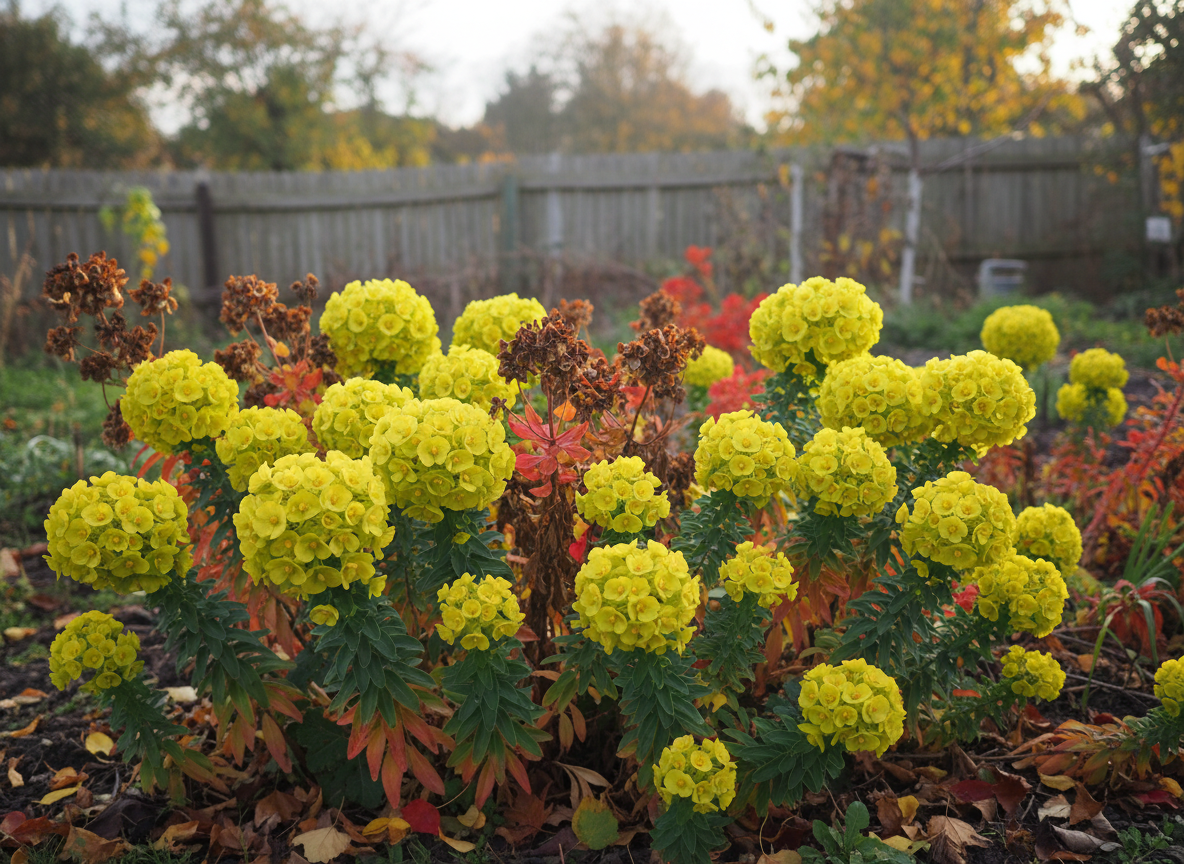 A clump of euphorbia in full lime-green bract in a late-season border — AI-generated illustration
”But I read you should wait until autumn”
You’ll find perfectly good gardeners who say the spent stems should stay until late summer or autumn. They’re not wrong, exactly — they’re optimising for something different.
The case for leaving them is partly structural (the standing stems and seed heads give winter shape and self-seed around, which some people want) and partly about avoiding the heat: cutting a Mediterranean plant hard in the middle of a hot, dry spell asks a lot of it. If your summers are brutal, or you actively want euphorbia seedlings popping up around the garden, leaving the spent stems and tidying in autumn is a legitimate choice.
But for most gardeners in a temperate, maritime climate the early-summer cut wins, for one concrete reason: light. Take the spent stems out now and the new shoots get the whole of June, July and August in full light to fatten up and set a strong flower bud for next spring. Leave them until autumn and those young shoots spend their best growing months shaded by stems that are doing nothing but dying slowly. You also stop a tired-looking plant being the thing you notice every time you walk past for three months.
The compromise, if you’re torn: cut the spent stems out now for the light, but leave two or three of the best seed heads on if you want a few self-sown plants. You get the vigour and a handful of free seedlings.
Which euphorbias this applies to — and which it doesn’t
The cut-the-whole-spent-stem-to-the-base rule is specifically about the evergreen, biennial-stemmed types: Euphorbia characias and subsp. wulfenii, E. × martinii, E. amygdaloides (including ‘Purpurea’ and var. robbiae), and the trailing evergreen E. myrsinites. On all of these, the flowered stem is spent and comes out at the base after flowering.
The herbaceous types behave differently and shouldn’t be cut to the base now:
- Euphorbia polychroma (cushion spurge) forms a neat acid-yellow dome in spring. It isn’t carrying separate year-one and year-two stems — it dies back to the ground each winter. After flowering you can shear it over lightly to keep it tidy, but the full cut-down waits until autumn.
- Euphorbia griffithii (‘Fireglow’, ‘Dixter’) is also herbaceous: enjoy it through summer, cut it to the ground in autumn.
If you’re not sure which you have, the test is the stem. If your euphorbia is evergreen and you can see distinct old (flowered) and new (flowerless) stems standing together, it’s a biennial-stemmed type and this is its week. If it’s a soft, low, dies-back-completely cushion, leave the hard pruning for autumn and just deadhead.
Quick reference
- When: when the bracts fade from lime-green to a dull tea-brown — for characias and wulfenii, late May through June. Watch the colour, not the calendar.
- What to cut: every stem that flowered this spring — arched, woody at the base, fading dome on top — right down to the ground.
- What to leave: every upright, leafy, flowerless new shoot. Those flower next spring.
- Why now: clearing the spent stems gives the new shoots a full summer of light to build strong buds.
- Safety, non-negotiable: gloves and long sleeves; keep sap off skin and out of eyes; wash skin, gloves and blades; cut on a cloudy day; flush and get help if sap reaches an eye.
- Doesn’t apply to: herbaceous euphorbias like polychroma and griffithii — deadhead now, cut to the ground in autumn.
Get into the habit and your euphorbia never becomes the leggy, brown-stemmed thing slumped over the path by July. It stays a tight, glaucous, architectural mound that earns its place — and flowers like a firework every spring. Cresco tracks the bract-fade window for your specific euphorbia and your postcode, and reminds you to glove up before you cut, so the job gets done at the right moment and not the painful way.