The one-flush trap most choisyas fall into
There are two ways the average choisya gets treated at the end of May, and both of them throw away the best thing about the plant.
The first is to do nothing. The white, orange-scented flowers that smothered the bush in April and May go over, brown at the edges, and sit there as a faint tea-coloured haze across the top of the foliage. The shrub looks tired, you mean to get to it, and then it’s July and the moment has passed. You got one show.
The second is to reach for the hedge trimmer. The bush had got a bit blowsy, a bit wider than you remembered, so you run the shears over the dome to tidy it — the same way you’d do a box ball. Two weeks later the cut edges of every trifoliate leaf have browned off, the surface looks scorched, and come autumn there’s barely a flower on it.
Both routes end in the same place: a choisya that flowers once a year. And that’s a shame, because Choisya ternata is one of a small handful of evergreen shrubs that will reliably flower twice — a big spring flush and a softer encore in late summer and autumn — if you make one light, deliberate cut in the next fortnight. The cut is quick. It just isn’t the cut most people reach for.
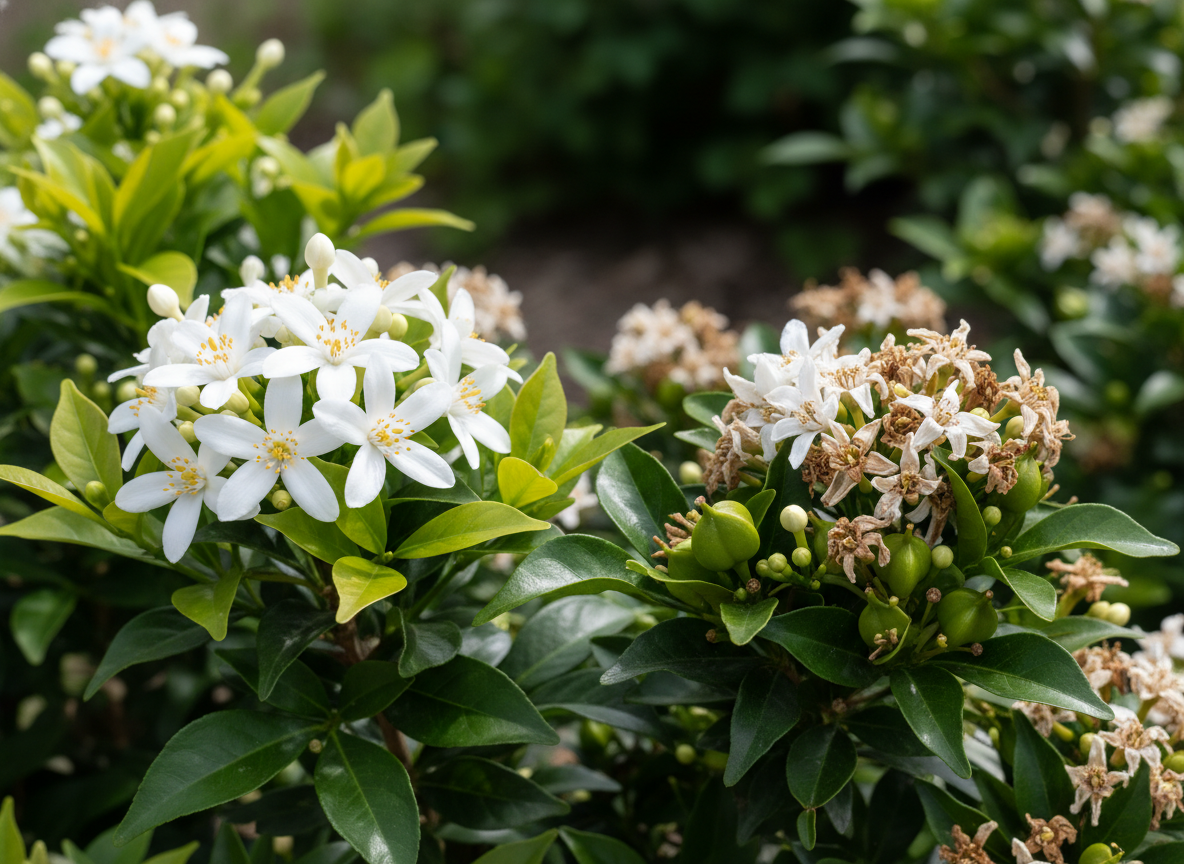 . Choisya flowers bloom next to spent flowers and green foliage — AI-generated illustration
Why choisya can flower twice when most evergreens flower once
Most spring-flowering shrubs set their flower buds the previous summer, on wood made the year before. Cut them at the wrong time and you remove next year’s flowers — that’s the whole anxiety behind pruning a lilac, a weigela or a philadelphus. They get one chance a year and the timing is unforgiving.
Choisya plays by different rules. It’s a member of the Rutaceae — the citrus and rue family — which is why the crushed leaves smell of sharp orange peel, and it shares the family’s willingness to flower on the current season’s growth. The spring froth comes off wood made last year. But the new shoots that push out after that spring flush can ripen, set buds and flower again the same year, usually from late August into October. Left entirely alone, an established choisya will often manage a thin scattering of those autumn flowers on its own. The light trim doesn’t create the second flush out of nothing — it multiplies it. Every flowered shoot you tip back wakes up two or three new shoots below the cut, and each of those carries the potential for an autumn truss. You’re turning a scatter into a proper second show.
This is also why choisya sits in RHS Pruning Group 8 — the easy-going evergreens that need almost nothing done to them. There’s no compulsory annual prune, no “do it now or lose the year” cliff edge. But of all the Group 8 shrubs, choisya is the one that pays you back most generously for a few minutes with the secateurs at the right moment.
The cut: deadhead to a strong leaf, don’t shear the dome
Here’s the actual job, and why it works.
Take secateurs — not shears, not a hedge trimmer — and work shoot by shoot. Find each cluster of spent flowers at the end of a shoot and follow it back a few centimetres to the first strong, healthy leaf or pair of leaves. Cut just above that leaf, on a slight angle, so you remove the dead flowerhead and the short tuft of stem behind it. That’s it. The bud in the axil of the leaf you cut to becomes the new shoot, and on a vigorous plant it’ll branch into two or three.
If the bush has also got too big, you can do the reshaping in the same pass: take up to a third off the length of the longest, most wayward shoots, always cutting back to a leaf and always to an outward-facing one so the new growth fills the gap rather than crossing into the centre. A third is the ceiling for a light trim. Choisya will tolerate far harder cutting — more on that below — but a light, selective tip-prune is what keeps the natural rounded outline and gives you the most flowering shoots for autumn.
Now the contrast, because it’s the whole point. A hedge trimmer does three things wrong at once:
- It shreds the leaves. Choisya’s leaf is divided into three fingers (ternata means “in threes”). A blade run across the dome slices straight through those fingers, and a cut evergreen leaf doesn’t drop and regrow like a deciduous one — it just browns along the wound and stays on the plant, brown, for months. A sheared choisya looks scorched for the rest of the summer.
- It cuts every shoot to the same height. That gives you a flush of leafy regrowth in a tight outer shell, but the shell shades the inside of the bush, the centre bares out, and the regrowth is uniform leaf rather than the spaced-out flowering shoots you actually want.
- It removes growing tips indiscriminately, including plenty of shoots that hadn’t flowered and didn’t need cutting, so the plant pours its energy into recovering rather than reflowering.
Secateurs and ten patient minutes beat the trimmer every time on this shrub. If you only remember one thing: cut to a leaf, never across the leaves.
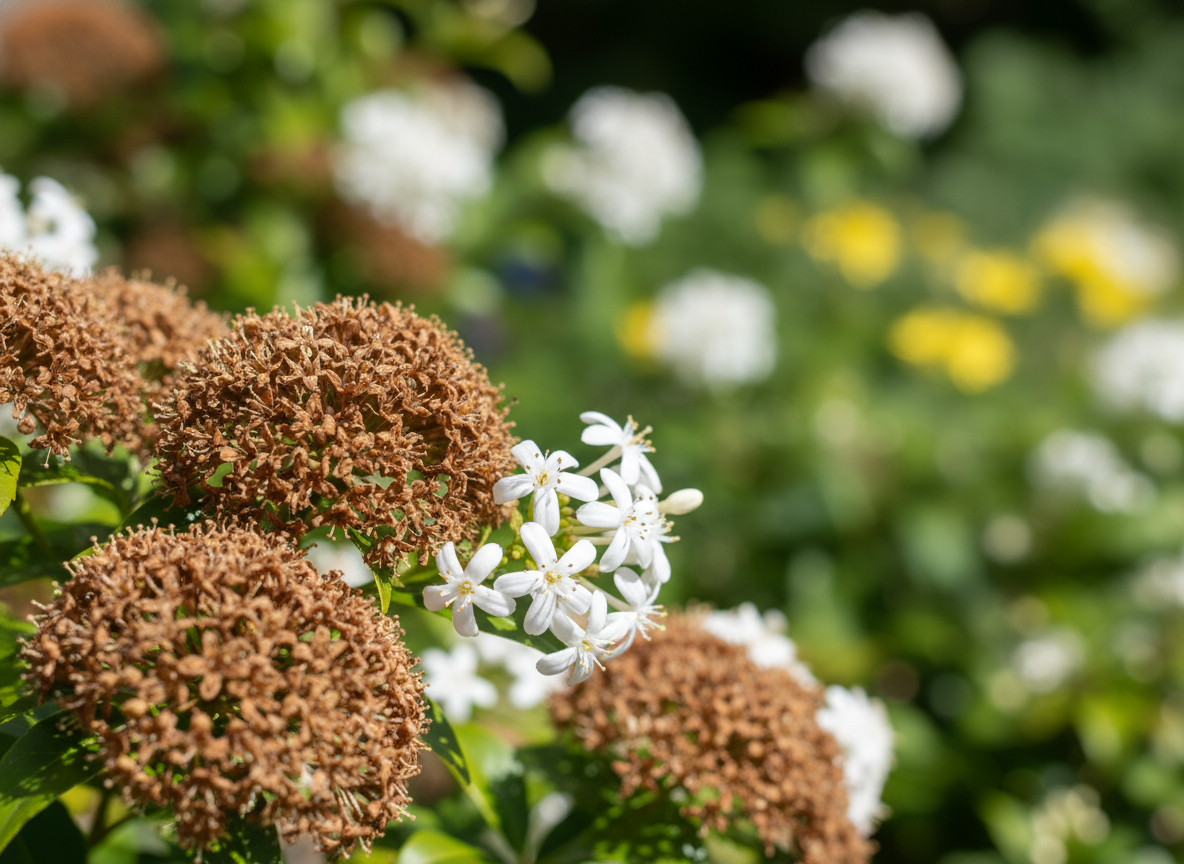 Chosen flowering plants with brown seed heads — AI-generated illustration
Timing: chase the brown froth, not a date on the calendar
The window opens the moment the spring flowers are clearly going over and closes well before midsummer. For most of Britain, the Low Countries and northern France that means roughly the last week of May through to mid-June. After a cold spring, or in a colder inland garden, slide the whole thing a week or two later. Watch the plant, not the calendar: when the white has gone to weak-tea brown and the first petals drop as you brush past, the window is open.
Why the deadline matters as much as the start. The new shoots you’re triggering need the warm half of the summer to grow, ripen their wood, and set buds for the autumn flush. Make the cut now and they’ve got June, July and August to do it. Leave the prune until late July or August and two things go wrong: the new growth has no time to flower before the season ends, and it goes into autumn soft and sappy, exactly the kind of growth that a first hard frost blackens. So the rule is the mirror image of the spring-shrub rule — not “don’t cut too early,” but “don’t cut too late.” Get it done before the longest day if you can.
There’s one more reason to be prompt. Spent choisya flowers, left on, start to set seed, and seed-setting is a quiet drain on the plant’s reserves. Deadheading now redirects that energy straight into the new shoots you’re trying to encourage.
Golden and variegated forms need a steadier hand
The plain green Choisya ternata is the most forgiving, but the forms most people actually buy are the coloured ones, and they want reading before you cut.
‘Sundance’ and ‘Goldfinger’ are the yellow-leaved sorts. Their colour is a trade-off: the gold only develops in good light, so a plant in shade drifts to a flat lime-green, but a plant in full, hot, reflected sun — against a south wall, beside paving — scorches at the leaf tips. When you prune one of these, you expose leaves that have been growing in the shaded interior straight to the sun. Done gently that’s fine; done with a hedge trimmer on the south side of the plant in June, you get a flush of pale interior leaves that promptly bleach and brown. Feather the cuts on the sunny side, take less off there, and let the existing canopy keep part-shading the new growth as it hardens.
‘Aztec Pearl’ (strictly Choisya × dewitteana) is the narrow-leaved hybrid — finer, more elegant foliage, pink-tinged buds, and noticeably the best of the lot at repeat-flowering. It’s also a touch hardier, rated to around -15°C against the -10°C of plain ternata. Treat it exactly the same way: tip-prune the flowered shoots to a leaf, and it rewards you with the most generous autumn encore of any choisya.
Whichever you’ve got, the principle holds: secateurs to a leaf, never a blade across the dome.
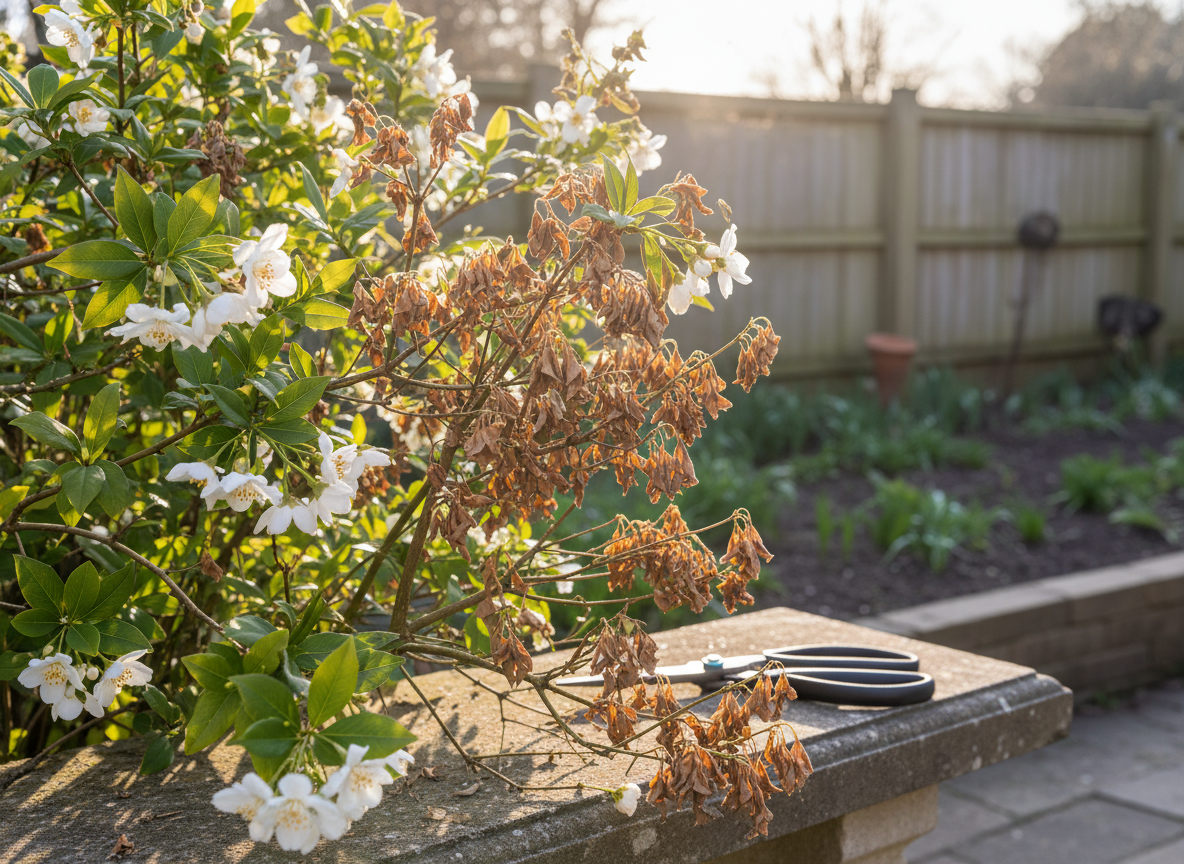 A close-up of a choisya plant with dead and live leaves, next to shears — AI-generated illustration
After a hard winter, read the dieback before you cut
Choisya is evergreen and broadly hardy across lowland north-west Europe, but it has a weak spot: cold, dry east winds and prolonged hard frost. It’s reliably happy down to about -10°C (‘Aztec Pearl’ a little lower), and most winters in the Low Countries and southern Britain stay the right side of that in a sheltered spot. But after a sharp winter you’ll often find the outermost shoots browned, the leaves on them crisp, and a band of dead wood at the tips.
The after-flowering trim is the perfect moment to deal with it, because by late May the live wood has shown its hand: you can see exactly where fresh green growth begins and the dead tip ends. Cut each frost-damaged shoot back to the first healthy, actively-growing leaf below the dead section — the same cut-to-a-leaf technique, just starting a little further down. Do not do this tidying in autumn or winter: cutting frost-burnt wood then only opens fresh wounds to the next freeze and stimulates soft growth at the worst possible time. Late spring, with summer ahead to heal and regrow, is when the plant can afford it.
Feed, water, and the renovation option
A shrub you’ve just asked to throw a second flush needs fuel. Right after the cut, scatter a handful of a balanced slow-release feed around the base and lay a 5 cm mulch of compost or bark over the root zone, keeping it off the stems. Water through any dry spell in June and July — established choisya is fairly drought-tough, but the new shoots that carry your autumn flowers won’t push hard in baked, dry soil.
And if your choisya is past the point of a light trim — bare-legged, gappy, a metre wider than its spot allows — here’s the good news that sets it apart from a broom or a ceanothus, both of which die if you cut into old wood. Choisya breaks freely from old wood. You can cut a tired specimen hard back — down to 30–45 cm, or take out a third of the oldest stems at the base each year over three years for a gentler reset — and it will reshoot densely from the bare framework. The best time for that harder renovation is mid- to late spring, just as growth gets going; you’ll sacrifice flowering for a year, but you get a compact, leafy plant back rather than the woody skeleton you started with.
Quick reference
- When: as the spring flowers brown, before midsummer — for most gardens late May to mid-June.
- What: the spent flower clusters and the short stem behind them; up to a third off the longest shoots if reshaping.
- How: secateurs, shoot by shoot, cutting back to a strong outward-facing leaf — never a hedge trimmer across the dome.
- Coloured forms: go lighter on the sunny side of ‘Sundance’ and ‘Goldfinger’ so exposed interior leaves don’t scorch.
- Frost damage: cut browned tips back to the first live leaf — now, not in autumn.
- After: balanced feed, 5 cm mulch, water in dry spells through June and July.
- Overgrown and bare? Choisya, unlike broom or ceanothus, takes hard renovation from old wood — but do that in mid-spring, not now.
Make the light cut this week and you flip your choisya from a once-a-year shrub into a twice-a-year one, with the second helping of orange-blossom scent arriving just as the rest of the garden is winding down. The window is short and it’s the kind of job that slips the mind once the flowers stop demanding attention — so if you’d rather not track it by eye, Cresco will watch the calendar and your local weather and nudge you the week your choisya’s spring flush is due to fade, then again when it’s time to feed the autumn show along.