Two kinds of shoot, one rule
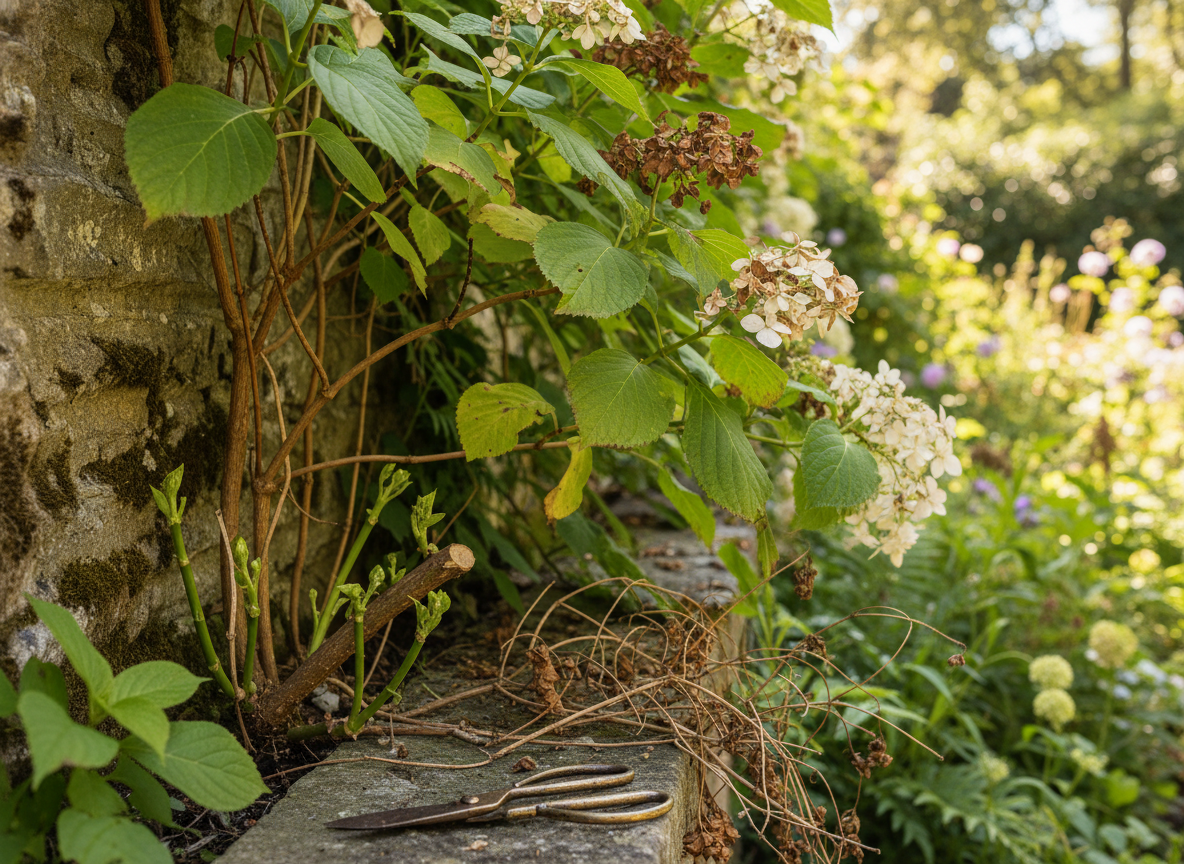
Walk up to a mature Hydrangea anomala subsp. petiolaris in the first week of June and you’re really looking at two plants in one. Pressed flat against the brick are the clinging shoots — pale, almost lizard-like, glued to the mortar by little aerial roots. Sticking out at right angles, sometimes a forearm’s length from the wall, are the projecting shoots. Those projectors are the ones carrying the flat white lacecap flowers that have just started to brown at the edges.
That structural split is the whole pruning lesson. The clingers are the wall. The projectors are the show. After flowering, you cut the projectors back. You leave the clingers alone. Get that one rule right and there’s almost nothing else to learn about pruning this plant.
 AI-generated illustration
The August deadline that decides next May
The window for pruning a climbing hydrangea opens the moment the lacecaps turn from cream to tan and closes around the start of August. The RHS is explicit about it: cut after flowering in summer so the plant has time to lay down flower buds for the following year on the new growth that follows your cut (RHS Hydrangea pruning guide).
The trap is autumn tidying. People look at a climbing hydrangea in September, see the brown flower heads still hanging on, and reach for the secateurs in a wave of late-season tidiness. That cut is six weeks too late. By September the plant has already set next May’s buds at the tips of the new shoots that grew after flowering. Shortening those shoots in September shortens next year’s display.
So the real rule is: cut from the moment the flowers turn, through to the end of July at the latest. In early June you’re at the front of that window, which is the best place to be — every day you cut earlier is a day the plant has to ripen new wood before the days shorten.
The cut: stop at the next pair of buds
The mechanic is simpler than the wall of leaves makes it look. Each projecting shoot that flowered has, lower down its length, pairs of leaves at regular intervals. In the joint between each leaf and the stem sits a bud — sometimes two, sitting opposite each other in a pair. Those are next year’s potential flowering tips.
You follow a flowered projector back from its faded lacecap towards the wall and stop at the first strong pair of buds you find. Cut about a centimetre above the buds, on a slight angle away from them. That’s the whole technique. The shoot you’ve shortened will push out one or two new growths from those buds within a fortnight, and those new growths are what will carry the lacecaps in May 2027.
Two practical adjustments. First, if the projector is unusually long — a metre or more from the wall — you can take it back further, to the second or third pair of buds in from the tip. Don’t try to remove the whole projector in one cut unless it’s clearly dying or in the wrong place. Second, where a pair of buds points outward (away from the wall) and inward, pick the cut just above the outward-facing pair if you want the regrowth to fill space, or the inward-facing pair if you want regrowth back towards the brickwork. Most of the time you want outward — into the air, where the flowers can be seen.
 Climbing hydrangea covers a stone wall next to a garden path — AI-generated illustration
What never gets cut
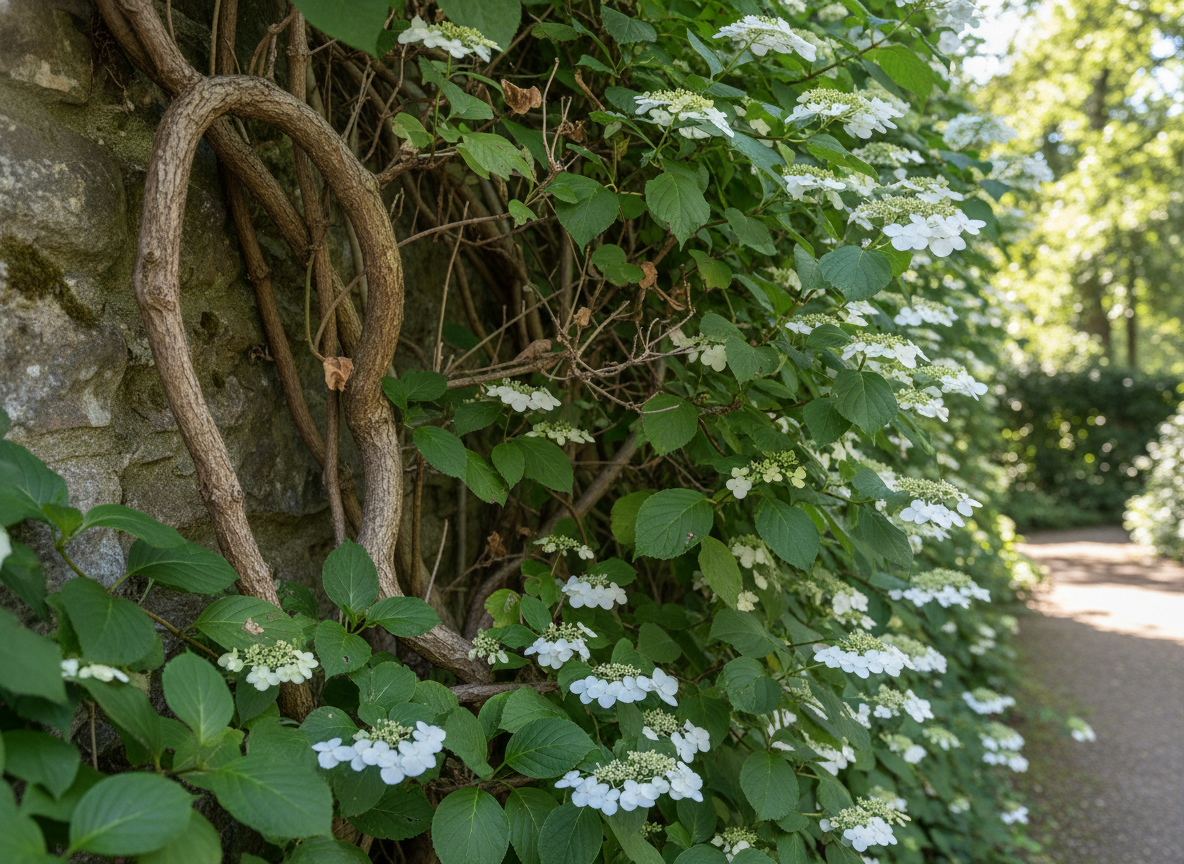
The clinging framework — the flat, wall-hugging stems with the rusty aerial roots — is not pruning material in early June. Those stems are the plant’s skeleton. They’re often a decade old, sometimes more, and they support every projector you can see. Cutting one severs the supply line to a whole section of plant.
The only time you cut a clinging stem is when you’re actively trying to remove the plant from a piece of wall — around a new window, off a recently rendered patch, away from a soffit. Even then, do it in stages over two or three years rather than one go; the dead aerial roots that remain on the brickwork take a long time to weather off.
The second thing you don’t cut in June: the very topmost growth. Mature climbing hydrangeas put their best lacecaps near the top of the plant, partly because that’s where the light is and partly because that’s where the oldest wood lives. If you reach a ladder up there in June, the temptation is to give the crown a haircut. Don’t. Spot-prune individual projectors at the top to control them, but never shear the canopy as if it were a hedge.
The window-frame trick
The most common reason people prune climbing hydrangea is that it’s started to project across a window. In early June, this is straightforward. Find each projector that’s growing into the glass, follow it back to the first pair of buds that point away from the window (parallel to the wall, or back into the wall), and cut just above them. Within three weeks the new growth comes out along the wall rather than into the room.
Doing this every June for two or three years trains a climbing hydrangea around a window opening so cleanly that visitors think you’ve planted it that way. Doing it in October instead — once the projectors are woody and the buds are set — just leaves stubs that block half the light.
First three years: leave it alone
A climbing hydrangea planted in the last three springs probably shouldn’t be pruned at all in June 2026. Young plants of this species spend their first two to four years building the clinging framework — laying down those flat wall stems — and barely flower at all. Pruning during that phase delays flowering further, sometimes by years.
If your plant hasn’t yet flowered, your job is to keep watering it through dry spells, feed it once in spring with a general fertiliser, and wait. The first flowers will come, and once they do, the plant has switched gear and the June cut described above starts to apply.
 AI-generated illustration
Renovation: the three-year staged cut
The hardest case is the one you usually inherit: an old climbing hydrangea covering half a gable, projecting half a metre out, and now blocking gutters or peeling render. You can cut the whole thing back hard to within thirty centimetres of the wall, and it will survive — but it will not flower for two or three summers afterwards, and the regrowth can look rough for a season.
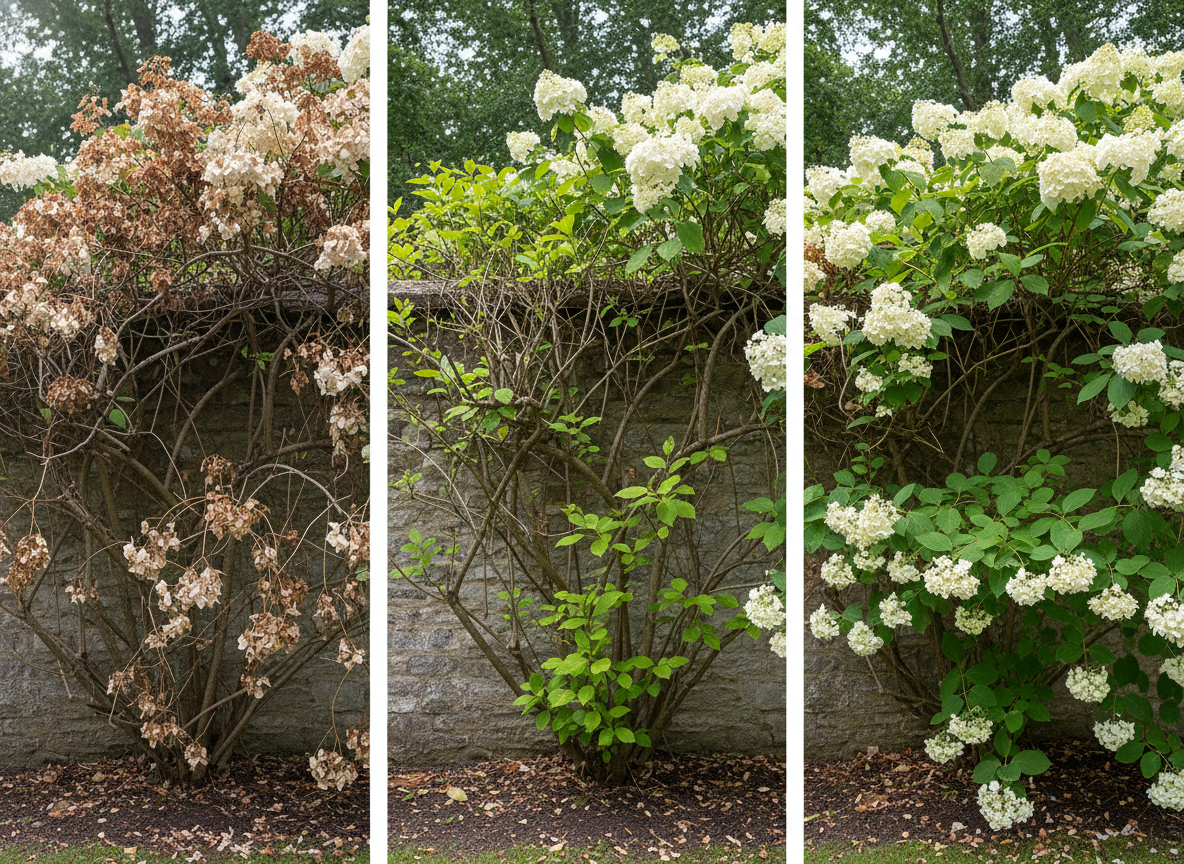
A staged renovation is almost always the better choice. Split the plant into thirds. In year one, hard-cut the leftmost third back to the framework in June. In year two, the middle third. In year three, the rightmost. By the time you finish, the section you started with is flowering again on new wood, and you’ve never had a year with zero blooms. The RHS explicitly recommends this gradual approach over single-cut renovation (RHS climbing hydrangea growing guide).
What the cut actually looks like, ten days later
It’s worth knowing what success looks like before you start, so you don’t panic mid-cut. Ten days after a clean June cut above a pair of buds, you’ll see two pale-green points pushing out of those bud positions, each about a centimetre long. By the end of July, those points are five-to-ten-centimetre shoots with two or three pairs of new leaves. By late August, the tip of each new shoot will have a small, slightly fatter bud at its apex — that’s next year’s flower.
Find one of those fat tip buds on your plant in late August and you’ll know, before next May arrives, exactly where the 2027 lacecaps will be.
Cresco does the windows for you
The reason this post is appearing on the first of June rather than the first of July is that climbing hydrangea timing depends on when your local lacecaps actually browned, not on a calendar week. In a mild Cornish or Brabant spring the window opens in late May; in a cold Scottish or Frisian one it doesn’t open until mid-June.
Cresco tracks your local growing degree days and the specific flowering stage of the plants you’ve added to your garden, then tells you when your climbing hydrangea’s window is open and — more importantly — when it’s about to close. Snap a photo of any projecting shoot you’re not sure about and the app will tell you whether you’re looking at a clinger or a projector before you make the cut.
The plant has been holding the wall for you since the last decade. Spend ten minutes with it in June, and it’ll hold the windows open for the next one.