Late October is when the border gets its big clear-out, and hellebores look like obvious candidates. The leaves are big, leathery and a bit battered after summer, some of them are blotched with brown, and they lie in a heavy ring over the crown. It’s tempting to cut the whole lot to the ground with everything else. For most hellebores that’s a cut made about two months too early — and for some of them it’s a cut you should never make at all.
Why the old leaves stay on for now
The common garden hellebore, Helleborus × hybridus (the Lenten rose), keeps its leaves through autumn for a reason. They’re still working: through October and November they feed the plant while its roots grow in the cool, moist soil, and that stored energy goes straight into the flowers that open in late winter.
The leaves also sit like a roof over the crown. Underneath them, next year’s flower buds are already forming at soil level. Strip everything now and you leave those buds bare through the wettest, coldest months, with nothing between them and the frost, the slugs and the rain that pools on a flat, open crown.
And there’s a simpler point: a hellebore with no leaves in November is just a bare patch of soil in the border. The ring of evergreen leaves is one of the few things holding the bed together until spring.
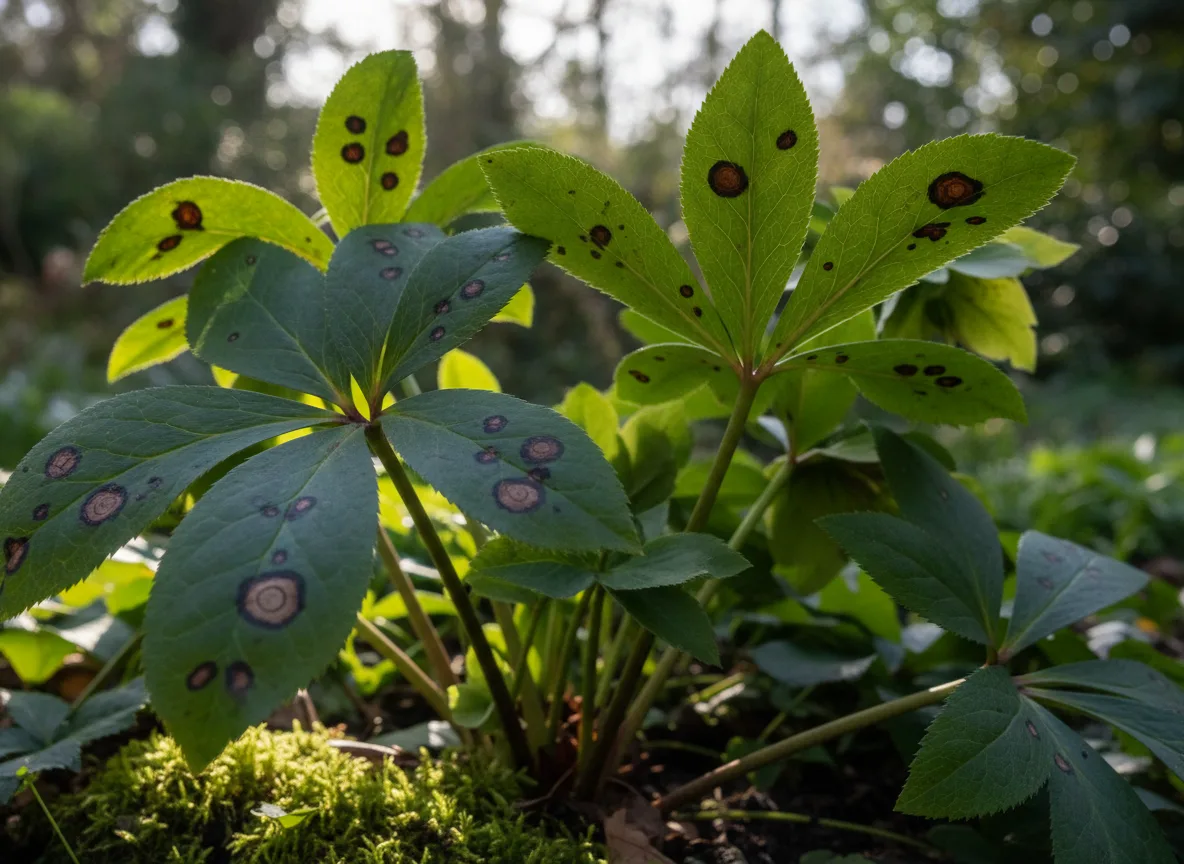 Hellebore leaves with dark spots in natural daylight — AI-generated illustration
What to remove now: only the spotted leaves
That doesn’t mean leaving every leaf alone. Hellebore leaf spot is a fungal disease that shows up as round brown or black blotches, often with darker rings, that spread until the leaf yellows and collapses. It thrives in mild, damp autumns, and it moves from old leaves to new ones and onto the flower stems.
So this is the job for now:
- Cut off any leaf with spots, right at the base of the leaf stalk, with clean secateurs.
- Bin it or burn it — don’t compost it. The fungus survives on dead leaves and starts the next round of infection in spring.
- Rake out fallen and rotting leaves from around the crown, including tree leaves that have blown in and are lying wet against it.
- Leave every clean, green leaf where it is.
It’s the same idea as pulling only the spotted leaves on bergenia: take out the disease, keep the cover. If the crown looks thin after you’ve done this, you’ve still done the right thing — a few clean leaves beat a full set that’s spreading spores.
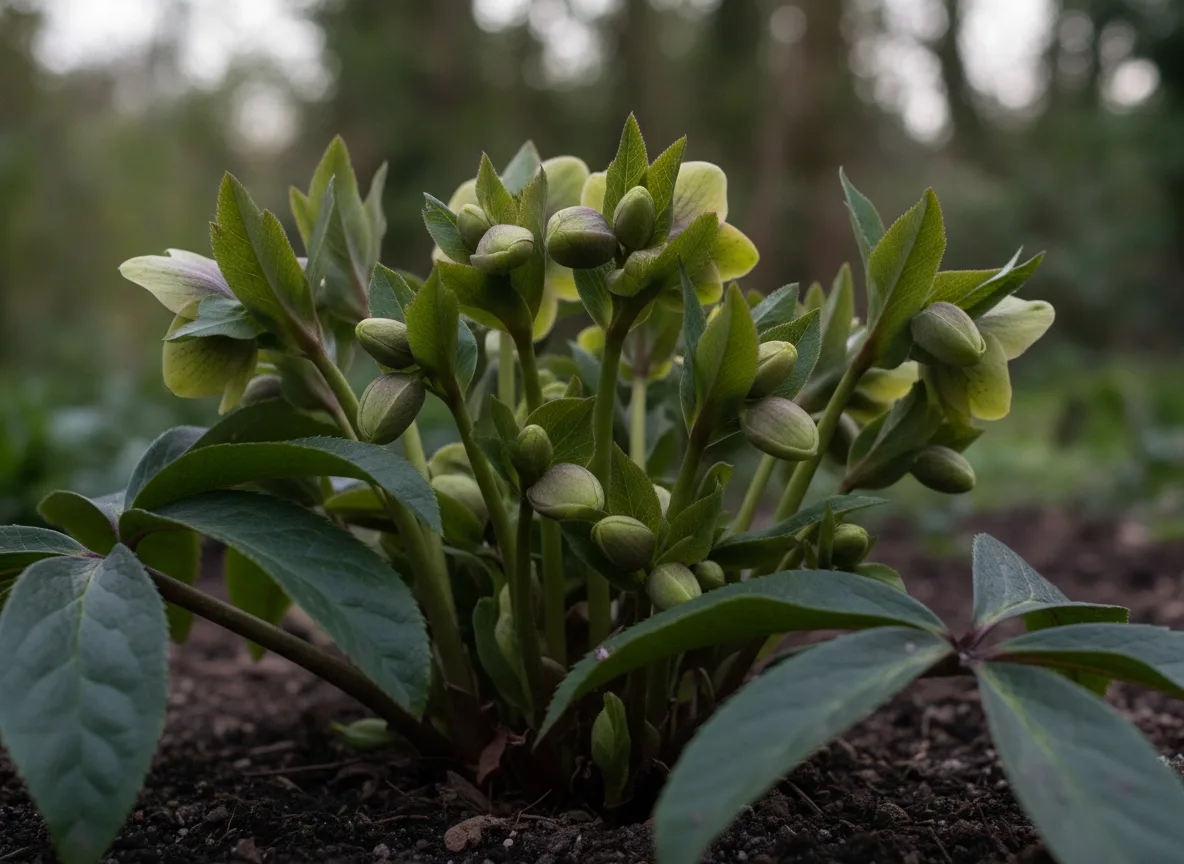 Hellebore plant with visible flower buds and mature leaves in a garden — AI-generated illustration
When to cut the rest: as the flower buds show
The main cut comes in midwinter, usually December or January, when you can see the flower buds pushing up from the crown. Some gardeners wait until February in a cold garden. The timing is set by the plant, not the calendar: as soon as the buds are visible, cut every old leaf off at the base.
Done at that moment, the cut does three things at once:
- It shows off the flowers. Hellebore flowers nod downwards on short stems. With last year’s leaves out of the way, they’re not hidden under a flat green roof.
- It breaks the disease cycle. Clearing the old foliage before the new leaves unfold stops leaf spot jumping from one year’s growth to the next.
- It gives the new leaves a clean start. Fresh foliage comes up after the flowers, so the plant is never without leaves for long.
Work carefully. The buds and the old leaf stalks come out of the same crown, so follow each stalk down to its base with your fingers before you cut. One careless snip with the shears takes off a flower stem you’ve waited all year for.
In a very cold spell, it’s fine to wait a week or two. Bare buds caught by a hard frost straight after the cut can blacken; the leaves are worth leaving on until the weather softens.
The hellebores you should never cut this way
Not every hellebore grows like the Lenten rose. The stemmed hellebores carry their leaves and flowers on the same upright stems:
- Helleborus argutifolius, the Corsican hellebore, with spiny grey-green leaves
- Helleborus foetidus, the stinking hellebore, with narrow dark fingers of leaves
- Helleborus × sternii and its hybrids
On these, the leafy stems standing now are the ones that will flower this winter. Cut them back in autumn and you cut off the whole display. Leave them alone until they’ve finished flowering in spring, then cut each flowered stem to the ground once new shoots are coming through from the base — much like the after-flowering cut for euphorbia. Wear gloves for both: hellebore sap can irritate skin.
The Christmas rose, Helleborus niger, sits in between. It can start flowering in December, so its buds may already be showing by late November. Treat it like the Lenten rose: take out spotted leaves now, and clear the old ones once the buds appear.
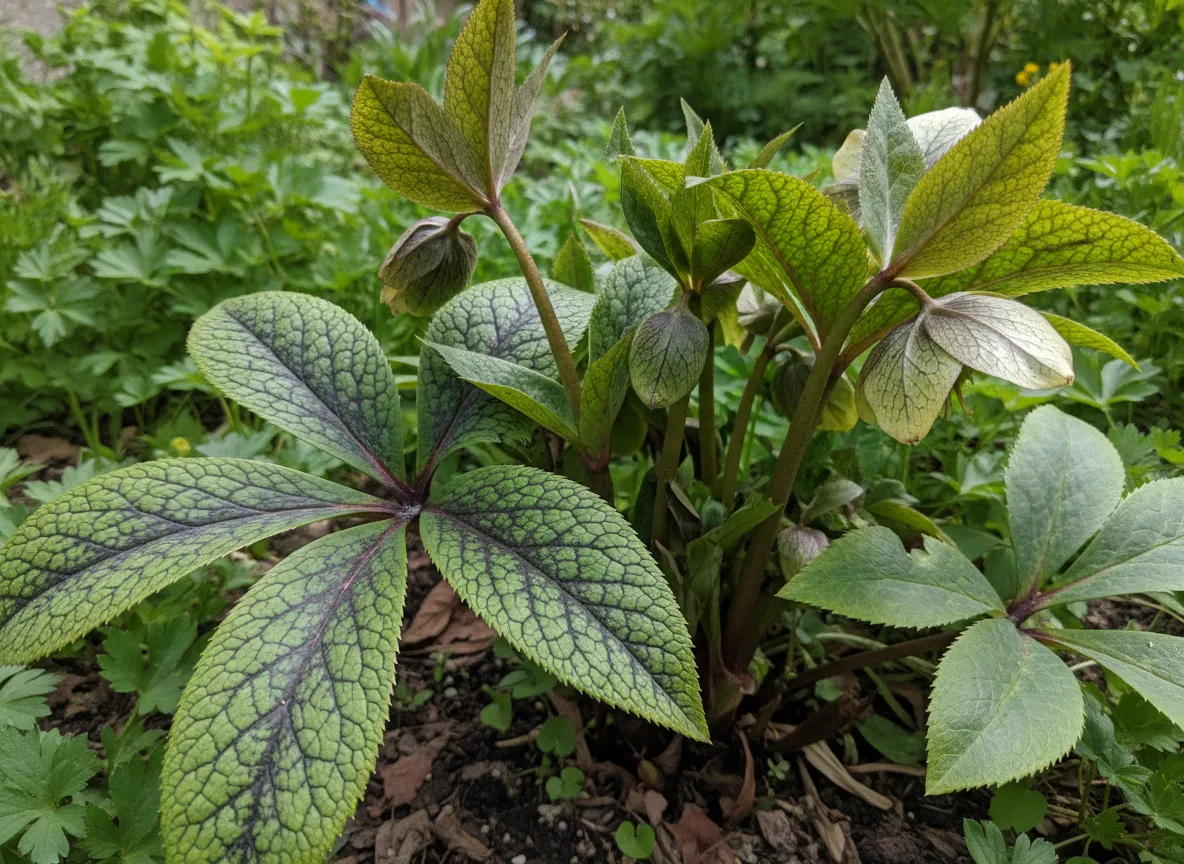 Hellebore plant with black streaks and netting on leaves — AI-generated illustration
When it isn’t leaf spot
One thing to watch for while you’re down there. If the leaves show black streaks and netting along the veins, and later the flowers come up streaked and twisted, that isn’t leaf spot but hellebore black death, a virus. Cutting won’t fix it. Dig out the whole plant and bin it, and control aphids nearby, since they spread the virus to healthy plants.
The short version
- Now (October–November): cut off only spotted or dead leaves, bin them, and clear debris from the crown.
- Midwinter, as buds appear: cut all old leaves of Lenten roses and Christmas roses to the base.
- Stemmed hellebores: don’t cut in autumn; remove flowered stems in spring.
If you’d rather not keep track of which plant needs what when, Cresco builds a pruning schedule for each plant in your garden and reminds you when the right window opens.