There’s a moment in late October when the forsythia by the back gate looks like a problem waiting to be dealt with. The leaves are turning and dropping, the shape has gone shaggy over summer, and a bare, twiggy shrub is practically asking for the secateurs while you’re out tidying everything else. Resist it. Cut a forsythia now and you spend the winter looking at neat, well-behaved stems — then get far less yellow in March, because you’ve cut off most of the buds.
Forsythia flowers on last year’s wood
The whole thing turns on one fact: forsythia blooms on growth made the previous year. Those arching stems the plant threw out this summer are the ones that will carry flowers next spring, and the flower buds are set along them by autumn — they’re already there, tucked against the wood, right now as you’re eyeing the shrub with the shears.
That’s why the timing feels counter-intuitive. A forsythia in October isn’t a plant winding down for winter with nothing to lose; it’s a plant that has already loaded next spring’s display onto its stems and is just waiting to open it. Every long stem you shorten, every branch you take out, removes a run of buds that would have been flowers. The shrub doesn’t make new ones over winter to replace them — so an autumn prune is paid for, pound for pound, in lost spring colour.
The shrub itself is tough: an established forsythia is hardy to about −25 °C (USDA zones 5–8), so winter cold is rarely the problem. Young plants in pots are more vulnerable, because roots in a pot freeze sooner — move them somewhere sheltered or wrap the pot during a hard frost.
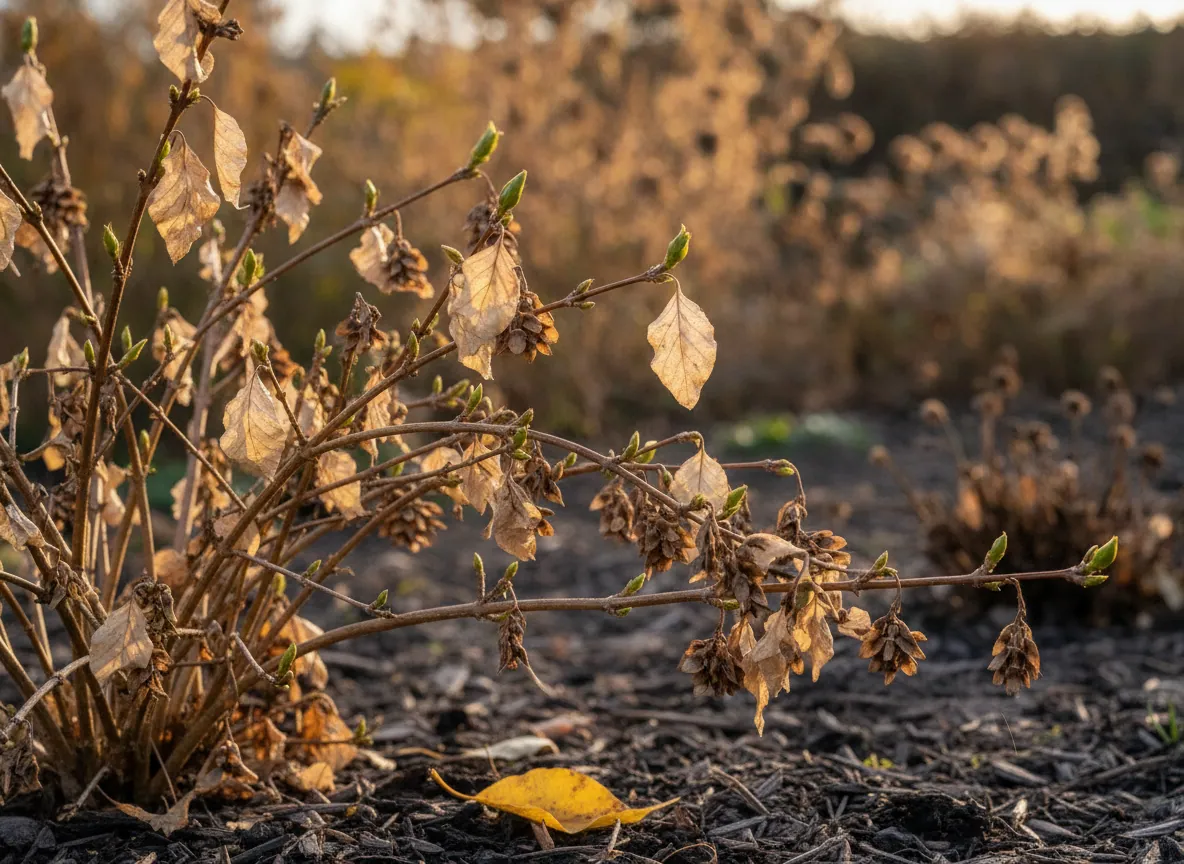 A cluster of dry, brown leaves and seed pods on branches in a garden setting — AI-generated illustration
Why the autumn tidy is the wrong instinct
The mistake is understandable. By late October the forsythia is one of the last things still standing with leaves on, it’s often grown wider and taller than you bargained for, and the surrounding border has been cut to the ground — so the eye wants it brought into line too. There’s also a stubborn idea that “tidy now, neat all winter” is good gardening.
For most deciduous shrubs it isn’t, and for an early-flowering one it’s actively costly. It’s the same trap people fall into with lilac and other spring shrubs: the plant that looks most in need of a cut in autumn is often the one you least want to touch, because it flowers on old wood. The rule of thumb is blunt and reliable — if a shrub flowers before midsummer, don’t prune it in autumn or winter. Save the shears for after it has bloomed.
It’s the same reasoning as leaving mophead hydrangeas unpruned through autumn: the cut that looks helpful in October does its damage in spring.
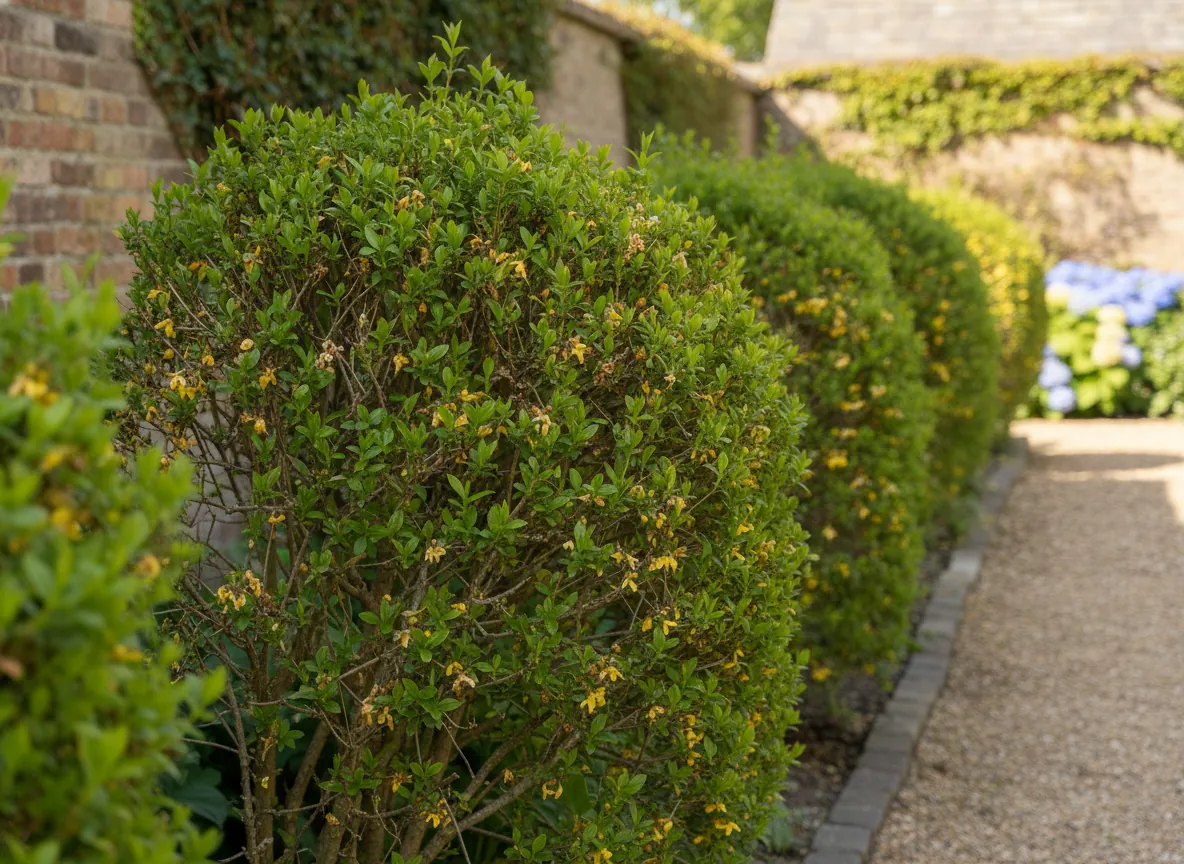 A row of green bushes with small yellow flowers lines a gravel path in a garden — AI-generated illustration
The right time: the fortnight after flowering
Forsythia’s pruning window opens the moment the last flowers fade — typically late March into April, depending on how your season runs. That’s not a loose “sometime in spring”; it’s a genuine window of two or three weeks. Prune in that gap and the shrub has the whole growing season ahead of it to throw out fresh stems, which ripen over summer and set buds for the following spring. Miss it and prune in, say, June, and you’ll get fewer flowers next spring.
So the cycle is simple once you see it:
- It flowers (early spring) → you prune (immediately after) → it grows (summer) → it sets buds (autumn) → it flowers again (next spring).
How to prune it: one in three, not a flat-top
When the window does come round in spring, prune with the plant’s habit in mind. Forsythia flowers best on young, vigorous stems; the oldest, thickest wood gradually goes shy and produces fewer blooms further and further from the ground. So the job is renewal, not shaping.
Work on the one-in-three principle — the same approach that keeps a weigela productive:
- Take out about a third of the oldest stems each year, cutting them right down to the base or to a strong low shoot. These are the thick, grey, twiggy ones that flowered least.
- Leave the younger stems to flower next spring and carry the display while this year’s new growth matures.
- Shorten any over-long or wayward shoots on the stems you keep, cutting back to a sideways-facing bud or a healthy junction.
Done this way, you never take the whole shrub down at once, and there’s always a mix of ages — old enough to flower, young enough to flower well. What you’re avoiding is the hedge-trimmer approach: shearing the outside into a tight lollipop leaves a dense shell of twigs, forces all the flowers to the very surface, and bares out the middle. A forsythia that’s been flat-topped for years is all wood and no bloom.
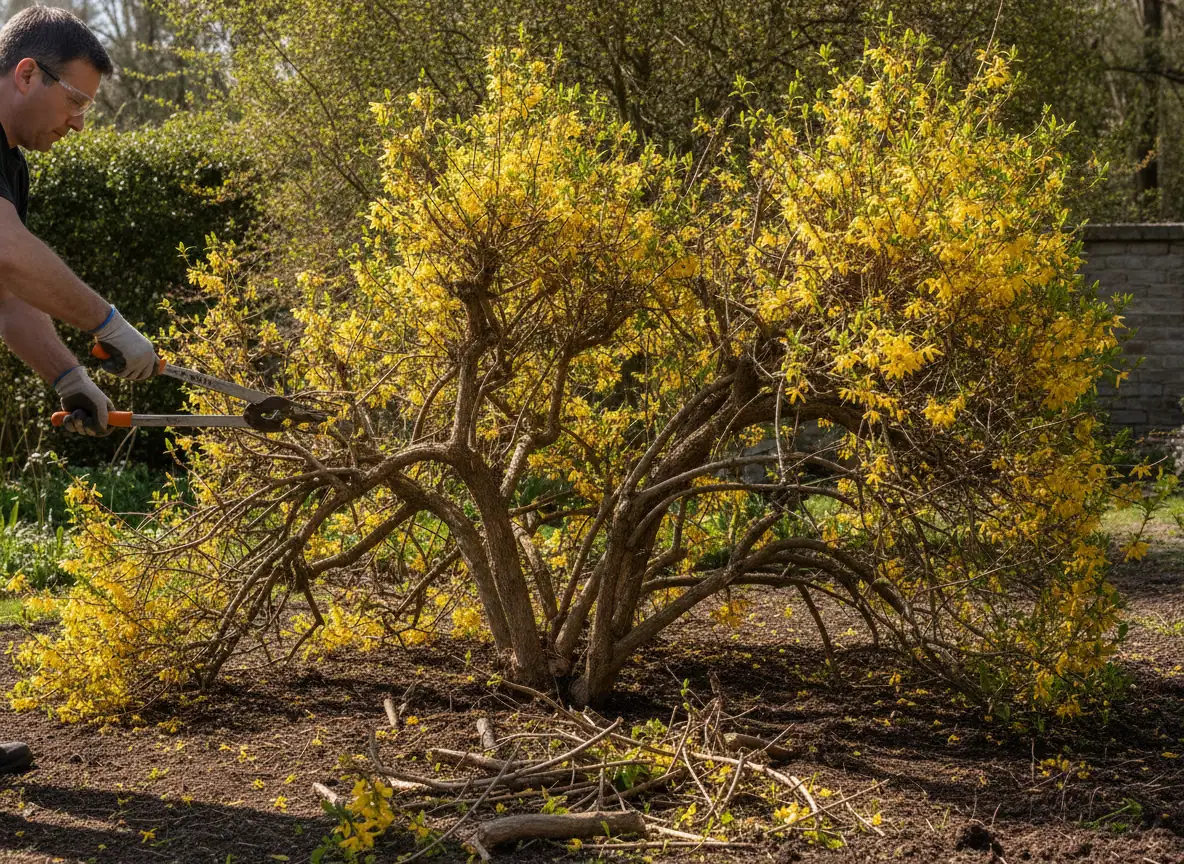 A person prunes an overgrown forsythia bush with loppers — AI-generated illustration
Renovating a leggy, overgrown forsythia
If you’ve inherited a monster — bare-legged, flowering only at the top, a tangle of grey wood at the base — it can be brought back, but still on spring’s timetable, not autumn’s. Immediately after flowering, cut the whole shrub down hard, to 30–45 cm from the ground. It will look brutal and it won’t flower the following spring, because you’ve removed this year’s flowering wood along with everything else.
That’s the trade: one lost season for a reset plant. Through that summer it responds with a thicket of strong new shoots from the base; thin those to the best-placed half-dozen or so as they grow, and those stems will flower the spring after. From there, drop back into the gentler one-in-three routine each year and it stays easy to keep in check. If a hard renovation feels like too much in one go, spread it over two or three springs instead, taking out the worst third of the old wood each year — easier on the plant and on the nerve.
The one-line version
A forsythia in October has already set most of its flower buds for spring, so an autumn tidy is a spring display thrown on the compost heap. Leave the shears in the shed, let it bloom, and prune in the two or three weeks right after the flowers fade — one in three of the oldest stems to the base, nothing sheared flat. If you track your jobs in Cresco, this is exactly the kind of timing it pins to each plant and your own local weather, so the forsythia gets a cut after it flowers, not the one that would have cost you the show.