Often it isn’t the frost itself — it’s water freezing in the crown
The cabbage palm (Cordyline australis, the New Zealand cabbage tree) gets written off every autumn by people who assume the first proper frost will blacken it. A settled one is tougher than that. Cordyline australis is the hardiest of the bunch and an established plant shrugs off a fair bit of cold in a mild, sheltered spot — plants die in winters far gentler than their worst, and when they go, raw cold usually isn’t what did it. Severe, prolonged frost can kill an established plant too: many cordylines died of the cold itself in the hard winters of 2009–2011. An established Cordyline australis tolerates roughly −5 to −10 °C; young plants and plants in pots far less.
Water is. A cordyline grows from a single point tucked deep in the centre of each leaf rosette, where the leaves meet the stem. Rain and melt run down those strappy leaves like a funnel and collect right on top of that growing point. Let that water sit there when a hard frost arrives and it freezes, the tissue turns to mush, and the rot spreads down into the stem. In that case the plant doesn’t die of cold — it drowns and then freezes. So the job this month isn’t to parcel the whole thing up against the chill. It’s to keep water out of the crown.
 A person’s hands tend to a young plant surrounded by dark cordyline roots — AI-generated illustration
Find the growing point before you protect it
It pays to know what you’re shielding. A cordyline isn’t a palm at all, despite the nickname — it’s a tree-like relative of agave and asparagus that holds its leaves in a dense rosette at the top of each stem. All the new growth comes from one tender tip right in the middle of that rosette, down where the youngest leaves are still clasped together. That single tip is the whole plant’s future. The mature leaves around it are expendable; frost can scorch the outer leaves brown and the plant barely notices, because the growing point underneath is fine.
That changes everything about how you protect it. You’re not trying to keep every leaf green over winter — you can’t, and it doesn’t matter. You’re keeping that one buried tip dry and unfrozen. Everything you do this autumn works outward from there.
 Cordyline leaves tied in a topknot above the plant’s base — AI-generated illustration
Tie the leaves up into a topknot
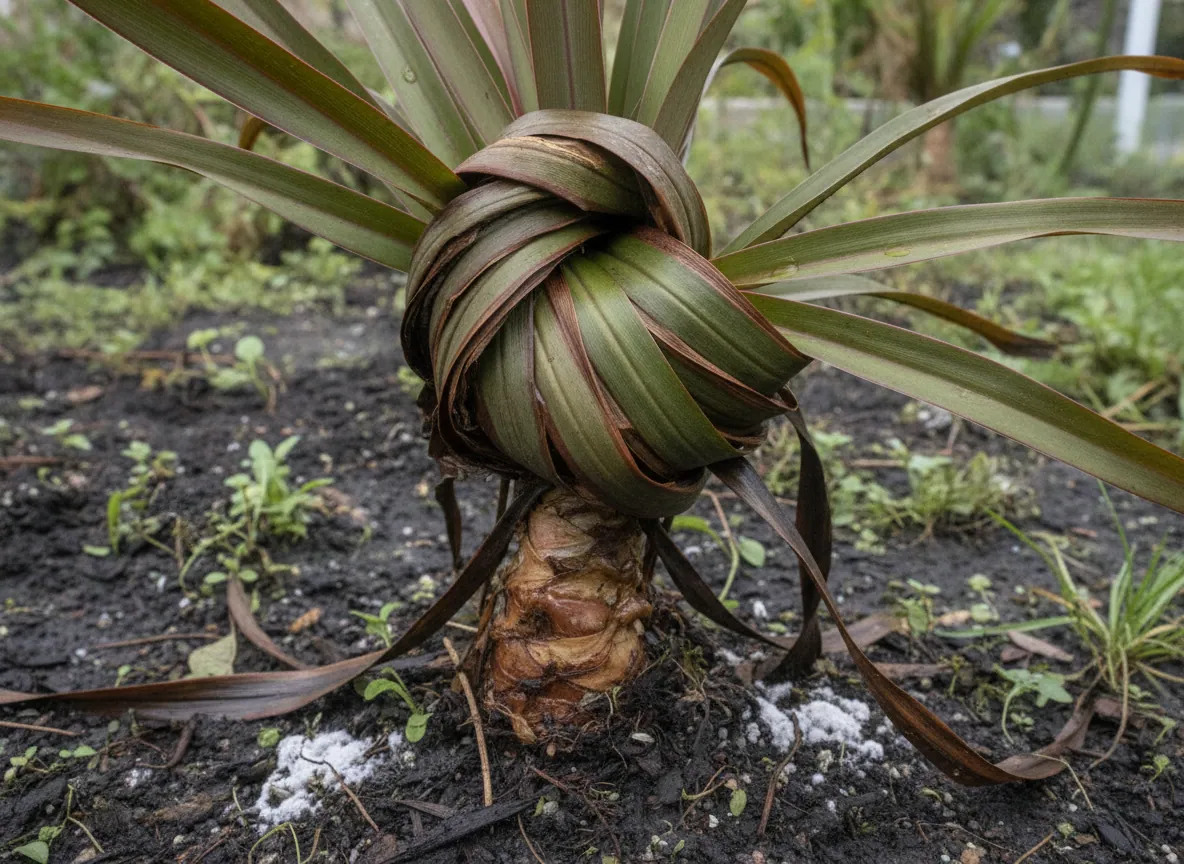
Here’s the single most useful thing you can do, and it costs nothing but a length of twine. Gather all the leaves upward into a bundle, as if you were tying a ponytail, and loop soft twine around them once or twice near the top. The rosette closes into a tight shuttlecock, the outer leaves fold over the crown, and water now runs down the outside and off instead of pooling in the centre. As a bonus, a tied-up head catches far less wind, so you lose fewer leaves to winter gales and the plant doesn’t rock in its roots.
Time it with the weather, not the calendar. Wait until the leaves are tired and the first frosts are in the forecast — across the UK and the Low Countries that’s usually late October into November, earlier in a cold, open garden. Don’t rush it in warm, wet weather: a head bound up tight while it’s still mild can sweat and rot just as surely as a frozen one. Use soft jute or garden twine, not wire or cable ties that bite into the leaves, and don’t crank it tight — a loose bundle still sheds water.
Fleece is for cold snaps, not the whole winter
In a mild, coastal garden, a tied-up head is often the entire job. The colder and more exposed your plot, the more you add — but add it in the right order and for the right reasons. When a hard, prolonged freeze is forecast, slip a layer of horticultural fleece over the bundle, or a loose sleeve of bubble wrap around a young plant, to take the edge off. In a cold inland garden it’s worth wrapping the main stem too, and in every case spread a thick mulch of bark, leaf mould or straw over the root zone so the roots don’t freeze solid. Wet feet in winter are as dangerous as water in the crown: in the ground, plant in free-draining soil, not heavy, wet clay.
The mistake is leaving all that on from October to March. Fleece and plastic trap moisture, and a crown sealed up through every mild, damp spell will rot from the warmth and wet — exactly the fate you tied it up to avoid. Treat wrapping as emergency cover: on for the freeze, off again the moment the weather turns mild so the plant can breathe. The tied head can stay bundled all winter; the fleece comes and goes with the forecast. This is the same lesson a tree fern teaches when you pack its crown — dry and airy almost always beats sealed and smothered.
 Potted cordyline plants are stored in a frost-free greenhouse — AI-generated illustration
Potted cordylines go somewhere cold but frost-free
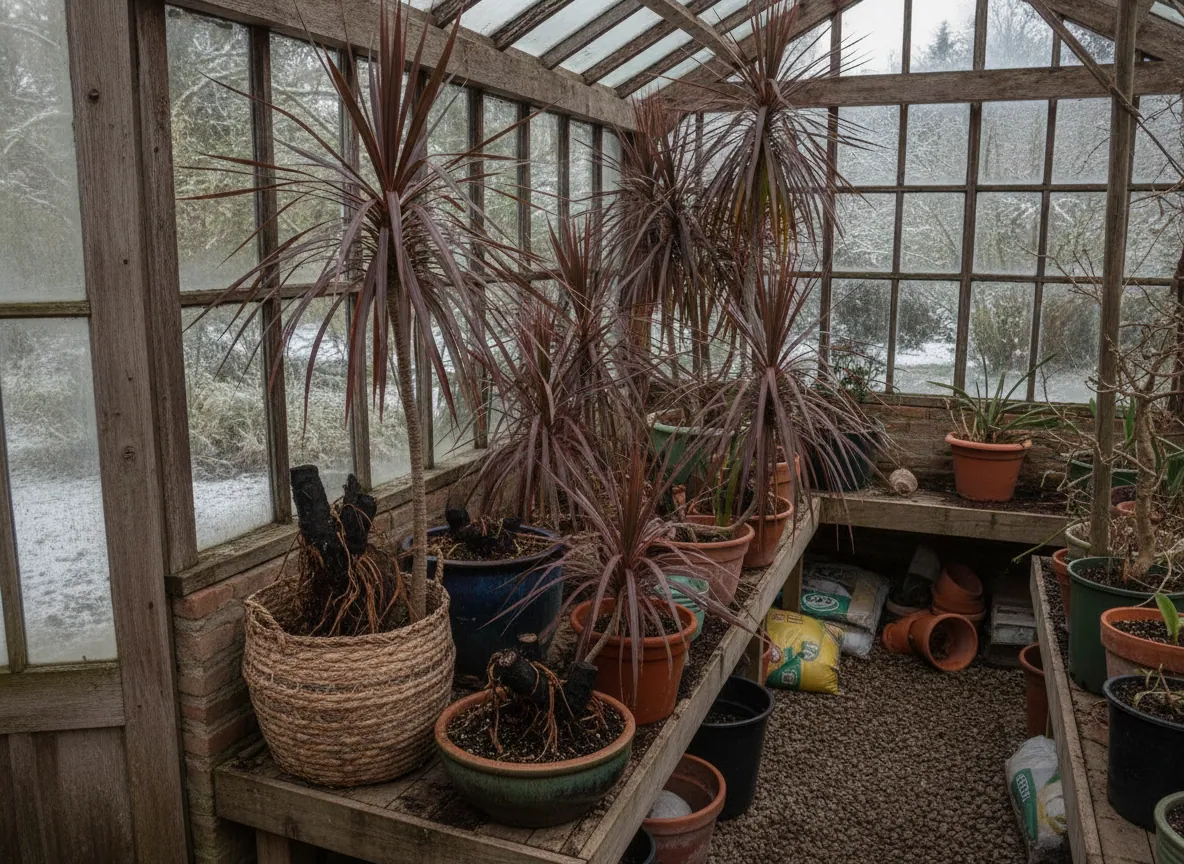
A cordyline in a pot is far more vulnerable than one in the ground, because its roots have nothing but a few litres of compost between them and the frost, and roots are the least hardy part. Don’t try to nurse a container plant through a hard winter outside on tying alone. Move it to somewhere cold but frost-free — an unheated porch, a greenhouse with frost protection (a cold greenhouse isn’t automatically frost-free), a sheltered spot against a house wall under cover. It doesn’t want warmth, which only pushes soft growth; it wants protection from a deep freeze and from sitting in sodden compost. Ease off the watering so the rootball stays just-moist, never wet, and it’ll hold quietly until spring.
Don’t cut frosted leaves off — and don’t write the plant off
Say a cold snap catches you out and the top takes a hit: the leaves brown, flop and look wretched by midwinter. The instinct is to cut the lot off and tidy up. Don’t. Those tatty leaves, ugly as they are, are still shedding water off the crown and sheltering the growing point underneath — strip them now and you expose the one part that matters to the worst of the weather. It’s the same reason you never give a phormium a hard shear across the top in autumn: on these strappy, architectural plants the tidy-up cut is the one that does the damage.
Leave it be until spring. Even a cordyline that loses its whole head often isn’t dead — Cordyline australis is notorious for shooting again from low on the stem, or from the base, once the warmth returns, sometimes coming back as a cluster of new heads. Wait until you can see where the live growth is before you cut anything. Then, in mid-spring, trim back cleanly to just above the new shoots and let it rebuild. The only time to cut sooner is if the stem turns soft and smells of rot — that tissue won’t recover and is best taken back to firm, healthy growth. Hold your nerve over winter, and more often than not the plant does the rest.