Every autumn someone takes the secateurs to a climbing rose the way they’d prune a bush rose in the border — cutting the whole thing back hard to knee height, tidying it up for winter. Next June the wall is a mass of leaf and barely a flower, and the year after that it’s worse. The plant isn’t sulking and it isn’t the wrong variety. It’s been cut in a way that throws away the very wood it flowers from.
A climbing rose is built differently from a bush rose, and it has to be pruned differently too. Get the distinction right and the same plant will flower from the ground to the gutter, year after year, off a structure you barely touch.
A climber isn’t a bush rose
A hybrid tea or floribunda in the border is grown to be cut back hard each year. It makes its flowers on vigorous new shoots thrown up from low down, so you can take the whole plant back to a framework of stubs in late winter and it rewards you.
A climbing rose works the other way around. It builds a permanent framework of long, woody main stems — the ones you tie to the wall or fence — and then flowers each summer on short side-shoots that break from those stems. Cut the framework off and you’ve removed next year’s flowering wood in one go. That’s why the hard “bush rose” prune is so destructive on a climber: you’re not resetting the plant, you’re amputating it.
So the whole job comes down to one idea. Keep the main stems. Prune the side-shoots. Everything below is detail on that.
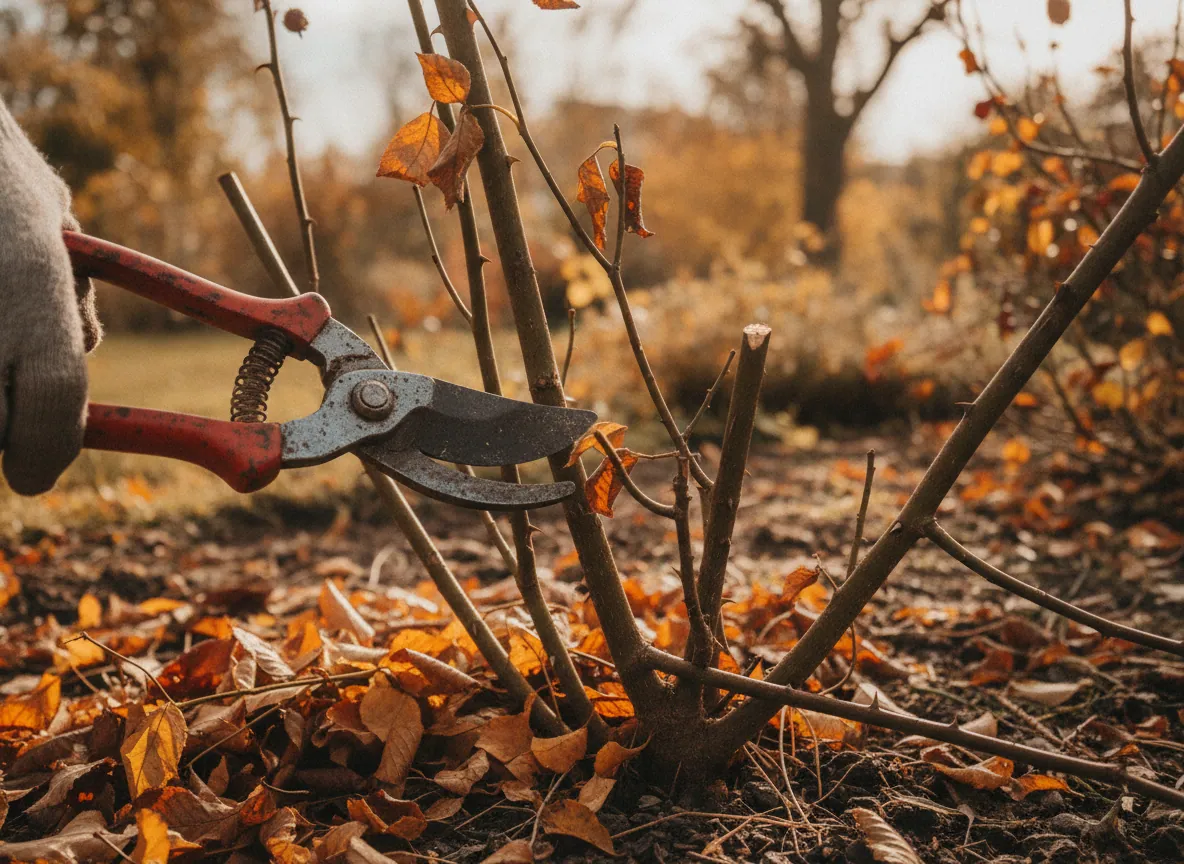 A gloved hand uses pruning shears on a woody plant in autumn — AI-generated illustration
What to do now, in autumn
Mid-autumn isn’t the moment for the real prune — but there’s one job worth doing now, and it isn’t cutting.
Through summer a vigorous climber throws out long, whippy new stems that stand well clear of the support. Leave them loose into the winter gales and the wind catches them like sails: it snaps them, tears them away from the wall, and rocks the whole plant at the root. The same wind-rock that loosens tall bush roses does its worst on an untied climber.
The autumn job is simply to tie those long shoots in — not to prune them. Pull each one down to a roughly horizontal line where you can and loop it to a wire or trellis with a soft tie, leaving a little slack so it doesn’t bite into the stem. If a shoot is far too long to place, shorten it by a third just to take the whip out of it; the proper shortening comes later. Bending the new stems towards the horizontal does something useful on its own, too — it’s exactly why a tied-down cane flowers along its whole length instead of only at the tip.
That’s it for October. Tie in, make it safe for winter, and leave the framework alone.
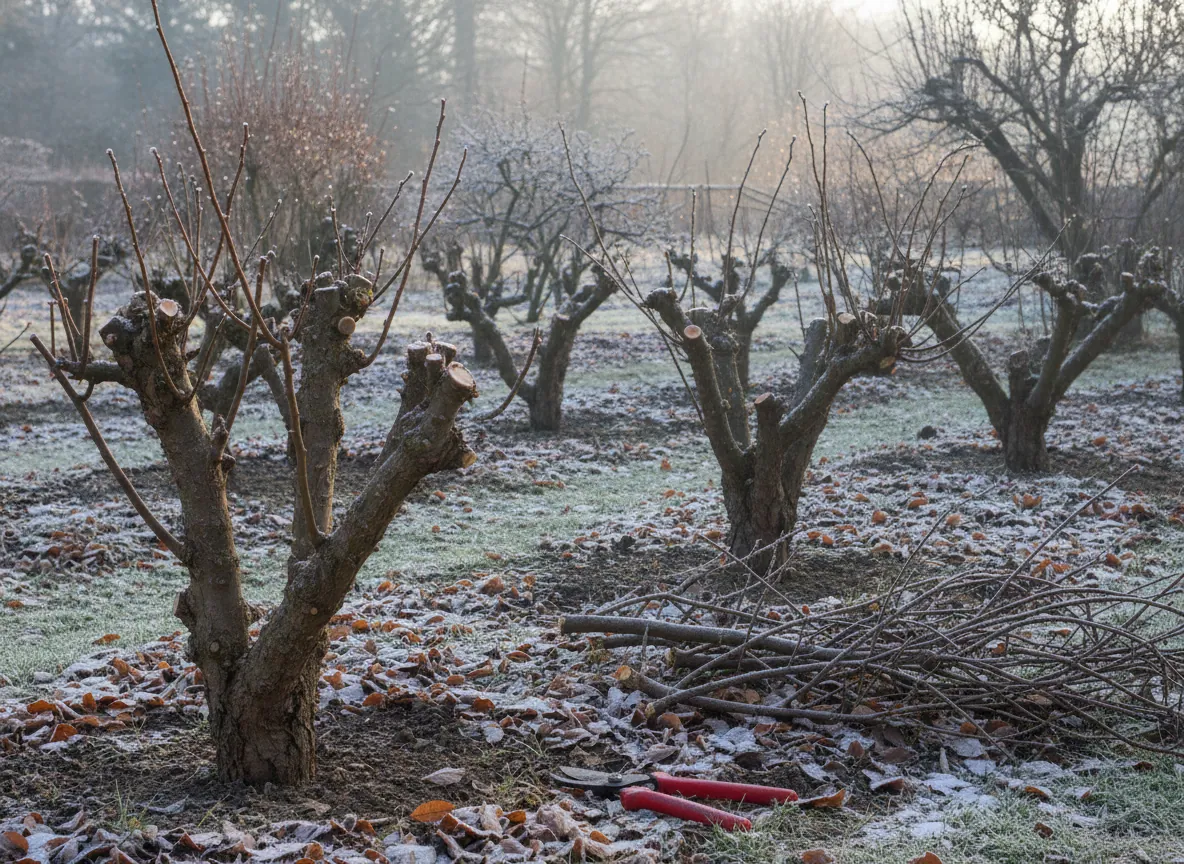 Pruned trees in a winter garden with frost and tools — AI-generated illustration
The real prune waits for winter
The main prune on a climbing rose happens in the dormant months, any time from leaf-fall through to late winter — the RHS puts it in the dormant season, late autumn to late winter, once flowering has finished. Wait until the plant is bare and the job gets far easier: with the leaves gone you can finally read the framework, see which stems are tying the plant together and which are just clutter, and work without fighting a wall of foliage.
When the plant’s leafless, work through it in this order:
- Dead, diseased and damaged wood first. Take it back to healthy growth or right to the base. This is the only cutting that’s always justified, and doing it first clears the view for everything else.
- One or two of the oldest, tiredest main stems. A framework stem that has stopped throwing strong side-shoots and is all gnarled bark can be cut hard to the base — but only if there’s a young replacement stem to tie in where it was. Never strip out more than a couple of main stems in a single winter.
- Tie in the new stems to fill the supports. Spread them out to cover bare patches, fanned and as near horizontal as the space allows. A well-trained climber has its framework spread wide, not bunched in a vertical column.
- Shorten every flowered side-shoot. These are the short stems coming off the main framework that carried this year’s blooms. Cut each one back by about two-thirds of its length, down to a few healthy buds. Those buds are where next summer’s flowers come from.
Done this way, the framework stays put from one year to the next and only the side-shoots are renewed — which is exactly how a climber wants to be grown.
Climber or rambler? They’re pruned differently
Before you cut, be sure which rose you have, because the two are pruned at opposite ends of the year.
A climber is usually repeat-flowering, with stiffer stems and larger flowers carried through summer and into autumn on that permanent framework. It’s the one this article is about: tie in now, prune in winter.
A rambler flowers once, in a single spectacular flush around midsummer, usually on wood made the previous year, and it’s far more vigorous — the plant that swallows a shed or an old apple tree. A rambler is pruned right after it finishes flowering in summer, not in winter, by taking out the canes that have just bloomed. Prune a rambler in winter and you cut off the wood that was about to flower; cut a climber’s framework back hard in summer and you lose the autumn repeat. Deadheading a climber’s spent flowers in summer is fine, though. Same family, opposite calendar.
If you’re not sure which you’ve got, the flowering is a good rule of thumb: one big burst and done usually means rambler; on and off all summer usually means climber. Some climbers flower only once, though.
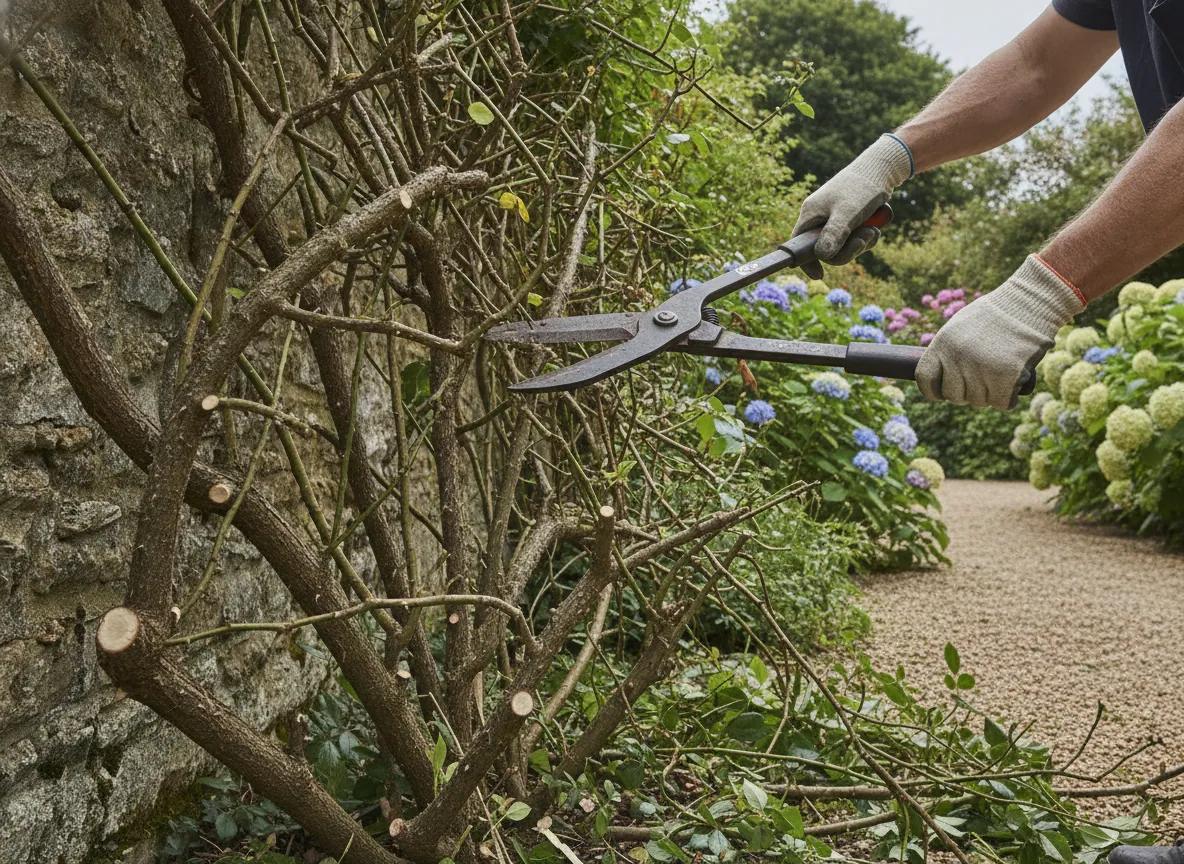 Hands pruning a tangled climbing plant with secateurs — AI-generated illustration
Renovating a tangled old climber
If what you’ve inherited is a decade of untied growth — a bird’s nest of brown stems flowering only at the very top — that’s a renovation, and the dormant season is the time for it. A leafless plant is easier to untangle.
Don’t do it all at once. Take out the oldest, most exhausted main stems close to the base to force fresh growth from low down, but keep enough of the framework to carry a show while the new stems build. Spreading a hard renovation over two or three winters keeps the plant flowering throughout, rather than giving you one bare year and a sulk.
Let the plant tell you the month
The hardest part of pruning a climbing rose isn’t the cut — it’s knowing whether the rose on your wall is a climber waiting for winter or a rambler you should have cut in July, and whether this week is tie-in time or prune time. That’s exactly what Cresco is for: snap a photo, and it tells you which rose you’re actually growing and the right job for it this week, in your garden and your weather — so the secateurs come out when they’ll help, not when they’ll cost you a summer.