There is one rose question that gets answered wrong more often than any other: when do I prune my rambler? The honest answer is that most people prune it at exactly the wrong moment, in exactly the wrong way, because they treat it like a climbing rose. It isn’t one. And the difference decides whether you get a waterfall of bloom next June or a thorny green tangle with a few flowers stuck up out of reach.
This guide is about the cut that happens right after the flowers fade — the single most important pruning moment in a rambler’s year.
Rambler or climber? Get this wrong and every cut is wrong
Before you pick up the secateurs, you need to know which rose you actually have, because the two are pruned in opposite seasons.
A climbing rose repeat-flowers through summer, carries larger flowers (often one or a few to a stem), has stiffer canes, and is pruned in winter, while it’s dormant. A rambling rose usually flowers once, in a single overwhelming flush around June, in big sprays of many small flowers, on long, whippy, flexible canes that can run 5 to 10 metres. It’s pruned in summer, right after that one flush — never in winter.
Here’s why the season matters. A rambler flowers on wood that grew the previous year. If you prune it in winter the way you’d prune a climber, you cut off the very wood that was about to flower. People do this every year, then wonder why their “rambler won’t bloom.” It bloomed fine — they just removed the buds in February.
So: identify the plant first. One huge June flush, small clustered flowers, canes you could tie in a knot? That’s a rambler. Keep reading. Repeat-flowering all summer, bigger blooms, stiffer wood? That’s a climber — leave it until winter, and read our guide on tying in climbing roses instead.
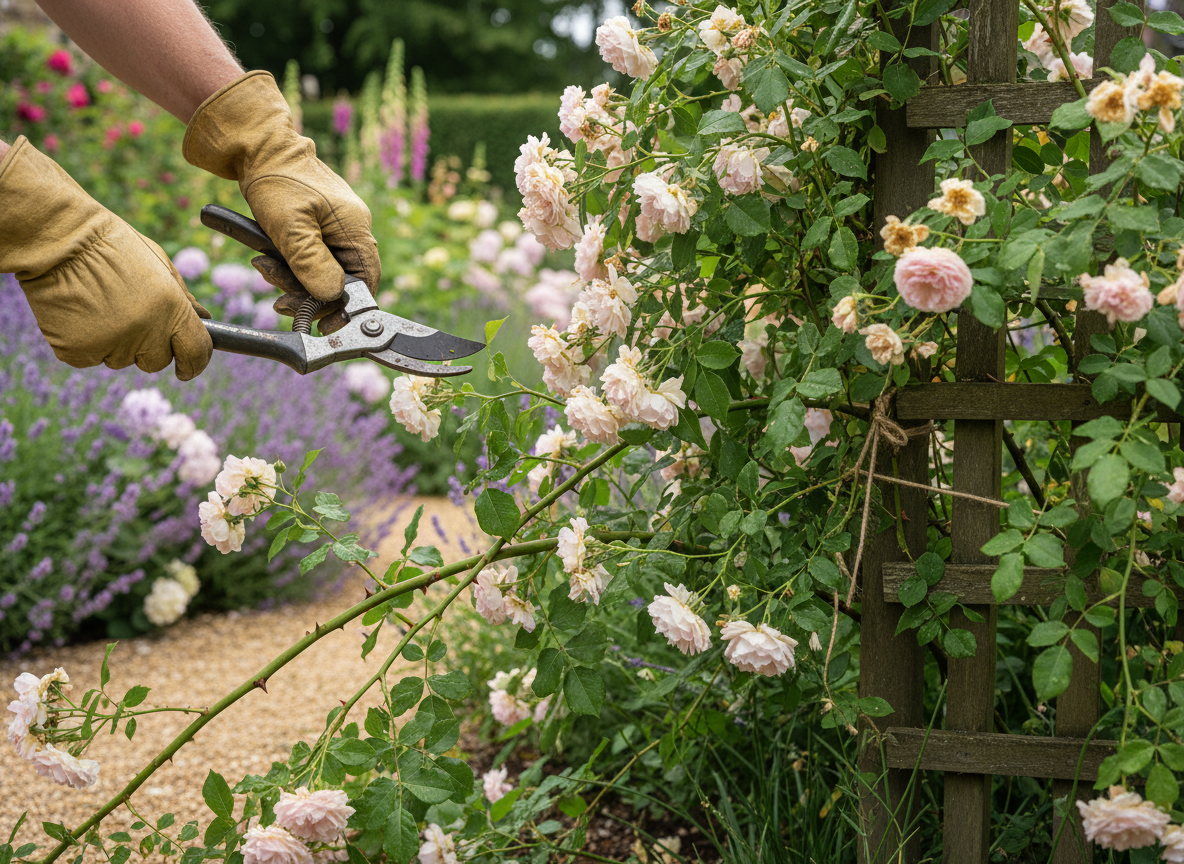 A person prunes a rambling rose with secateurs in a garden — AI-generated illustration
What the plant is doing in June
To prune a rambler well, picture what it’s up to the moment the petals drop.
The arching canes that just flowered are a year old — they grew last summer, ripened over winter, and carried this June’s sprays. Their flowering job is now done. At the same time, down at the base and along the main framework, the plant is firing out new canes: vigorous, often thumb-thick, sometimes head-height in a fortnight. These fresh canes are next year’s flowering wood. They will ripen over this summer and autumn and bloom in June 2027.
That’s the whole logic of rambler pruning in one sentence: out with the old flowered wood, in with the strong new canes. Every cut you make after flowering should serve that swap. Get the timing right and the plant renews itself on a rolling cycle, staying floriferous and roughly the same size year after year. Ignore it and the old wood accumulates, the centre congests, flowering drifts upward and outward, and you end up with a bird’s nest that’s miserable to fix.
The after-flowering cut, step by step
The window opens as the last sprays go over — for most gardens that’s July, though early ramblers can be ready in late June. You’re working on a plant in full leaf, so wear long sleeves and proper gauntlets; rambler thorns are vicious and the canes are long enough to whip back at you.
On an established rambler grown on a wall, fence or pergola, work in this order:
-
Take out a share of the oldest wood at the base. Each year, cut roughly one in three of the oldest, woodiest, flowered canes right down to ground level (or to a strong low shoot). This is the renewal cut — it clears congestion and forces the plant to keep producing young canes. On a very old, neglected rambler you can be braver, but never strip it bare in one go.
-
Shorten the side shoots on the canes you’re keeping. The canes that flowered this year carry short side shoots off the main stems. Cut these flowered side shoots back to two or three buds (about 8–10 cm) from the main cane. Those stubs will produce next year’s flowering spurs.
-
Tie in the new canes as replacements. Take this year’s vigorous new growth and tie it in to fill the space left by the canes you removed. Spread and bend them as close to horizontal as the support allows — laying a cane sideways forces flowering buds all along its length instead of just at the tip. It’s the same trick that transforms a climber, covered in our piece on training canes horizontally for more blooms.
Use a clean, sharp pair of secateurs for the side shoots and loppers or a pruning saw for the old basal canes. Wipe the blades if you move between plants — black spot and rust travel on dirty steel.
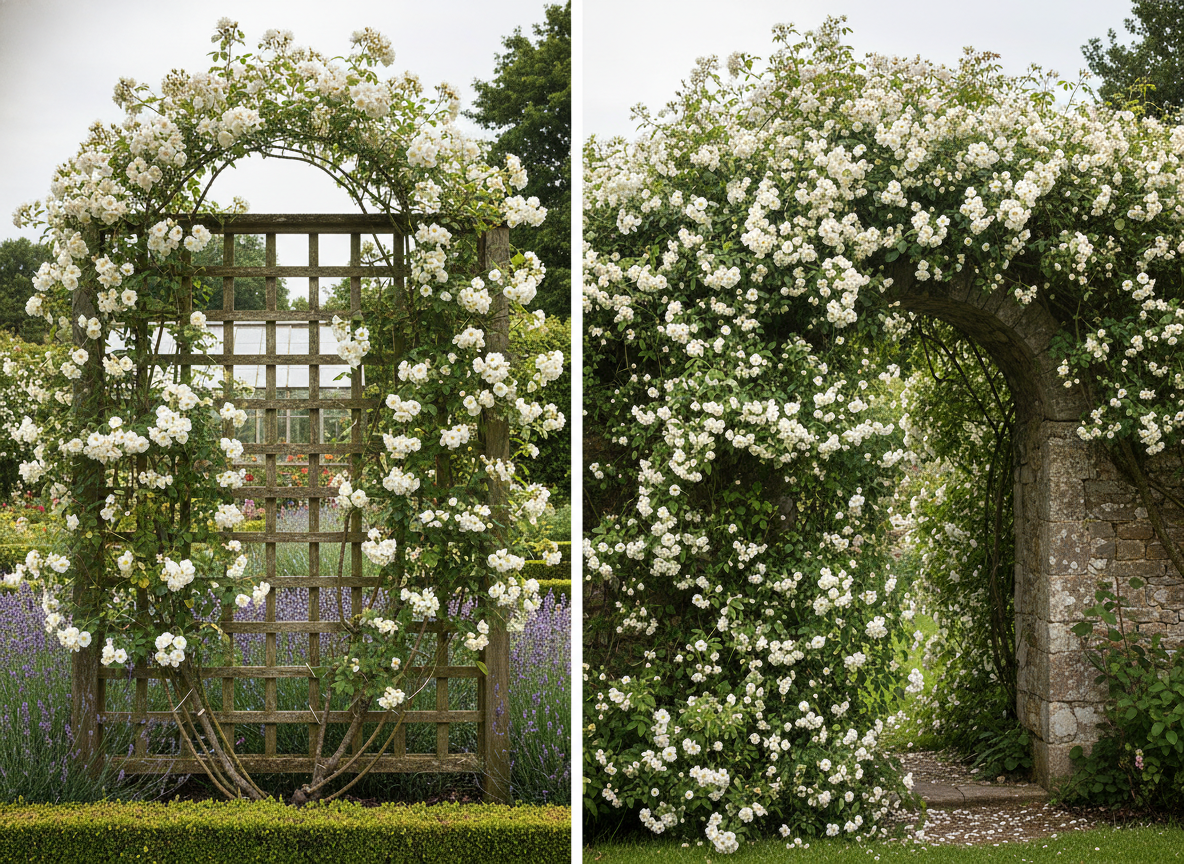 Two rambling rose bushes grow, one on a wooden trellis and one on a stone archway — AI-generated illustration
The restrained rambler vs. the one you let run wild
Not every rambler wants the same treatment, and the deciding factor is space.
In a tight spot — a small pergola, an arch, a fence panel — be disciplined. The simplest reliable system is to remove all the stems that have just flowered, right down to the base, and tie in the new canes to take their place completely. Finish by shortening any remaining side shoots by about two-thirds. It’s a harder annual cut, but it keeps a vigorous rambler genuinely in bounds rather than slowly swallowing the structure.
Given room to roam — scrambling into an old apple tree, swallowing an ugly shed, cascading down a bank — a rambler barely needs pruning at all. Monster varieties like Rosa ‘Kiftsgate’, ‘Rambling Rector’ or ‘Paul’s Himalayan Musk’ are happiest left to their own devices. Just pull out dead or broken wood, keep it off the path, and otherwise let it go. Trying to “tidy” a 10-metre tree-scrambler from a ladder every year is a losing battle nobody needs.
Hips or no hips? The deadheading trade-off
There’s one good reason to hold off on the after-flowering cut: hips.
Many of the best ramblers follow their June flowers with a generous crop of small orange or red hips that light up the plant from September into winter and feed the birds. ‘Kiftsgate’ and ‘Rambling Rector’ are famous for it. If you want that autumn display, don’t deadhead, and keep your summer pruning light — limit yourself to removing dead and crossing wood, and accept a slightly bushier plant. The flowered side shoots you’d normally shorten are the ones that carry the hips.
If hips don’t interest you and you’d rather steer every calorie into next year’s flowers, deadhead the spent sprays as you prune. You can’t fully have both on the same plant in the same year, so decide what that rose is for before you start cutting.
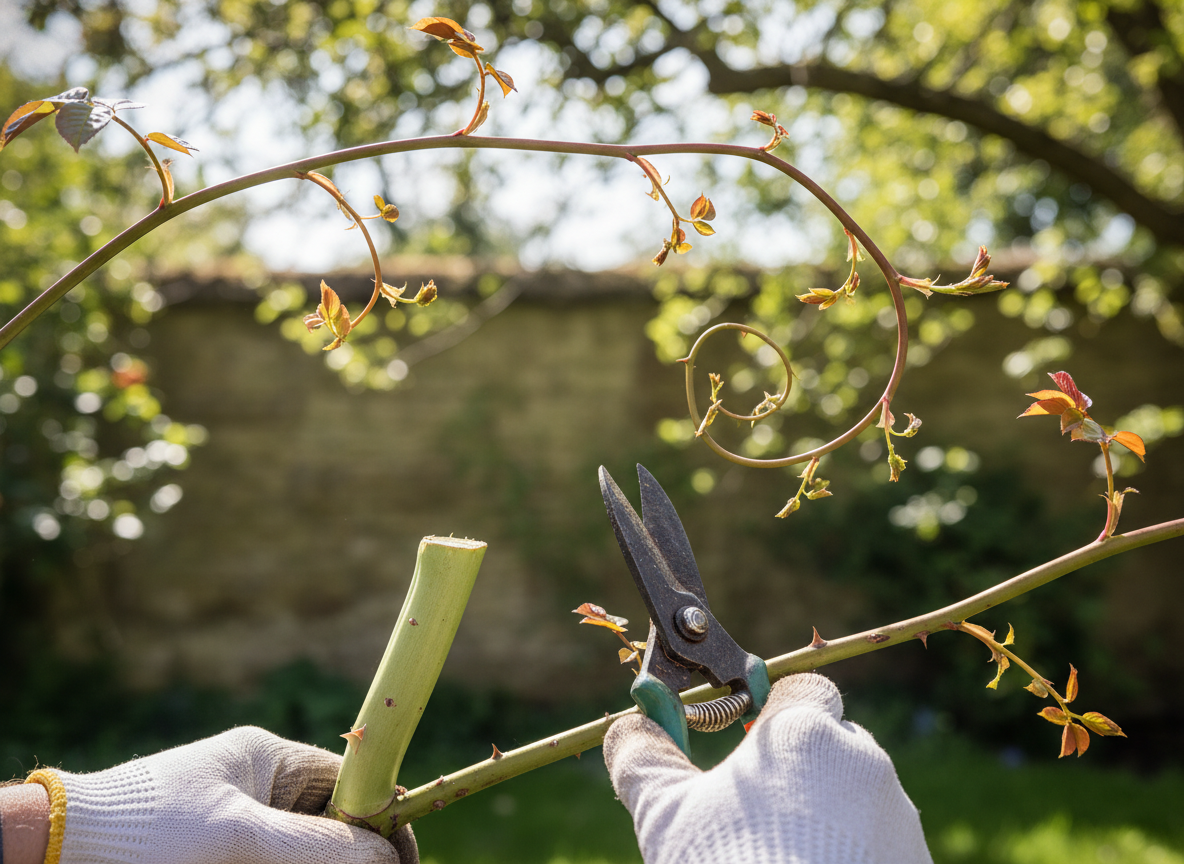 Hands in gardening gloves pruning a rambling rose cane with secateurs — AI-generated illustration
Don’t mistake a sucker for a new cane
Here’s a trap that catches people doing exactly the right thing at the right time.
Most ramblers are grafted onto a rootstock, and that rootstock will occasionally throw up its own shoots — suckers — from below the graft union. In June and July, when you’re scanning the base looking for healthy new canes to tie in, it’s easy to mistake a sucker for the very replacement growth you want. Tie one in and you’ll be cultivating the wrong rose, which is usually more vigorous and will eventually take over.
The tells: suckers emerge from below the knobbly graft union (often a little way out from the main plant), and the foliage frequently looks different — different leaflet count, a paler or more matte green, sometimes more thorns. Crucially, you never cut a sucker off flush; that only makes it branch and return stronger. We cover the right technique — tracing it back and pulling it off at the root — in why cutting rose suckers makes it worse.
Get the timing right for your garden, not the calendar
“Prune after flowering” is the rule, but after flowering lands on a different date in every garden. A sheltered south wall in a mild year finishes weeks ahead of an exposed rambler in a cold pocket, and a late spring shifts everything. The plant, not the page of a diary, tells you when it’s ready — and the moment to look is the week the last sprays brown over.
That’s exactly the kind of timing Cresco is built for: tell it which rose you’re growing and where, and it works out your local after-flowering window instead of handing you a generic month. For the bigger picture of how the rose year fits together — winter work on climbers, summer work on ramblers, and everything in between — see our complete guide to when to prune roses.
Cut at the right moment this summer and your rambler does the rest: a wall of new canes ripening now, tied in low and wide, ready to break into one enormous flush of bloom next June.