Why a beech hedge needs only one cut a year — if you time it right
A beech hedge (Fagus sylvatica) is the rare formal hedge that asks almost nothing of you in exchange for the look it gives. Glossy spring green from April, deepening to dark emerald by midsummer, copper-bronze in October, and then — the trick that makes the species famous — those bronze leaves hang on through winter. The botanical term is marcescent: dead but retained. From November to March a clipped beech hedge is the warmest, most sheltering presence in a bare garden, and the reason so many continental front gardens use beech where the British reflex would be box or yew.
Almost all of that depends on a single trim, taken once a year, in roughly the last week of June. Cut earlier and the hedge wastes energy flushing back through summer with pale, soft leaves that never harden. Cut later — into August or September — and the hedge looks raw all autumn, the marcescent display is patchy, and the late tender shoots get scorched by the first hard frost.
The window most beech-hedge gardeners actually have, in Northern Europe, sits roughly between June 20 and July 5. That’s the same span the old continental almanacs mark as Sint-Jan or St John’s Day (24 June) — the traditional Dutch and Belgian date for trimming beech, hornbeam and yew. The folklore isn’t sentimental. It tracks the moment the spring flush has hardened off, growth has slowed, and the hedge will accept a cut without flushing again.
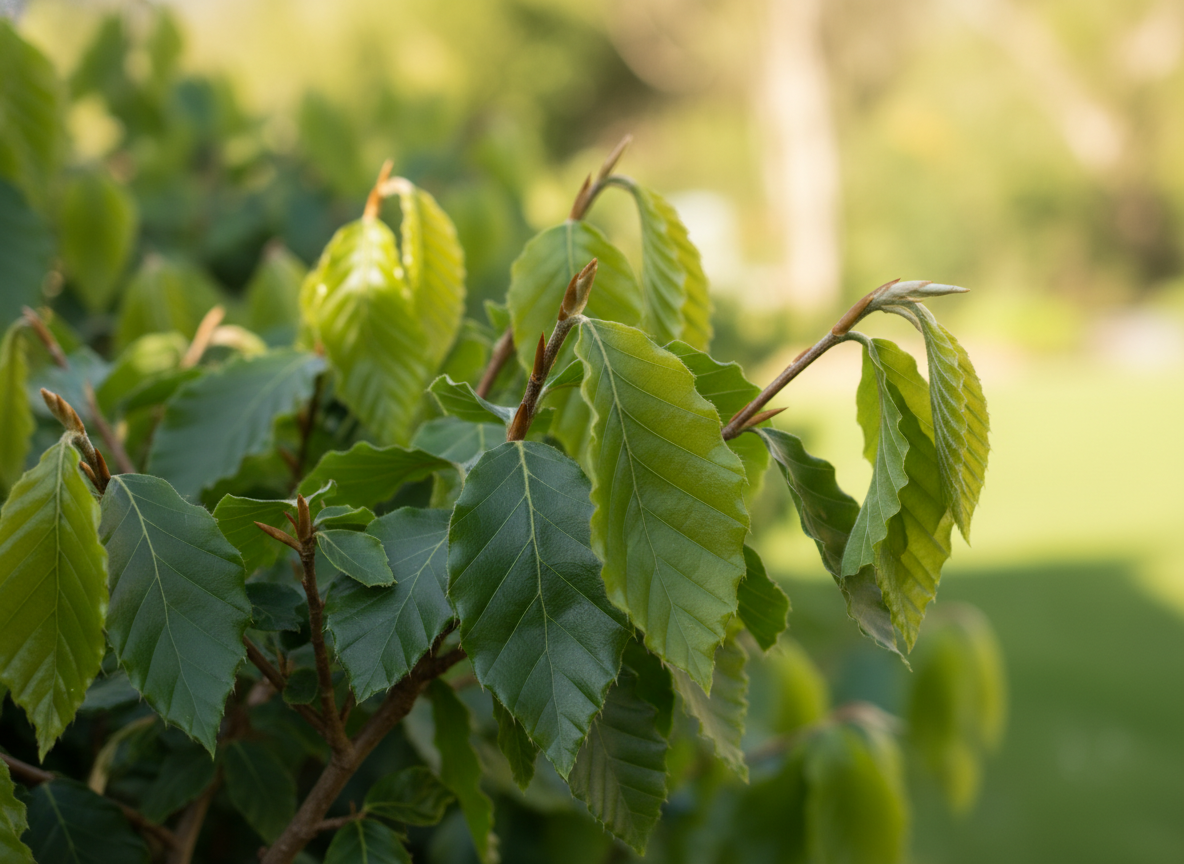 This photograph depicts hardened off beech leaves on a beech hedge — AI-generated illustration
What “hardened off” looks like on a beech leaf
The decision isn’t really a date — it’s a leaf test. Take any new shoot at the front of the hedge and run a leaf between thumb and forefinger.
- Soft, almost translucent, bright lime-green, limp when bent: still actively growing. Cut now and you’ll cut through soft tissue that browns at the edges within a week, the hedge will flush a second wave to replace what you removed, and the second wave is paler and weaker than the first. This is what you see in late May and most of early June.
- Firmer, darker, leathery, snaps cleanly rather than folds, midrib stiff: the leaf has finished expanding and the cuticle has waxed up. The shoot has stopped extending. A cut now closes cleanly, the hedge doesn’t push a wasteful second flush, and the existing dark leaves stay through autumn. This is the late-June signal — and once you’ve felt the difference once, the calendar becomes a backup.
In a cool, slow spring (and 2026 has run two weeks behind average across much of the Netherlands, Belgium and the southern UK) the hardening point can slip into the first week of July. In a hot, fast spring it can arrive by 18–20 June. The leaf tells you. The date is the prompt.
The cut: taper, depth, and the brown-edge trap
Beech is a forgiving hedge to cut, but it will tell on you. Three things matter more than anything else.
The taper. A beech hedge wants to be slightly narrower at the top than at the bottom — what’s called an A-frame or batter. Even five centimetres of inward slope over a 1.8 m hedge is enough. The reason is light: a perfectly vertical face shades its own base, and the lower 30 cm of the hedge slowly thins out and goes bare. Once that happens you can’t easily restore it, because beech regenerates only weakly from old, leafless wood near the base. A faint inward slope from the start keeps light on every leaf and the hedge furnished to the ground for the next twenty years.
The depth. A correctly timed beech hedge is trimmed back to roughly where it was the previous summer, or about 2–3 cm into this season’s new growth. You’re shaving the flush, not carving into the framework. If you ever find yourself cutting into wood older than this year, stop — you’ve drifted into renovation territory, and that’s a different job done in February when the hedge is dormant. The June cut is a shave, not a saw.
The brown-edge trap. Beech leaves are large and thin, and a powered hedge trimmer with worn or blunt blades will crush rather than slice the leaf edge. Within a week the bruised tissue browns and the whole hedge takes on a tatty, scorched look that lasts until the next flush — except there won’t be another flush this season. Two fixes: sharpen your blades before the trim, or take a slow pass with long-handled hand shears for the front face. Most gardeners accept some browning; for show pieces and front-garden hedges the hand-shear finish is worth the extra hour.
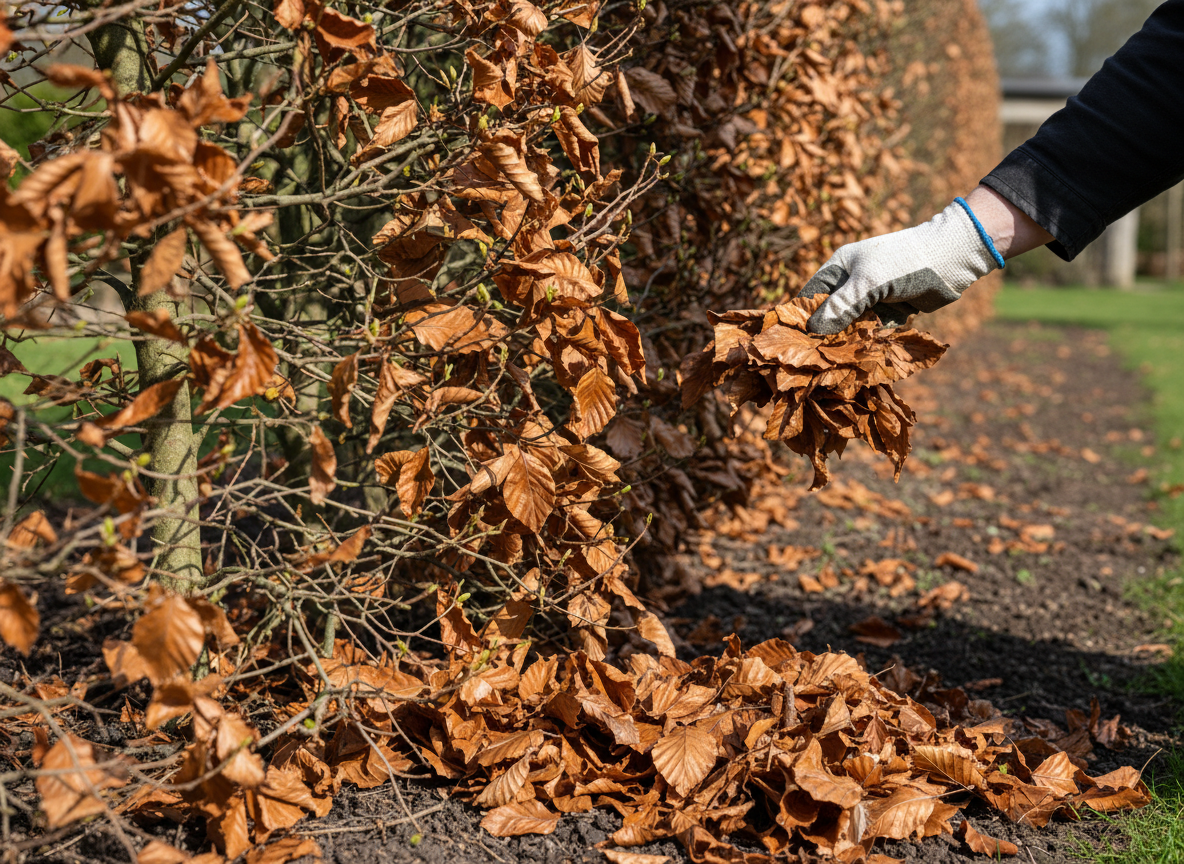 A gloved hand removes dead leaves from a beech hedge — AI-generated illustration
Before you cut: clear last year’s leaves from inside the hedge
This is the step most guides skip and most gardeners pay for. By late June a mature beech hedge has accumulated a surprising amount of dead material inside the canopy: brown leaves from last autumn that didn’t drop, snapped twigs, old birds’ nests, a windborne plastic bag or two. A trim closes the outer face and locks all of that inside, where it slowly composts in damp pockets and creates the kind of stagnant, fungal microclimate beech canker (Neonectria) loves.
Before the shears come out, walk the hedge and reach in with a gloved hand at chest height. Pull out the loose brown stuff. Shake the hedge with both hands at intervals along its length and let the debris fall to the path, then rake it. It takes ten minutes for a five-metre hedge and adds years to its life. Check at the same time for box-shaped silk webbing on the inner branches — if you have box pieces nearby, the box caterpillar is laying its first webs deep inside hedges in May and June, and a beech hedge that touches a box ball will quietly share the problem.
Hornbeam: same window, slightly more forgiving
Hornbeam (Carpinus betulus) is beech’s near-twin in the hedge garden — same marcescent winter leaf, same formal habit, slightly tougher in heavy clay and damp shade. It takes the same late-June cut, for the same reasons.
The one difference: hornbeam can be cut a fortnight earlier or later than beech without complaint. If the weather collapses in your June window and you can’t get the shears out until the second week of July, your hornbeam will be fine and your beech will be mildly grumpy but recover. If you have both species in the same garden — and many continental gardens do, with hornbeam on the wetter, shadier side and beech on the dry, sunny side — start with the beech on the first dry warm day after 20 June, and finish with the hornbeam if you run out of time.
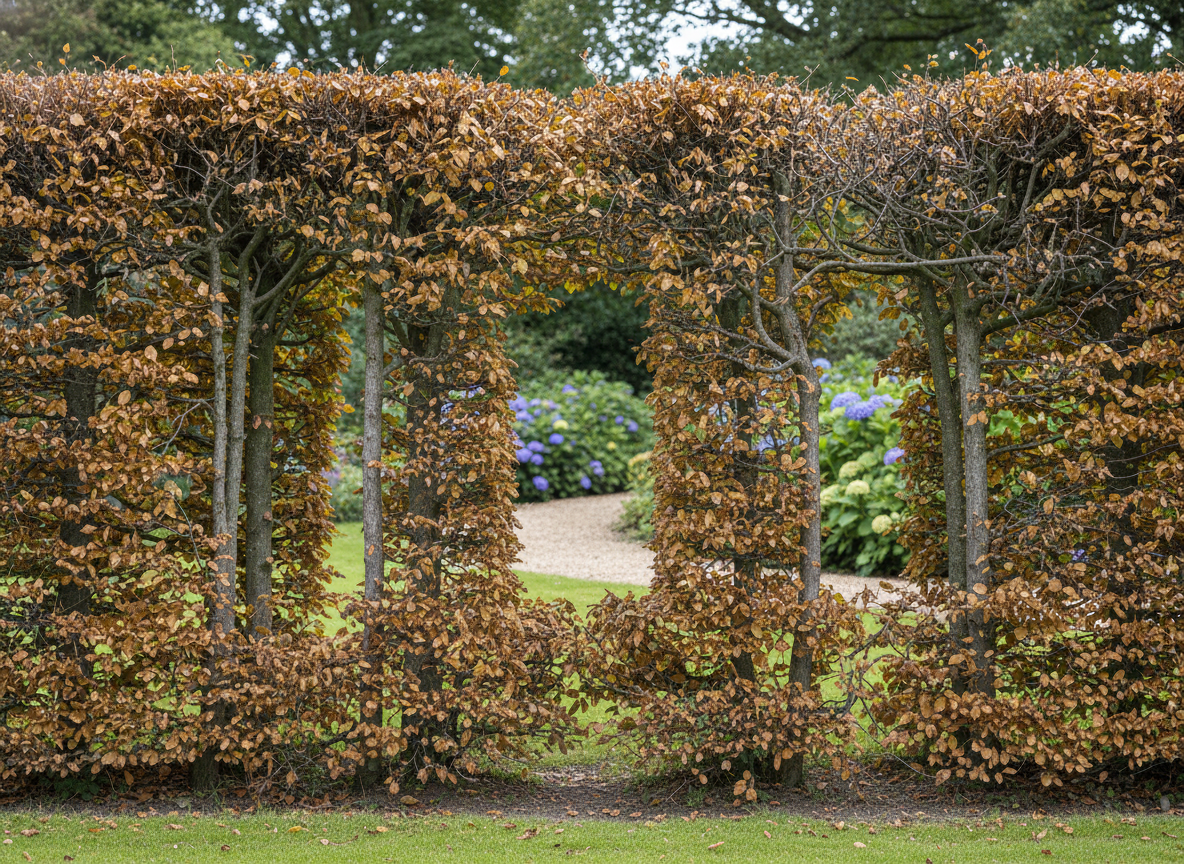 A beech hedge with brown leaves frames a garden path and hydrangeas — AI-generated illustration
What if you missed the window?
The honest answer: nothing dramatic. A beech hedge that goes uncut for a year doesn’t die, doesn’t get diseased, and doesn’t lose its winter leaf display. It just looks shaggy, and the bottom 20 cm thins a little because the upper canopy got denser and shaded the base for an extra season.
If you’re reading this in late July or August, the choice is:
- Leave it until next June. This is what most experienced beech gardeners do. The hedge survives, and you get one tidy cut instead of a half-job that pushes a tender September flush.
- Take a light formal trim in late August. Acceptable for clipped hedges where appearance is paramount, but the cut needs to be light (1–2 cm into the new growth, no deeper) and you need a settled forecast — a hard early frost on a freshly cut beech is the one thing that does cause real damage. Aim for late August rather than September; the later you cut, the less time the hedge has to seal the wound before the cold arrives.
- Renovate properly in late February. If the hedge has drifted to twice the size it should be and there are bare patches at the base, the only honest fix is a hard dormant cut in February while the buds are still tight. Beech can be cut back into multi-year wood when fully dormant, and it will reshoot from the framework — slowly, but it will. Don’t try this in summer.
The 2026 forecast for the late-June window
This year, the cool and slow spring across the Netherlands, Belgium and the southern UK has pushed beech roughly ten days behind its long-term average. As of the first week of June 2026, new beech growth in most gardens is still soft and lime-green — clearly not yet ready. The leaf-test is likely to flip somewhere in the last week of June or the first weekend of July.
Watch for the first run of three or four warm settled days after 22 June, do the leaf test the morning of the trim, and clip on a dry overcast day if you can — full sun on a freshly cut beech face is the second most reliable way (after blunt blades) to brown the leaf edges. Cloud cover gives the cuticle time to seal before the first hard light hits it. The same overcast rule that earns the Derby Day box trim its reputation applies, for the same reason, here.
One trim. The right week. A hedge that holds its line, holds its leaves, and holds its garden together from now until next April.
For the full month-by-month map of which shrubs and hedges want a cut and which want to be left alone, see our pruning calendar by month.