What “after flowering” actually means for a camellia
For most flowering shrubs, “prune after flowering” is a comfortable instruction — you watch the petals fall, you get the secateurs out the same week, and you’re done. A camellia is sneakier. The last flowers on a Camellia japonica in a sheltered UK or Dutch garden can drop as early as the first week of April or hang on into the second week of May. The shrub then puts on a vigorous flush of pale, almost lime-green new growth that hardens into the dark glossy leaves you know from the rest of the year. By the time you notice that the plant looks finished, you may already be three or four weeks past the start of the safe pruning window — and only two or three weeks short of the moment it slams shut.
Camellias flower on previous-season wood, but with an unusually long handover. The buds that opened this spring were formed on shoots that grew in the summer of 2025, and the buds that will open in January, February and April of 2027 are about to start forming on the shoots you’re looking at right now. The biology is what makes this a hard-edged deadline rather than a soft preference. From late June onwards, when soil temperatures and day-length combine, the leaf-axil meristems on this year’s new growth switch from making leaves to differentiating flower buds. North Carolina State University’s pruning timing notes for camellias put the cutoff at June 1 in their southern climate, and the RHS’s camellia growing guide edges that to mid-June in cooler UK conditions. Either way, the door is open for a fortnight at most, and it’s open now.
Prune inside the window and the plant has eight to ten weeks to push, harden and set new flower buds on the shoots it’s grown in response to your cut. Prune outside it — even a “tidy-up” on July 1 — and you’re physically removing the very buds you wanted, and the plant has no time to make replacements before the season ends. There is no nasty surprise; there’s just a quiet, total reduction in next January’s display, and it shows up six months later when you can’t remember the cut you made.
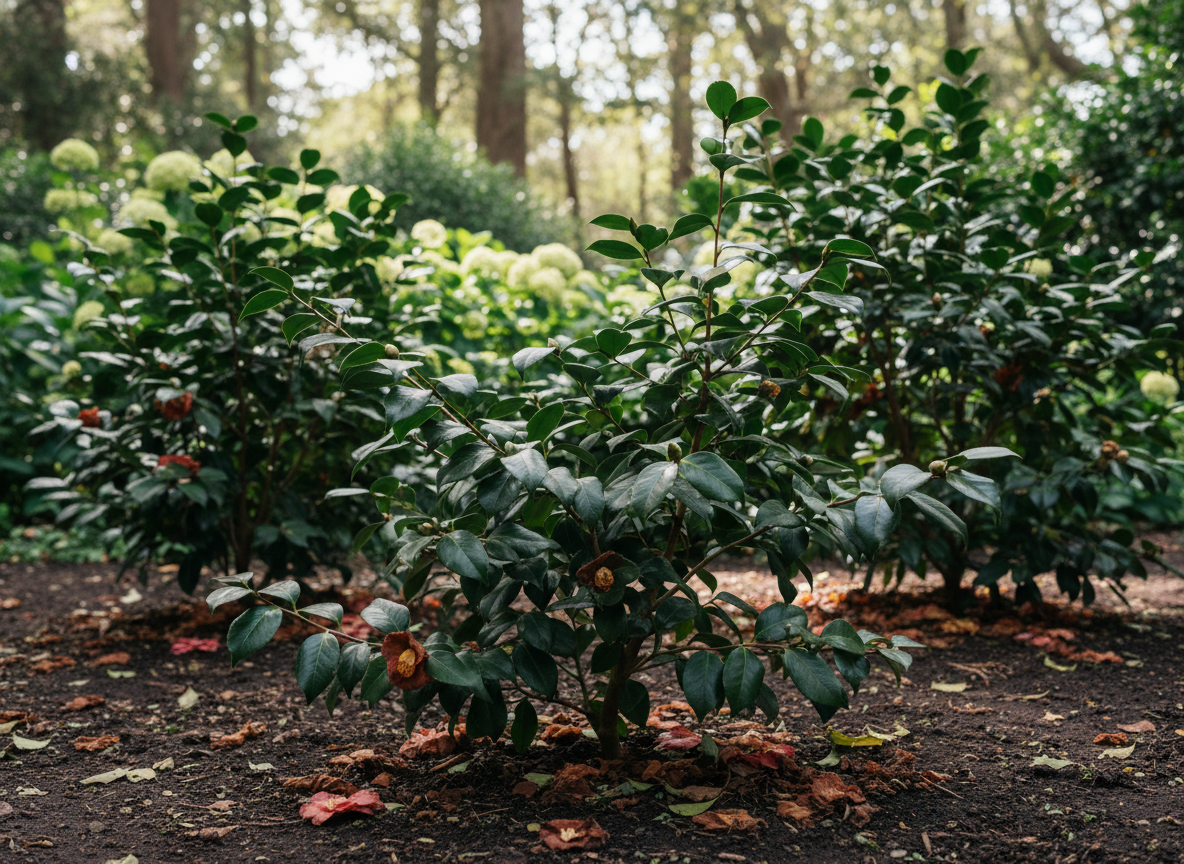 A camellia plant is shown in a garden setting — AI-generated illustration
The mid-June cutoff — when the plant locks in next spring’s bloom
The reason June is the wall, not July or August, comes down to two overlapping clocks. The first is the plant’s developmental clock: once the new shoots that pushed in late April and early May reach roughly 8 to 15 cm and the tip leaves harden off, the buds tucked into each leaf axil begin a one-way switch into floral primordia. By early July, that switch is well underway on the strongest shoots. By the end of July, the buds are visibly fatter and rounder than the slim, pointed leaf buds further down the stem, and you can pick them out with a fingernail.
The second clock is the weather. Camellias respond to a combination of soil temperature climbing past about 16 °C and day-length stretching past sixteen hours. In a normal Northern European year that crossover happens in the third week of June. After an unusually warm May — like the one most of the UK and Low Countries just had — the crossover slides forward into the first or second week of June. The Lee County extension’s pruning calendar records 70–90% bloom loss when pruning is delayed even two to three weeks past local bud-set; it isn’t a graceful fade, it’s a cliff.
This is the same biological logic that closes the two-week window on lilac after flowering and turns shearing pyracantha in June into a deal that costs you the autumn berries. In every one of these cases the shrub is telling you something simple — the wood that flowers next year is being made right now, and any cut after the deadline removes it. With camellia the deadline is just unusually unforgiving, because the gap between “still safe” and “too late” is sometimes a single warm week.
The practical rule for a Northern European garden: aim to be done by June 15. If you’re north of Edinburgh, in coastal Denmark, or in a notably cold pocket where the new growth hasn’t yet hardened, you can push that to about June 20. If you’re in southern France, Spain or Italy, or anywhere the May heat has already pushed lime-green new growth into dark glossy leaves, the door has probably already closed and you should leave the shrub alone until next year. Looking at the new growth — pale and supple means safe, dark and stiff means stop — is more reliable than any date.
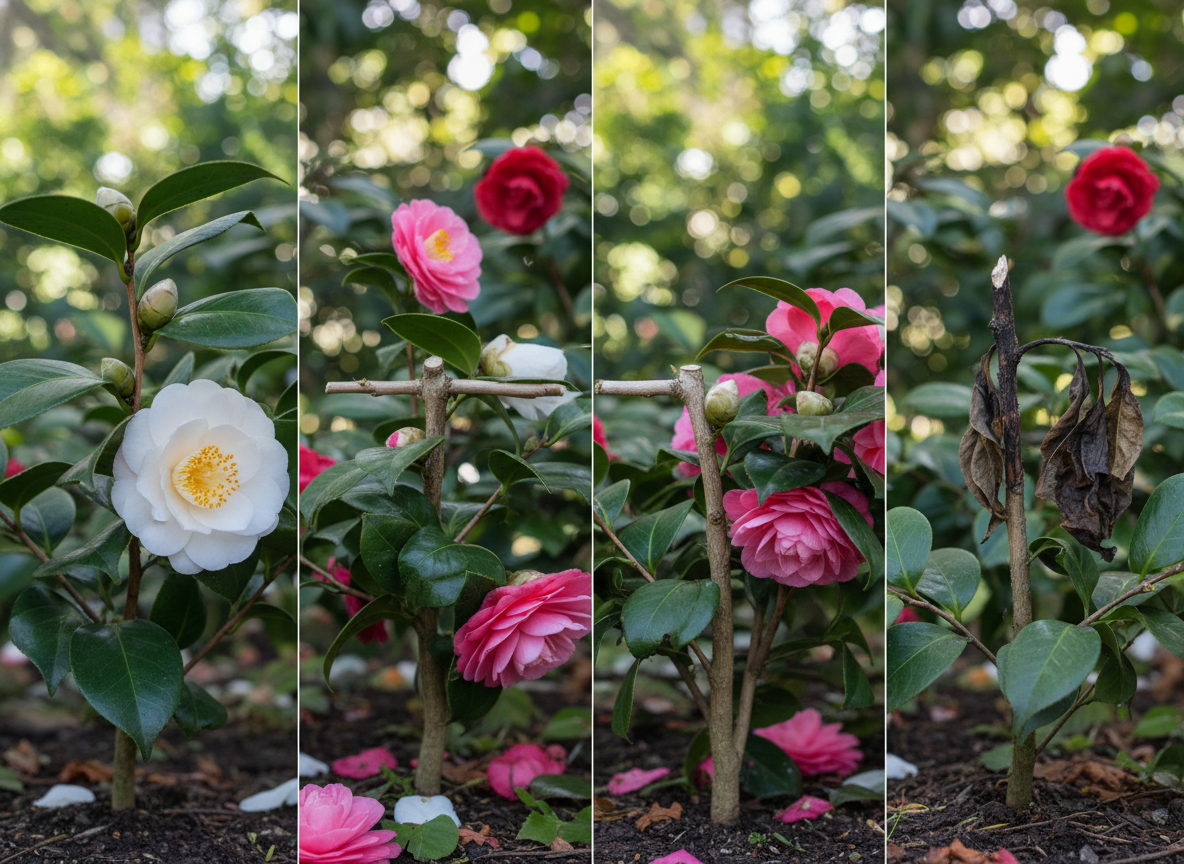 A camellia plant is shown in four stages of flowering and pruning — AI-generated illustration
The three cuts that work — and the one that doesn’t
Camellias don’t need a lot of pruning in any given year, and in fact one of the commonest ways to spoil a mature plant is to treat it like a deutzia or a forsythia and renew it hard. What they want, almost always, is a light combination of three small cuts in one short session — and the discipline to leave the rest of the plant alone.
Cut one is the dead-tip clean-up. Run your eye over the outermost shoots and you’ll find the small, blackened, dried tips where the last flowers sat. Camellia petals don’t always shed cleanly; the calyx can hold on, brown and crisp, and behind it the very tip of the shoot will often be a dead 2 to 4 cm. Find the first healthy, plump leaf bud below that dead piece and cut back to roughly 5 mm above it, on the bias. You aren’t shortening the shoot to reshape the bush; you’re just removing the part that has already died, so the plant doesn’t waste energy holding it. This cut is safe at any point in the window and is the only one most well-established camellias need each year.
Cut two is the rub-and-cross removal. Camellia branches are slow, dense and prone to growing across each other — especially in the centre of a mature plant. Reach into the interior and find any pairs of branches that are touching, crossing, or already rubbing a bark wound. Take out the weaker one of the pair right back to a junction with a larger branch or the main trunk. Don’t leave a stub. This cut opens the centre slightly, lets light into the interior leaves, and prevents the slow, hidden cankers that follow chronic bark wear. It’s the single most underrated cut on an evergreen flowering shrub, and the same logic does the quiet structural work on a climbing hydrangea after flowering.
Cut three is the shape cut, used sparingly. If a single shoot has shot up well above the canopy line — a vigorous upright “water shoot” that breaks the dome of the shrub — follow it back inside the canopy to a side branch and cut to that. Never shorten a shoot to a blind point in the middle of a leafless internode: camellia bark is slow to push fresh growth from old, dormant wood and the cut will sit there sulking, sometimes for years. Always cut to a destination — a leaf, a side shoot, a junction. Three or four shape cuts on a mature plant in a single year is plenty; if you find yourself making more than that, you’re trying to reshape the shrub, which a camellia will not forgive in one season.
The cut that doesn’t work is the hedge shear. Some gardeners — particularly people who’ve inherited a camellia trained as a flat-fronted formal — will reach for the powered shears and pass them over the surface in late June or July to “tidy” the new growth. Two things happen. The shear chops every shoot at the same arbitrary point regardless of where the leaf buds and growth tips actually sit, leaving brown, half-leafed stubs all over the surface. And, because almost every shoot the shrub just pushed is carrying a future flower bud at its tip, you’ve quietly removed virtually every bloom the plant was about to set. The same evergreen, leaf-bud-tipped logic is why we snap rather than snip rhododendron deadheads in May: you’re protecting the next-year buds that sit immediately below the cut. Camellia needs the same care, just at a slightly later date.
Japonica, sasanqua, williamsii — the timing isn’t the same for all three
“Camellia” in a UK or Dutch garden almost always means one of three things — Camellia japonica, C. sasanqua or C. × williamsii — and their pruning windows are offset from each other by a month or more. The bigger mistake than missing the cutoff is applying a japonica timetable to a sasanqua, or vice versa.
Camellia japonica is the classic — the big-leaved, formal, mid-winter-to-spring camellia, flowering from January through April depending on cultivar and shelter, with cups, peonies and formal doubles in white, pink, red and stripes. Almost every named garden cultivar — ‘Adolphe Audusson’, ‘Nuccio’s Gem’, ‘Bob Hope’, ‘Lady Campbell’ — is a japonica. The window for these opens the moment the last petal drops, and it closes around June 15 in a normal British or Dutch year. This is the camellia the rest of this article is written about, and the one most readers will be holding the secateurs over.
Camellia × williamsii hybrids — ‘Donation’, ‘J.C. Williams’, ‘Anticipation’, ‘Debbie’ — flower a fortnight or so earlier than japonica on average, often through March and April, and the helpful thing they do is drop their spent flowers cleanly rather than holding them on as brown crisps. That makes the start of the window obvious and the dead-tip clean-up cut almost unnecessary. The end of the window, however, is the same: around mid-June. Treat them like a japonica with a slightly earlier start.
Camellia sasanqua is the autumn-flowering camellia — smaller, narrower leaves, a more open arching habit, single or semi-double flowers in October, November and December, sometimes still going at Christmas. The pruning logic is identical (cut after flowering, before next year’s bud set) but the calendar is completely different. Sasanqua finishes in January, sets buds through summer for an October opening, and the safe pruning window is late January to mid-March, not May to June. If you have one and you’re holding the secateurs in June, put them down — you’re three months too late. The same shoot-watching rule applies in reverse: pale supple new growth in February is safe; dark hardened leaves in April mean stop.
A useful tell when you can’t remember which species you’ve got: flowering date is the clearest cue. Spring-blooming, glossy big leaves, finished by May means japonica or williamsii. Autumn-blooming, narrower leaves, finished by January means sasanqua. The leaves alone are subtler than gardeners often claim — both groups have dark, glossy, evergreen foliage — and the flowering date is what you really go by.
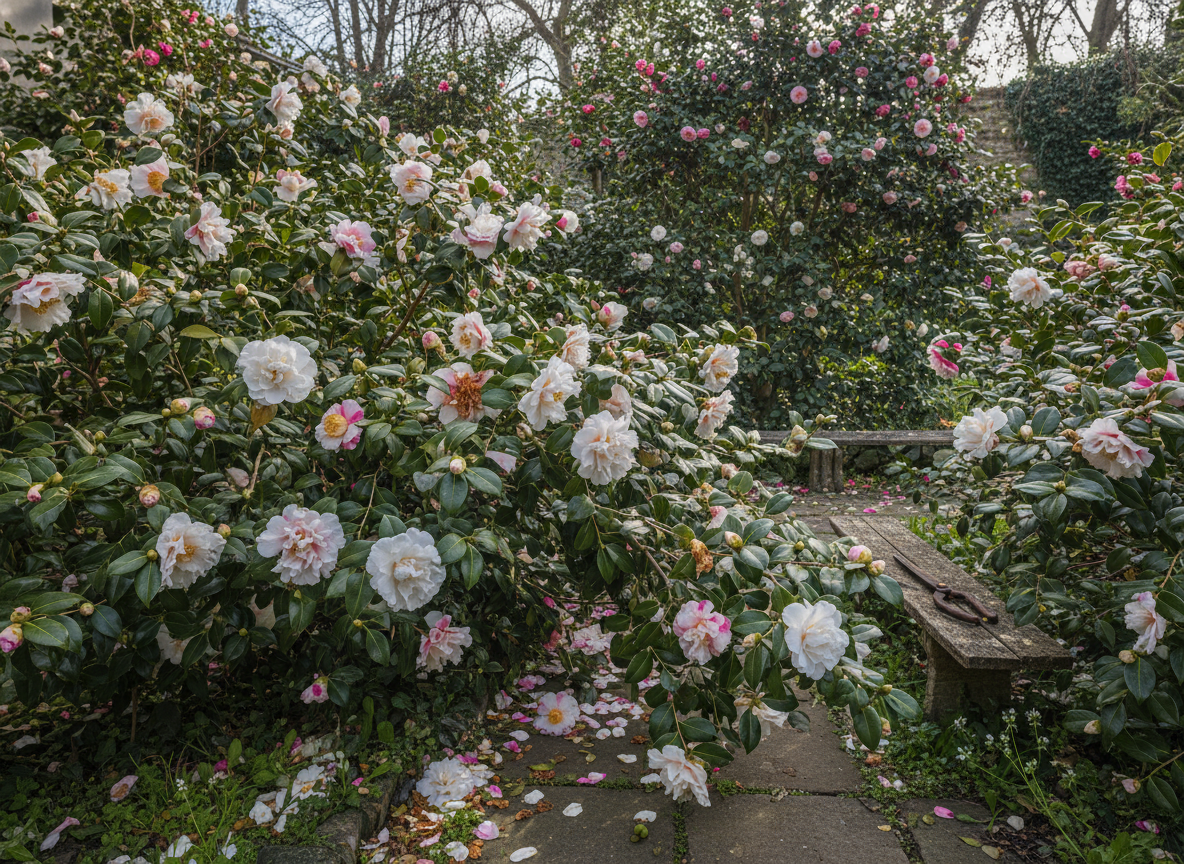 Overgrown camellia bushes with white and pink flowers line a garden path — AI-generated illustration
Overgrown camellias: what you can do now, and what to wait for
A camellia that hasn’t been touched in fifteen years can be a sight: 3 metres tall, almost as wide, congested in the middle, the inside leaves dropped years ago, the bottom third bare-stemmed and the flowering pushed up onto a thin shell around the top. The instinct is to renovate hard, the same way you’d renovate a leggy buddleia or a tangled deutzia. With camellia, the instinct is half right and entirely the wrong time of year.
The good news is that camellia is one of the few broadleaf evergreens that genuinely will break new growth from old, leafless wood — even from the main trunk — given enough time and good growing conditions. The University of California Marin Master Gardeners’ camellia notes confirm that mature plants can be cut back to the main framework and will respond with strong new shoots, sometimes from bark that’s been bare for a decade. It’s a real option, not a desperate gamble.
The bad news is that the right time to do that hard renovation is late winter, just before the new growth pushes — not June. February or early March, in the same window you’d use for a major restorative cut on an apple tree, is when the plant has the carbohydrate reserves and the season ahead of it to respond properly. A hard renovation in June, when the plant has already committed its reserves to the spring flush, leaves it stressed through the hottest months, vulnerable to camellia leaf-blight and bark cankers, and very slow to push replacement growth. You’ll get away with it, but you trade two years for what would have cost you one.
What you can do in the current window, on an overgrown plant, is the staged-thinning version of the renovation. Take out two or three of the oldest, most congested branches at their junction with the main trunk — full removal, not shortening — and leave the rest alone. The plant won’t push major new growth from low down in response (that needs the winter cut) but it will redirect this summer’s energy into the surviving branches, set more buds on them, and open the centre to light. Do that again next June, and again the June after, and by year four you’ve quietly rebuilt the structure of the shrub without ever losing a winter’s worth of flowers. It’s the same staged logic that works on the deutzia after flowering, but slower, gentler and with no heading cuts on the outside of the canopy.
If the plant is so far gone that staged thinning won’t be enough — bare for the bottom metre, dead branches throughout the interior, last winter’s flowering reduced to a thin upper crust — diary the hard renovation for next February, mulch the plant heavily this autumn, water it deeply through any dry summer week, and resist the temptation to do anything more aggressive than the staged thinning in the meantime. The wait is genuinely worth it.
The week the window opens depends on your spring, not your calendar
Look at what the camellia window depends on and the same pattern keeps coming back: when the last petals fell, when the new flush hardened off, what the soil temperature has done in May, how much warm rain came in the last fortnight. None of those are calendar things. A Camellia japonica ‘Adolphe Audusson’ against a south-facing brick wall in Devon may be ready for its three cuts on May 25 and locked shut by June 8. The same variety in a shaded courtyard in Groningen might still be safe to prune on June 22. A ‘Donation’ williamsii in Belfast and a ‘Bob Hope’ japonica in Berlin will open and close their windows on completely different weeks even in the same year.
This is exactly the gap Cresco was built to close. Photograph the shrub and the app identifies which camellia you actually have — japonica versus williamsii versus sasanqua, and increasingly the cultivar — then reads your local soil temperature, recent weather and the way your spring has unfolded to tell you the week the after-flowering window genuinely opens, and the week it shuts. Next year, when you’ve half-forgotten which plant is which, it remembers for you. For the wider picture of what else is competing for the secateurs in the first fortnight of June, the month-by-month pruning guide shows where camellia sits in the early-summer rush, alongside the deutzia, the climbing hydrangea and the weigela that share its tight after-flowering deadline.
The 30-second version
- Camellias flower on previous-season wood — next January’s buds start forming in late June on the shoots you’re looking at right now.
- The window is the fortnight after the petals drop and before the new growth hardens — in most British and Dutch gardens that closes around June 15.
- Make three small cuts in one session: dead-tip clean-up, rub-and-cross removal, and a few sparing shape cuts back to a side branch or leaf — never to a blind point on bare wood.
- Never hedge-shear a camellia. Powered shears in June or July remove next year’s flower buds wholesale, and the brown stubs don’t grow out.
- Japonica and williamsii want the May–June window; sasanqua is autumn-blooming and wants late January to mid-March instead.
- An overgrown plant takes staged thinning in June, not a hard renovation — that’s a February job.
- Watch the new growth, not the calendar: pale and supple means safe, dark and stiff means stop.