The two peonies people get wrong
Walk through any garden centre in spring and the labels are clear: “herbaceous peony” on the bare-root packs that look like pale carrots in February, “tree peony” on the dormant woody stem in the pot beside them. By late May both are flowering, often only a metre apart in the same border. By the second week of June both have dropped their petals. And it’s the cut you make in that next fortnight that decides whether each plant goes on or gives up.
The trap is symmetry. The herbaceous peony — Paeonia lactiflora, the Sarah Bernhardts and Karl Rosenfields most of us grow — dies back to the ground every autumn and gets sheared to soil level in November. So it feels logical to give the tree peony the same treatment in summer, once the flowers are spent. That logical move is the one most likely to kill the plant. Tree peonies (Paeonia suffruticosa and its Chinese, Japanese and American cultivars, plus the species P. delavayi and P. ludlowii) are woody shrubs. The grey-brown stems you see now are the same stems that opened the flowers, and they’re the same stems that will carry next year’s bowl-sized blooms. Cut them down to soil level and you’ve removed the entire framework of the plant — many won’t come back at all, and the survivors won’t flower for three years.
What tree peony actually wants in early June is two small, deliberate jobs: a clean deadhead at the right spot on the woody stem, and a check at the base for the herbaceous understock most grafted plants throw up around the same time. Neither takes long. Both are easy to get wrong.
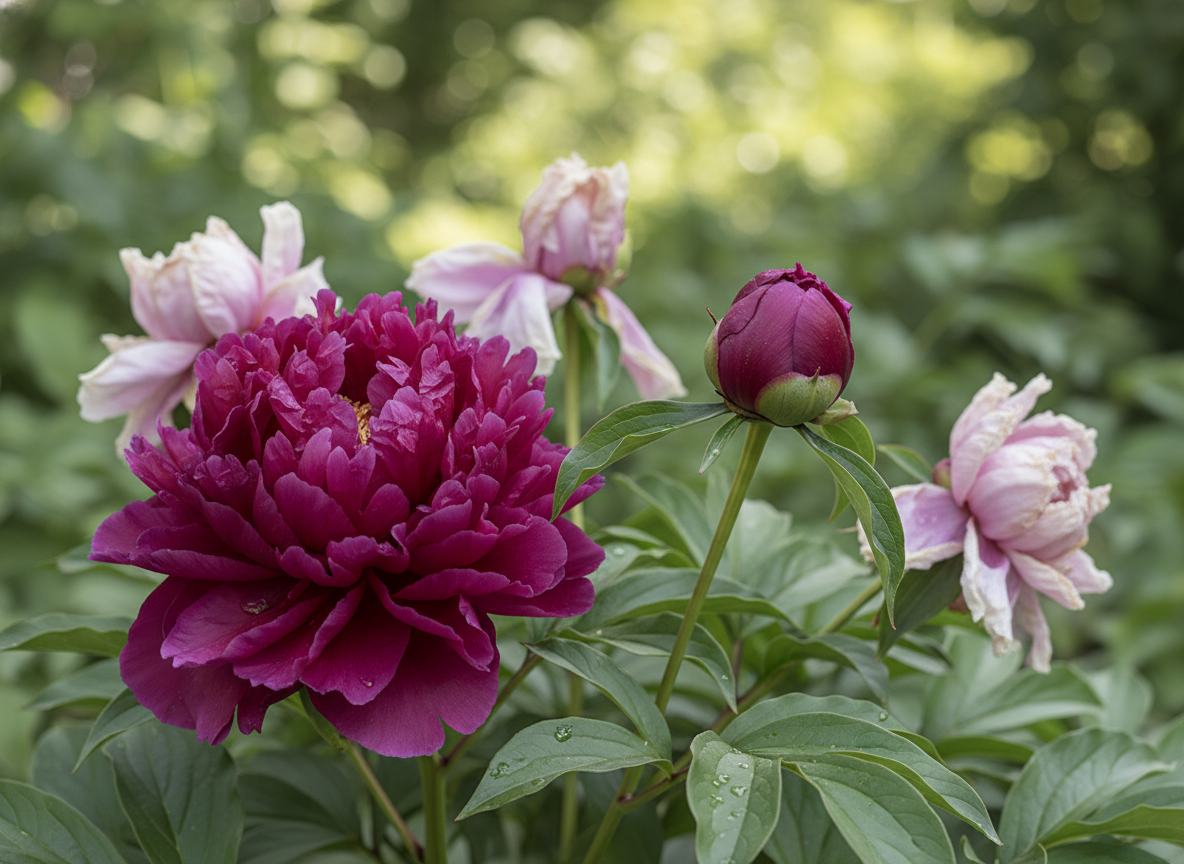 AI-generated illustration
The deadhead — and the bud you’re protecting
Look at any spent tree peony flower head and follow the stem downwards. Three or four centimetres below the dead bloom you’ll find a leaf joint, and tucked into the angle between that leaf and the woody stem is a tiny, pale, slightly fuzzy bump — sometimes barely the size of a pinhead, sometimes already a clear pea. That is next May’s flower bud. It was set during last summer’s growth, hardened off through the winter, and it’s been quietly enlarging since the petals dropped a week ago. Everything you do for the rest of the year is about protecting it.
The deadhead itself is undramatic. Take the spent flower head between finger and thumb and snap it off where it joins the leafy stem — just above the first full leaf below the bloom, never cutting into the woody stem itself. The Royal Horticultural Society’s deadheading guidance treats tree peony as a snap-or-snip job at the spent head only; secateurs are fine if the seed pod has already started to swell and won’t break cleanly, but the cut still sits in the same spot, just above the first leaf joint. What you must not do is take the cut down to the next “obvious” pruning point lower on the stem. Every leaf you remove below the spent flower removes photosynthetic area that’s currently building energy into the bud you just exposed, and every centimetre of woody stem you take off removes a bud you can’t see yet.
There are two reasons the wrong cut is so quietly damaging. The first is that tree peony bark hides far more bud-forming nodes than you’d guess from looking at it — even an inch of apparently bare grey stem can carry two or three pinhead buds that will swell over July and August. The second is that tree peonies repair wounds slowly and don’t bleed sap to seal a cut the way a vigorous shrub does. A heading cut into the woody stem in summer leaves a die-back zone that often kills the wood for another five to ten centimetres below the cut, taking the buds with it. By spring you’ve lost a whole branch that should have flowered, and you can’t get it back.
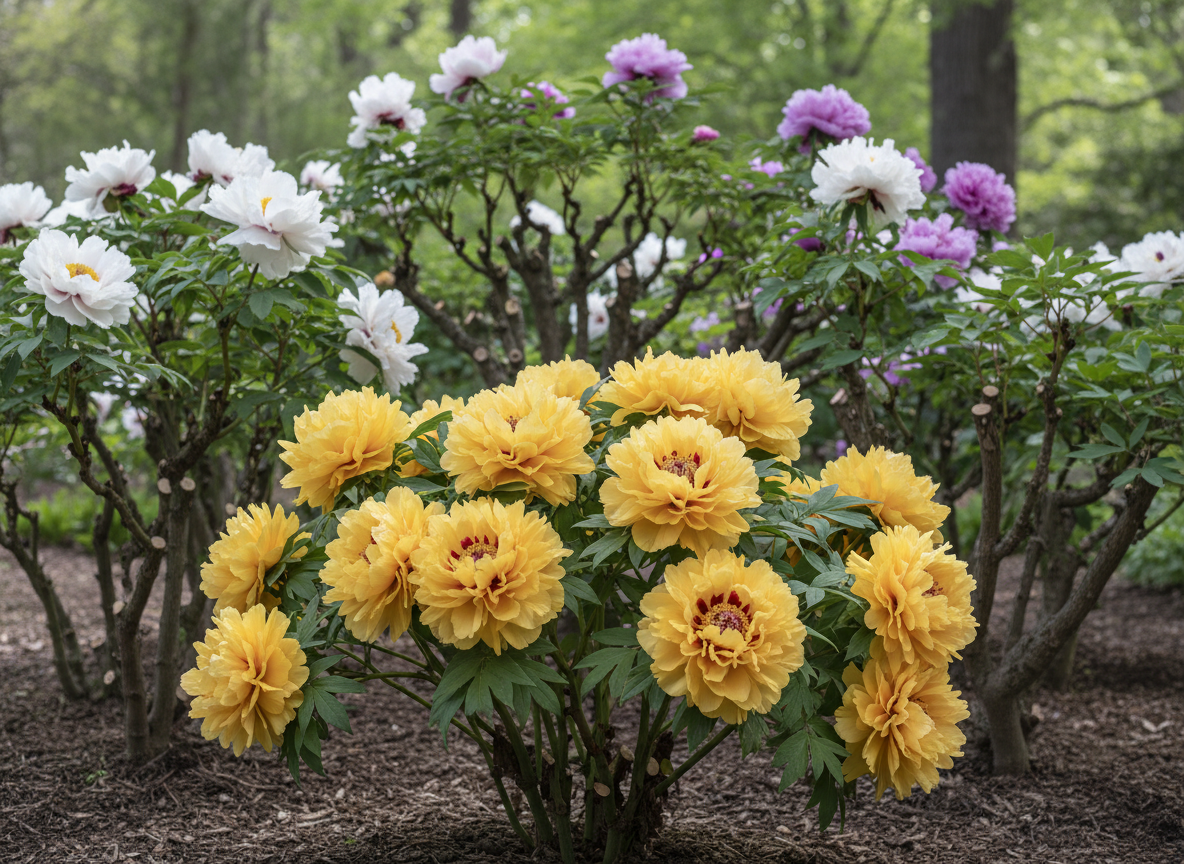 A cluster of yellow peonies bloom in the foreground with tree peonies behind — AI-generated illustration
The wood you never cut — and the Itoh hybrid that breaks the rule
If you only remember one thing this June, make it this: on a tree peony, the woody stems stay. They don’t get cut to the ground in autumn, they don’t get shortened in summer, and the spring pruning that some books mention is limited to dead wood and the occasional crossing branch — done in March, before the leaves emerge, and only when there’s clearly dead wood to remove.
That’s the opposite of what your herbaceous peony, two metres along the same border, asks for. Paeonia lactiflora puts up entirely new soft stems each spring, flowers on them, then dies back so completely that you’d think the plant had given up — and in autumn you cut every one of those stems to the soil. Tree peonies don’t do any of that. The grey-brown framework persists year-round, the leaves drop in November but the stems and dormant buds carry through winter, and the show comes back from the same wood. A mature Paeonia suffruticosa in a Belgian or Dutch garden can carry the same main stems for twenty or thirty years and flower harder every season.
There is one important exception, and it’s the source of half the confusion in modern gardens: the Itoh hybrids, also called intersectional peonies. These are crosses between tree peonies and herbaceous peonies — ‘Bartzella’ (lemon-yellow), ‘Cora Louise’ (white with a magenta flare), ‘Julia Rose’, ‘Garden Treasure’ and the rest of the Roger Anderson lineage you’ll see at the Chelsea trade stands every spring. They look like tree peonies in flower, with big bowl-shaped blooms in colours no herbaceous peony can manage, but they behave like herbaceous peonies underground: they die back to a low woody crown each autumn and need cutting down to about 10 cm in November. If your “tree peony” goes completely dormant and disappears each winter, it’s almost certainly an Itoh, and the rules in this post don’t apply to it — treat it like a herbaceous peony with showy flowers.
The quick test: in early June, after flowering, look at the stems above where this year’s flowers sat. A true tree peony has visibly woody, grey-brown, bark-textured stems that persist year-round and clearly came through last winter. An Itoh has fleshy, green stems that grew up this spring from a low woody base. The deadhead is the same in both; the autumn job is completely different.
The rootstock sucker — mid-June’s quieter task
Almost every tree peony sold in a garden centre is a grafted plant. The desirable scion — the Chinese cultivar with the silk-petalled flowers — is grafted onto a vigorous herbaceous Paeonia lactiflora root, because tree peonies are slow and finicky to root from cuttings or layers. The graft union sits five to ten centimetres below the soil surface on a properly planted specimen, and for the first two or three years after planting the herbaceous rootstock often tries to send up its own shoots from below the union. Mid-June, with the plant in full leaf and the scion finished flowering, is the easiest week of the year to spot them.
The tell is in the leaves. Tree peony leaves are deeply dissected — each leaflet split into three or five narrow lobes with cleanly cut edges, often with a slightly bluish or grey-green cast, the texture matte and almost leathery. Herbaceous sucker leaves are ovate and undivided — wider, more rounded, often glossier and a fresher green, and they sit on a soft, shiny, sometimes reddish stem rather than a woody one. Cricket Hill Garden’s side-by-side photographs are worth a glance if you’ve not seen the contrast before — once you have, you can spot it from across the border.
Left alone, those suckers don’t sit quietly. A vigorous Paeonia lactiflora root that’s no longer feeding a graft will throw progressively stronger shoots each year, and within three or four seasons the herbaceous understock can outcompete the slower-growing tree peony scion and “swamp” it — what gardeners call losing the graft. The scion declines, flowers less, and eventually dies; the rootstock takes over and you end up with a plain pink or white Paeonia lactiflora where your prize Chinese cultivar used to be. It’s the second most common reason a tree peony “fails” after planting (the first is planting it too shallow, which is what allows the suckering in the first place).
The fix is small but uncompromising. Trace each suspect shoot down to where it emerges from the soil, then follow it with your fingers — or a small trowel — five to ten centimetres further down until you reach the herbaceous crown. Snap or cut the sucker off at its origin on the rootstock, not at soil level. A cut at soil level leaves a stub that will simply throw two or three new shoots within a fortnight. A cut at the crown removes the dormant bud that produced it and the rootstock gives up on that point. Backfill, firm the soil, and check again in two weeks — vigorous understocks usually try twice before they accept the message.
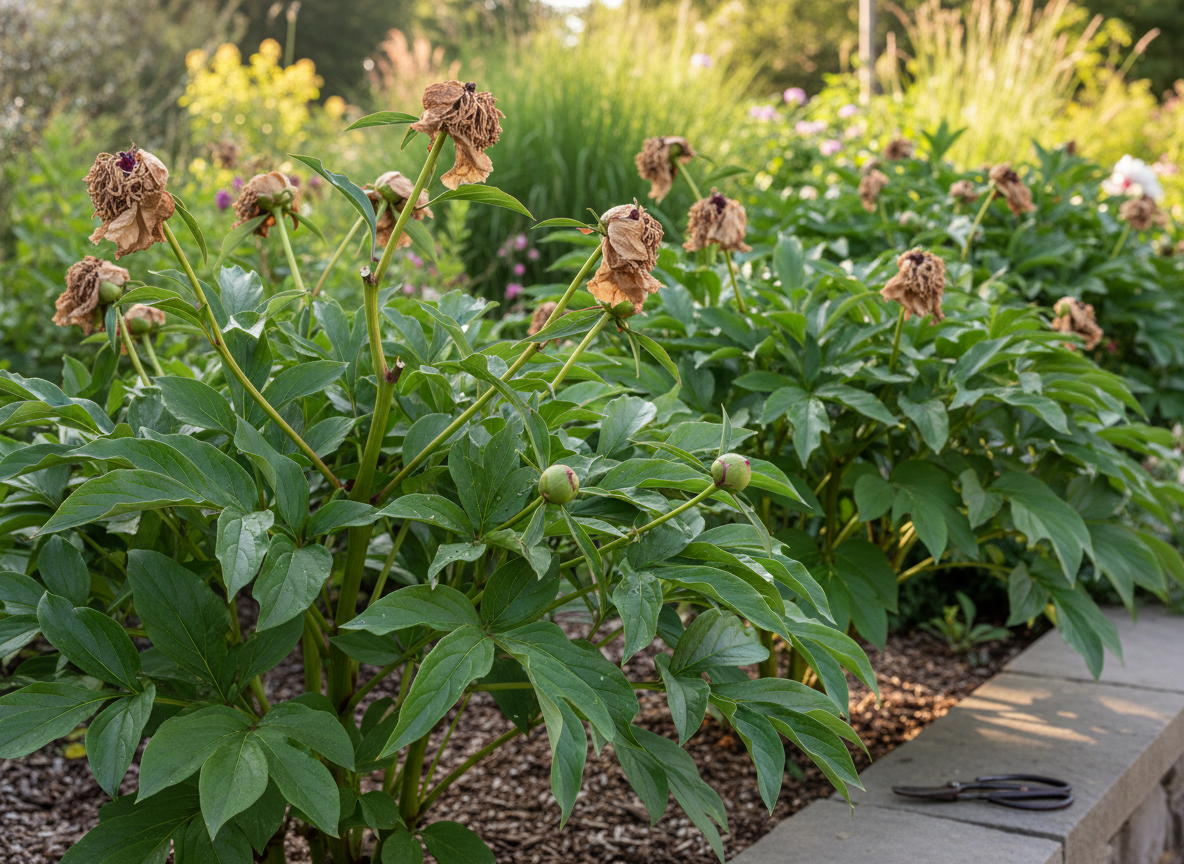 Garden with tree peonies in natural daylight — AI-generated illustration
After the deadhead: what your tree peony needs through the rest of summer
The work that decides the size and number of next May’s flowers happens in the next twelve weeks, and almost all of it is about leaving the plant alone with the right resources. Tree peonies are deep-rooted, drought-tolerant and undemanding once established, but the bud-forming stretch from mid-June to late August is when a small amount of help pays for itself.
Water deeply once a fortnight in a dry spell — a slow soak that wets the soil to 30 cm, not a daily sprinkle — and feed once now with a balanced or slightly potash-leaning granular feed scattered around the drip line and gently scratched in. Avoid high-nitrogen feeds, which push soft leaf growth at the expense of bud set; old gardening books recommending a top-dressing of bonemeal in mid-summer are still right, if a little slow. Keep mulch off the woody base of the plant — tree peonies hate having their crowns smothered, and a thick mulch ring against the woody stems is one of the few ways to rot a previously healthy plant. Mulch the wider root zone, leave a 15 cm clear collar at the base.
Above all, leave the leaves. Tree peony foliage often takes on bronze and rust tints by late August and looks slightly tired by September — that’s normal, not a problem, and it’s not a signal to cut anything down. The plant draws every last gram of energy out of those leaves before they drop naturally in November, and that energy is what enlarges the buds you protected with the right deadhead in June.
The window the calendar can’t see, and the day Cresco can
Notice the pattern that runs through everything above: the right move depends on what kind of peony is in front of you, and the deadhead window opens when the plant decides, not when the diary does.
A Paeonia ludlowii in a warm South Holland courtyard can be petal-drop by the third week of May. A double-flowered P. suffruticosa ‘Hana Kisoi’ on a cool Norfolk clay soil might still have one or two intact blooms in the second week of June. An Itoh ‘Bartzella’ in a city centre micro-climate often flowers a clean ten days later than the same plant in the same town’s allotment site. Add a warm dry April — like the one most of Northern Europe just had — and the whole sequence shifts forward by a fortnight; add a cold backward spring and it slips the other way. “Deadhead tree peonies in early June” is a decent rule of thumb, but the plant in front of you is the only authority that matters, and on a shrub where the wrong cut can lose you a whole branch and the wrong-shaped sucker can lose you the whole plant over three years, knowing which week — and which leaf — is the difference between a thirty-year show and a three-year disappointment.
That’s exactly the gap Cresco is built to close. Photograph your peony and it identifies what you’ve actually got — a true tree peony, an Itoh hybrid or a herbaceous lactiflora — then reads your local weather and the way your spring has actually unfolded to tell you the week the deadhead window opens on your specific plant, flags the mid-June sucker check on grafted specimens, and reminds you again next year, because once you’ve started doing the right job at the right week you don’t want to skip a season. For the bigger picture of what else is asking for attention in the same fortnight, the month-by-month pruning guide shows where tree peony sits in the early-summer rush — and the herbaceous peony disbudding post is the companion piece for the lactiflora two metres along the same border, where the rules are completely different.
The 30-second version
- Tree peonies (Paeonia suffruticosa, P. delavayi, P. ludlowii) are woody shrubs — the grey-brown stems stay year-round and carry next year’s buds.
- Deadhead in the fortnight after petal drop: snap or cut at the spent head, just above the first leaf below the bloom — never into the woody stem.
- Never cut the woody framework down in summer or autumn. Tree peony repairs slowly; a summer heading cut dies back another 5–10 cm and takes hidden buds with it.
- Itoh hybrids (‘Bartzella’, ‘Cora Louise’, ‘Julia Rose’) look like tree peonies but die back like herbaceous — cut to 10 cm in November, not in June.
- Most tree peonies are grafted onto Paeonia lactiflora rootstock — check the base in mid-June for ovate, glossy sucker leaves rising from below the graft union, and remove them at their origin, not at soil level.
- Water deeply in dry spells, feed once with a balanced or potash-leaning granular feed, keep mulch off the woody collar, and leave the foliage on until natural leaf-drop in November.
- Watch the petals fall, not the calendar — every garden’s window opens on a different day, and the wrong fortnight is the difference between a thirty-year shrub and a costly mistake.