This guide belongs with what not to prune in autumn.
Do not prune mophead or bigleaf hydrangeas (Hydrangea macrophylla) now. Leave the spent flower heads on until spring — they sit over next year’s buds and take the worst of the frost. Panicle hydrangea (H. paniculata) flowers on new wood, so it can be cut back in late winter; it still should not be shortened in this autumn tidy-up.
Why you don’t prune a hydrangea now
On most hydrangeas, an autumn cut is expensive: you lose next year’s flowers. That is especially true of mophead and lacecap hydrangeas (Hydrangea macrophylla, including H. serrata) and oakleaf hydrangea (H. quercifolia). These types flower on old wood. The buds for next season are already in the top few centimetres of the stems, just beneath the faded head. Cut back now “to a tidy height” and those buds go with the trimmings.
To see why the brown heads matter, and where the buds sit, read why faded hydrangea heads should stay on.
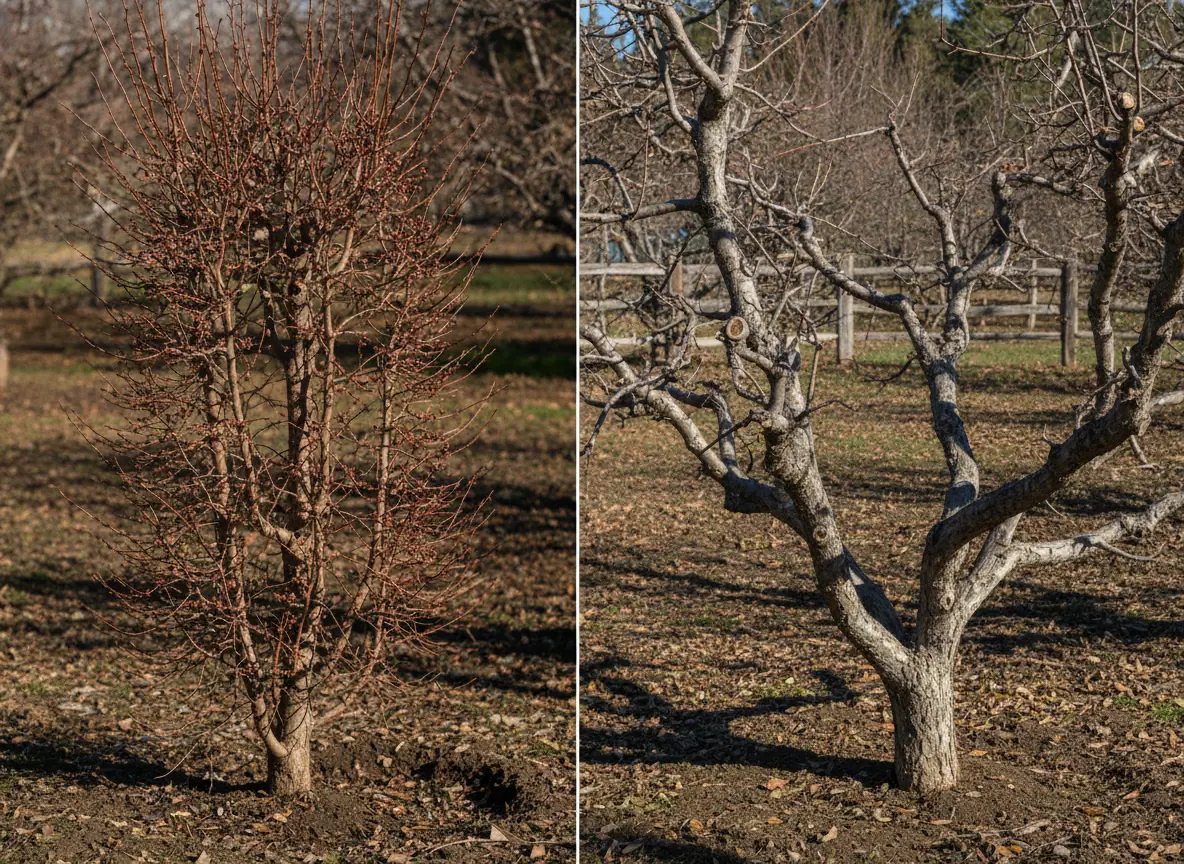 The image depicts two distinct types of Don Prune trees in a garden setting — AI-generated illustration
Which type do you have?
Not every hydrangea follows the same calendar.
- Mophead and lacecap (H. macrophylla, including H. serrata) and oakleaf (H. quercifolia) flower on old wood. Leave them alone in autumn; the spent heads protect the buds underneath.
- Panicle hydrangea (H. paniculata) and smooth hydrangea (H. arborescens, ‘Annabelle’) flower on new wood. Do not prune those in autumn either. The hard cut belongs in late winter, once the worst frosts have passed — often February into March. Until then, leave the cones and globes standing for winter structure.
Not sure which you have? Wait. Waiting never costs you a flower; an early cut can. For the spring cut by type, see hydrangea pruning in April.
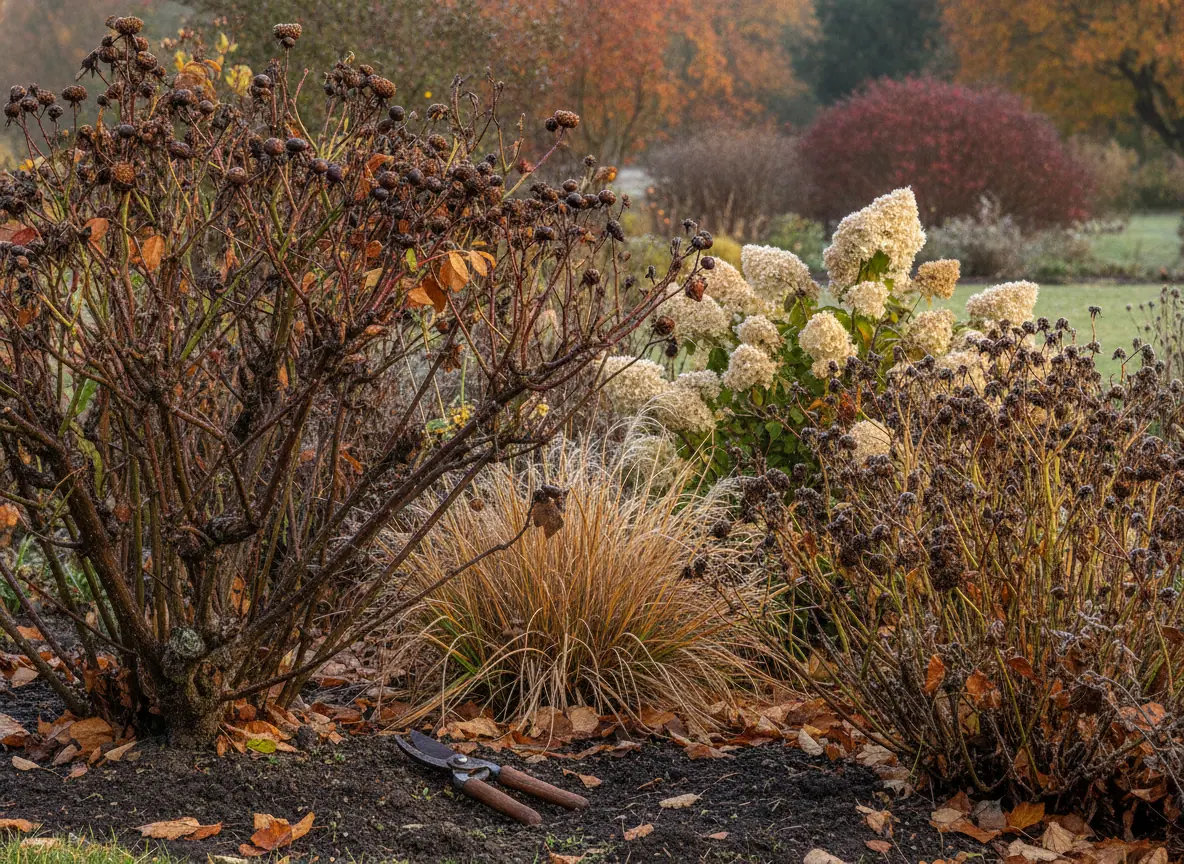 AI-generated illustration
What October and November are actually for
Autumn is a clearing season in the rest of the garden. On a hydrangea, the useful work is protection and preparation — not shortening.
- Leave the spent heads on. On old-wood types they act as a small umbrella over the buds below. Tidy them in early spring, cutting just above the first strong pair of buds.
- Take out only wood that is clearly dead. If you are unsure whether a tip has died, wait until spring, when the buds swell and live wood is obvious.
- Mulch around the base. A layer of compost or shredded bark (a hand’s width clear of the stems) holds moisture, steadies soil temperature, and feeds the soil. Do not heap it against the stems.
- Plants in pots: move them to a sheltered, preferably frost-free spot in a hard freeze, or wrap the pot in hessian or bubble wrap so the rootball does not freeze through. Drainage matters; a wet, frozen pot is worse than dry cold.
- Stop feeding. Late nitrogen pushes a soft autumn flush that has no time to harden. Feeding belongs in spring, when growth starts.
- Wind? In a very open garden you can loosely tie tall stems of old-wood types so they do not rock — without shortening them.
These quiet jobs do more for June than any “neat” autumn prune: you keep the buds, limit winter damage, and send the plant into spring in decent shape.
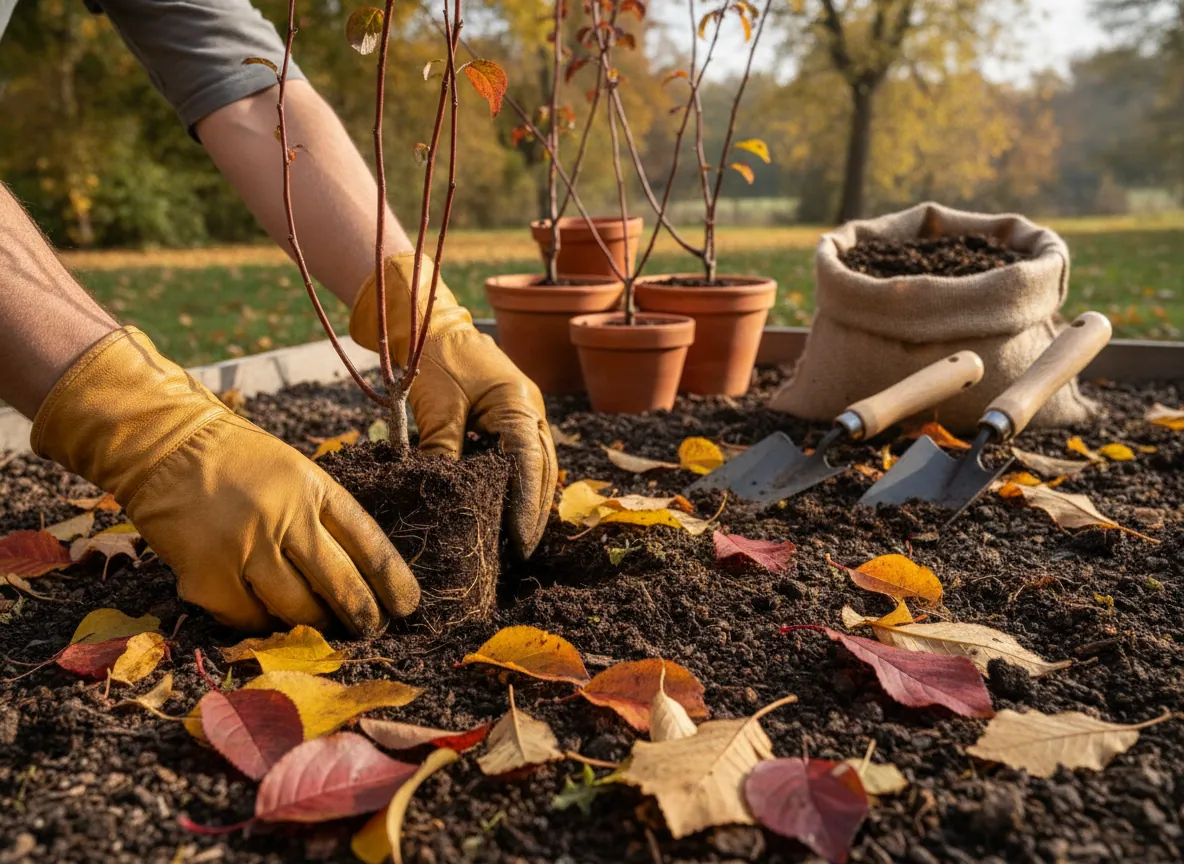 A person wearing gloves plants a small tree in autumn soil — AI-generated illustration
Autumn is also planting time
Container-grown hydrangeas can be planted or moved in mild climates through autumn, while the soil is still warm and not waterlogged — often September into November. Roots keep growing after the top has slowed, so the plant settles before spring. A few cautions:
- Choose a spot out of the sharpest east wind, and water well in the first dry weeks.
- Do not plant into saturated or standing-wet ground, and wait out a hard freeze.
- In colder regions, or on very wet soil, postponing until early spring is the safer call.
The same applies to moving an established plant: lift a generous rootball, trim only damaged roots, and replant at the same depth. Work compost into the hole, firm out air pockets, and water.
When to prune, then
The real prune sits on the spring calendar. On old-wood types (mophead, lacecap, oakleaf) you wait until after winter, then take off the old heads and thin dead or crossing wood — without cutting into live bud wood. On new-wood types (panicle and smooth) you cut harder, in late winter, to a low framework that will push strong new flowering growth. The full walk-through by type is in hydrangea pruning in April.
Until then, doing nothing is the best thing you can do for most hydrangeas — aside from a few protective autumn jobs. More on why those brown heads matter is in why faded hydrangea heads should stay on.
Want to know when your hydrangea can safely be pruned — matched to type and local weather? Cresco Pruning plans the cut in the right window and sends seasonal reminders. Try it at cresco-pruning.com.