Walk down a street in October and you’ll see two completely different agapanthus. One clump is already a soggy yellow heap, collapsing into the border. The one next door is still a tidy fountain of strappy green leaves. Same genus, same front garden, same weather — and one of them will sail through winter untouched while the other quietly dies at the first proper frost.
The difference isn’t luck or soil. It’s which of the two broad groups you own, and almost nobody checks before the cold arrives.
The one test that tells you everything
Forget variety names for a moment. In autumn, agapanthus split cleanly into two camps, and you can tell them apart by eye:
- Deciduous agapanthus die back completely. The leaves yellow, flop and rot down to nothing by late autumn, leaving a bare patch of soil. These are the tough ones — the campanulatus types and most of the old Headbourne hybrids, hardy down to roughly −10°C.
- Evergreen agapanthus keep their leaves all winter. The clump stays green and strappy right through the cold months. These are the tender ones — mostly the broad-leaved africanus and praecox types — and they start dying at around −5°C.
So the test is simply: does your plant disappear in winter, or stay green? If you can’t remember from last year, mark it now. A plant that holds its foliage into November is telling you it needs help the deciduous ones never will.
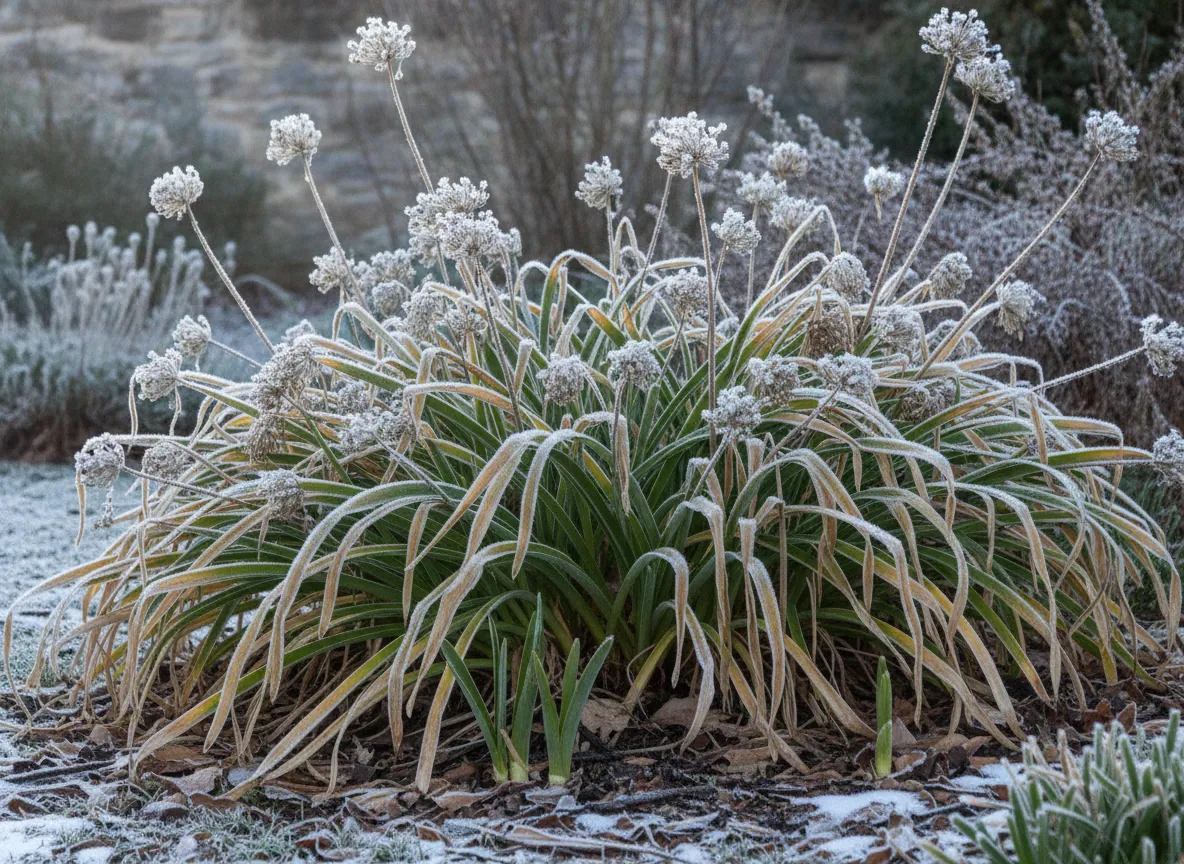 Agapanthus plants with frost and ice — AI-generated illustration
Deciduous agapanthus: tougher than they look
If yours dies back, relax — in most of northwest Europe you can leave it exactly where it is. The yellowing collapse you’re seeing now is normal and even useful: the plant is pulling everything back down into its fleshy roots before the cold. Don’t rush to cut it.
The one thing worth doing is a loose blanket over the crown in a cold or exposed garden: a 10–15 cm layer of straw, bracken or your own fallen leaves, kept airy rather than packed down. That’s insurance against a hard, bare freeze, not a necessity everywhere — the RHS rates these as the hardiest agapanthus of all, and a Master Horticulturist I read this week reckons that outside the very coldest regions they’re fine with no protection at all.
Two things not to do. Don’t lift and store them like dahlias — they resent the disturbance and flower worse for it. And don’t cut the leaves off while they’re still green and upright; as with deadheading agapanthus after flowering, it’s the feed from the foliage, not the chop, that sets next summer’s bloom count. Let the leaves die back on their own, then clear the mush.
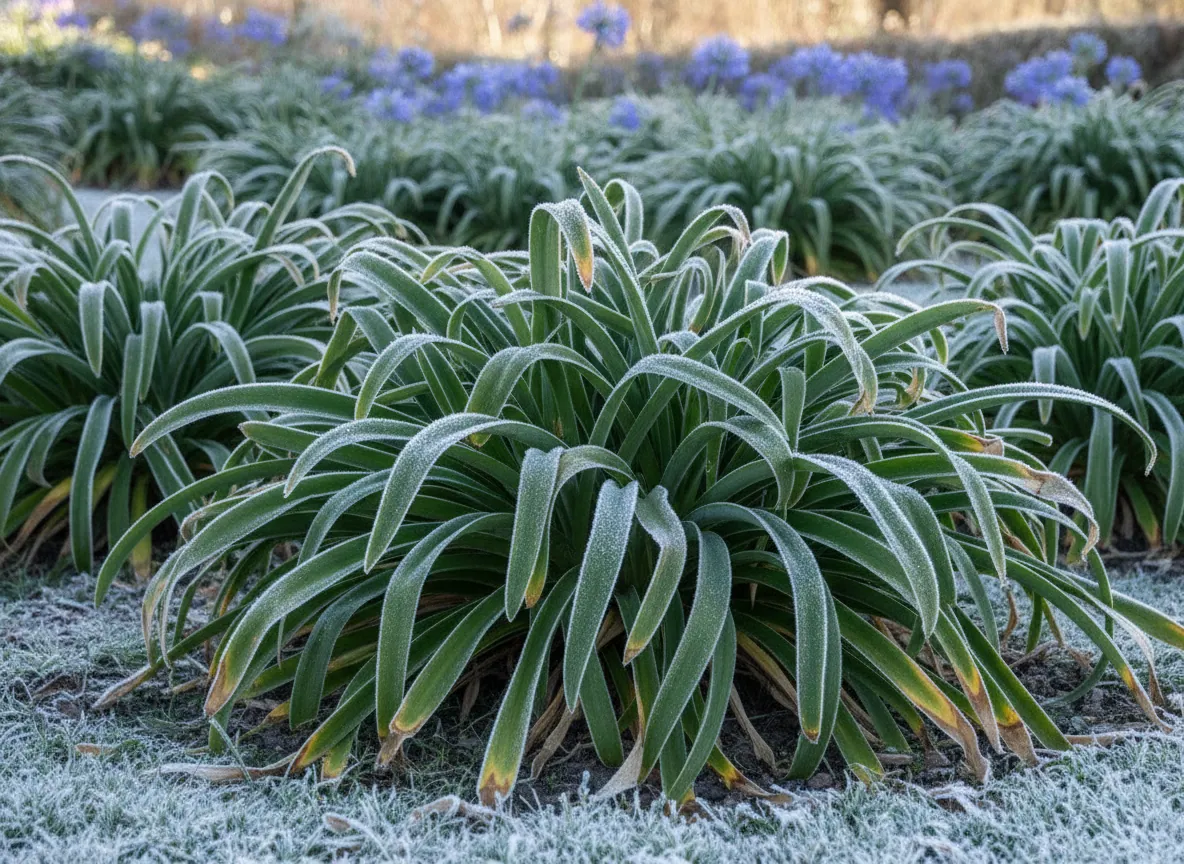 Evergreen agapanthus plants covered in frost — AI-generated illustration
Evergreen agapanthus: the ones that die at −5°C
These are the plants that catch people out. They look the picture of health in October — lush, green, no sign of slowing down — which is exactly why their owners do nothing and lose them in January.
An evergreen agapanthus hardy only to about −5°C has no dormant, buried retreat to fall back on. Its living leaves and crown sit fully exposed to every frost. In a mild, coastal or city garden it may scrape through most winters. In a cold inland one, a single hard week finishes it.
What to do depends on whether it’s in a pot or the ground:
- In a pot: this is the easy case, and the main reason to grow the tender types in containers in the first place. Move the pot somewhere frost-free but light before the first hard frost — a cool greenhouse, an unheated porch, a cold conservatory or a bright shed. It doesn’t need to be warm, just above freezing. Keep it barely watered through winter.
- In the ground: throw a double layer of horticultural fleece over the whole clump on frosty nights, and mulch the base thickly as for the deciduous types. In a genuinely cold garden the safer bet is to lift a prized plant into a big pot in autumn and overwinter it under cover, then plant it back out in May.
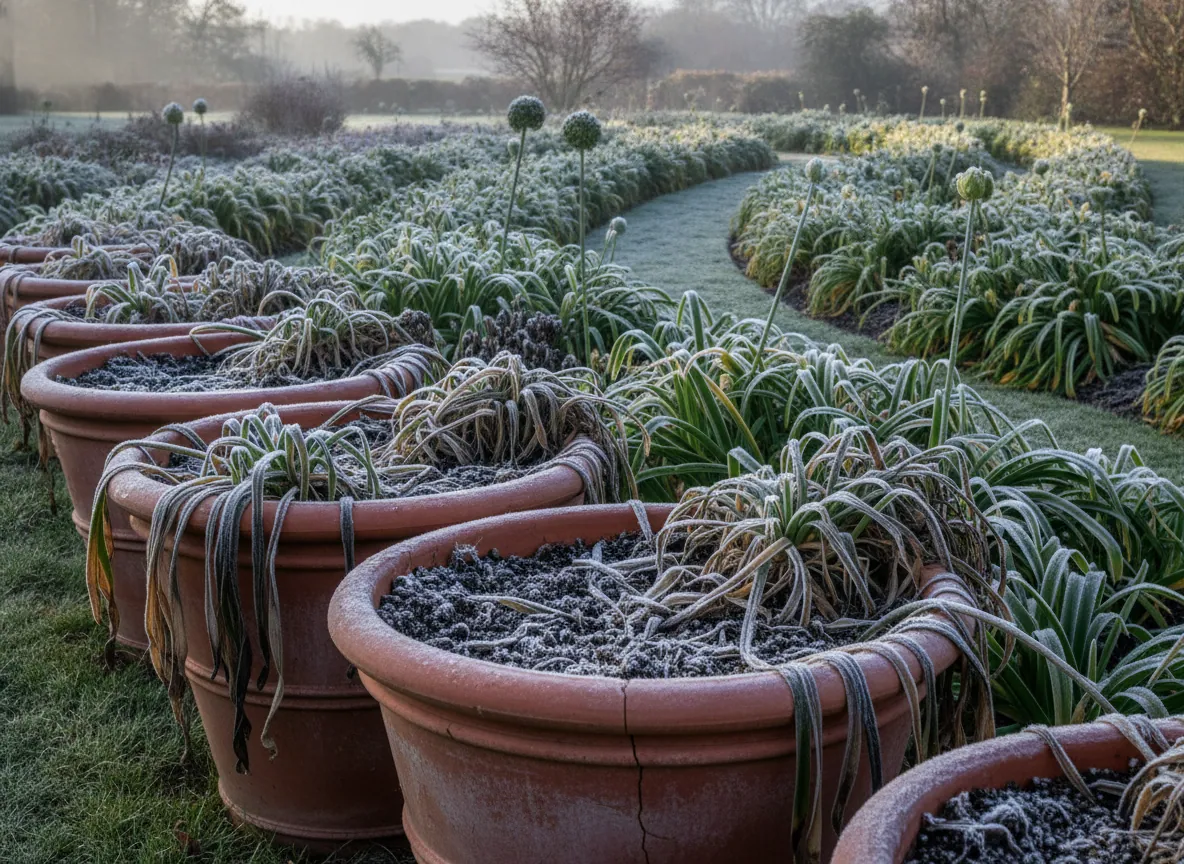 Potted and bordered agapanthus plants show frost damage in a garden — AI-generated illustration
Pots freeze faster than borders
Whichever type you grow, a potted agapanthus is at more risk than one in the open ground, because the roots sit in a thin skin of compost that can freeze solid right through — soil in a border never does. A deciduous plant that would be bone-hardy in the ground can still lose its roots in a small pot left out on exposed paving.
So even for the hardy deciduous types in containers, move the pot against a warm house wall or into a sheltered corner for winter, stand it up on feet so it drains, and wrap the pot (not the plant) in bubble wrap or hessian if a hard spell is forecast. The tender evergreens in pots go a step further: under cover and frost-free, as above.
The mistake that costs next summer’s flowers
The single most common agapanthus error in autumn is tidiness in the wrong direction. People shear the evergreen types hard “to neaten them up” going into winter — stripping off exactly the living leaves the plant needs to protect its crown and fuel spring growth. Trim off the odd tatty leaf by all means, but never cut an evergreen agapanthus back to the ground before winter.
The opposite mistake sinks the deciduous ones: a thick, wet, packed mulch dumped straight on the crown. Agapanthus hate sitting cold and sodden, and a sodden crown rots. Keep any mulch loose and airy, lift it off a touch from the very centre, and pull it back in spring as the new shoots push through.
Agapanthus is just one plant on the mid-October tender list. If you grow it, you’ve almost certainly got others asking the same question right now — whether to lift or leave your dahlias at the first frost, when to lift gladioli corms before the cold, and whether your cannas can survive winter in the ground. Each one has its own frost deadline, and they don’t all fall on the same day.
That’s the real catch with tender plants: the right move is obvious once you know the plant, but the timing shifts every year with your own weather. Cresco keeps the whole list for you — every plant you own, its hardiness, and the week your local forecast says to act — so you protect the evergreen agapanthus before the frost finds it, and leave the deciduous one well alone.