The grass that doesn’t take a haircut
Autumn is when the shears come out across the border. The perennials have gone over, the deciduous grasses are bleaching to straw, and somewhere around now the urge to “cut everything back” takes hold. For most ornamental grasses that urge is simply mistimed — you leave them standing and cut in spring, as we cover in why you don’t cut ornamental grasses back until spring. But there’s a whole group of grasses where the usual autumn-or-spring question doesn’t apply at all, because the answer is neither: you don’t cut them to the ground in either season.
These are the evergreen grasses — Stipa, most Festuca, the evergreen sedges and carex, Luzula. They don’t die back to a dormant crown the way Miscanthus or Calamagrostis do. They stay green (or green-ish) all winter and grow from the base more or less continuously. Shear one to a stubble and you’re not giving it a tidy dormant-season reset — you’re removing living tissue the plant was relying on, and in a cold, wet winter that stub often rots and the plant never comes back. The job these grasses actually want is a comb, not a cut.
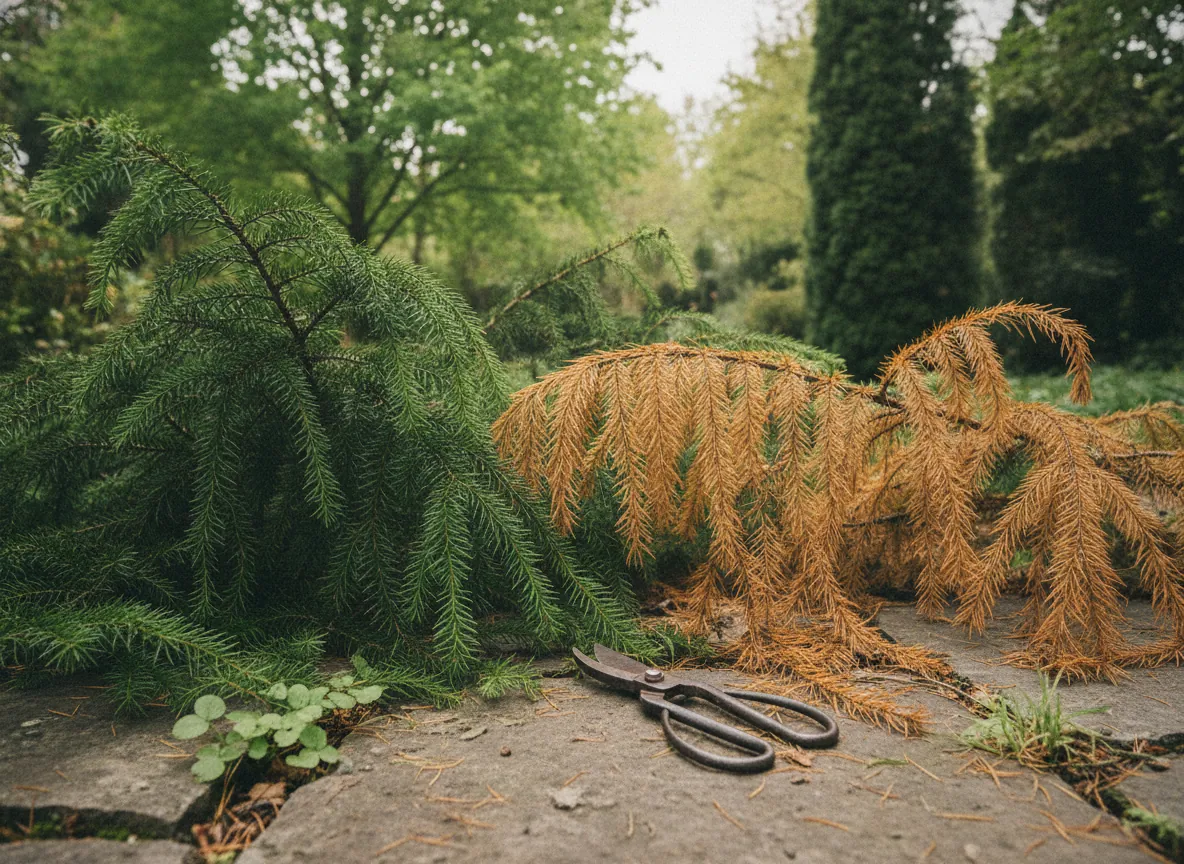 A pair of pruning shears lies between green and brown evergreen branches — AI-generated illustration
Evergreen or deciduous? Decide before you cut
The whole rule hinges on knowing which kind of grass you’ve got, and it’s an easy distinction to make if you check before the secateurs are moving.
Deciduous grasses die back completely. By late autumn the foliage has turned uniformly buff, gold or brown, the plant feels dry and papery all the way down, and there’s no green at the base. These are the ones you leave standing for winter structure and cut hard — right down to 10–15 cm — in late winter or early spring, before the new growth pushes through. Miscanthus, Calamagrostis, Panicum, Molinia, Pennisetum and deschampsia all belong here. Pampas grass is effectively in this camp too, though it has its own rules — see why pampas grass is cut back in spring, not autumn.
Evergreen grasses keep living foliage through winter. Part the clump with your fingers and you’ll find green or silver-green blades at the heart even in December, and the plant grows from that persistent base rather than dying back to it. Stipa (including Stipa tenuissima, Mexican feather grass), most fescues (Festuca glauca and friends), the evergreen sedges (Carex), wood rush (Luzula) and Anemanthele belong here.
A quick test when you’re unsure: grab a handful low down and tug gently. A deciduous grass in autumn sheds dead blades freely and feels hollow and dry at the base. An evergreen one holds firm, stays anchored and shows green when you look inside. If there’s living green at the crown, put the shears down.
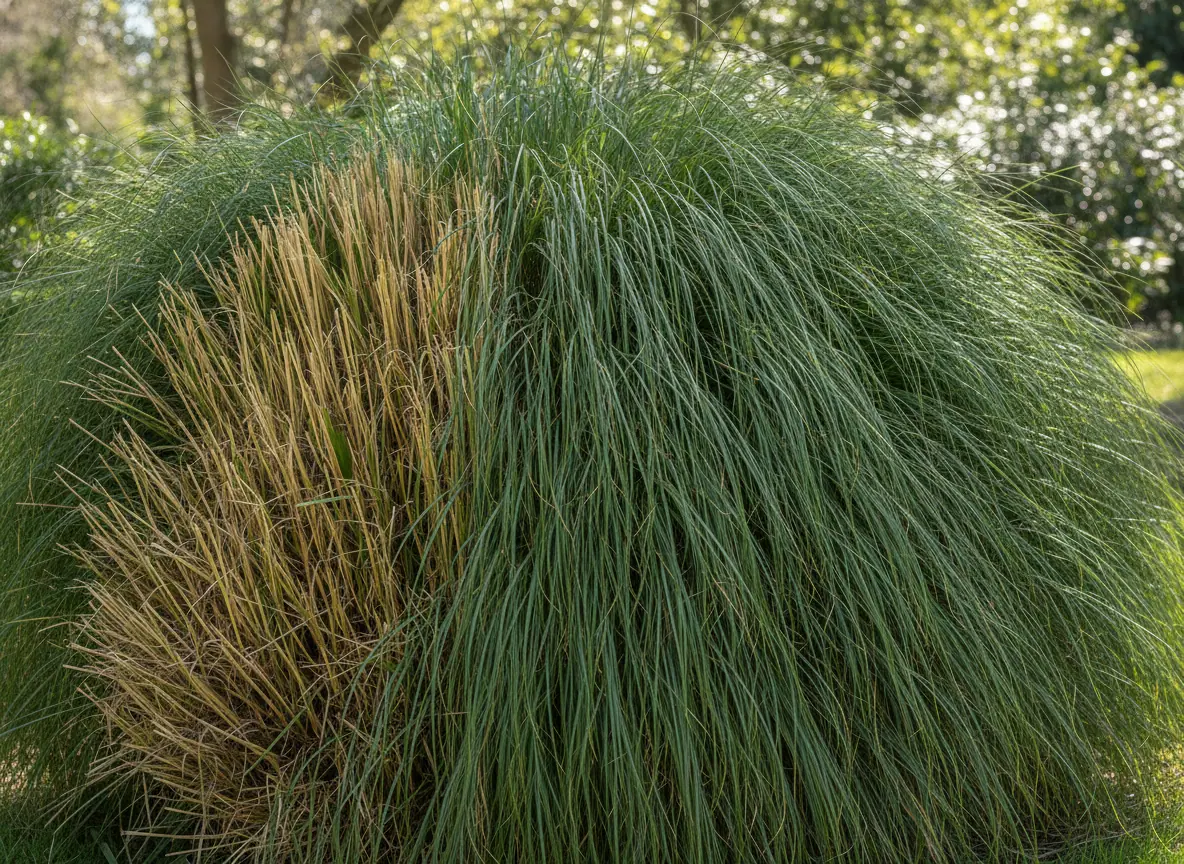 A comb evergreen grass bush shows dead and living sections — AI-generated illustration
Why shearing an evergreen grass can kill it
A deciduous grass carries next year’s growth safely underground over winter, so cutting the dead top off does no harm — there’s nothing living up there to lose. An evergreen grass is the opposite. Its growing points sit up in the clump, among the foliage, and the green blades are feeding the plant right through the cold months. Cut the whole thing down to a hedgehog of stubble and three things go wrong at once.
First, you strip away the living leaf the plant uses to tick over all winter. Second, that flat-topped stub collects rain and sits wet, and in a cold snap the water-logged crown rots — this is what actually finishes off a sheared fescue far more often than the cutting itself. Third, even if it survives, an evergreen grass is slow and reluctant to regenerate from bare old wood at the base; it doesn’t have the deciduous grass’s spring surge waiting underground, so it comes back thin, patchy and half-dead, often with a bald centre that never fills in. People do this in good faith every autumn — they’re tidying — and then wonder why the tidy fescue is a brown doughnut by March.
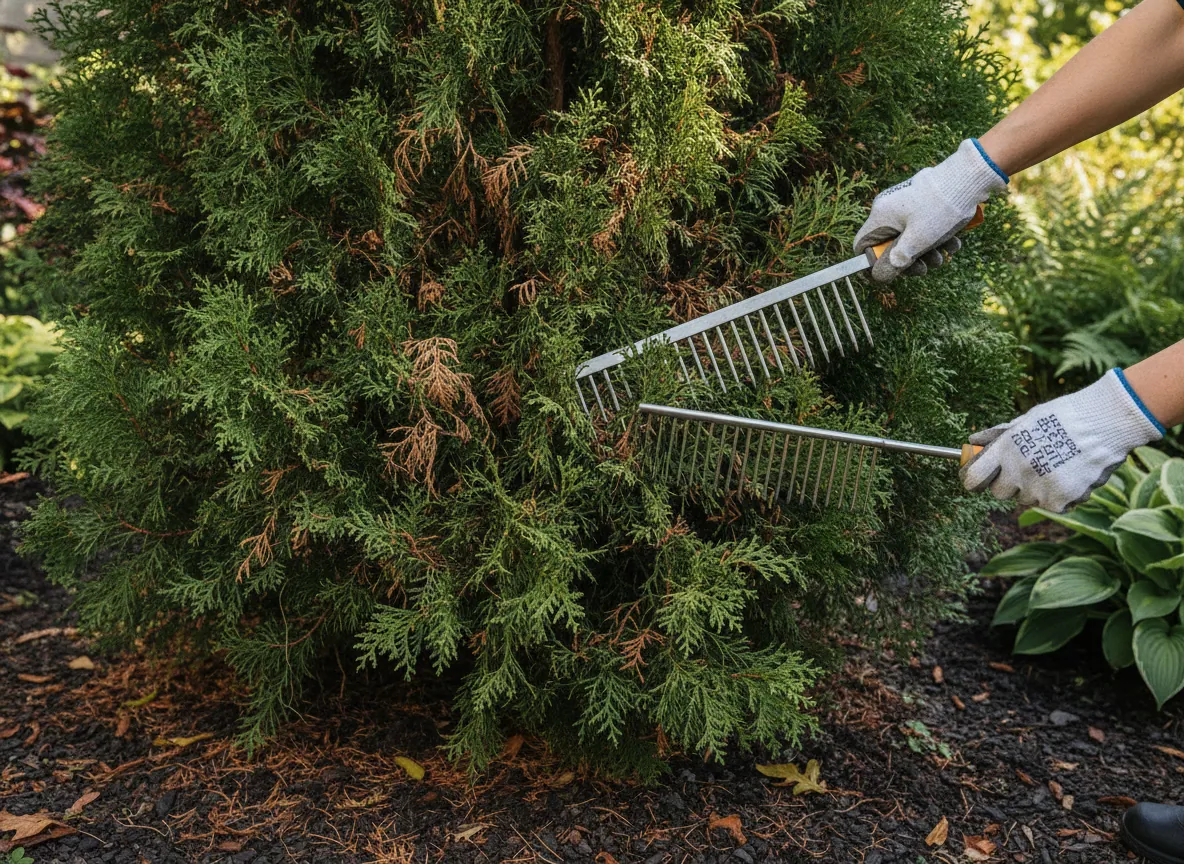 Hands with garden combs pruning an evergreen bush — AI-generated illustration
How to comb one properly
Combing is exactly what it sounds like, and it takes a couple of minutes per plant. Put on a pair of gloves — Stipa and the sharper fescues can give you paper cuts — and simply run your fingers up through the clump like a rake, from the base outwards. The loose, dead, strawy material slides out and stays in your hand; the living blades, still rooted, stay put. Work right round the plant until you’ve pulled out the bulk of the thatch and what’s left is clean, living foliage.
That’s the whole job. You’re grooming out the dead to let light and air into the crown and show off the fresh growth — not reducing the plant’s size or shape. A spring-tine lawn rake does the same job on a big clump if your fingers won’t reach, used with the same light, upward pulling action. If a few flower stems have gone fully brown and ratty, you can snip those individually at the base, but you’re taking out named stems, not giving the plant a level trim.
The only evergreen grasses that tolerate anything firmer are the large, tough evergreen sedges and Anemanthele, which can take a light tidy with shears — a trim of the worst of the tips, never a shear to the ground. When in doubt, comb.
When to do it, and the one exception
For most evergreen grasses the comb-out can be done any time from autumn through to early spring whenever the clump looks tired — there’s no narrow window, because you’re not racing dormancy. Many gardeners leave it until late winter so the plant keeps its full, soft presence through the season; a frosted Stipa catching low winter sun is one of the best things in the garden, and combing it out in October throws that away. If your grasses look good, enjoy them and comb in February or March instead. If they’ve already collapsed into a wet, matted mess, comb now rather than let the thatch smother the crown.
The exception worth knowing: Stipa gigantea, the giant golden oat grass, is semi-evergreen and the one Stipa you can cut back harder — but even then it’s an early-spring job, taking out the old flowered stems and combing the base, not an autumn shear. And if you’ve inherited a fescue that’s already gone bald in the middle, don’t try to prune it back to life; lift it in spring, pull it apart into small rooted pieces and replant those. Evergreen grasses renew by division, not by cutting — the same instinct that leaves the border’s seedheads standing for winter structure applies here. Comb, don’t cut, and the clump that greets you in spring will be green to the core instead of a ring of brown.