A phormium doesn’t grow back from a cut
There’s a particular mistake that gets made to phormiums — New Zealand flax — every autumn, and it’s the kind you can’t undo. The plant gets big, the border tidy-up comes round, and someone takes the shears across the top of it like a hedge, levelling the fan of leaves off at waist height. It looks neat for about a week. Then it dawns on you that the cut doesn’t heal: every blade you sliced through now ends in a blunt, browning stub, and it will stay that way. A phormium leaf grows from its base, not its tip, so a cut tip never extends, never tapers back to a point, never greens over. You’ve given the plant a flat-top it will wear until that entire generation of leaves dies off — which, on a phormium, takes years.
This is the single most important thing to understand before you go near one with a blade in October: a phormium is not a shrub and not a grass. You can’t shorten it, you can’t shape it, and you can’t “cut it back” the way you’d cut back an aster or a buddleia. Its leaves are either whole or ruined. So the real autumn job isn’t a cut at all in the usual sense — it’s the removal of individual dead leaves, one at a time, from the base. Everything else waits.
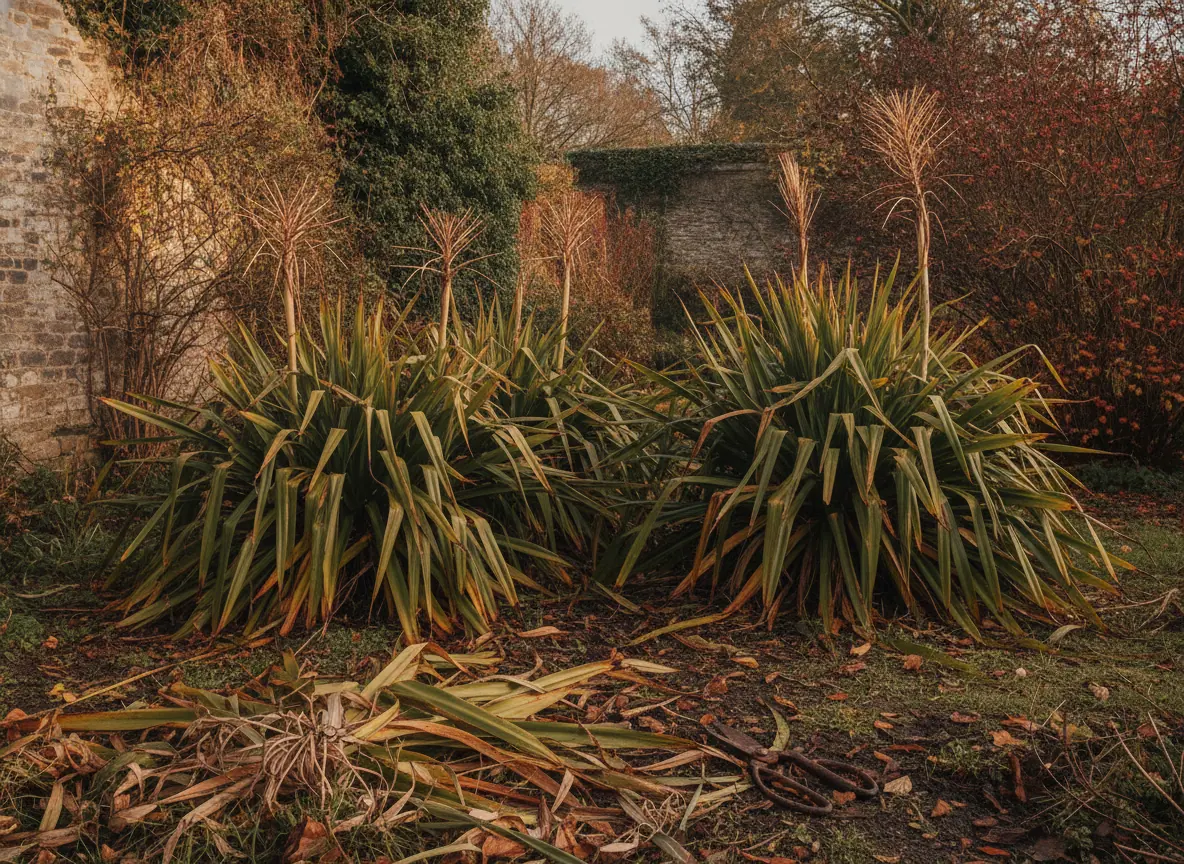 Phormium plants with fallen leaves and pruning shears in an autumn garden — AI-generated illustration
Why autumn is the wrong time for any real pruning
Even setting aside the flat-top problem, autumn is the wrong moment to do anything drastic to a phormium. These are borderline-hardy plants in most of the UK and the Low Countries — they’ll take a few degrees of frost in a sheltered spot, but a hard, wet winter is what kills them, and it kills them through the crown. Cut into the plant now and you open fresh wounds right as the cold and the wet arrive, on a plant that won’t be growing again for months and can’t seal them. Those wounds sit open all winter and rot sets in at exactly the point — the centre of the crown — where rot is fatal.
The leaves you’re tempted to remove are also doing a job through winter. The dense, upright fan funnels rain away from the centre and the mass of foliage gives the crown a degree of its own shelter. Strip it back or chop it down in October and you expose the heart of the plant to every freeze-thaw and every soaking from now until March. The right time for the proper tidy-up — taking out tired old leaves and any spent flower spikes, cutting hard into a congested clump, or dividing it — is spring and early summer, when the weather is mild, the plant is growing again, and new leaves are already pushing up to replace what you take. That’s the same logic that keeps you off a hardy fuchsia until spring and leaves ornamental grasses standing over winter: the top growth is this winter’s protection, and you remove it when the plant can replace it, not when it’s about to need it most.
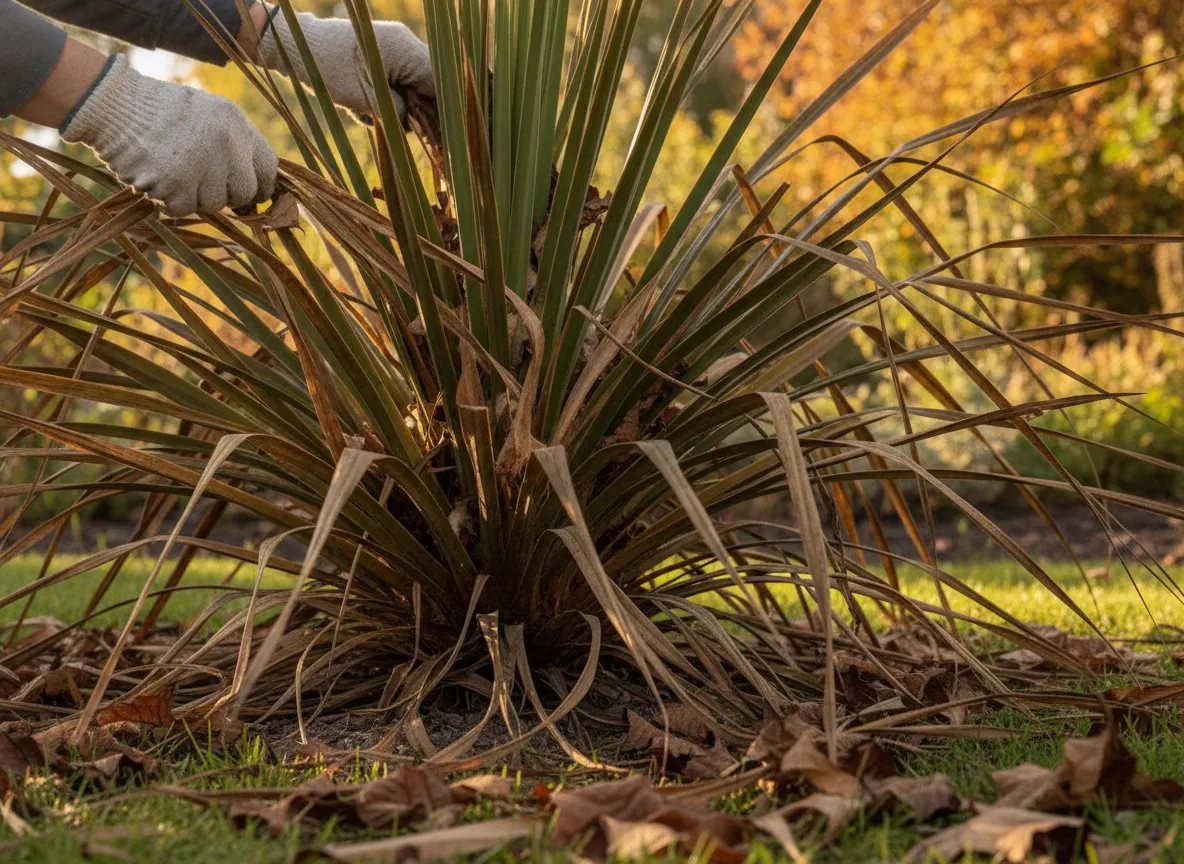 A person in gloves pulls dead leaves from the base of a phormium plant — AI-generated illustration
The one autumn job: pull the dead leaves from the base
Here’s what you can — and should — do in October. Walk round the clump and find the leaves that are genuinely finished: the ones gone brown, collapsed, slimy at the base, or split and tatty from the summer. Each of these comes away from the crown with a firm, steady downward-and-sideways pull. Grasp the dead leaf low down, close to the base, and tug it towards the outside of the clump; a leaf that’s truly spent detaches cleanly from the fan. If a leaf resists and you’d have to tear healthy tissue to shift it, it isn’t ready — leave it, or cut that one off right at the base with a sharp, clean knife rather than ripping the crown.
The rule is simple: you’re removing whole leaves at the base, never shortening leaves across the top. A dead leaf taken off at the bottom leaves no stub and no scar on display — the fan closes over the gap and looks untouched. A living leaf cut across the middle leaves a permanent brown fence-post. Work through the outside and the base of the clump, clear out the dead skirt that collects down there, and bin it — a mat of rotting old leaves around the base is where slugs and crown rot both set up over winter, so clearing it does double duty. What you’re left with is a clean, whole fan of living leaves and an open base that can breathe and drain. That’s the entire autumn job.
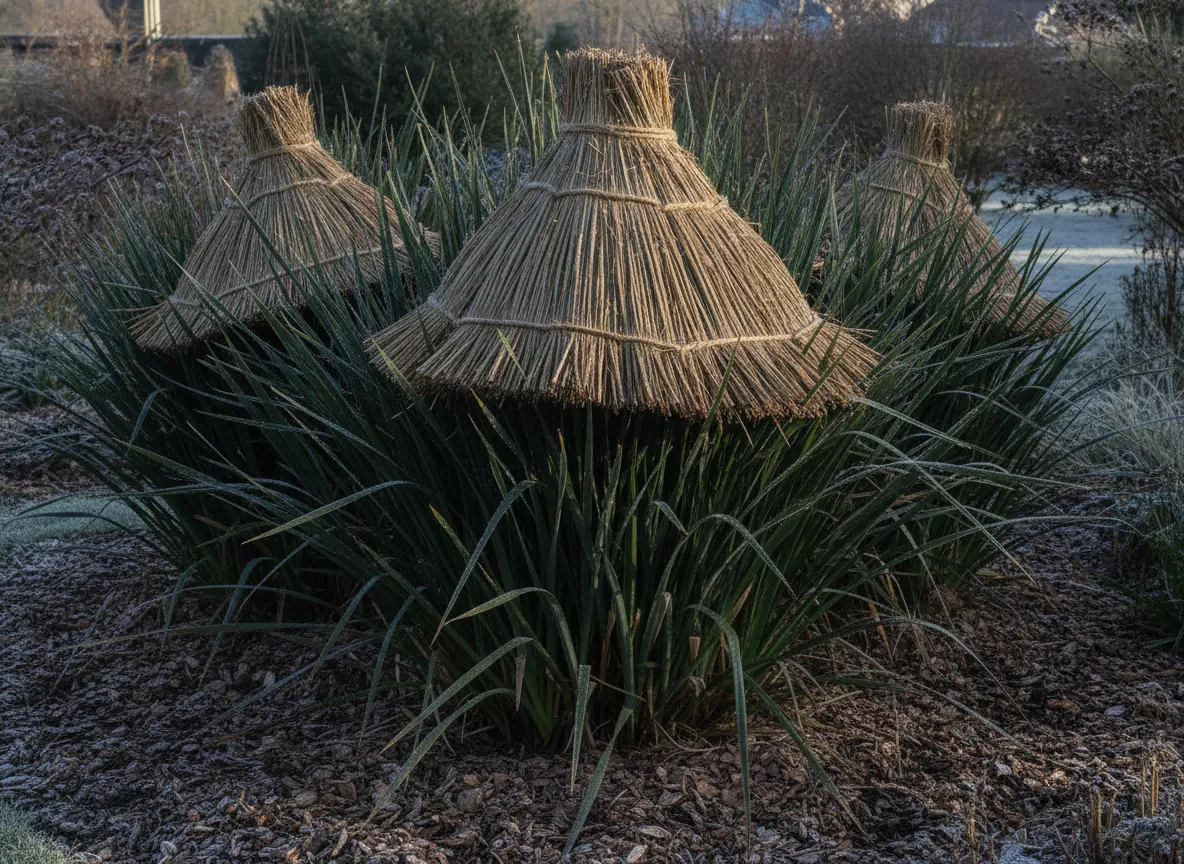 Phormium plants with straw cones protecting their crowns in a winter garden — AI-generated illustration
Keeping the crown dry through winter
Phormiums die of wet far more often than of cold, and almost always at the crown. Everything you do over winter should point at keeping water moving away from the centre of the plant. Clearing the dead leaves from the base, as above, is the first part of it — that soggy collar is what holds moisture against the crown. If your plant sits in heavy or slow-draining soil, that’s the bigger risk than the air temperature, and a phormium in a pot should be stood up on feet so the compost can drain freely rather than sitting in a saucer of winter rain.
In a genuinely cold or exposed spot, there’s one old trick worth doing: gather the whole fan of leaves up together and tie it loosely near the top with soft twine, turning the open funnel into a closed column. It sheds rain and snow off the crown instead of letting it settle in the centre, and it gives the growing point a bit of extra shelter. It’s the same instinct behind tying red hot poker leaves up over the crown and packing a tree fern’s crown before the frost — with strappy, crown-forming plants, winter is won or lost at the centre, and the job is to keep that one point dry rather than to cut anything off. Untie it again in spring once the worst has passed.
When a phormium does go brown over winter
Even a well-kept phormium can look rough by February — whole leaves browning off after a hard frost, or a scorched, bleached look across the fan after a cold wind. The temptation, again, is to grab the shears and level the lot. Don’t. Wait. A phormium that looks half-dead in late winter very often pushes clean new growth from the centre once it warms up, and the damaged leaves are still, right up to the last frost, doing their bit to shelter the crown. The time to assess the damage and cut out the dead and spoiled leaves — at the base, always — is mid- to late spring, when you can see what’s genuinely dead versus what’s merely tatty, and when anything you remove is immediately being replaced by fresh leaves coming up through the middle.
If a whole clump has been killed to the ground, even that is often not the end: phormiums will frequently resprout from the base weeks later, so give a frost-hit plant until early summer before you write it off and dig it out.
Let Cresco time it for your garden
The hard part of phormium care isn’t the pulling — it’s resisting the shears in autumn and knowing that the real work, the dividing and the hard tidy, belongs to spring. That’s exactly the kind of “do nothing now, do it properly later” timing that’s easy to get wrong when the whole border is screaming to be cut down at once. Plant & Bloom by Cresco tracks the actual plants in your garden against your local weather, so instead of giving everything the same October haircut you get the right instruction for each one — leave the phormium standing and tie it up before the first hard frost, then a reminder to go back in spring and do the real tidy. Snap a photo of a browning fan in February and it’ll help you tell frost damage from crown rot before you decide whether to cut or to wait. With a phormium, almost always, the answer is wait.