It isn’t the cold that kills a tree fern — it’s wet in the crown
Dicksonia antarctica looks like it belongs in a dripping Tasmanian gully, so most people assume the first proper frost will finish it. It won’t. A settled tree fern is hardier than its jungle looks suggest — it shrugs off temperatures down to around -10°C once it has some size on it. Plants die in far milder winters than that, and when they do, the cold usually isn’t the culprit.
The killer is water. The top of a tree fern’s trunk is a shallow, cupped crown — the hollow where the new fronds uncurl each spring. Rain collects there. If that water is sitting in the crown when a hard frost arrives, it freezes, the growing point rots, and because a tree fern grows from that one spot and nowhere else, the whole plant goes with it. You don’t get a resprout from the base the way you would with a frosted canna left in the ground. The crown is the plant.
So the job this autumn isn’t to bundle the whole thing up against the cold. It’s to keep the crown dry.
 AI-generated illustration
The trunk is alive, but the growth is all at the top
It helps to know what you’re looking at. The “trunk” of a tree fern isn’t wood and it isn’t really a stem in the usual sense — it’s a slim stem wrapped in a thick, fibrous mass of old leaf bases and aerial roots. That casing holds moisture, which is why a tree fern wants its trunk misted and damp through the growing season. It’s tough, spongy, and surprisingly frost-tolerant on its own.
All the actual growth, though, happens at the very top, in the crown. That’s the part that can’t take a wet freeze, and that’s where your protection goes first. In the mildest coastal gardens a handful of straw in the crown is the whole job. The colder and more exposed your plot, the more you add on top — but you always start from the crown and work out, never the other way round.
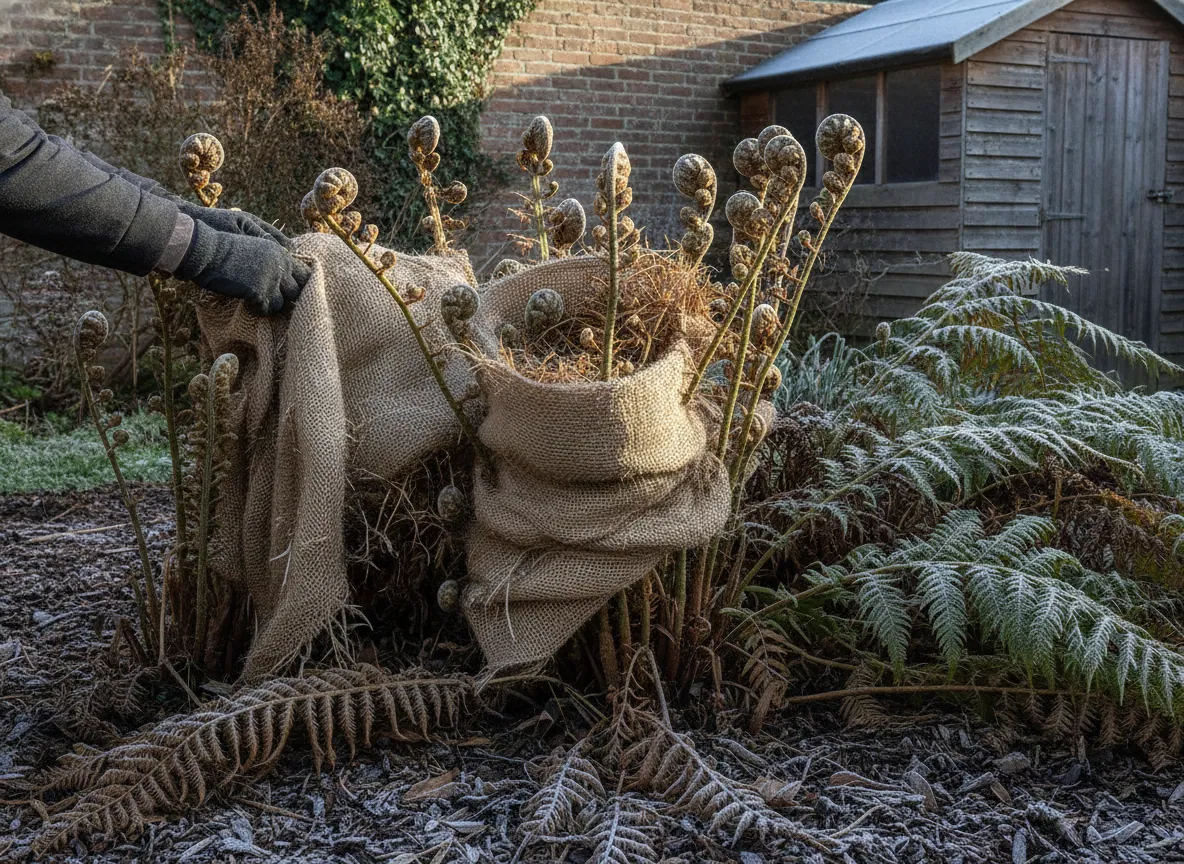 A person wraps the crowns of tree ferns with burlap — AI-generated illustration
Pack the crown before the first hard frost
Wait until the fronds are clearly going over and the first frosts are in the forecast — in most of the UK and the Low Countries that means late October into November, though a cold, open garden can call for it sooner. Don’t rush it in early autumn: a crown stuffed and sealed while the weather is still mild and wet can sweat and rot just as surely as a frozen one.
When the moment comes, take a couple of good handfuls of dry straw — not damp hay, which carries its own rot — and push them down into the crown, filling the cup so there’s a plug of dry insulation over the growing point. Horticultural fleece scrunched into the crown does the same job if straw is hard to come by. The aim is simple: a dry, airy layer sitting between the growing point and the weather.
Don’t cut the old fronds off — fold them over
This is the step most people get wrong, because autumn feels like tidy-up season and a tree fern full of browning fronds looks like it’s asking for a cut. Leave them. Those big, spent fronds are the best rain cover the plant has.
Once the straw is in, bend the old fronds inward and down over the crown so they form a loose thatch — an umbrella that throws the rain clear of the straw plug underneath. It’s exactly the trick we use on red hot pokers, where you tie the evergreen leaves up over the crown for the same reason: it’s the winter wet collecting in the heart of the plant, not the cold, that does the damage. The same lesson sinks a lot of pampas grass each winter — a soggy, rotting crown, not a frozen one.
In a cold or windy garden, go one layer further. Over the folded fronds, wrap the crown and the top of the trunk loosely with horticultural fleece and tie it off — snug enough to stay put in a gale, loose enough to let air move. In a hard winter you can fleece the whole trunk too. One thing to avoid: plastic or bubble wrap directly on the plant. It traps moisture, the crown sweats, and you’ve engineered the exact wet rot you were trying to prevent.
 Photorealistic photograph of several tree ferns in a garden environment — AI-generated illustration
Keep the trunk damp, don’t let the crown sit wet
There’s a balance here that catches people out. The fibrous trunk still wants to stay moist — in a dry, frosty spell a hose over the trunk now and then keeps those aerial roots alive. But the crown must drain. Damp trunk, dry crown: hold those two ideas together and you’ve understood tree fern overwintering.
Tree ferns in pots are more exposed, because the rootball itself can freeze solid. Move a potted plant to a sheltered spot against a wall, out of the wind, and wrap the pot as well as the crown. If you can shift it into an unheated porch or cold greenhouse for the worst of it, better still — just don’t let the trunk dry out indoors.
When to uncover — and the one cut you do make
Leave the protection on until the frosts are genuinely done, which in practice means late March into April. Pull the straw out of the crown on a mild day so the new croziers — the tightly coiled new fronds — can unfurl into the open. Take the fleece off at the same time.
Now, and only now, is there any cutting to do: trim away the old fronds that carried you through winter and any that have browned off completely, cutting them back close to the trunk. Fresh fronds will rise from the crown through spring and arch out over the summer, and you’re back to a plant that looks like it has no business surviving a European winter — which, handled right, it comfortably does.
The honest summary: a tree fern asks for almost nothing, but it asks for that one thing at the right moment. Pack the crown, fold the fronds, keep the water out — before the first hard frost, not after it. If you’d rather have that reminder pinned to your own plant and your own local forecast than to a generic calendar, that’s what Cresco is built for: it tracks what you grow and tells you the week each job actually falls due, wherever you garden.