It’s the plant still earning its place in October. While the border browns off around it, a basket fuchsia is often at its best right now — dripping with buds, flowering harder than it did in August — and that’s exactly what gets it killed. The display fools you into leaving it where it is. But most of the fuchsias sold for baskets, pots and standards aren’t remotely frost-hardy, and one clear, still night can take the lot. So the job this month isn’t pruning in the usual sense. It’s deciding which of your fuchsias has to come under cover, and getting it in before the night that ends it.
Hardy or tender? The label settles it, not the flowers
A fuchsia in full flower in October tells you nothing about whether it’ll live through winter — plenty of the tender ones flower latest and hardest of all. What settles it is the type of plant, not how it looks right now.
The small-flowered, upright, shrubby fuchsias — Fuchsia magellanica and cultivars like ‘Riccartonii’, ‘Mrs Popple’, ‘Hawkshead’ and ‘Genii’ — are hardy in most of the UK and the Low Countries. They stay in the ground, keep their top growth on as frost protection over winter, and get cut back in spring. Leave those exactly where they are; cutting them down now does more harm than good, which is a whole article of its own — don’t cut a hardy fuchsia back until spring.
Everything else is the plant you have to rescue. The trailing and cascading basket types, the big blowsy doubles, and the slim orange-red triphylla fuchsias like ‘Thalia’ are tender — they’re really bedding plants, and they die at the first hard frost whatever the label promised.
And one caveat that catches people out every year: a standard fuchsia — the lollipop on a bare stem — comes in regardless of variety. Even a “hardy” cultivar grown as a standard carries its whole growing framework up on a clear trunk, well out of the ground’s shelter, and a hard frost will kill the head and the stem even when the same plant would have shrugged it off as a low bush. If in doubt, or if the label went in the bin months ago, treat it as tender and bring it in. A fuchsia you lift unnecessarily loses nothing; a tender one you leave out loses everything.
 Frosted fuchsia plants bloom by a closed window — AI-generated illustration
The window closes with the first hard frost
The deadline is the first proper frost, not the first chilly night. In most of Britain and the Netherlands that lands somewhere between mid-October and the first week of November inland — earlier in a frost pocket, later on the coast or in the middle of a town. Early October, right now, is when you get the plants ready and start watching the forecast, not when you wait for the damage to tell you you’re late.
A light touch of frost will brown the soft tips of a tender fuchsia. A hard, still, clear-sky frost of a few degrees below zero turns the whole of that soft growth to mush overnight and can take the entire plant with it — and you don’t get a second warning. The safe move is to bring tender fuchsias under cover as soon as the nights start dropping towards freezing: a few days early costs you nothing, a single night late costs you the plant. It’s the same calendar that governs everything else still standing out there tender — lifting begonias and cutting back and overwintering geraniums are the same decision made on the same nights.
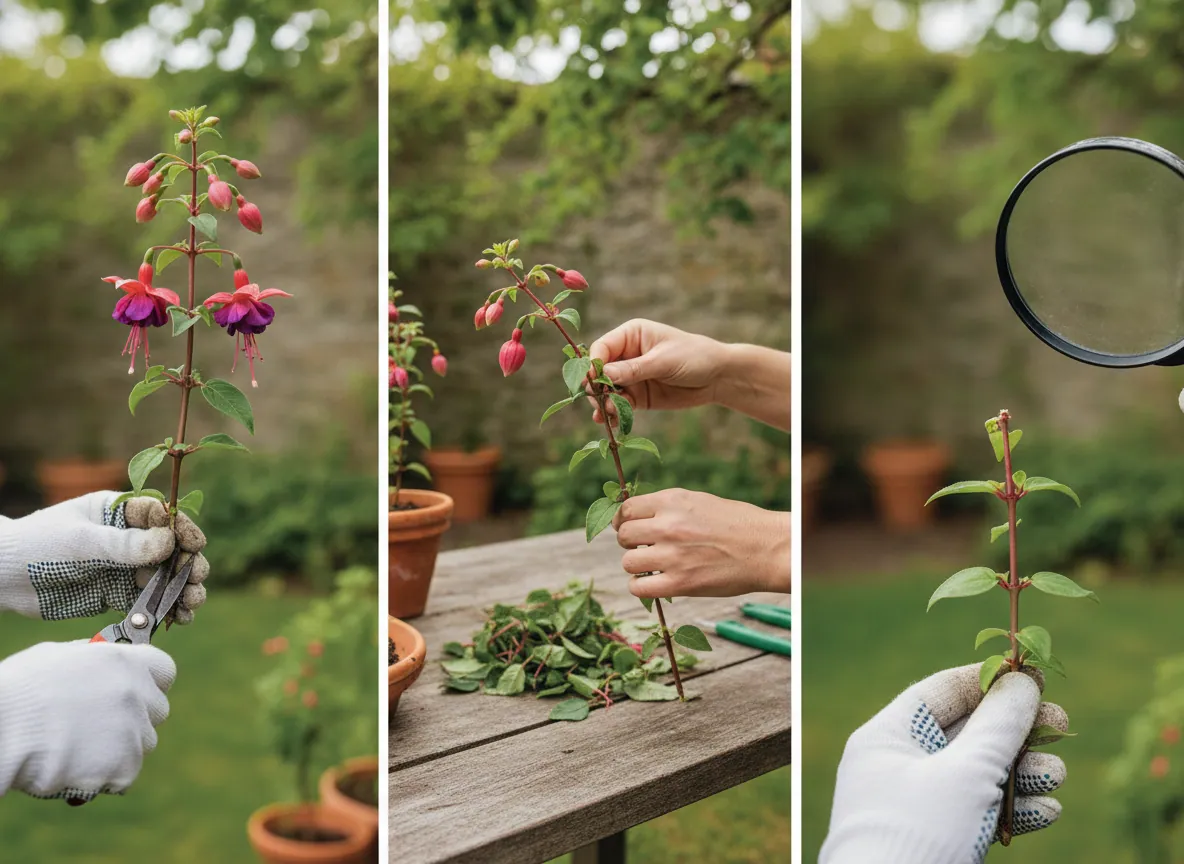 Three hands perform a three-step fuchsia plant preparation — AI-generated illustration
Bringing one in: cut, strip, check
There are three quick jobs before a fuchsia goes into store, and doing them now saves a mouldy, pest-ridden mess by February.
Cut the top growth back by about a third. This isn’t the hard prune — that waits for spring — it’s just reducing a big, soft, sprawling plant to something compact that won’t flop and rot in a confined space. Take off the longest whippy stems and all the remaining flowers and buds.
Strip the leaves. Pull or pick off the rest of the foliage and clear any fallen leaves off the surface of the pot. A dormant fuchsia has no use for leaves, and a heap of dying foliage in a cool, still shed is precisely what grey mould (botrytis) is waiting for.
Check for passengers. Fuchsias happily carry whitefly and aphids indoors with them, and a mild room wakes the pests up long before the plant. Rinse or wipe down the stems, and if the plant has sat in the same pot for a season or two, tip it out and check the rootball for the fat white C-shaped grubs of vine weevil before you tuck it away somewhere you won’t look again until spring.
 The image depicts a fuchsia plant, dormant on the left and flowering on the right — AI-generated illustration
Dormant in the dark, or ticking over in the light
There are two ways to keep a tender fuchsia alive until May, and which you pick depends mostly on what space you’ve got.
Fully dormant is the forgiving option. A frost-free but cold, dim place — a shed, garage, cellar or cool spare room held somewhere around 3–7°C — lets the plant drop everything and sleep. Water only enough to stop the rootball drying to dust: roughly a splash once a month, no more. The commonest way to lose a stored fuchsia isn’t cold at all, it’s rot from a pot kept too wet in the cold and dark. But don’t swing the other way and let it bake bone dry either — a completely desiccated rootball kills it just as surely, only slower.
Ticking over keeps it half-awake: a cool, bright windowsill or a frost-free greenhouse at around 5–10°C, barely watered. It holds a few leaves and a little life, and you get a slightly earlier, stronger start in spring. Either route works. The one combination to avoid is warm and dark — a heated room with no light makes a fuchsia grow pale, drawn and sickly, and that’s the plant that doesn’t make it to spring.
Waking it up in spring
Once the light is returning and you can give it some warmth, that’s when the real prune happens. Cut the plant back hard — down to a framework of just a few buds on each main stem — and it breaks far bushier and flowers better than if you’d nursed the leggy old growth through. Step up the watering, move it into warmth and light, and it’ll shoot away within a couple of weeks.
Then harden it off gradually, and don’t put it back outside until the frosts are genuinely finished — for most of us that’s mid- to late May. A fuchsia you’ve carried all winter is just as easily lost to one careless late frost in the garden as to an early one in autumn, so the last night out is as much a judgement call as the first night in.
Let Cresco time it for your garden
The whole thing turns on one judgement: is this fuchsia hardy or tender, and has tonight’s forecast crossed the line? It’s an easy call to get wrong at the end of a long season, when half the border is clamouring to be cut down at once and every plant seems to want something different. Cresco Pruning knows which of your fuchsias is which and factors in your local weather to plan the timing — with seasonal reminders — so you don’t leave the tender ones too late. Photograph a plant you can’t put a name to and it’ll tell you whether it’s one to leave out under a mulch or one to get under cover before frost. Get that single call right and the fuchsia flowering in your basket this October is back in it next June.