The bedding geranium is a shrub, not an annual
Every autumn, thousands of perfectly healthy plants go on the compost heap for no reason. The bright red, pink and salmon “geraniums” that fill our pots and window boxes all summer aren’t geraniums at all — they’re Pelargonium, tender subshrubs from South Africa. And they aren’t annuals. In their own climate they live for years, building woody stems and flowering again and again. We treat them as one-summer plants only because a British or Dutch winter kills them outdoors, not because the plant has run out of life.
That distinction matters, because there are two very different plants sharing the name. The hardy Geranium — cranesbill — is a herbaceous perennial that stays in the ground all winter and doesn’t want lifting at all. The pelargonium is the tender one in the patio pots, and it’s the one worth rescuing. If yours are still flowering their heads off right now, that’s exactly the point: they have plenty of years left in them, and it costs almost nothing to keep the same plants going rather than buying trays of new ones next May.
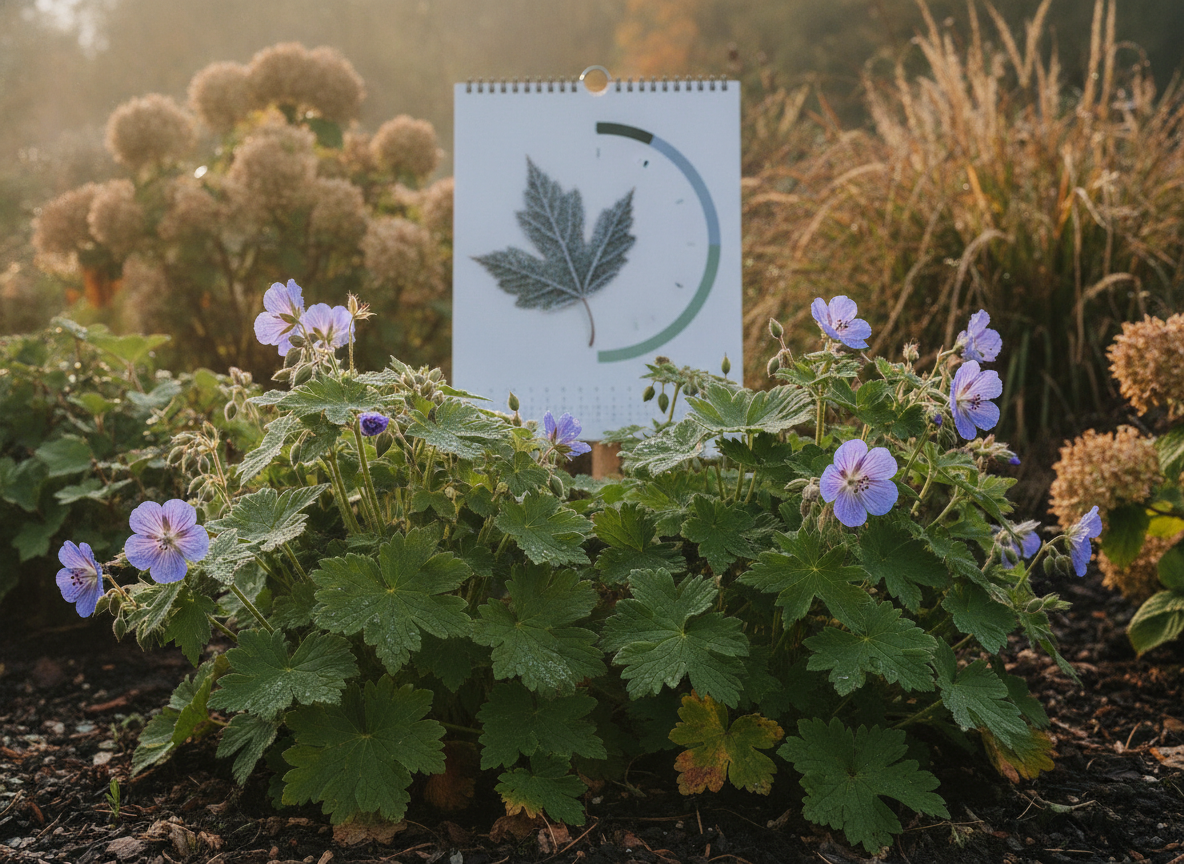 ](photorealistic, editorial-style garden photograph illustrating “Timing: about six weeks before your first frost” in the context of… — AI-generated illustration
Timing: about six weeks before your first frost
Pelargoniums are tender. The foliage is damaged at around 0°C and a hard frost turns the whole plant to mush overnight — there’s no recovering it once that happens. So unlike a dahlia, where the advice is to wait for the first frost to blacken the top growth before you cut it down, a pelargonium has to come in before the cold arrives, not after.
In most of the UK and the Low Countries the first real frost lands somewhere between mid-October and mid-November, but a single clear, still night can bring it three weeks early in a frost pocket. That’s why late September into early October is the moment to act: it gives you a six-week run-in to get the plants lifted, cut back and settled before a surprise cold snap does the job for you. If you gamble on the forecast and lose one still night, you lose the plant. Bring them in while they’re still growing strongly and the move barely registers.
If you’re also thinking about the dahlias in the same beds, note that they play by the opposite rule — wait for the frost to blacken dahlia foliage before you cut them down. Tender bedding comes in before the frost; tuberous dahlias come down after it.
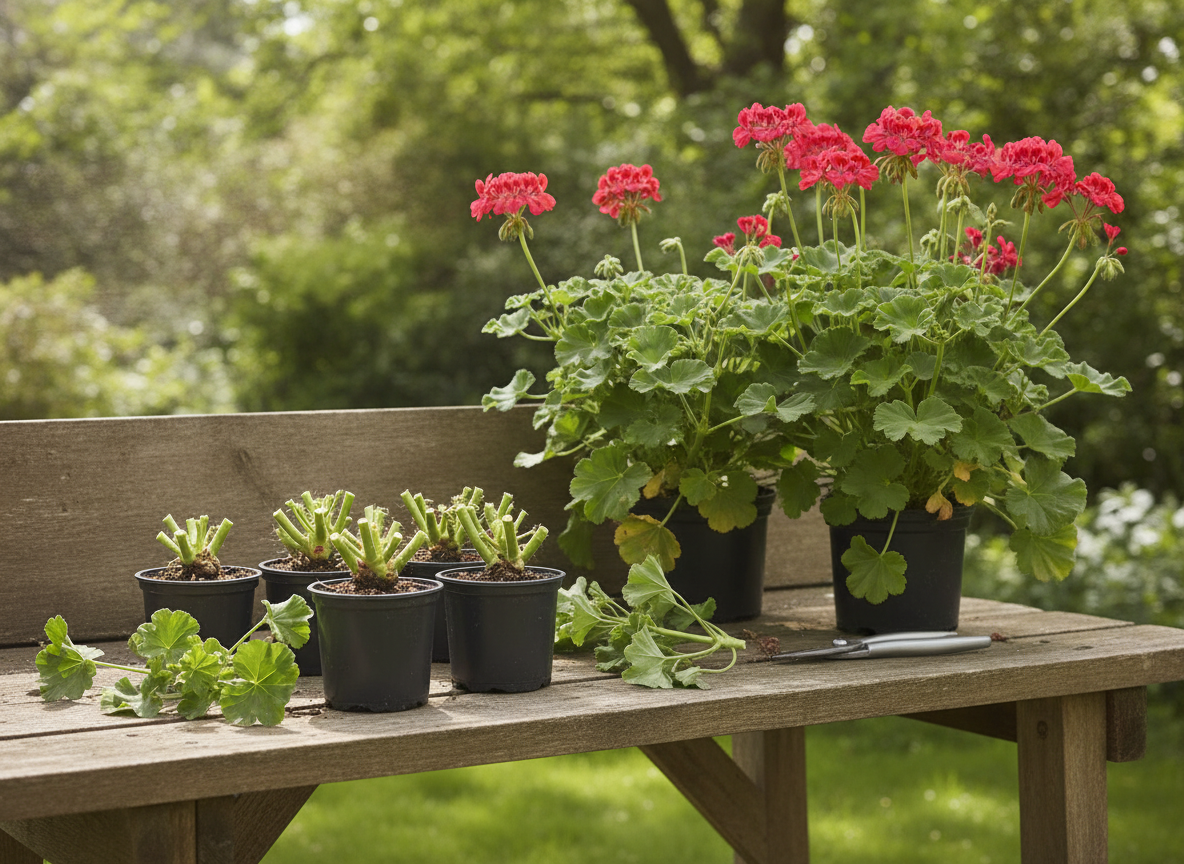 Potted geraniums, some cut back, on a wooden garden bench — AI-generated illustration
Cut back by a third before you bring them in
However you plan to store them, cut the plants back first. Take off about a third of the top growth — up to a half if they’ve grown tall and leggy — cutting cleanly just above a leaf joint. Strip off every flower, every fat bud and all the yellowing lower leaves while you’re at it.
It feels brutal on a plant still in full flower, but there’s a reason. Indoors, in low winter light, soft leafy growth can’t support itself: it stretches, goes pale, and the dense old foliage traps damp air and starts to rot. A plant cut back to a compact framework of firm stems needs far less water, holds far less disease, and breaks into fresh growth cleanly in spring. You’re not pruning for shape here — you’re reducing the plant to something that can coast through four dark months without collapsing.
Three ways through winter
There’s no single right method — pick the one that matches the space you have.
- On a cool, bright windowsill. Pot each plant into just-moist compost and keep it somewhere frost-free but genuinely cool — an unheated spare room, porch or frost-free greenhouse at around 5–10°C. Warm, dark rooms are the enemy: they coax out weak, drawn growth. Bright and cool keeps the plant ticking over dormant.
- Bare-root and dormant. The traditional method, and the most space-saving. Lift the plant, shake most of the soil off the roots, and hang it upside down or lay it in a paper bag or open box in a frost-free shed or cellar at about 7–10°C, in the dark. Check it once a month and rub off any stem that’s gone soft or mushy. The plant looks half-dead all winter — that’s normal.
- Take cuttings as insurance. Even if you keep the parent, snip a few 8–10 cm non-flowering shoots, trim below a leaf node, and root them in gritty compost on a windowsill. They root readily now, take almost no space, and give you spare plants if the old ones don’t make it.
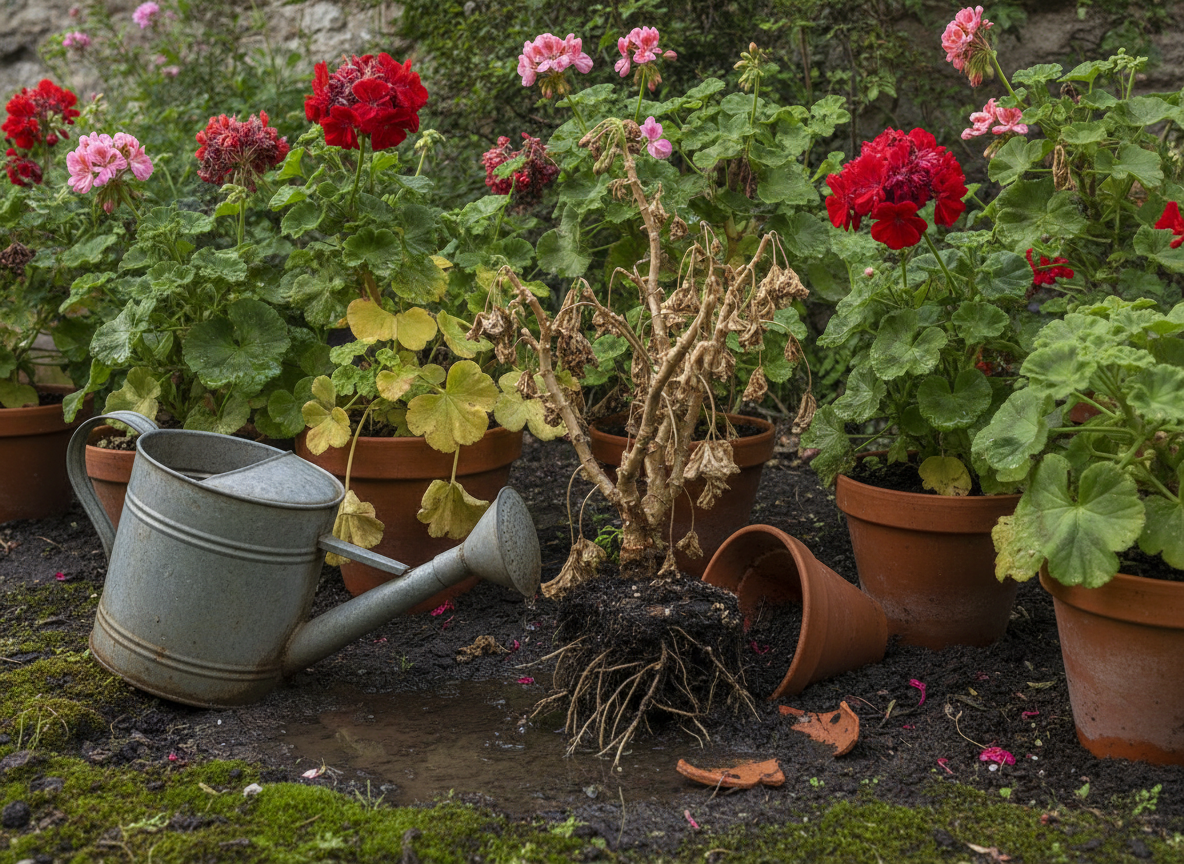 An overturned watering can, spilled water, and dead geraniums in terracotta pots — AI-generated illustration
The watering mistake that kills more than frost does
If an overwintered pelargonium dies, cold is rarely the culprit — overwatering is. Sitting in wet compost through a cold, low-light winter is the fast route to blackleg and stem rot, and it kills more stored geraniums than any frost. Keep them on the dry side of just-moist and let the compost dry out almost completely between waterings; a plant that’s cool, dry and dormant wants a fraction of the water it drank in July. When in doubt, don’t water. Cool, dry and bright is the whole recipe.
Waking them up in late winter
Around late February or early March, as the light returns, bring the plants back into growth. Cut them back again to a framework of healthy stems, pot bare-root plants into fresh compost, and slowly step up the watering and light. New shoots appear within a few weeks.
Don’t rush them back outside, though. Pelargoniums stay indoors until the last frost is genuinely past — in most gardens that means late May. If you time your planting-out by soil temperature rather than the calendar, you’ll put them out at the right moment and they’ll romp away, a full season ahead of anything bought new that spring.
That’s the quiet payoff of overwintering: the same plants, bigger and stronger each year, flowering weeks earlier than a garden-centre replacement ever could — and not a euro spent. If you’d like a reminder of when to lift, cut back and bring in each of your tender plants, Cresco tracks every plant’s window against your own local weather, so the frost never catches you out.