By mid-July the mophead that was a clean blue dome a month ago has gone soft. The colour is fading to green, dusty pink, or papery beige, the edges are browning, and the whole thing is starting to flop. Every instinct says: tidy it up, snip it off, give the plant a clean line for the rest of summer.
On a bigleaf hydrangea, that snip is one of the most expensive tidy-ups in the garden. Wait, and you keep next year’s flowers. Cut now, and you can spend a whole summer looking at healthy green leaves and nothing else.
The tidy-up is the trap
The problem is timing, and it comes down to when your hydrangea makes its flower buds.
Bigleaf (Hydrangea macrophylla) — the classic mophead and the flat-topped lacecap — and oakleaf (H. quercifolia) flower on old wood. Right now, in July, the plant is already building the buds that will open next summer. They form low down on this year’s stems, just beneath the flower you’re looking at, and they will sit there through autumn and winter waiting for spring.
So when you cut a faded head off in July, you rarely stop at the flower. Secateurs drift down to a “neat” point on the stem, and that point is almost always below the fat little buds that were next year’s blooms. The plant looks tidier for a fortnight. Then it leafs out beautifully next spring and gives you nothing on top.
This is the same mistake people make in April, from the other end of the calendar — and it’s why generic “prune your hydrangeas” advice quietly ruins so many plants. On an old-wood hydrangea, the safe rule for July is short: hands off the heads.
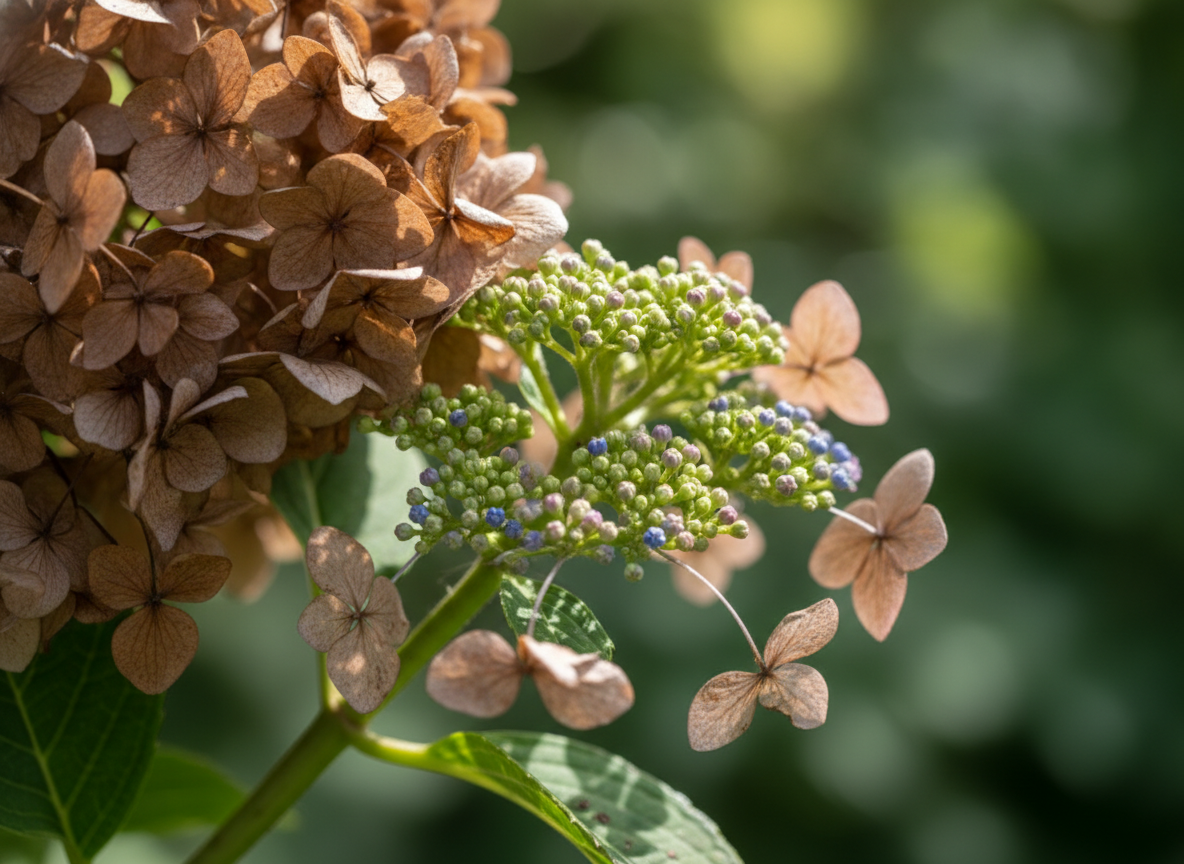 Brown hydrangea blossoms on a stem — AI-generated illustration
What the brown heads are actually doing
Leaving faded flowers on a plant feels like laziness. On a mophead, it’s insulation.
Those dried heads sit directly above the buds that matter, and through autumn and winter they take the edge off frost — trapping a little air, shrugging off the worst of the cold, shielding the tender growth points just below them. The RHS advice is explicit: on mopheads, leave the old flowerheads on over winter to protect the developing buds, and remove them in early spring instead.
Cut them off in July and you strip that shelter away six months early. Worse, a hard summer cut can nudge the plant into a flush of soft new growth right when it should be winding down — growth that has no time to harden before the first frosts and gets blackened for its trouble. The scruffy brown dome you’re itching to remove is doing a quiet, useful job. Let it.
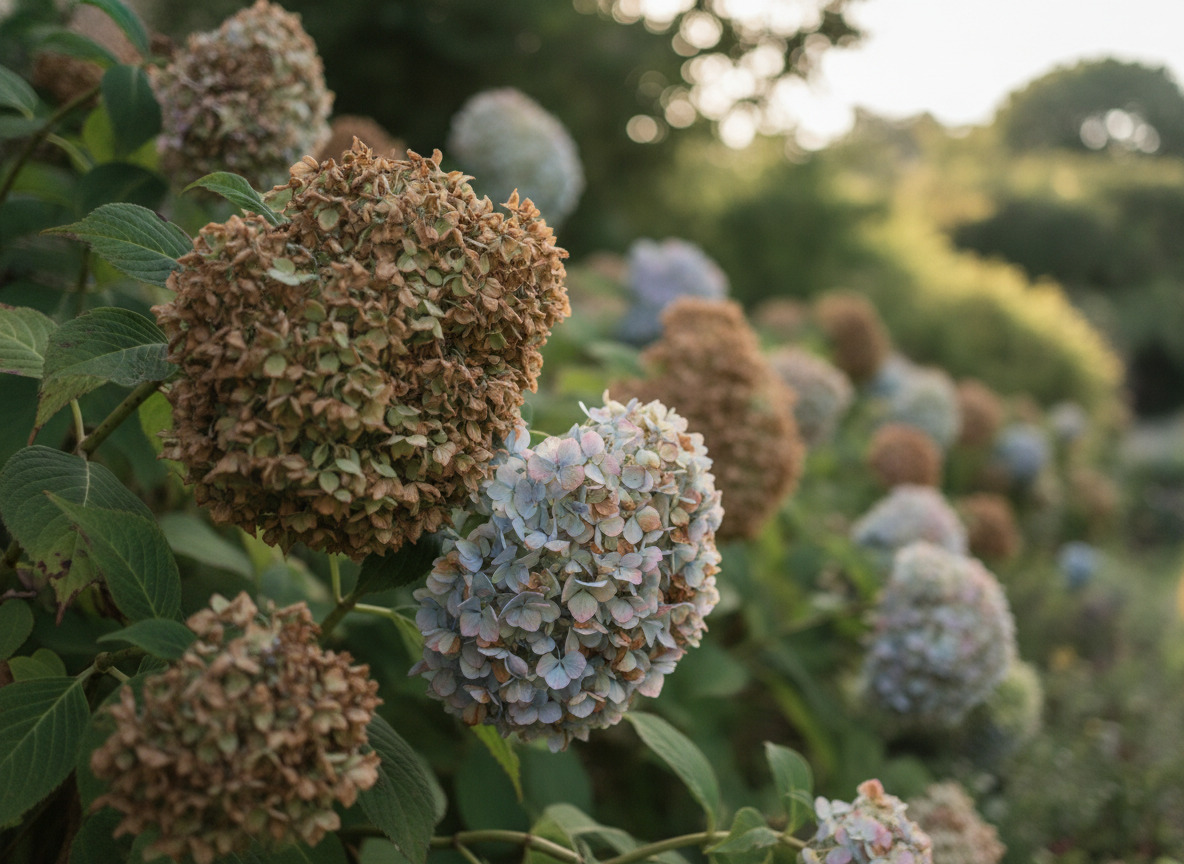 A hydrangea bush with dried and fresh flowers — AI-generated illustration
If you genuinely can’t stand the look
Some gardeners can’t leave a browning flower alone, and in a mild, sheltered garden the risk is smaller. If you must tidy, do it as lightly as possible:
- Remove only the spent flower head, snipping just above the first full pair of fat buds below it.
- Never drop lower “to make it even”. Every centimetre you take below those top buds is a flower you’re deleting.
- Leave the leaves. The foliage is feeding the buds; a stripped stem is a starved one.
But understand the trade-off honestly: even a careful summer deadhead removes the frost shelter, and in a colder or more exposed garden that shelter matters more than the tidiness does. The default that keeps the most flowers is still the simplest one — leave the whole head until spring.
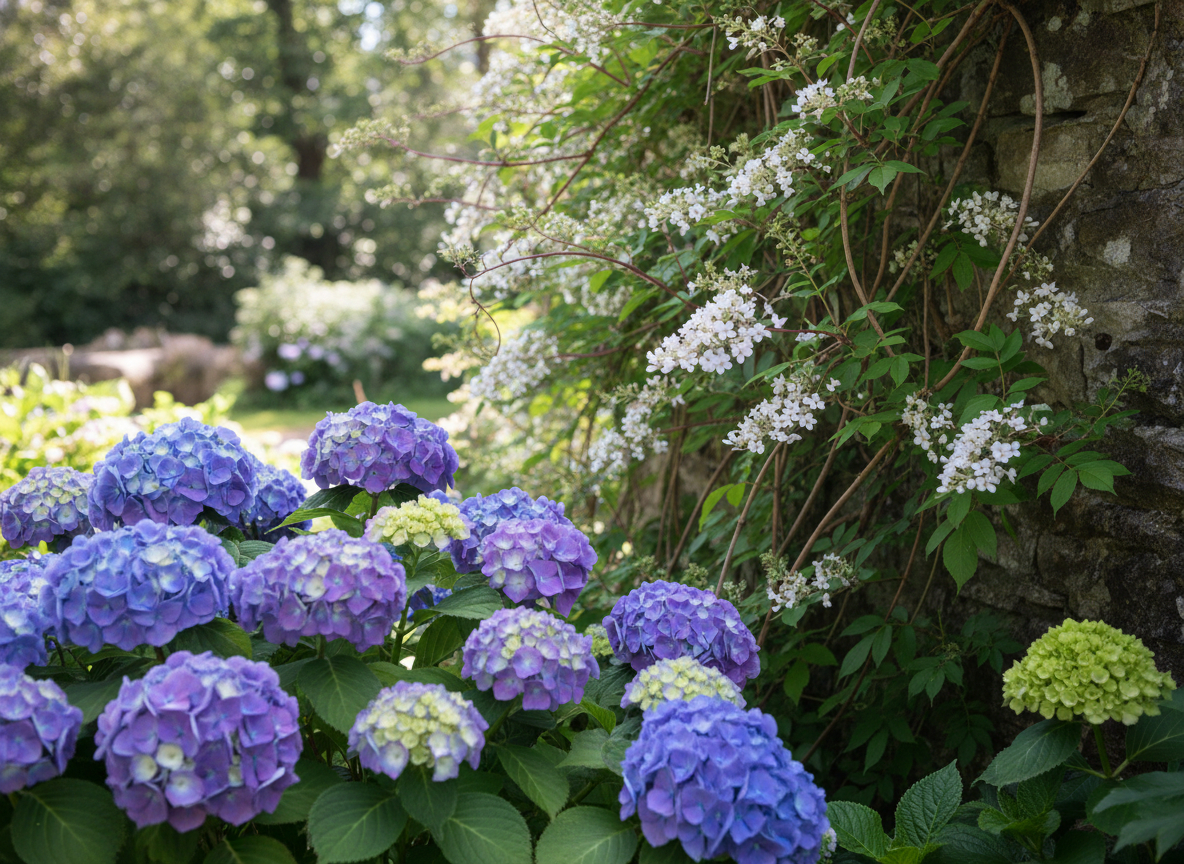 Purple hydrangeas bloom near a stone wall with white climbing flowers — AI-generated illustration
Not every hydrangea plays by this rule
Two common types flower on new wood, which means they’re not building next year’s buds on these stems and you’re not going to lose anything by cutting late:
- Panicle (H. paniculata) — cone-shaped heads, often white ageing to pink; varieties like ‘Limelight’ and ‘Vanille Fraise’.
- Smooth (H. arborescens) — big round white heads; ‘Annabelle’ is the famous one.
You could deadhead these now, but there’s still little reason to. The dried cones and globes hold their shape beautifully through autumn, catch frost and low winter light, and give the border structure when everything else has collapsed. Leave them standing, enjoy the silhouettes, and cut the whole plant back hard in spring — that spring cut is what gives them their big summer heads.
Not sure which type you’ve got? The quick tell: if it flowered on bare, woody, grey stems that were there last year, treat it as old-wood and leave the heads. If the flowers sat on top of fresh green growth that shot up this spring, it’s a new-wood type. When in doubt, leave it — waiting never costs you a flower, cutting can.
The cut you’re waiting for happens in spring
None of this means “never prune”. It means the calendar for the real cut is spring, not mid-summer. In early spring, once the worst frosts have passed and you can see the buds breaking, that’s when you take the old heads off a mophead — back to the first strong, healthy pair of buds — and thin out any dead or spindly stems. Do it then and the shelter has done its winter job and the buds are safe.
If you want the full type-by-type walkthrough of that spring cut — which hydrangeas to cut hard and which to barely touch — it’s here: Hydrangea pruning in April. The principle is the same one that saves penstemons: on frost-tender growth, you deadhead now but hold the hard cut until spring.
What to do this week
- Identify the type. Old-wood (mophead, lacecap, oakleaf) or new-wood (panicle, smooth)?
- Old-wood plants: leave every faded head on. No exceptions if your garden gets real frost.
- If you can’t resist, snip only the spent bloom — just above the top pair of fat buds, never lower.
- New-wood plants: leave the heads for winter structure and cut hard in spring.
- Diarise the real cut for early spring, when the buds break — not now.
A hydrangea forgives almost everything except a cut at the wrong moment. The faded head you want gone in July is next spring’s flower and its winter coat at the same time. Leave it, and the plant will pay you back.
Want a plant that tells you the exact week to make each cut — based on your hydrangea type and your local frost, not a generic calendar? Try Cresco at cresco-pruning.com.