The three buds at the tip of every dahlia stem
Go out to your dahlias this week and look — really look — at the very end of a flowering stem. You won’t see one bud coming. You’ll see three: a plump central one, sitting slightly higher and further forward, flanked by two smaller buds a little way back on short side stalks.
That trio is how dahlias are built. Every flowering stem finishes in a cluster of three, and left alone, all three will open. The central bud goes first and biggest; the two laterals follow a week or so later, smaller, on shorter stalks, and by the time they’re out the middle flower is already fading. The result is the thing gardeners complain about without knowing why: a plant covered in medium flowers on stubby stems, none of them the showstopper the catalogue promised.
Disbudding is the one small edit that changes that. You remove the two side buds while they’re tiny and pour the whole stem’s energy into the one in the middle. That’s it. No tools required, no timing window measured in days — just a fingernail and the willingness to pinch off something that would have flowered.
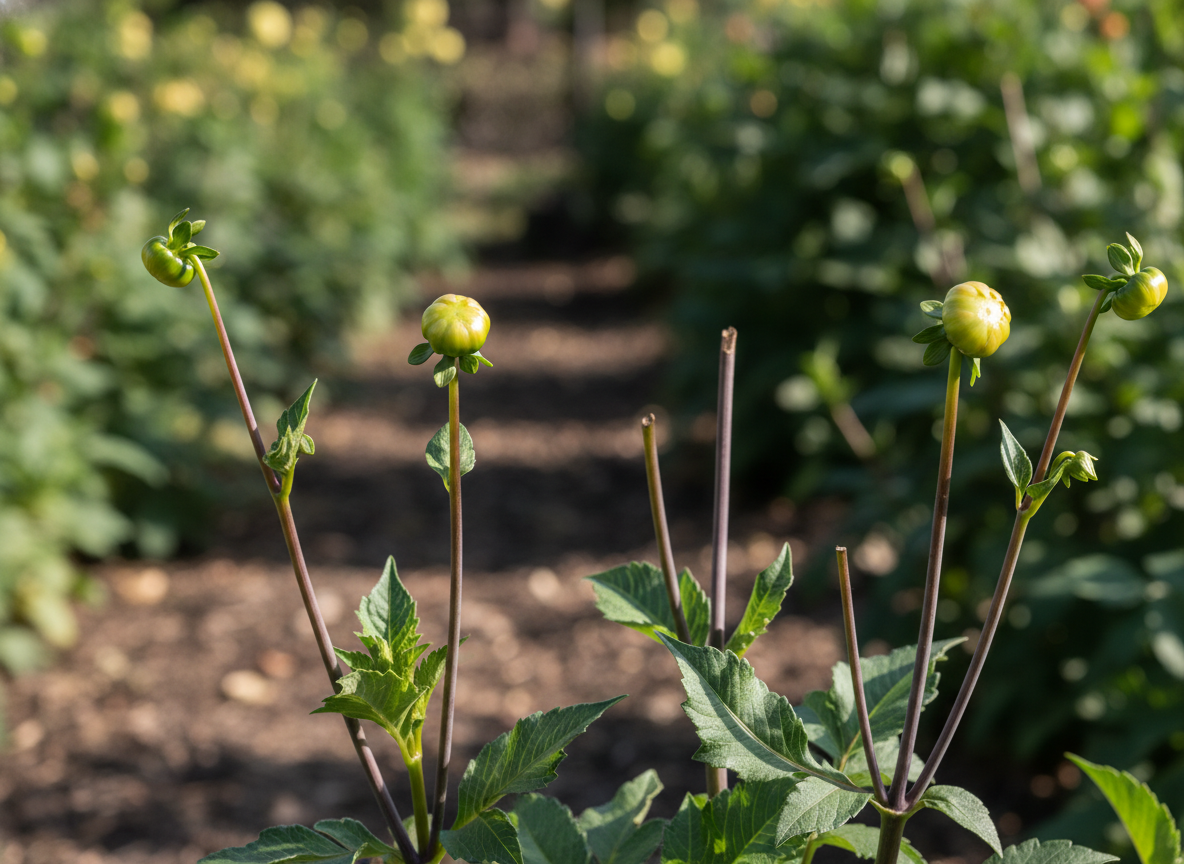 Two dahlia plants with buds in a garden row — AI-generated illustration
Which bud to keep — and the mistake that throws away the big one
Here’s the part people get backwards. The instinct, especially if you’ve disbudded anything before, is to take out the fat central bud and “even things up.” Do that and you’ve removed the very flower you were trying to grow. On a dahlia the central bud is the prize: it’s the oldest, it’s furthest along, and it opens into the largest, best-formed bloom on the longest stalk. The two you remove are the small side ones.
This is the opposite of what you may have read about some other flowers, and it’s worth being clear about. With peonies you disbud in May for bigger blooms using the same logic — fewer buds, more size — and there too you keep the dominant terminal bud and remove the smaller sidebuds around it. So the principle is identical; only the plant and the month change. What you never do is decapitate the main bud and hope the sides make up for it. They won’t. They’ll give you two half-sized flowers on short stems and you’ll have worked to make the plant worse.
To do it: find the cluster of three, hold the stem steady, and pop off each of the two side buds with a thumbnail or a small snip, right where the little side stalk meets the main stem. Leave the central bud completely untouched. Step back and you should see one bud standing alone at the top of a clean stem.
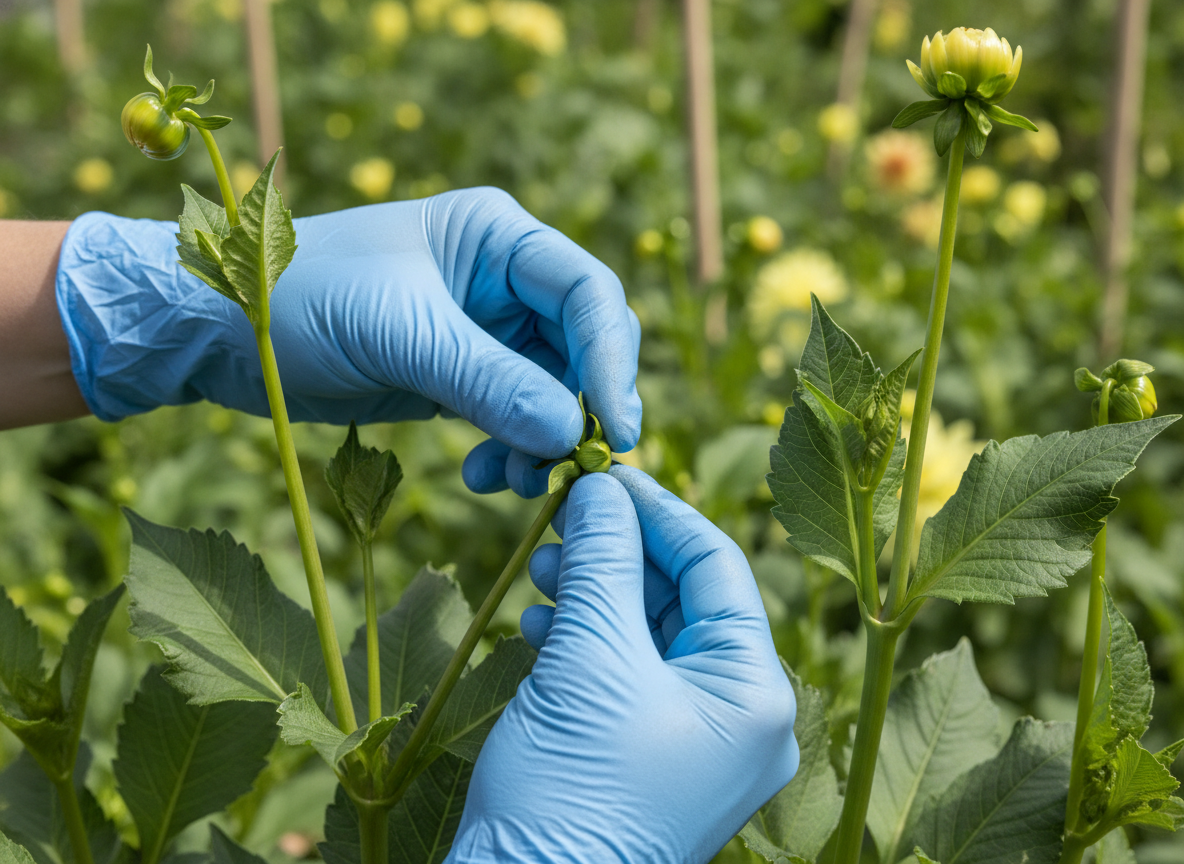 AI-generated illustration
Do it at pea size, not later
Timing here isn’t about the calendar — dahlias bud from July until the first frost, so there’s no single date. It’s about the size of the bud. Disbud when the side buds are around the size of a pea, or smaller. At that stage they snap off cleanly with no wound to speak of, and, more importantly, the plant hasn’t yet spent weeks of sugar building flowers you’re about to bin.
Leave it too late and you lose twice. The side buds are now walnut-sized and woody, so they tear rather than pinch and leave a bigger scar; and all the energy they hoarded getting that big is energy the central bloom never received. The whole point of disbudding is redirecting resources before they’re committed. A pea-sized pinch is worth ten times a late one.
Pick a cool part of the day — early morning or evening — when the stems are turgid and the buds pop rather than crush. It takes seconds per stem once your eye is in.
Disbud the stem, too, for a long clean cutting stem
If you grow dahlias for the vase — and most people who disbud do — there’s a second move that turns a good bloom into a florist’s stem. Below the bud cluster, look down the stem and you’ll find pairs of small side shoots emerging where each set of leaves joins. Each of those will, in time, grow its own bud cluster and its own short flowers, crowding the base of your stem with foliage and competing side blooms.
Rub or pinch those side shoots out for the top two or three leaf joints below the flower. What you’re left with is a single bloom on a long, bare, straight stem — exactly what you can’t buy and exactly what makes a hand-tied bunch look professional. Leave the lower side shoots alone; they’ll flower later and keep the plant productive. You’re only clearing the top stretch that shows in the vase.
This is really the same habit as pinching out the growing tip earlier in the season — you removed one tip in spring to force a bushy plant with many stems, and now you’re refining each of those stems into a clean, single flower. Stopping builds the plant; disbudding finishes it.
 AI-generated illustration
When you should skip it entirely
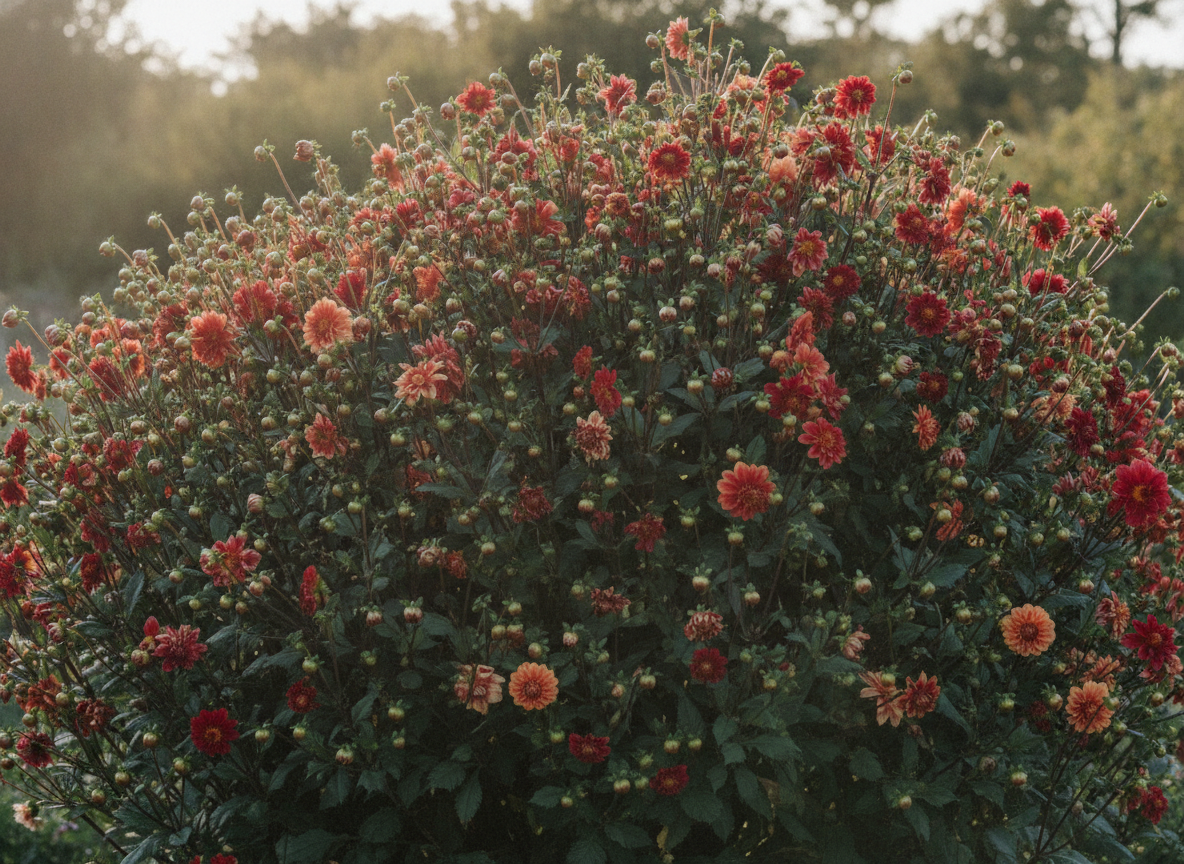
Disbudding is not compulsory, and for a lot of gardens it’s the wrong call. If what you want is a dense, humming border stuffed with colour — a plant carrying forty flowers rather than fifteen large ones — then leave the clusters alone. All three buds opening on every stem gives you more flowers, just smaller. Bees don’t care about stem length, and a mass of medium blooms reads better across a border than a handful of dinner plates.
Type matters as well. The technique earns its keep on the big decorative and cactus dahlias, and on anything you’re growing to cut. It’s largely pointless on pompon, ball and small single dahlias, whose charm is the profusion of little flowers — disbud those and you’ve spent effort making the plant do the opposite of what it’s good at. So decide what the plant is for first: a cut-flower row and show blooms get disbudded; a pollinator border of ball dahlias does not.
It’s a habit, not a one-off
The thing to understand is that disbudding isn’t a job you finish. A dahlia in full stride throws new bud clusters continuously from midsummer to frost, so every few days there’s a fresh trio forming somewhere on the plant. Wander the row with a coffee, pinch the pea-sized sides as you find them, and it becomes thirty seconds of maintenance rather than an afternoon’s task.
It also pairs with the other half of dahlia upkeep. Disbudding shapes the flowers that are coming; deadheading the spent ones keeps them coming at all — and the trickiest part of that is telling a fat unopened bud from a spent flower that’s already gone over, since on a dahlia they look confusingly alike. Do both through the season and a single plant will feed the vase from July until the cold shuts it down.
Knowing which small jobs matter this week — and which plant wants which one — is exactly what Cresco is built to tell you. Photograph your dahlia and it reads the type and your local season to say whether this is a plant to disbud for size or leave alone for numbers, and reminds you while the buds are still pea-sized. For the wider picture of what else is asking for your hands in mid-July, the month-by-month pruning guide puts dahlias in the queue alongside everything else.
The 30-second version
- Every dahlia stem ends in three buds — one big central one and two smaller side buds.
- For bigger blooms on longer stems, pinch off the two side buds and keep the central one. Never remove the middle bud.
- Do it at pea size or smaller, in the cool of the morning or evening, so the buds pop off cleanly before the plant wastes energy on them.
- For cut flowers, also rub out the side shoots on the top two or three leaf joints for a long, clean stem.
- Skip disbudding on pompon, ball and small single types, and on any border where you’d rather have more flowers than bigger ones.
- It’s ongoing — new clusters form every few days from July to frost. Pair it with regular deadheading.