Two gardens on the same street, both with a hardy banana. In October one owner takes the loppers to it, cuts the whole thing down to a knee-high stump, and piles compost on top. The neighbour wraps the standing trunk and walks away. Come next August, the first garden has a fresh 1-metre clump of leaves — lush, but no taller than it was two springs ago. The second has a 3-metre giant throwing out leaves the size of ironing boards.
Same plant, same weather. The only difference was a decision made in the next couple of weeks.
It’s the trunk that’s tender, not the plant
The banana almost everyone grows outdoors here is Musa basjoo, the Japanese fibre banana — far and away the hardiest. Its roots are genuinely tough: under a decent mulch they shrug off −10°C and often colder, and the plant will resprout from the base even after a brutal winter. That part rarely dies.
What is tender is the pseudostem — the fat green “trunk”. It isn’t wood; it’s tightly rolled leaf bases, full of water, and a hard frost turns it to mush. Lose the pseudostem and you lose every centimetre of height the plant built last summer. The roots live, but you’re back to square one.
That single fact is the whole decision. Protect the roots and you keep the plant alive. Protect the trunk and you keep the plant tall.
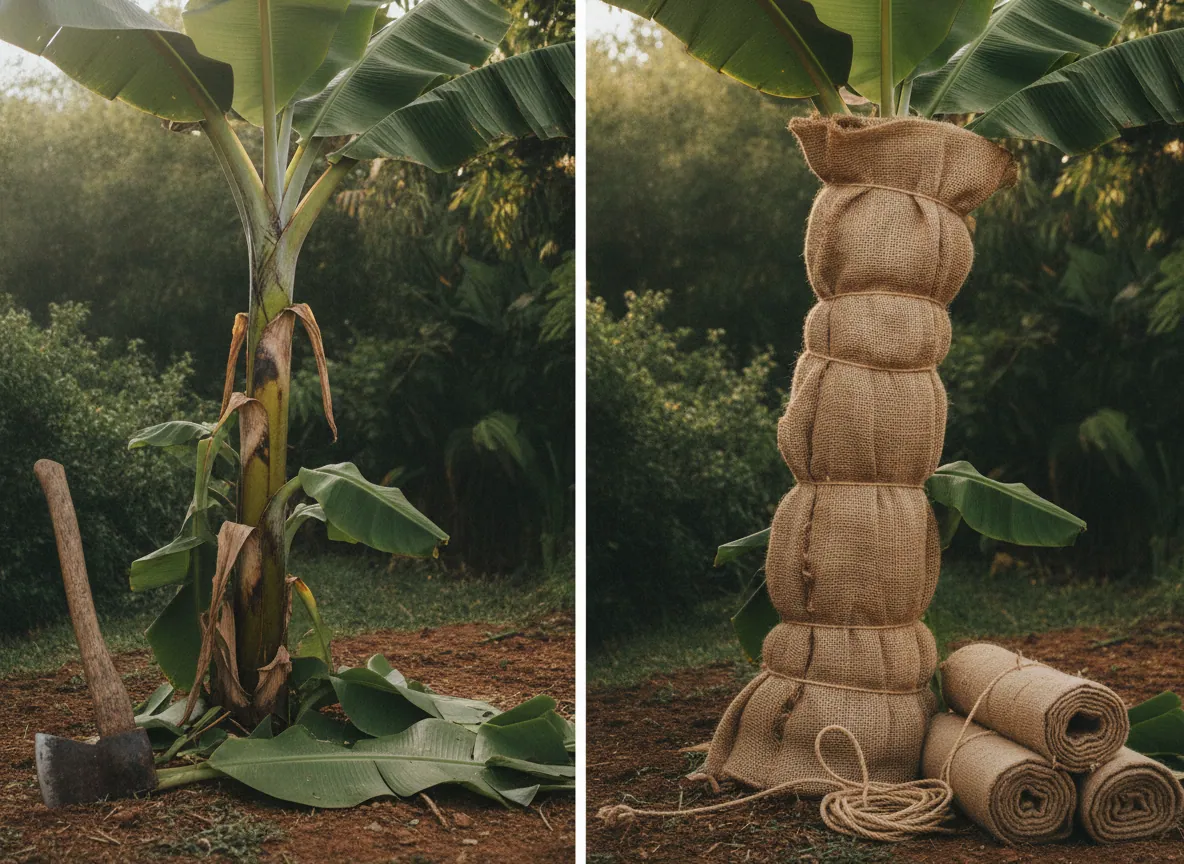 A banana plant with an axe next to it, and another banana plant wrapped in burlap — AI-generated illustration
The choice: cut it down, or wrap it up
Both routes are legitimate — they just give you different plants.
- Cut it down. Chop the pseudostem to about 15 cm, pile 15–20 cm of dry mulch, straw or leaf mould over the crown, and forget it. It’s quick, it’s bombproof for the roots, and it suits anyone who’s happy with a low jungle of foliage each year. But the plant spends the whole next summer just climbing back to where it was — it never builds, never gets properly tall, and will almost never flower.
- Wrap it standing. Keep the trunk alive through winter and the plant carries on from full height next spring — often taller year on year, and in a mild, sheltered garden it can eventually flower and even set small fruit (which isn’t edible). It’s more faff for a few weeks in autumn. If you grow a banana for the drama of its size, this is the only route that gets you there.
Wait for the first frost — then take the leaves off
Timing trips people up in both directions. Wrap too early, while the plant is still growing and nights are above about 5°C, and you trap warmth and damp around a living stem — the fastest way to rot it. Wrap too late and a hard frost has already got into the trunk.
The signal is the plant’s own: wait for the first proper frost to blacken the big leaves, usually from late October into November depending on where you garden. That’s your cue. Strip off the collapsed leaves — they’ve done their job and will only hold water against the stem. When you cut a leaf or the top of the stem, make a sloping cut angled away from the centre so rain runs off the outside rather than channelling straight down into the crown.
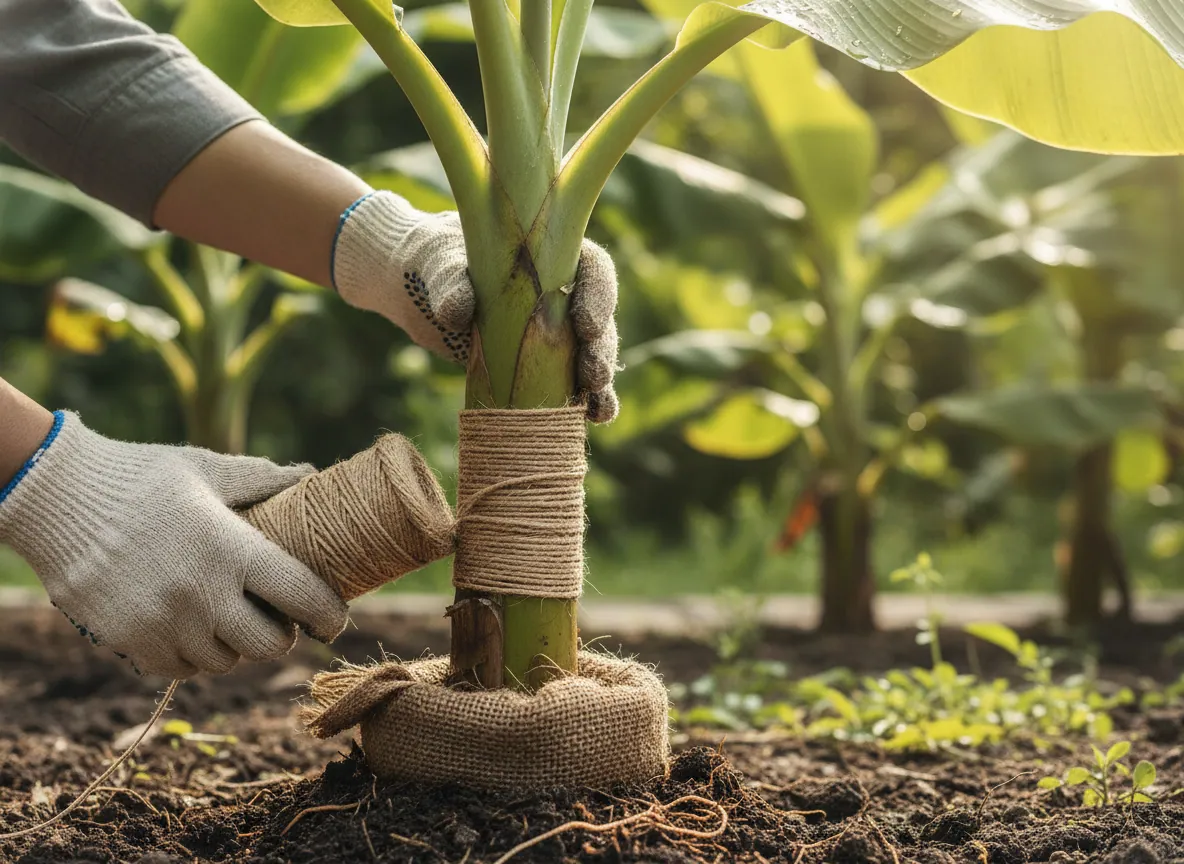 Hands in gloves wrap a banana plant stem with twine — AI-generated illustration
How to wrap the stem
The method is simple and the materials are cheap:
- Push three or four stakes into the ground around the trunk, or bend a cylinder of chicken wire around it, leaving a hand’s width of gap all round.
- Pack that gap with a dry, breathable insulator — straw, bracken, dry leaves or horticultural fleece. The air it traps is what keeps the frost out.
- Put a waterproof hood or cap over the very top so rain and snow can’t soak down into the packing — but leave the sides able to breathe. Don’t shrink-wrap the whole thing in plastic.
- Whichever route you took, mulch thickly over the root zone too. The roots are hardy, but a 15 cm blanket of mulch is cheap insurance in a hard winter.
In a mild city garden a single fleece wrap may be plenty; somewhere colder and more exposed, a straw-packed cage is worth the effort.
Rot is often a bigger threat than cold
This is the part most guides underplay. In the British and Dutch climate it’s rarely the cold that finishes a wrapped banana — it’s trapped water. A stem sealed in damp packing or capped with non-draining plastic will rot from the inside while a neighbour’s bare, frozen stump sails through.
So keep it dry: a waterproof top, breathable sides, and good drainage at the base. If your soil is heavy clay that sits wet all winter, work in grit and compost before you ever plant a banana — soggy roots are as much of a threat as frost. Dry and cold almost always beats warm and wet.
 . A bunch of bananas hangs from a tree, one partially peeled — AI-generated illustration
Unwrap before it cooks
Take the wrapping off by May, and sooner if you see new growth pushing up through the mulch — often around March. Left on into warm spring weather, the same packing that saved the plant now holds heat and damp against fresh shoots and invites the rot you spent all winter avoiding. Unwrap on a dry day, pull the mulch back off the crown, and let it get on with the season.
The cut you’ll regret
If you’ve got a Musa basjoo and you genuinely want the architectural height — the tropical-looking screen, the leaves taller than you — stop cutting it to the ground “to be safe” every autumn. That habit is exactly what keeps it a permanent knee-high clump. The trunk is the plant’s memory of last summer; protect it, and next year starts where this one left off.
For the other big exotics that need help through the cold, the same logic applies in different shapes: with tree ferns you pack the crown, not the trunk, with gunnera you fold the dead leaves over the crown, and with agapanthus it’s worth knowing which type even needs wrapping before you reach for the fleece.
Not sure when the first frost is due in your garden, or whether your banana is big enough to bother wrapping this year? That’s exactly the kind of local, plant-specific timing Cresco is built to work out for you.