Why big shrubs die after a move
Most established shrubs that fail after being moved don’t die from the move itself. They die over the following summer, slowly, from thirst.
The reason is where their roots actually are. A shrub that has been in the ground for five or ten years doesn’t keep its working roots close to the stem. Near the trunk you find a few thick, woody anchor roots — good for holding the plant up, almost useless for drinking. The fine, fibrous feeder roots that take up water sit much further out, roughly under the edge of the canopy and beyond, in a ring you’d never get inside a rootball you can actually lift.
So when you dig a mature shrub out in one go, you keep the woody middle and leave most of the feeding roots behind in the soil. The top of the plant is still the same size, still losing water through every leaf, and the roots it has left can’t keep up. It may look fine through winter. Then the first dry spell in May or June arrives and it scorches, drops leaves and dies back.
Root pruning fixes this by doing the damage early, on purpose, a full season before the move.
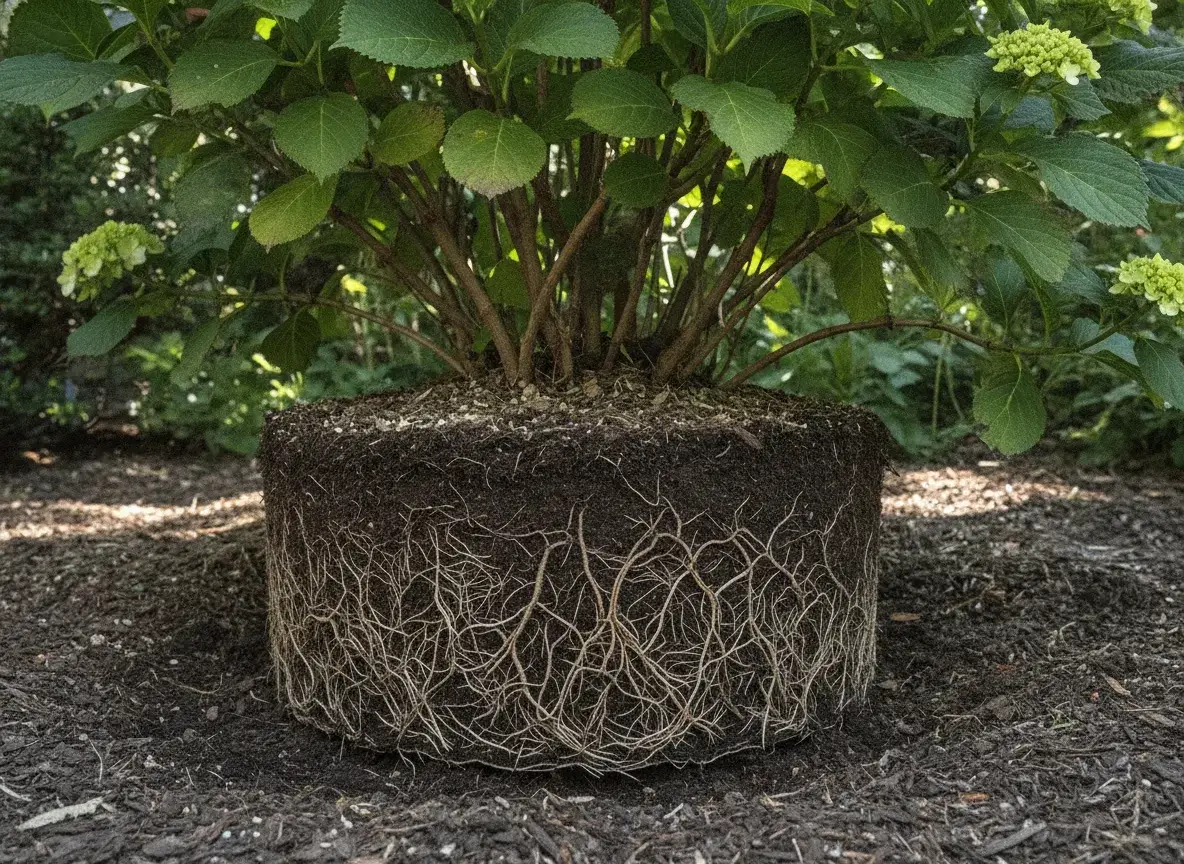 A healthy shrub with a dense rootball, ready for transplanting — AI-generated illustration
What root pruning actually does
The idea is simple. You cut through the outer roots in a circle around the shrub, at the size of the rootball you’ll eventually lift. The plant then has a whole growing season to respond — and it responds the way a hedge does when you clip it: by branching.
Every severed root end sends out a mass of fine new roots just inside the cut. By the time you come back to move the shrub, the rootball you dig up is no longer a woody core with its feeders amputated. It’s packed with young, fibrous roots that are ready to drink the moment they’re replanted.
The RHS recommends exactly this for mature specimens: prepare the plant in one season, move it the next. It’s the same principle nurseries use when they undercut field-grown trees every year or two so they lift with a compact, transplantable rootball.
The window: from now until February
Root pruning is a dormant-season job. Once deciduous shrubs have dropped their leaves — or are about to — and evergreens have slowed down for winter, you can start. In practice that means late October through February, on any day when the ground isn’t frozen or waterlogged.
Late October and November are the best of it. The soil still carries some warmth, so the cut roots start callusing and making new growth before winter properly closes in, and they get a head start for spring. That gives you a full year: root-prune this autumn, move the shrub next autumn (or, at a push, next late winter).
If you can’t wait a whole year, root pruning two or three months ahead still helps — but the longer the plant has to regrow, the better the rootball.
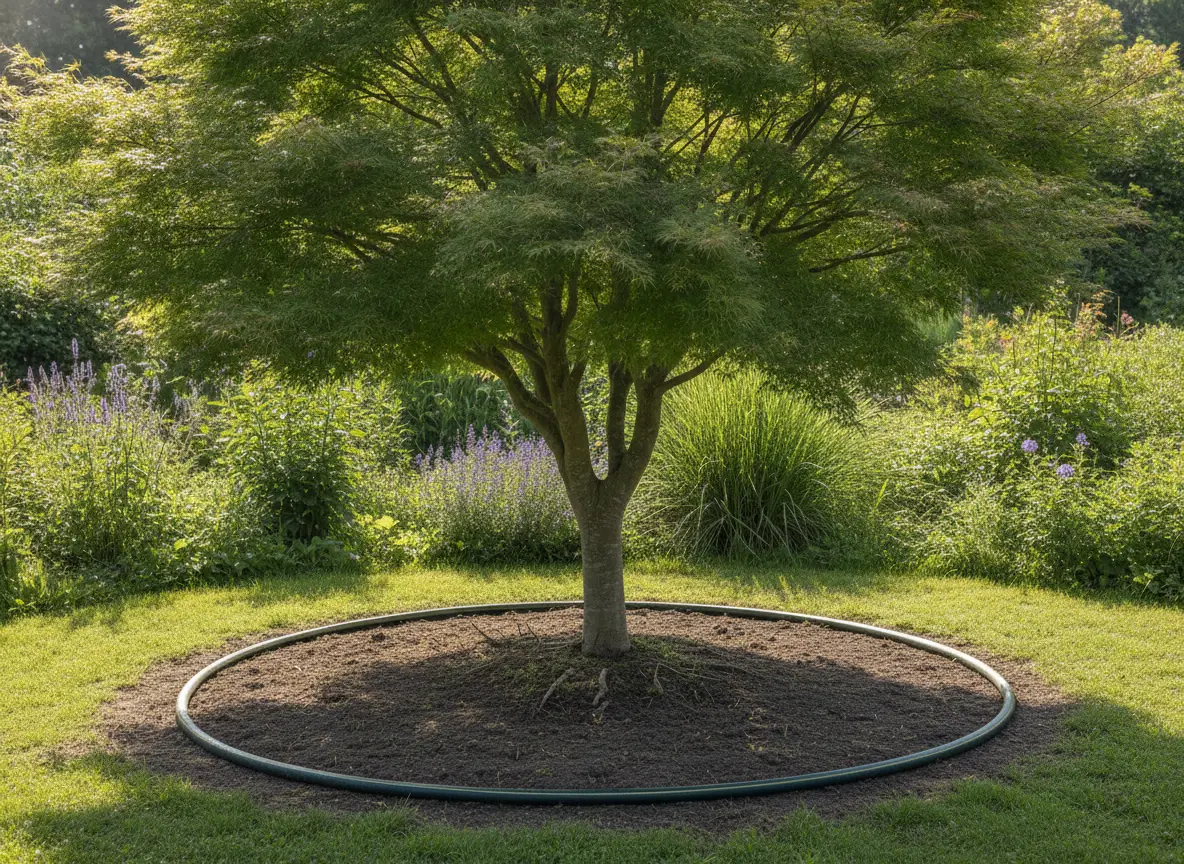 A small tree with a hose marking a circle on the ground around its base — AI-generated illustration
How to root-prune, step by step
1. Mark the circle. Decide how big a rootball you can realistically lift and carry — be honest, a 60 cm ball of wet clay is far heavier than it looks. As a rule of thumb, aim for a radius of about 30 cm for every 2.5 cm of trunk diameter at knee height, and never closer than roughly two-thirds of the way to the edge of the canopy. Mark the circle on the ground with sand or a length of hose.
2. Tie the branches in. Loosely gather spreading shrubs with soft twine so you can get at the soil without snapping stems. It also shows you exactly where the edge of the plant is.
3. Dig a narrow trench. Using a sharp spade, dig a trench along the outside of your circle, about 30 cm wide and one to two spades deep (30–45 cm). Most feeder roots live in the top 30 cm, so you don’t need to go deeper than that on most soils.
4. Cut cleanly. Slice through every root you meet on the inside face of the trench. Use the spade for thin roots and loppers or a pruning saw for anything thicker than a finger — a clean cut regrows far better than a root that’s been torn or crushed.
5. Backfill with something better. Refill the trench with the soil you took out, mixed with garden compost or leaf mould. Loose, rich soil right at the cut is where the new fibrous roots will grow, and it’ll make the trench easy to dig out again next year.
6. Water it in. Soak the trench, then untie the branches. That’s it until next autumn.
Doing it in two halves
For a large or precious shrub, split the job. Root-prune half the circle this autumn — every other quarter, or one side — and the remaining half next autumn. Move the plant the autumn after that. It takes two years instead of one, but the plant never loses more than half its outer roots at once, and that’s the safest route for anything old, big, or slow to recover.
What not to do
Don’t cut the top back hard to compensate. It’s tempting to think a smaller shrub needs fewer roots, but heavy pruning now just forces a flush of soft growth next spring that the plant has to feed. The RHS advises only a light thinning of old wood. Save any real shaping for after the move, and even then go gently.
Don’t feed it. A dose of fertiliser in autumn pushes the wrong kind of growth at the wrong time. Compost in the trench is all it needs.
Don’t undercut it yet. Root pruning is about the sides. You’ll sever the roots underneath on moving day, when you slide the spade under the ball — doing it now would leave the shrub with nothing to hold it upright through winter gales.
Don’t let it dry out next summer. A root-pruned shrub has less reach than it used to. In a dry spell, water it as you would a newly planted one.
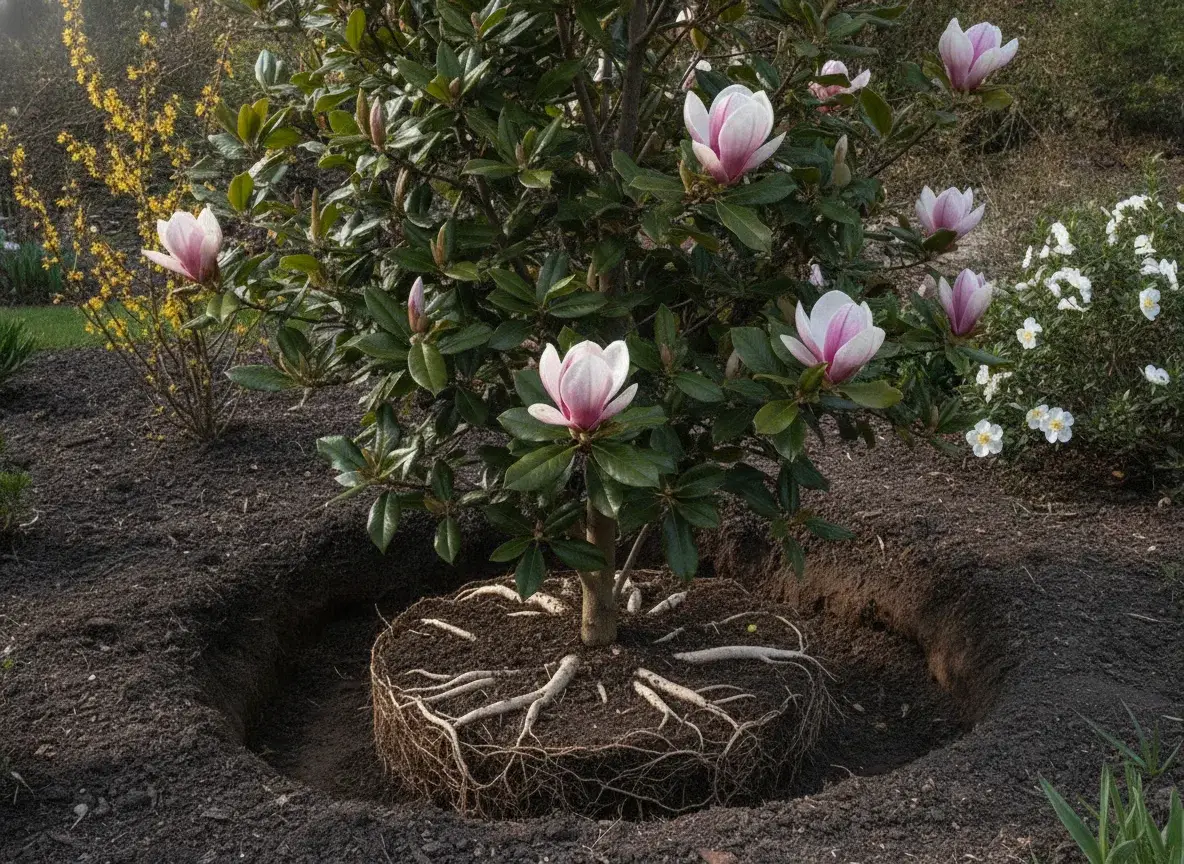 A healthy magnolia shrub with exposed roots in a garden — AI-generated illustration
Which shrubs are worth the effort
Root pruning is worth doing for any established shrub that’s more than three or four years old — the young ones have compact enough roots to move without it. It matters most for plants that are known to resent being moved: magnolias, roses, brooms (Cytisus), rock roses (Cistus), daphnes and witch hazels. With some of these — brooms and rock roses especially — even root pruning only improves the odds; an old one is often better replaced with a young plant grown from a cutting.
Evergreens such as camellias, rhododendrons, hollies and yews also benefit, because they lose water through their leaves all winter. Rhododendrons and azaleas are the easy exception: they grow a naturally shallow, fibrous mat of roots and usually move well without preparation.
If you’re taking the shrub out anyway and can’t move it, the prunings from a dormant shrub can also become new plants — see our guide to hardwood cuttings from autumn prunings. And if what you’re really moving is a border perennial rather than a shrub, the rules are different; a peony, for example, is all about planting depth.
Moving day, next year
When you come back to it, dig a fresh trench just outside last year’s cut, so you keep all the new fibrous roots inside the ball. Undercut it with a spade, rock it onto a sheet of hessian or a tarp, and wrap the ball tightly before you drag it to its new spot. Plant at the same depth it was growing, firm it in, water well, and stake anything tall against wind rock for its first winter.
A shrub moved this way usually flowers the following year as if nothing happened. The trench you dig this week is what makes the difference.